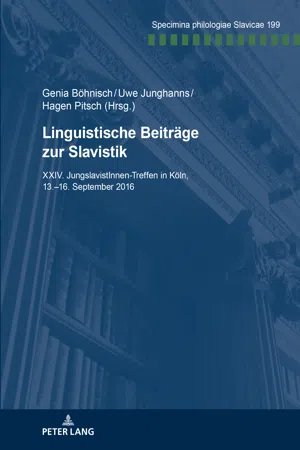
Der Sammelband enthält Beiträge des XXV. JungslavistInnen-Treffens, das vom 13. bis 16. September 2016 am Seminar für Slavische Philologie der Universität Göttingen stattfand. In ihren Aufsätzen geben die AutorInnen Einblick in Themen und Ergebnisse ihrer aktuellen Forschungen auf verschiedensten Gebieten der slavistischen Sprachwissenschaft, darunter der synchronen und diachronen Linguistik, der Semantik und Pragmatik, der Sozio- und Kontaktlinguistik und der Spracherwerbsforschung.
eBook - PDF
Linguistische Beiträge zur Slavistik
XXV. JungslavistInnen-Treffen in Göttingen, 13.16. September 2016
- 207 pages
- English
- PDF
- Available on iOS & Android
eBook - PDF
Linguistische Beiträge zur Slavistik
XXV. JungslavistInnen-Treffen in Göttingen, 13.16. September 2016
About this book
Information
Table of contents
- Cover
- Inhalt
- Vorwort
- Russen und Turken im Kontakt (Alexander Böhnisch (Göttingen))
- Der Einfluss von Emoticons auf die Interpretation schriftlicher Äußerungen (Genia Böhnisch (Göttingen))
- Bosnische, kroatische, montenegrinische und serbische Sprachenpolitik im europäischen Kontext (Daniel Bunčić (Köln))
- Zielona przestrzeń, teren zielony – eine Korpusuntersuchung zur Wortstellung polnischer Farbadjektive (Christina Clasmeier (Bochum))
- Schriftlichkeitsdiglossie, Bibelsprache und Emblematik (Thomas Daiber (Gießen))
- Sprachenkonflikt oder situative Sprachverwendung? Das Ukrainische und das Russische in der gegenwärtigen Literatur in der Ukraine (Donbas – arena vijny) (Martin Henzelmann (Hamburg))
- Konditionale Infinitive im Tschechischen (Uwe Junghanns & Hagen Pitsch (Göttingen))
- Wie slavisch ist das Polnische? Zur Typologie klitischer Systeme im Slavischen (Irenäus Kulik (Göttingen))
- Zur sprachlichen Vitalität der Bergitka Roma in Polen (Anna-Maria Meyer (Bamberg/Köln))
- Glamouröser Patriotismus. Politische Rhetorik und populäre Kultur in Russland nach 2014 (Marina Scharlaj (Dresden))
- Zu Wortfolge und Informationsstruktur von russischen Elementarkonstruktionen/Adversativen Impersonalen (Katrin Schlund (Heidelberg))
Trusted by 375,005 students
Access to over 1.5 million titles for a fair monthly price.
Study more efficiently using our study tools.
Frequently asked questions
Yes, you can cancel anytime from the Subscription tab in your account settings on the Perlego website. Your subscription will stay active until the end of your current billing period. Learn how to cancel your subscription
No, books cannot be downloaded as external files, such as PDFs, for use outside of Perlego. However, you can download books within the Perlego app for offline reading on mobile or tablet. Learn how to download books offline
Perlego offers two plans: Essential and Complete
- Essential is ideal for learners and professionals who enjoy exploring a wide range of subjects. Access the Essential Library with 800,000+ trusted titles and best-sellers across business, personal growth, and the humanities. Includes unlimited reading time and Standard Read Aloud voice.
- Complete: Perfect for advanced learners and researchers needing full, unrestricted access. Unlock 1.5M+ books across hundreds of subjects, including academic and specialized titles. The Complete Plan also includes advanced features like Premium Read Aloud and Research Assistant.
We are an online textbook subscription service, where you can get access to an entire online library for less than the price of a single book per month. With over 1.5 million books across 990+ topics, we’ve got you covered! Learn about our mission
Look out for the read-aloud symbol on your next book to see if you can listen to it. The read-aloud tool reads text aloud for you, highlighting the text as it is being read. You can pause it, speed it up and slow it down. Learn more about Read Aloud
Yes! You can use the Perlego app on both iOS and Android devices to read anytime, anywhere — even offline. Perfect for commutes or when you’re on the go.
Please note we cannot support devices running on iOS 13 and Android 7 or earlier. Learn more about using the app
Please note we cannot support devices running on iOS 13 and Android 7 or earlier. Learn more about using the app
Yes, you can access Linguistische Beiträge zur Slavistik by Genia Böhnisch, Uwe Junghanns, Hagen Pitsch in PDF and/or ePUB format, as well as other popular books in Languages & Linguistics & Languages. We have over 1.5 million books available in our catalogue for you to explore.