In recent years, multi-stakeholder partnerships (MSPs) have become popular for tackling the complex challenges of sustainable development. This guide provides a practical framework for the design and facilitation of these collaborative processes that work across the boundaries of business, government, civil society and science. The guide links the underlying rationale for multi-stakeholder partnerships, with a clear four phase process model, a set of seven core principles, key ideas for facilitation and 60 participatory tools for analysis, planning and decision making.The guide has been written for those directly involved in MSPs – as a stakeholder, leader, facilitator or funder – to provide both the conceptual foundations and practical tools that underpin successful partnerships.What's inside draws on the direct experience of staff from the Centre of Development Innovation (CDI), at Wageningen University & Research Centre, in supporting MSP processes in many countries around the world. The guide also compiles the ideas and materials behind CDI's annual three week international course on facilitating MSPs and social learning.This work has been inspired by the motivation and passion that comes when people dare to "walk in each other's shoes" to find new paths toward shared ambitions for the future.
eBook - ePub
The MSP Guide
About this book
Information
Subtopic
Global Development StudiesIndex
Social Sciences1INTRODUCTION
Are you working to connect businesses and NGOs to create better environmental and social standards? Or are you a government policy officer needing to work with the fisheries sector and local communities to create a sustainable management plan? Is your business partnering with farmer organisations, NGOs, and an impact investor to source responsibly from small-scale farmers? Perhaps your NGO is trying to work with government and businesses to create more opportunities for youth in rural areas?
Multi-stakeholder partnerships offer practical ways forward in these types of situations, and in many others. How to design, facilitate and manage these partnerships is what this book is all about.
In 2015 the global community agreed to a set of Sustainable Development Goals that address the big issues facing humanity for the coming decades. They will only be achieved through strengthened multi-stakeholder partnerships, as the UN Secretary General himself recognises. It will be the collective efforts of partnerships everywhere that will make the difference. This guide is a contribution to that effort.
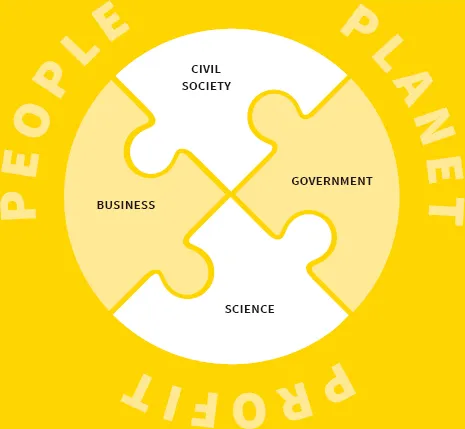
MSPs: collaborating to tackle the complexity of sustainable development
MSPs are advocated by everyone
Paul Polman
CEO of Unilever
“The issues we face are so big and the targets are so challenging that we cannot do it alone. When you look at any issue, such as food or water scarcity, it is very clear that no individual institution, government, or company can provide the solution.”
Ban Ki-Moon
UN Secretary General
“One of the main lessons I have learned during my five years as Secretary-General is that broad partnerships are the key to solving broad challenges. When governments, the United Nations, businesses, philanthropies, and civil society work hand-in-hand, we can achieve great things.”
Neil Keny-Guyer
CEO of Mercy Corps
“We live in a time where the boundaries between the public, private, and civil silos are blurring and breaking down. If we are going to find solutions to poverty and injustice, it is going to be in that blurred space, not in the silo space.”
Louise O. Fresco
President of Wageningen UR
“While better methods to produce scientific and technical knowledge remain necessary, they need to be integrated with methods that produce practical wisdom to guide us in our strategies and actions in a moral, ethical, and political rather than only in a technical and instrumental sense.”
The challenges of our globalised world
We are living in a globalised world with a population heading towards nine billion people, putting the earth's resources under immense pressure. Increasingly, we find that the challenges and opportunities we face are large and complex. Our actions are linked with the actions of others, our solutions are embedded in a web of interlinked interests and responses, and we cannot work alone. There is a profound need for new approaches – for innovation – in how we govern ourselves, in how we use and share resources, and in how we create harmony between people of differing wealth, culture, and religion.
Creating a better world takes partnership. Increasingly, government, business, civil society, and science recognise the need to work together to tackle the challenges of the modern world and bring about change for the common good. Many of the issues we confront and the opportunities we would like to exploit are embedded in a network of changing social, economic, political, and environmental factors. And many different groups may be concerned with the same issues, but from a different perspective and with different interests. In our world of social media and interconnected economies, bringing about change depends on dialogue and alignment across different sectors in society. We need to foster relationships across these groups and help them collaborate. Although no one group can bring about change on its own, the power of one group can be enough to block the actions of others. To avoid this, we need to develop shared perspectives, new understanding, and collective commitment for action, even between groups who may at first seem to have diverging interests or be in conflict.
Partnering for change
If you want to tackle real world issues and achieve real change, you will need to work together with a range of different people and organisations with different backgrounds. This is what we mean by a ‘multi-stakeholder partnership’ (MSP). While the different actors may share a common problem or aspiration, they also have different ‘stakes’ or interests. Across the world, people are creating new coalitions, alliances, and partnerships, and many inspirational examples are emerging of what can be achieved when people mobilise to take action together. But just agreeing to work together is no guarantee of success. The way these partnerships are set up, the process taken, the capacity for leadership, and the skill of facilitation will have a strong impact on how they develop and how successful they are. Enabling people to work well together, especially if they start with very different views of the world or are in conflict, is never easy. But if you succeed you will be able to make the most of the potential for human good, innovation, and transformational change.
The good news is that from experience we now know much more about how to create successful partnerships for change through multi-stakeholder collaboration. And, as successful examples gain attention, business, government, and non-governmental organisation (NGO) leaders are increasingly calling for more. This wave has been called ‘the collaboration paradigm of the 21st century’1 and a ‘stunning evolutionary change in institutional forms of governance’.2 Civil society organisations have discovered that they are more effective if they engage and collaborate.3 Citizens discover that they can change their world by finding new ways to collaborate and make demands using online tools. And business is looking to new ways that bring ‘shared value’.4
The collaborative and learning-oriented approach of MSPs is certainly not a silver bullet for every difficult situation we face. Yet, it is often surprising just how much progress can be made when you focus on the human aspects that help people cooperate, rather than remaining locked in conflict.
This guide aims to:
- be a backup for professionals involved in MSPs,
- inspire readers to try out new approaches for facilitation,
- connect to the theory that underpins MSP practice, and
- point readers to practical tools that can make their MSP practice more effective and rewarding
Is this guide for you?
This guide is for anyone interested in MSPs and how to make them more effective. It is particularly addressed to anyone responsible for setting up, leading, or facilitating an MSP – the ‘you’ of this book – but will be equally useful for those involved in commissioning, funding, or managing an MSP, and even for those who would just like to know what MSPs are about. If you are interested in combining practical steps and tools with a deeper insight into the theoretical foundations and underlying principles of MSPs, you will find the guide especially useful. And we hope it will also be a valuable resource for training in MSP and facilitation skills, as well as for use in higher education courses.
The guide offers a roadmap for designing and facilitating MSPs. We have woven together real world experience with sound theoretical foundations and practical facilitation tools to provide a coherent approach for getting the best out of an MSP. This is not a recipe book; rather, it provides a broad outline. Each MSP will have its own unique dynamics requiring insight and creativity to bring out the best in people and to forge the understanding and collaborative relationships that make change possible. We have written this guide to help you bring insight and creativity to the process of your MSP.
Like us, you may be familiar with MSPs that start full of energy and a spirit of optimism, but where the enthusiasm slowly but surely fades away. Some people become impatient and leave. Others start doubting that the MSP can deliver real change, or they feel unheard. Establishing an MSP doesn't automatically lead to harmonious collaboration between the partners. You may need a lot of patience. Developing trust and understanding can be a slow and difficult process when people have opposing interests or are competing for resources, or there are deep or long-held conflicts. It may take time until all partners understand and agree on the need for shared decisions and collective action. The guide will give you ideas and strategies for working through such challenges.
Our experiences of MSPs come largely from the agriculture, food and natural resource managements sectors, and the examples we use are drawn mostly from this work. However, the basic framework for MSPs that we offer is not sector specific so it will be just as relevant for working in other sectors such as health, education, governance, economic development, peace building or community development.
We hope that the guide will help committed businesses, governments, NGOs, and researchers to become more effective in their efforts to achieve environmental and economic sustainability and social justice. Each of these groups will come to an MSP with different interests, values, responsibilities, technical language, communication styles, and constraints. We have tried to ensure that this guide speaks to the needs of all.
How to use the guide
The power of this guide comes from its underlying framework for understanding and facilitating MSPs. This framework links theory with practice and provides a model and set of principles to guide the design of MSPs, tips on facilitation, and a set of participatory process tools.
The guide has been designed so that you can dip in at different places to find what you need, without reading cover to cover. In Section 2, we discuss MSPs in more detail, what they are, and their key characteristics. Section 3 focuses on the key elements for developing an MSP, the different phases, and designing the MSP process. Section 4 looks at seven principles that we have identified as the basis for effective MSPs, backed up by a set of conceptual models that capture key theoretical ideas and will help you to understand how MSPs can make transformative change possible. Section 5 looks at moving from design to practice – what it takes to facilitate an MSP and support partnership processes, what human dimensions need to be in place, and how you get organised. Section 6 considers the type of tools you will need at different stages of the MSP process, and gives a brief introduction to a selection of participatory tools that can be used to help stakeholders work more effectively together in building trust, exploring issues, strategising, and planning action. Section 7 offers you some stories from the frontline in the form of interviews with different stakeholders talking about their experience with MSPs. Finally, a resources section gives you links to further information on the theoretical basis of MSP practice, details of the references, and additional resources.
The guide is backed up by the CDI MSP resource portal (www.mspguide.org), where you will also find more details on the underlying theory of MSPs, additional examples and case studies, detailed descriptions of the tools, and many other resources.
Finally
Remember, the primary ‘tool’ at your disposal is…yourself. We assume that you have picked up this guide because you want to change something, and have realised that you will need to do this together with others. The quality of your personal leadership to drive change is more than the sum of all the tools and concepts in this guide. It is also about integrity, knowing yourself, balancing the head and the heart. This guide can help you hone your ability to become a more effective change agent. We have included reflection questions to help you on this path.
Some questions this guide will help you answer:
- Stakeholder...
Table of contents
- Cover Page
- Title Page
- Copyright Page
- Contents
- The Authors
- Preface
- 1 - Introduction
- 2 - Multi-Stakeholder Partnerships
- 3 - Designing the Process
- 4 - Seven Principles that make MSPs Effective
- 5 - From Design to Practice
- 6 - Choosing Tools
- 7 - MSPs in Action
- 8 - Additional Resources
- Notes
- References
- Back Cover
Trusted by 375,005 students
Access to over 1.5 million titles for a fair monthly price.
Study more efficiently using our study tools.
Frequently asked questions
Yes, you can cancel anytime from the Subscription tab in your account settings on the Perlego website. Your subscription will stay active until the end of your current billing period. Learn how to cancel your subscription
No, books cannot be downloaded as external files, such as PDFs, for use outside of Perlego. However, you can download books within the Perlego app for offline reading on mobile or tablet. Learn how to download books offline
We are an online textbook subscription service, where you can get access to an entire online library for less than the price of a single book per month. With over 1.5 million books across 990+ topics, we’ve got you covered! Learn about our mission
Look out for the read-aloud symbol on your next book to see if you can listen to it. The read-aloud tool reads text aloud for you, highlighting the text as it is being read. You can pause it, speed it up and slow it down. Learn more about Read Aloud
Yes! You can use the Perlego app on both iOS and Android devices to read anytime, anywhere — even offline. Perfect for commutes or when you’re on the go.
Please note we cannot support devices running on iOS 13 and Android 7 or earlier. Learn more about using the app
Please note we cannot support devices running on iOS 13 and Android 7 or earlier. Learn more about using the app
Yes, you can access The MSP Guide by Herman Brouwer in PDF and/or ePUB format, as well as other popular books in Social Sciences & Global Development Studies. We have over 1.5 million books available in our catalogue for you to explore.