Taking the absence of Aboriginal people in South Australian settler descendants' historical consciousness as a starting point, 'Memory, Place and Aboriginal–Settler History' combines the methodologies and theories of historical enquiry, anthropology and memory studies to investigate the multitudinous and intertwined ways the colonial past is known, represented and made sense of by current generations. Informed by interviews and fieldwork conducted with settler and Aboriginal descendants, oral histories, site visits and personal experience, Skye Krichauff closely examines the diverse but interconnected processes through which the past is understood and narrated. 'Memory, Place and Aboriginal–Settler History' demonstrates how it is possible to unsettle settler descendants' consciousness of the colonial past in ways that enable a tentative connection with Aboriginal people and their experiences.
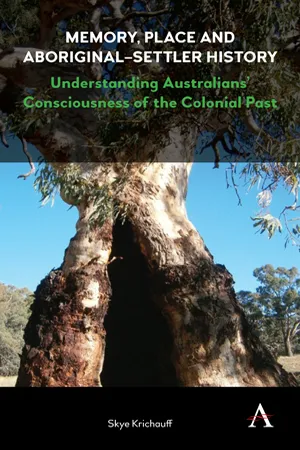
eBook - ePub
Memory, Place and Aboriginal-Settler History - Understanding Australians' Consciousness of the Colonial Past
Understanding Australians' Consciousness of the Colonial Past
- 264 pages
- English
- ePUB (mobile friendly)
- Available on iOS & Android
eBook - ePub
Memory, Place and Aboriginal-Settler History - Understanding Australians' Consciousness of the Colonial Past
Understanding Australians' Consciousness of the Colonial Past
About this book
Information
Chapter 1
HISTORICAL INHERITANCE: TRACING THE PAST
In the case of living memory […] critical examination cannot be reduced to a fragmented analysis [… the historian] must examine all the stages of elaboration, conservation and emergence of the recollection. Criticism must go back in time, from the present moment of the account to the time when the recollection was created, passing through all the intermediate stages.1
Numerous scholars working in diverse fields and disciplines who are interested in understanding how the past is recollected through individual, social and collective memory stress the important link between experience and memory. They point out that individual memory is crucial to the production of information that passes through the generations; memory is not a random terrain where anything goes – nothing will be transmitted unless someone, at some time, has remembered it on the basis of personal experience and communicated this memory to others.2 Regarding social memory, scholars remind us of the need to keep in view the ‘experiential bases on which collective memory rests’3 and that histories which are told in specific places are closely related to very specific experiences.4 Myths similarly arise in the course of human experience; they too have human/historical sources and are created and recreated in the midst of historical contingency.5
These conclusive findings reinforce the need for memory scholars to seriously acknowledge that settler descendants’ understandings and narratives of the colonial past are connected to aspects of reality experienced by previous generations. Factors such as the timing of arrival, geography of place of settlement and, relatedly and most importantly, the extent, nature and calibre of my interviewees’ forebears’ relations with Aboriginal people are historical contingencies which must be taken into account. Historical research enables us to distinguish between different types of colonists – pastoralists and freeholders, for example. By providing a more nuanced account and utilising more precise, accurate terms, we are better placed to demonstrate how one’s forebears’ experiences shape current generations’ attitudes and perceptions of the colonial past. We are also better able to critically question and test memory in order to learn what in settler descendants’ narratives and understandings is empirically accurate and what has a different, but equally significant, status.6
Learning from the Historical Records
Myth
Mid-northern settler descendants who have grown up on or closely connected with land occupied by their forebears in the nineteenth century have a consciousness of the colonial past that is oriented around the first forebear to arrive in the district and purchase what was to become the family farm.7 Common among this group is a perception that their families were the first people to live on the land that became the family property. This lack of recognition of prior Aboriginal occupation indicates that the nationwide myth of terra nullius (a legal term used to ‘to justify the occupation or possession of territories that were unoccupied or not occupied according to Western precepts of civilisation’) continues to prevail in twenty-first-century Australia.8 Myths can be understood as stories drawn from a society’s history which symbolise that society’s complexities and contradictions; they are formulated as ways of explaining problems that arise in the course of historical experience.9 At the international level, among settler-colonial collectives, narratives of unutilised land and ‘immaculate origin’ are common. However Australia’s foundation myth of terra nullius differs from other settler-colonial societies and reflects our different history.
At the national level, South Australia’s foundation myth reflects historical contingencies which distinguish South Australia from other Australian states. South Australians proudly perceive their state’s origins as different from other Australian states and are aware their state has a long history of being at the forefront of political and social reform.10 Certain unique aspects of the colony’s foundation – the lack of convicts, lack of an established church, the Wakefield scheme’s principles of regulated land sales and assisted migration, and relative legislative independence – endure in collective memory. Informatively, what is not incorporated into South Australian’s collective consciousness is the groundbreaking clause inserted into the state’s founding document and proclamation which recognised Aboriginal rights to land.
In the early 1830s, when the establishment of the colony of South Australia was becoming a reality in the Colonial Office in London, an awareness of Aboriginal occupancy of and attachment to specific tracts of land was widespread and accepted enough for relevant government officials to ensure that ‘proper mechanisms for acquiring land from the Aborigines’ were clearly articulated in the Colony’s relevant founding documents.11 In the Letters Patent sealed in February 1836, King William IV clearly stated that Aboriginal people’s proprietary rights to land were to be respected. The Colony of South Australia could be officially proclaimed:
Provided always that nothing in those our Letters Patent contained shall affect or be construed to affect the rights of any Aboriginal Natives of the said Province to the actual occupation or enjoyment of their own Person or the Person of their descendants of any Lands therein now actually occupied or enjoyed by such natives.12
Governor John Hindmarsh reiterated this provision when he proclaimed the Colony at Holdfast Bay on 28 December 1836. Although the word ‘ownership’ does not appear in the Letters Patent or other affiliated documents (instead, Aboriginal people were understood as possessing lands ‘in occupation and enjoyment’), observant Europeans soon became aware that Aboriginal people had a system of hereditary ownership and strict laws governing territorial rights. Five years after the establishment of the colony, a Select Committee of the House of Commons was presented with evidence that ‘every adult native possesses a district of land which he calls “his country”, and which he inherited from his father’.13
As a clear indicator of how myths are based on a selective interpretation of historic events, although vague and self-congratulatory understandings that the founders and settlers of South Australia were less violent and more enlightened in their dealings with Aboriginal people endure, the Letters Patent’s groundbreaking clause recognising the rights of Aboriginal people and their descendants to continual occupation and enjoyment of their land has not been incorporated into South Australia’s foundation myth.
History of land occupation
In contrast with other Australian colonies, from its conception South Australia had an official policy of systematic and concentrated settlement. However, slow government surveys did not meet the colonists’ demand for land. Within months of the colony’s establishment, newcomers began occupying unsurveyed land. As an interim measure, Governor George Gawler introduced Special Surveys in 1839–1840 which enabled wealthy Britons to pay £4,000 for a private survey of 16,000 acres in a district of their choice from which they were entitled to select 4,000 freehold acres. By mid-1840, vast tracts of fertile and well-watered country had been claimed for Special Survey. With the exception of land around Pt Lincoln and Mt Gambier, this land generally lay within a day’s ride from Adelaide. Regarding unsurveyed country, colonists secured their right to occupy and depasture stock on such country by purchasing annual occupation licences, which were introduced in 1842. A licence cost £5 annually, plus one penny per head of sheep and sixpence per head of cattle. After 1851, pastoral leases of 14 years duration based on the size and quality of the lease were introduced (at a rate of £1 per square mile for ‘first class’ land, 15 shillings for second class and 10 shillings for third class). Occupation licence holders and pastoral lessees became known as squatters or pastoralists, and their leases were referred to as ‘runs’.
Much can be gleaned about Europeans’ desire for a particular country and, ultimately, the intensity and extent of European–Aboriginal relations by learning which districts were chosen for government surveys and Special Survey, the timing of applications for occupation licences and, later, pastoral leases, the size of the runs and the timing of land purchases. Much of the country in the North-East Highland district, including but not limited to the Booborowie and Mt Bryan Valleys, was leased by two pairs of brothers. John and William Browne originated from Wiltshire. Both had medical degrees from Edinburgh University. On arriving in South Australia, the Brownes purchased freehold land in the Barossa Valley. By 1843 the Brownes occupied 160 square miles of country known as the Booborowie/Canowie lease. They purchased the freehold for 46,978 acres of the Booborowie run (which contained some of the best sheep-grazing and wool-growing country in Australia) in 1863.14 The Brownes had enormous landholdings across the colony and did not reside on their Booborowie/Canowie run.15 In 1866 the brothers dissolved their partnership and returned to England, after which their estate was controlled by trustees. In 1897, three years after William Browne’s death, the Brownes’ Booborowie station was sold and subdivided.
In the early 1840s, John Hallett and his brother Alfred were granted ‘Lease no.10’ – ‘Willogoleche’ – which stretched 20 miles north to south, consisted of about 200 square miles and included the mountain (named by Governor Gawler) Mt Bryan and the areas upon which the future townships of Hallett and Mt Bryan were built.16 Between 1844 and 1855, the Halletts sold the northern half of the run (which retained the name Willogoleche) to the Brownes’ Barossa Valley neighbour and brother-in-law Joseph Gilbert.17 The Halletts retained 14,000 acres of the southern section and leased ‘outside country’ to the east of Wandillah.18 After John Hallett’s death in 1868, Alfred continued running the properties, which were sold at public auction after Alfred’s death in 1877. In 1851 an occupation licence containing 156 square miles was issued to Joseph Gilbert for a run which became known as Mt Bryan station.19Gilbert purchased the freehold of ten square miles of the Mt Bryan run in 1881 before selling it to Edmund and Charles Bowman in 1883.
The Brownes, Halletts and Gilbert purchased and leased enormous tracts of country throughout the colony. Not all who leased land in the North-East Highlands had s...
Table of contents
- Cover
- Half Title
- Series Information
- Title Page
- Copyright Page
- Dedication
- Contents
- Figures
- Preface
- Acknowledgements
- Introduction
- Chapter 1 Historical Inheritance: Tracing the Past
- Chapter 2 Dwelling in Place: Absorbing the Past
- Chapter 3 The Social Community: Networks of Memory and Attachment to Place
- Chapter 4 The Cultural Circuit: Making Sense of Lived History
- Chapter 5 ‘Memory’ TO ‘History’: From Verbal Transmission To Text
- Chapter 6 Settler Belonging, Victimhood and Trauma
- Chapter 7 Unsettling the Disconnect
- Notes
- Bibliography
- Index
Trusted by 375,005 students
Access to over 1.5 million titles for a fair monthly price.
Study more efficiently using our study tools.
Frequently asked questions
Yes, you can cancel anytime from the Subscription tab in your account settings on the Perlego website. Your subscription will stay active until the end of your current billing period. Learn how to cancel your subscription
No, books cannot be downloaded as external files, such as PDFs, for use outside of Perlego. However, you can download books within the Perlego app for offline reading on mobile or tablet. Learn how to download books offline
Perlego offers two plans: Essential and Complete
- Essential is ideal for learners and professionals who enjoy exploring a wide range of subjects. Access the Essential Library with 800,000+ trusted titles and best-sellers across business, personal growth, and the humanities. Includes unlimited reading time and Standard Read Aloud voice.
- Complete: Perfect for advanced learners and researchers needing full, unrestricted access. Unlock 1.5M+ books across hundreds of subjects, including academic and specialized titles. The Complete Plan also includes advanced features like Premium Read Aloud and Research Assistant.
We are an online textbook subscription service, where you can get access to an entire online library for less than the price of a single book per month. With over 1.5 million books across 990+ topics, we’ve got you covered! Learn about our mission
Look out for the read-aloud symbol on your next book to see if you can listen to it. The read-aloud tool reads text aloud for you, highlighting the text as it is being read. You can pause it, speed it up and slow it down. Learn more about Read Aloud
Yes! You can use the Perlego app on both iOS and Android devices to read anytime, anywhere — even offline. Perfect for commutes or when you’re on the go.
Please note we cannot support devices running on iOS 13 and Android 7 or earlier. Learn more about using the app
Please note we cannot support devices running on iOS 13 and Android 7 or earlier. Learn more about using the app
Yes, you can access Memory, Place and Aboriginal-Settler History - Understanding Australians' Consciousness of the Colonial Past by Skye Krichauff in PDF and/or ePUB format, as well as other popular books in History & Australian & Oceanian History. We have over 1.5 million books available in our catalogue for you to explore.