From kung-fu to tofu, tea to trade routes, sages to silk, China has influenced cuisine, commerce, military strategy, aesthetics and philosophy across the world for thousands of years.
Chinese history is sprawling and gloriously messy. It is full of heroes who are also villains, prosperous ages and violent rebellions, cultural vibrancy and censorious impulses, rebels, loyalists, dissidents and wits. The story of women in China, from the earliest warriors to twentieth-century suffragettes, is rarely told. And historical spectres of corruption and disunity, which have brought down many a mighty ruling house, continue to haunt the People's Republic today.
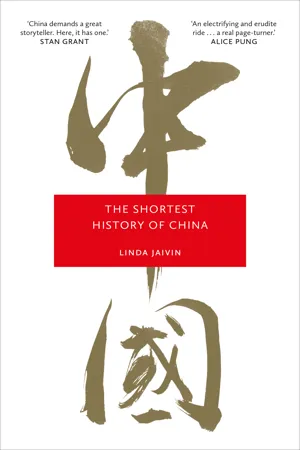
Modern China is seen variously as an economic powerhouse, an icon of urbanisation, a propaganda state or an aggressive superpower seeking world domination. Linda Jaivin distils a vast history into a short, readable account that tells you what you need to know, from China's philosophical origins to its political system, to the COVID-19 pandemic and where the PRC is likely to lead the world.
'China demands a great storyteller. Here, it has one.' —Stan Grant
'An electrifying and erudite ride … a real page-turner.' —Alice Pung
- 284 pages
- English
- ePUB (mobile friendly)
- Available on iOS & Android
eBook - ePub
The Shortest History of China
About this book
Information
1
ORIGINS
An Egg Hatches and a Civilisation Is Born
Far, far back in time, a popular Chinese creation story tells us, primal chaos congealed into an egg, in which the complementary cosmic energies of Yīn 陰 and Yáng 陽 thickened around a hairy, horned giant called Pángǔ. Eighteen thousand years passed. Pangu hatched fully formed, holding an axe, with which he hacked apart the Yin and Yang. The Yin became the earth beneath his feet, and the Yang, the sky. As he grew taller, he pushed the two further and further apart. After Pangu died, his flesh turned to soil, his sweat to rain and his breath to wind. His blood flowed as rivers and seas. His eyes became the sun and the moon. From his hair sprang plants and trees, and the fleas in his fur became animals and people.
Eons flew by. Warring deities laid waste to the heavens. Then Nǚwā, the daughter of the celestial Jade Emperor, repaired the sky with coloured stones. Some say it was Nüwa who created humans, fashioning them from clay.
AROUND 780,000 YEARS AGO, the Yellow River flowed much closer to the place we call Beijing than it does now, creating a fertile alluvial plain. Wild pigs, buffalo, sheep and deer roamed the lush meadows that spread out from China’s second-largest river, and birds nested in forests dense with nut and fruit trees. In caves in the surrounding mountains, Peking Man (homo erectus pekinensis ) and other of humankind’s Stone Age ancestors sheltered from sabre-toothed cats, wolves, bears, panthers and other predators, coming down to the flats to hunt and gather.
Two tribes, the Huá and Xià, from whom the ethnic majority Han Chinese claim descent, settled around the river’s middle and lower reaches. At some point around 13,000 years ago, one of them carved a bird from singed bone, two centimetres in length and balanced on a pedestal – the most ancient animal sculpture ever found in East Asia.

This carved bird, East Asia’s most ancient animal sculpture, was found in a pile of dirt left behind by a construction crew digging a well in Língjǐng, Hénán province, in 2020.
Farming heralded the beginning of the Neolithic (New Stone) Age. In the relatively arid north, people cultivated millet and in the fertile ground of the south, rice. Farmers raised pigs, sheep and cattle, and domesticated wild dogs. They built homes of mudbrick, mud-plastered wood and stone. In some places, their dwellings featured glossy red pottery walls and roofs of fired mud and wood. The houses clustered in walled communities that would eventually dot the central plains. With more time for leisure, people crafted bowls, goblets and musical instruments of fired clay, decorating them with abstract patterns and zoomorphic figures. They carved jade, turquoise and bone into jewellery and objects for use in worship or burial rites.
A fragment of silk from the Yellow River Valley, the oldest in the world, shows that the Chinese practised sericulture – the production of silk – as early as 3630 BCE. Sericulture seems to have been largely women’s work from the start, from chopping mulberry leaves to feed the silkworms – the larvae of the Bombyx mori moth – to collecting the cocoons and boiling them to loosen their threads before spinning, dyeing and weaving them into cloth.
Silk would eventually play an important part in China’s diplomacy and trade, as well as in fashion, communications and art (serving as paper and canvas). But how did anyone think of boiling moth cocoons in the first place?
One story goes that Madame Xīlíng, the principal wife of the semi-mythical Yellow Emperor, was sipping tea under a mulberry tree when a cocoon dropped into her cup and began to unspool. Gathering up the shimmering thread, she realised it was strong enough to weave.

The care and feeding of silkworms (which eat mulberry leaves) is the foundation of sericulture, which dates back to Neolithic times in China.
Other legends say it was Xiling’s husband, the Yellow Emperor himself, who figured this out. Similar legends credit him with inventing many other things, from carts, boats, wooden houses and the pottery wheel to the calendar, and even a bamboo pan flute tuned to the song of the mythical phoenix (a totem of the south, as the dragon is of the north). A mighty general, the Yellow Emperor fought fierce battles against his rivals – said to include horned demons and giants – to unify the tribes north of the Yellow River.
Accounts that also credit the Yellow Emperor with inventing writing underlie the popular claim that China has 5000 years of recorded history. The earliest hard evidence of Chinese script, however, dates back 3500 years, which makes it the third-or fourth-oldest system of writing in the world, after those of the Sumerians in Mesopotamia, the Egyptians and possibly the Minoans (whose writing system developed around the same time as the Chinese).
It’s unclear if the Yellow Emperor was an actual individual who, in the telling and retelling of his story, acquired godlike characteristics over time, or if he began as a god and was later given a human face. He has been a cult figure since the fifth century BCE. Han Chinese consider the Yellow Emperor and his successor, Yán Dì, the Fiery Emperor, their oldest ancestors.
Another semi-mythical dynasty, the Xia, began around 2100 BCE, after the reign of another three legendary emperors, Yáo, Shùn and Yǔ. Historical records firm up around five or six hundred years later, when the Bronze Age began and, with it, the Shāng dynasty, which lasted more than 600 years, beginning in the sixteenth century BCE.

The Shang ruled over the fertile land on the lower reaches of the Yellow River from its capital of Ānyáng, in today’s Henan province.
RECORDS ON SHELL AND BONE
The rulers of the Shang dynasty were warlike and highly superstitious, worshipping a number of gods and conducting human sacrifices to them. They kept slaves, including musicians and dancers. Each king had a primary wife and many secondary ones, or concubines – for most of Chinese history, men with the means to provide for more than one wife were free to take concubines. (In the Chinese language, a man ‘takes’, qǔ 娶, a wife, whereas a woman is ‘given’, jià 嫁, in marriage.)
The Shang used a calendar based on both the cycles of the moon and the solar year, and invented a system of timekeeping that divided days into twelve two-hour blocks – a system that, with some revisions, remained in use for the next three and a half millennia.
We know all this because their shamans would anoint the shoulder blades of oxen and the plastrons (undershells) of tortoises with blood and heat them until they cracked. They interpreted the pattern of the cracks to answer such questions as, how will the harvests be this year? Should I go to war? Does my tooth hurt because I offended my ancestors? The shamans inscribed the answers on the bones in the earliest recognised versions of Chinese characters, jiǎgǔwén 甲骨文 – shell bone writing, also called oracle bone script.
Chinese characters may be concrete or pictorial: for example, rì 日 for sun and yuè 月 for moon. They may be conceptual: combining sun and moon makes míng 明, meaning ‘bright’. Other characters are constructed from a ‘radical’, or signific – typically a stylised form of a simple character indicating a class of meaning (‘jade’, ‘human’, ‘fire’ and so on) – and a phonetic, which suggests its pronunciation, but gives no indication of tone (which, like pronunciation, can vary from place to place).
The character for horse 馬, mǎ , is highly pictorial: you can see the horse’s galloping legs and flying mane. It can also be used as either a radical or a phonetic. It’s a radical in the character yù 馭, which means ‘to drive a horse-drawn chariot’, and a phonetic in the character m ā 媽, meaning mother, where the radical is 女, woman.

Oracle bone script is the earliest form of Chinese writing. Unlike alphabetic languages, which use letters to represent sounds, Chinese writing is logographic, using characters to represent words or ideas.
Oracle bones tell the story of a formidable woman, Fù Hǎo, who was the consort of the Shang king Wǔ Dīng (r. 1250–1192 BCE). A hunter and a warrior, she once led 13,000 men into battle against the king’s enemies. (Some sources say her dowry included an army.) She also presided over divination and other ceremonies. When she died, she was buried with four battleaxes. Her military activities may or may not have been exceptional for the time, but her independent fortune and burial in her own tomb suggest that the Shang may have been a semi-matriarchal society.1
Fu Hao’s enjoyment of hunting was typical of the Shang ruling class, who were often buried with their favourite hunting dogs. Sometimes they were buried with their servants as well, to ensure comfort in the afterlife. Fortunately for the servants, figurines eventually took the place of real people.
The common people had a lot to say about the behaviour of the ruling classes. We know this thanks to one of the oldest collections of poetry in the world, the Book of Odes 詩經. Its verses and folk songs speak of love and courtship, sorrow and grief, housework, farming, the life of the soldier or soldier’s wife...
Table of contents
- Cover Page
- Title Page
- Copyright
- Dedication
- Contents
- Introduction
- 1. Origins: An Egg Hatches and a Civilisation Is Born
- 2. The Zhou: From Ideal Rule to Warring States
- 3. The Qin: Unification, Tyranny and All Under Heaven
- 4. The Han: Intrigue, Innovation and a Brief Interregnum
- 5. The Great Disunity: Three Kingdoms, Two Women Warriors, Seven Sages and a Five-Mineral Powder
- 6. The Tang: From Golden Age to Everlasting Sorrow
- 7. The Song: Proto-Socialists, Neo-Confucians and Urban Living
- 8. The Mongol Yuan: From ‘Glorious Slaughter’ to the Splendid City
- 9. The Ming: Splendour and Decay
- 10. The Manchu Qing: The Rocky Road to Modernity
- 11. The Republic: High Hopes and Vicious Betrayals
- 12. Japanese Invasion and Civil War: The Republic Disintegrates
- 13. The Mao Years: Continuous Revolution
- 14. The Reform Era: Prosperity and Its Discontents
- 15. The New Era of Xi Jinping: Rise of the Wolf Warriors
- Acknowledgements
- Further Reading
- Notes
- List of Images
- Index
- Back Cover
Trusted by 375,005 students
Access to over 1.5 million titles for a fair monthly price.
Study more efficiently using our study tools.
Frequently asked questions
Yes, you can cancel anytime from the Subscription tab in your account settings on the Perlego website. Your subscription will stay active until the end of your current billing period. Learn how to cancel your subscription
No, books cannot be downloaded as external files, such as PDFs, for use outside of Perlego. However, you can download books within the Perlego app for offline reading on mobile or tablet. Learn how to download books offline
Perlego offers two plans: Essential and Complete
- Essential is ideal for learners and professionals who enjoy exploring a wide range of subjects. Access the Essential Library with 800,000+ trusted titles and best-sellers across business, personal growth, and the humanities. Includes unlimited reading time and Standard Read Aloud voice.
- Complete: Perfect for advanced learners and researchers needing full, unrestricted access. Unlock 1.5M+ books across hundreds of subjects, including academic and specialized titles. The Complete Plan also includes advanced features like Premium Read Aloud and Research Assistant.
We are an online textbook subscription service, where you can get access to an entire online library for less than the price of a single book per month. With over 1.5 million books across 990+ topics, we’ve got you covered! Learn about our mission
Look out for the read-aloud symbol on your next book to see if you can listen to it. The read-aloud tool reads text aloud for you, highlighting the text as it is being read. You can pause it, speed it up and slow it down. Learn more about Read Aloud
Yes! You can use the Perlego app on both iOS and Android devices to read anytime, anywhere — even offline. Perfect for commutes or when you’re on the go.
Please note we cannot support devices running on iOS 13 and Android 7 or earlier. Learn more about using the app
Please note we cannot support devices running on iOS 13 and Android 7 or earlier. Learn more about using the app
Yes, you can access The Shortest History of China by Linda Jaivin in PDF and/or ePUB format, as well as other popular books in History & Chinese History. We have over 1.5 million books available in our catalogue for you to explore.