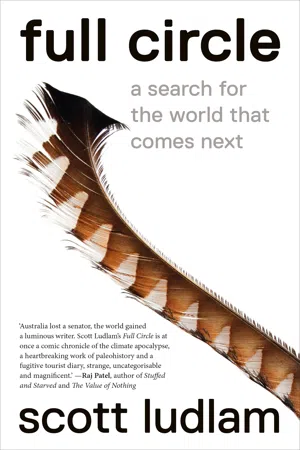
It's getting late. We have to get moving. A scorched eucalyptus leaf twirls out of a clear sky, a premonition that begins a journey into a world on the edge.In Full Circle, Scott Ludlam draws on his unique experience as senator and activist. Travelling the world, he discovers an emerging post-capitalist economics, and investigates everything from systems theory to community activism. Above all, he looks for what works: the falling grain of sand that sets off the avalanche of environmental and democratic change.This is a book about hidden connections and fresh possibilities, and what happens when we invite natural systems back into the urban world. Bringing together a wealth of new ideas, Full Circle outlines a new ecological politics. It is a visionary book for our wild time.
- 368 pages
- English
- ePUB (mobile friendly)
- Available on iOS & Android
eBook - ePub
About this book
Information
PART 1
the motive power of fire
the motive power of fire
The grounds for hope are in the shadows,
in the people who are inventing the world
while no one looks, who themselves don’t
know yet whether they will have any effect …
in the people who are inventing the world
while no one looks, who themselves don’t
know yet whether they will have any effect …
REBECCA SOLNIT
the road to wattle
Early summer, 1998: a dozen people are working by torchlight and gas lanterns, miniature figures under giant trees. Bent in exertion, they’re tearing into the bush track with spades and star pickets, taking turns to shovel the damp earth aside, bearing closer to the concrete culvert a few feet below. A short way back down the track, the warmth of a small fire lights the faces of another half-dozen people, and a pot of coffee is coming to the boil. A tarp has been slung across the roadway, sheltering a scatter of cushions and mattresses, a couple of sleeping kids. It’s sketchy but homely.
Quiet conversation, laughter, and the subsonic rush of the forest behind the hectic racket of a twelve-foot trench being cut across the access road.
This forest. The traditional ground of the Pibelmun Noongar; walled cathedrals of silver trunks, a vaulted canopy framing a drift of stars. Some of these great old ones seeded three hundred years before the founding of my city. Tiers of understorey home to an intricate community of birds, insects, frogs and marsupials that live nowhere but here. You can’t see them, with all the noise we’re making. But you can feel the watchfulness: that sense of multitudes of eyes-on.
There’s a minor celebration when we hit the buried culvert, and now the conversation turns to the best recipe for quick-set cement. I’m too new to this work to really understand what they have in mind: several lengths of chain are passed under the culvert, and a mess of wet concrete is being batched up on a big sheet of plastic. A couple of friends are admiring a two-foot section of steel pipe with an odd reverence; encrusted with welded spikes of rebar and scrap metal, it clearly has an important part to play in whatever is being done here.
I’m covered in mud, stepping back to the little campfire for another mug of coffee, as happy as I can recall being in a while.
Suddenly, a car is moving silently down the hill towards us. Headlights dipped; I can’t tell who’s steering, but there is quiet gravity in the sight of this battered station wagon rolling towards us, tyres crunching on the gravel. The earthmoving team pauses, leaning on their shovels. Now comes the hard part.
At the bottom of the trench, the concrete is already beginning to set, entombing the chains they’ve looped around the culvert and encasing all but the very end of that medieval-looking length of pipe. We line up and heave at the car, slewing it sideways across the track. Without really knowing how, we have shoved it into the trench and now here it lies, sunk up to its axles in the roadway. We begin to backfill, crude ramparts of an improvised roadblock.
It’s ready sometime after midnight. A young woman crawls across the front seats onto a cramped bed of pillows and cushions, and I finally realise what it is we’ve done. A hole cut through the floor of the car lines up precisely with the lock-on pipe buried in the setting concrete. Into this, she extends her arm and clips a carabiner chained to her wrist onto a slender bar welded within the pipe. Ragged hair, focused eyes, a smile; thumbs up with her free hand.
Come the morning, if it’s your job to police the passage of logging and earthmoving equipment through here, you have three options now. One: let them roll over the top and kill the woman in the car. Two: persuade her through legal threats or exhaustion to unclip and come off voluntarily. Three: dig out around the car and jackhammer through the concrete until you can put an angle grinder to the pipe, bearing in mind that it now encloses a fragile human arm.
In this particular place and time, option one is unthinkable. Options two and three will take many hours. Until the police and contractors show up and decide how they want to play it, the road into this small corner of the wild southwest is closed.
People are returning to the fire, dispersing, fatigue washing in. I’m too wired on caffeine to turn in quite yet, so let’s sit a while as the firelight sets shadows dancing.
These memories are more than twenty years old now, but I’ll never forget the sight of the sacrificial station wagon appearing out of the darkness; a battered piece of surplus technology repurposed and turned against a much larger and more complex machine.
To be clear, what we’re doing here is unlawful. Chopping up access roads and implanting cars in them is against the law. Occupying such a vehicle and refusing an order to leave; that’s unlawful too.
In contrast, it is entirely lawful to bring scrub-rolling dozers into this forest to pulverise the understorey and kill everything that doesn’t flee; the state has granted an explicit licence for the contractors to do just that. It is also lawful to turn machines with tank-tracks and tungsten saws against these silvered giants, sending them thundering to the ground and turning this valley into a moonscape over the course of a fortnight.
So here’s the problem: this localised extinction disaster is institutionalised. It has the full weight of global supply chains auspiced by modern industrial states behind it. Putting yourself in front of a bulldozer only slows it temporarily; the larger system learns, it adapts, and on some mornings it sends police in to lawfully beat the shit out of the people camped here.
I don’t know what brought you here – I’m not even sure if we’ve met. But me, I’m one of the fortunate few – I’m here by choice. I hitched down here because it felt right, because I know and trust these people, and because the campaign has hit a tipping point and it’s wild to be part of it. My family supports me being here. I work as a freelancer, so this has cost me literally nothing. I’m a temporary visitor from the comfortable bulge in the middle of the privilege bell curve, the university-educated part, where you are taught about bell curves but not about privilege. I haven’t been forced into this campaign because my life depends on it, or through ancestral obligations to Country. Until quite recently, ‘the environment’ was just something I read about in books.
That changed the first time I stood at the edge of a working clearfell. Watching a living place being violently dismantled breaks something inside. Felling is dangerous work, and the teams are methodical, professional and terribly effective. Trees that had anchored these hillsides for more than five hundred years were being loaded onto trucks, soon to be shredded into low-value woodchips for the international pulp market. We’d get some of it back in a few months’ time, as plastic-wrapped toilet rolls and blocks of perfectly white copy paper. What was left on the ground in that ruined place was then pushed into piles and torched – and all of this, not to labour the point, was lawful.
That’s why we’re here, around this little crackling fire: to prevent that from happening right where we’re sitting. Some of the most brilliant people I will ever meet have managed, over the course of more than thirty years, to turn the tide on this terrible destruction. Camped in the mud, organising demonstrations in the city, training two generations of newcomers, carefully working the politics. They don’t know it yet, but they’re about to succeed, swinging an election on the strength of this mobilisation and the presence of the place itself. Direct action gets the goods, so they say. They will silence the chainsaws, not just here but across a huge extent of this ancient ground. The law will change,1 and this powerful win will pass into activist folklore, even as new national parks are being drawn up, along with retraining packages for affected logging communities.
The larger system learns, and it adapts. In its current configuration it demands a certain tonnage of woodchips, no matter what. International buyers will now hit Sarawak a few million tonnes harder, and Vietnam, and places where putting your arm into a lock-on pipe absolutely could get you killed. None of this is the fault, or the intention, of the people who put themselves on the line here. But we can’t pretend that this isn’t happening everywhere, or that we aren’t now descending the rapids into a full-blown planetary extinction crisis. Turn the prism, and it looks like a climate crisis. And a crisis of democracy, of militarism, of poverty.
Years ago, I came across this old story about a village by a river. A group of villagers are washing clothes on the riverbank, and one of them looks up to see a young child floating past, clearly in distress. She wades in and rescues her, a little shaken. A shout – one of her friends has spotted another kid in the water, and then another. They drop their washing and set about rescuing these stricken children as they float past.
More kids are drifting helplessly down the river, and then more. Finally, in a fury, the original rescuer abandons the riverbank and strides away. ‘Wait!’ her comrades shout. ‘We need you here. Where are you going?’ Over her shoulder, she calls back, ‘I’m going to find the monster who’s throwing them in.’
Here, under these immense trees, we are organising a rescue. People in villages far from here – from Mathare to Mongolia to Minas Gerais – are organising other rescues. Soon we’ll set sail and meet with some of them, to learn a little of the rivers they stand in and the monsters they contend with. This traverse will take us from the floor of the Senate to a Hadean beach, from the winter of the Great Depression to a rebellion against extinction. While we travel, social movements working across every time zone will invoke one of those rare moments in history when they begin to converge and discover each other.
There are a great many children in the water, so it’s time to be up and moving. The first hints of dawn are touching the sky. With the access road bottled up, the forest protectors will be able to move many more people onto the main road into the logging area, where the confrontation will be easier for television news crews to reach. Later, I’ll catch the smell of woodsmoke on my clothes, and it will bring back how this improvised extinction roadblock looked under the torchlight. It looked rough, and clever, and beautiful, like the rising global movement it is a part of.
Because we were here, there will be no logging in Wattle Forest today.
1 Although, at the time of writing it remains illegal to implant station wagons in logging roads.
the oldest book in the world
On the eastern shores of the Mediterranean, in present-day Lebanon, stands the ancient city of Byblos. It is one of the oldest continually inhabited cities in the world, and somehow you can feel it. Walk these streets with someone who knows how to read the place, and the jumbled layers tell a story. The mountains behind are hazy, decked with unregulated apartment stacks built in a hurry for those fleeing the war in 2006, and the civil war before that. Closer to the coast, a mess of freeways and concrete tilt-up intersect with graceful architectures of the mid-twentieth-century French mandate.
We step back further, down cobbled streets past the Ottoman-era Sultan Abdul Majid mosque with its sky-blue dome, evening call to prayer echoing across the rooftops. Deeper, now: blocky ruins of a twelfth-century Crusaders’ castle the highest landmark in the old city, still bearing the scars of capture by Salah ad-Din. Archways of a Roman amphitheatre built a thousand years earlier. We call the city by its old name now, Jbeil, as we walk back through the years of occupation by Alexander the Great, hundreds of years as a Persian client state before that, Assyrians before them, Egyptians before them.
Shorelines reconfigure as the centuries unfurl; the original seaport silted up and only recently rediscovered. In your mind’s eye, watch as Phoenician merchant ships slip out of port laden with cedar bound for Memphis and Alexandria. They’ll return carrying precious papyrus, upon which scholars will write in the earliest recognisable forms of the Latin alphabet.
Deeper. Curved foundations of palaces long gone. Layers of trauma and war; walls built and ruined and built again. Bronze Age pottery fragments. The plastered floors of vanished houses laid down by a fishing community in the early Neolithic. The narrow avenues of the old souk still bustle with commerce and culture, lending continuity to the generations of families who built every age of this place. From some time after the closing of the Ice Age, these streets have shifted and reconfigured, languages and whole bodies of law have come and gone, and the city has endured.
There is a much older story here, if you know where to find it.
Down one narrow laneway, we step into a vaulted shopfront that looks, from the outside, like some kind of gallery. We are welcomed by a genial curator and his knowledgeable young son, both of them eager to share. On the walls hang intricate friezes in fine-grained limestone – fossil silhouettes of fish and crustaceans and rays preserved in the most extraordinary detail. These distant creatures lived in the long-vanished Tethys Sea a hundred million years ago – a span of years ten thousand times the age of this city.
At the back of the gallery, a heavy rack holds a block of these stone tablets, sliced vertically in a way that allows you to leaf through them, carefully, like the pages of the oldest book in the world. A form of geological memory can be recalled here, achingly fragile lives smothered by marine sediments under a younger sun, pressed into the fossil record as the seasons turned, and turned. If you know how to read them – as the curators of this small gallery clearly do – you can infer things about the world these creatures inhabited: how hot it was, what they ate, a little of how they lived.
Among those who have spent their lives trying to read meaning into these ghostly pages, the book is divided into chapters marked by relatively sudden changes in the geological narrative. The chapter they call the Permian ends with a mass extinction a quarter of a billion years ago. The more recent disappearance of the dinosaurs marks the sudden end of the Cretaceous chapter. All the way down into more recent times, when new technologies and more intact sediments mean the book can be read at higher and higher resolution.
Follow the storyline now through two and a half million years of Pleistocene Ice Ages broken by warm interglacial periods. The ice in retreat as shorelines advance, arriving, finally, in the long, eleven-thousand-year Holocene summer, in which the city of Byblos, and the entirety of our written history, is made and remade.
Into these most recent strata of the geological record, something new. In changing sedimentation patterns around river mouths, geologists read the quiet aftermath of ancient deforestation in Europe. In air bubbles trapped in an Antarctic snowstorm five thousand years ago, faint traces of increased methane levels from rice cultivation in China.
In the late 1800s, the signal becomes unambiguous. A thin film of localised ashfall in the British Midlands proliferates rapidly as industrial coal-burning hopscotches across the northern hemisphere. Radioactive isotopes of caesium and plutonium, falling out downwind of nuclear-weapon detonations in the 1950s and ’60s. In the background, slowly, trace amounts of carbon dioxide in the atmosphere and oceans continue to rise, exhaust gases building up faster than the planet can draw them down.
At a conference of the International Geosphere-Biosphere Programme in 2000 – an event that sounds like an absolute riot – one Nobel laureate’s throwaway line brings things to a momentary standstill: ‘We no longer live in the Holocene, but in the Anthropocene.’
The Anthropocene. Ever since that conference, the word has steadily diffused out of academic journals into popular culture. It has a certain ominous mystique to it; in my mind’s eye the great-grandchildren of the fossil curators of Byblos are reading the closing of the Holocene and the incendiary dawn of a new geological age, leafing through the ash-smudged fossil record and wondering at the sudden silencing of the world.
Palaeontologists and earth systems scientists are still skirmishing over what this Anthropocene concept even means, and when this new age began. With the coal burning? The methane in the air bubbles? One view is that we passed through an invisible inflection point in the 1950s, as our industrial and agricultural bootprint transcended local...
Table of contents
- Cover Page
- Title Page
- Copyright
- Dedication
- Contents
- Fireground
- Part 1. The Motive Power of Fire
- Part 2. New Silk Roads
- Part 3. Continuities
- Part 4. Power Laws and Dragon Kings
- Part 5. Full Circle
- Find the Others
- Acknowledgements
- Notes
- Index
- About the Author
- Back Cover
Trusted by 375,005 students
Access to over 1.5 million titles for a fair monthly price.
Study more efficiently using our study tools.
Frequently asked questions
Yes, you can cancel anytime from the Subscription tab in your account settings on the Perlego website. Your subscription will stay active until the end of your current billing period. Learn how to cancel your subscription
No, books cannot be downloaded as external files, such as PDFs, for use outside of Perlego. However, you can download books within the Perlego app for offline reading on mobile or tablet. Learn how to download books offline
Perlego offers two plans: Essential and Complete
- Essential is ideal for learners and professionals who enjoy exploring a wide range of subjects. Access the Essential Library with 800,000+ trusted titles and best-sellers across business, personal growth, and the humanities. Includes unlimited reading time and Standard Read Aloud voice.
- Complete: Perfect for advanced learners and researchers needing full, unrestricted access. Unlock 1.5M+ books across hundreds of subjects, including academic and specialized titles. The Complete Plan also includes advanced features like Premium Read Aloud and Research Assistant.
We are an online textbook subscription service, where you can get access to an entire online library for less than the price of a single book per month. With over 1.5 million books across 990+ topics, we’ve got you covered! Learn about our mission
Look out for the read-aloud symbol on your next book to see if you can listen to it. The read-aloud tool reads text aloud for you, highlighting the text as it is being read. You can pause it, speed it up and slow it down. Learn more about Read Aloud
Yes! You can use the Perlego app on both iOS and Android devices to read anytime, anywhere — even offline. Perfect for commutes or when you’re on the go.
Please note we cannot support devices running on iOS 13 and Android 7 or earlier. Learn more about using the app
Please note we cannot support devices running on iOS 13 and Android 7 or earlier. Learn more about using the app
Yes, you can access Full Circle by Scott Ludlam in PDF and/or ePUB format, as well as other popular books in Politics & International Relations & Political Biographies. We have over 1.5 million books available in our catalogue for you to explore.