- 240 pages
- English
- ePUB (mobile friendly)
- Available on iOS & Android
eBook - ePub
About this book
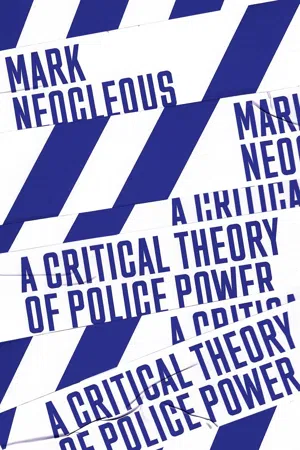
The ubiquitous nature and political attraction of the concept of order has to be understood in conjunction with the idea of police. Since its first publication, this book has been one of the most powerful and wide-ranging critiques of the police power. Neocleous argues for an expanded concept of police, able to account for the range of institutions through which policing takes place. These institutions are concerned not just with the maintenance and reproduction of order, but with its very fabrication, especially the fabrication of a social order founded on wage labour. By situating the police power in relation to both capital and the state and at the heart of the politics of security, the book opens up into an understanding of the ways in which the state administers civil society and fabricates order through law and the ideology of crime. The discretionary violence of the police on the street is thereby connected to the wider administrative powers of the state, and the thud of the truncheon to the dull compulsion of economic relations.
Information
1
‘Police Begets Good Order’
Mastering the masterless, imposing order
From the late fifteenth century political discourse in Europe centred very much on the concept of police. Originating in French-Burgundian policie in the fifteenth century, the word ‘police’ spread across Continental Europe and generated a range of words adopted from the French-Burgundian: ‘Policei’, ‘Pollicei’ ‘Policey’, ‘Pollicey’, ‘Pollizey’, ‘Pollizei’ ‘Politzey’, ‘Pollucey’, and ‘Pullucey’. Though the spelling of the word varied, the meaning remained constant, denoting the legislative and administrative regulation of the internal life of a community to promote general welfare and the condition of good order (as encapsulated in phrases such as ‘police and good order’ or ‘good police and order’), and the regimenting of social life (as in ‘regiment and police’). The instructions and activities considered necessary for the maintenance of good order were known as Policey Ordnung, or Polizeiordnungen – police ordinances – and referred to the management and direction of the population by the state. In giving rise to the Polizeistaat they referred, in effect, to the ‘well-ordered police state’.1
There are a number of reasons why ‘police’ or ‘Polizei’ emerged at this time, all of which are traceable to the collapse of feudalism. The determining characteristic of feudalism as a mode of production was the unity of economic and political domination. Serfdom, as a mechanism of surplus extraction, was simultaneously a form of economic exploitation and politico-legal coercion. With the growth of trade and industry, the division of labour, the mobility of labour, and the increasing importance of a money economy, the estates-based social order was gradually weakened and, with it, the unity of political and economic oppression which the lord exercised over the serf. The result was the displacement of politico-legal coercion towards a centralized (and militarized) summit. Diluted at local level, political and legal power came to be increasingly concentrated at a ‘national’ level. The slow emancipation of the serfs from their traditional system of domination led to their impoverishment and was the beginning of their proletarianization. The massive depopulation following the Black Death of 1349 led to a doubling of wages and an increase in the mobility of labour, along with the transformation of a large number of labour services into cash rents. With the increased mobility of labour, villeins could slip away from their manors and labourers demand more wages. At the same time, such individuals and the groups from which they emerged were increasingly radicalized. The early half of the sixteenth century, for example, saw revolts across Europe: the Communeros in Spain in 1520-21; the German Peasants’ Revolt of 1524-26; the revolts of English textile workers in 1525-28 followed by more widespread revolts in 1536-37; the Grande Rebeyne in Lyon in 1529; the revolt of the Straccioni at Lucca in 1531-32; and numerous other revolts in towns across Europe.2 The aristocracy also found itself facing an increasingly powerful (in economic terms at least) mercantile bourgeoisie, especially in the developing towns.
Concomitantly, the growth of towns also helped undermine the traditional forms of authority and social distinctions between estates, creating conditions for new ‘lifestyles’ which, combined with the increase in new forms of economic activity, led to a growth in consumption. New opportunities emerged for gambling, drinking, adultery, blasphemy and, more generally, the opportunity to ‘wander’ (though this term was often a euphemism for begging and vagrancy, about which we will have more to say below) much further than was traditionally possible. The increase in town living also meant an increased concern over hygiene in the towns, which were subject to a different set of health and cleanliness problems. Moreover, as towns developed, many of the matters which had previously come under the jurisdiction of the Church now came within the jurisdiction of urban authorities and required new forms of managing them. This also helped undermine the authority of the Church, which was to come under increasing pressure with the Reformation; it is not for nothing that, despite the word originating in French–Burgundian, police regulations first took a firm hold in the Protestant states of Germany and then only later in Catholic states such as France, Spain and Italy.
Police therefore emerged as part of an overall concern with the increasing ‘social disorders’ that were said to be plaguing the state. As the established and customary relations of the feudal world began to collapse, the old systems of authority were increasingly undermined. New means and practices for the constitution of political order were necessary and thus new concepts with which to understand them. In its origins, ‘police’ thus presupposed a breakdown of the estate-based order which had previously given form to the social body. Where, previously, the estates had formed the foundation of order, so, as they began to break down, new means were necessary to re-form that order. The absolutist state stepped in to impose this order amid a society of increasingly independent ‘individuals’, free (or at least relatively so) from their historic submission to the direct authority of the lord. In conceptual terms, these independent individuals appeared as a ‘dissolute condition of masterlesse men, without subjection to Lawes, and a coercive Power to tye their hands’.3 As ‘masterless men’, free from the traditional authorities that existed under feudalism, their social, economic and political condition appeared to undermine social order: as masterless men, they were considered disorderly. It is in this context that the police project has its roots.
In its concern with good order amid the breakdown of the old system of authority, police held an incredibly broad compass, overseeing and administering a necessarily large and heterogeneous range of affairs. In some sense, police was without parameters, since it was to see to everything that might be necessary to maintain order within a community. The police mandate extended to the minutia of social life, including the means of comfort, public health, food and wine adulteration, expenses at christenings, weddings and funerals, the wearing of extravagant clothing, the behaviour of citizens at church or during festivities, the maintenance of roads, bridges and town buildings, public security, the regulation of the provision of goods and services, the performance of trades and occupations, religion, morals and manners, and the behaviour of servants towards their masters. The stated aim of the Strasbourg police ordinance for 1628, for example, was the correction of ‘disorder and contempt of good laws … all kinds of wrong-doing, sin and vice’. It dealt with moral questions such as Sunday observance, blasphemy, cursing and perjury, provided rules for the bringing up of children, keeping domestics, spending at weddings and christenings, and dealings between innkeepers and guests. It also dealt with sumptuary regulations, the status of Jews, rules governing funeral celebrations, the prevention of usury and monopolies, the condition for good trading, rules concerning gaming and breaches of the peace. In other areas, police ordinances also concerned themselves with weights and measures, brewing and baking, and the serving of drinks. Even ‘frivolity’ and associated ‘extravagances’ such as gluttony came under the eye of police power, as did the sale and consumption of alcohol, scarce commodities such as in coffee in Prussia and commodities felt to be too important to leave ‘unpoliced’, such as grain in France.4 Carnivals and other festivities were increasingly banned or restricted via police measures, and the police also engaged in censorship of those with unacceptable religious, social or political views. Surveillance was also an important feature of policing: one French lieutenant of police, Sartines, boasted to Louis XV that if one was to see three men talking on the street, at least one of them will be working for him, and, in late-eighteenth century Russia, it was widely assumed that everybody’s words and actions were watched to such an extent that there may have been no social circle without a spy.5 The British police theorist Patrick Colquhoun, whose work is discussed at length in Chapter 3, liked to report that Sartines had perfected the surveillance of the population so well that he could inform Joseph II of where a criminal had stayed in Paris, the date he had left and the address he could be found at in Vienna, precisely the kind of ability that the modern police power would most love. Police also included overseeing the educational institutions on behalf of the Crown in order to ensure that teaching encouraged loyalty to king, church, order and labour, and paid attention to families and their domestic problems, ranging from unruly children to love triangles, exemplifying the police commitment to the family as part of the foundation of social order. Thus, as Duschesne noted in his Code of Police of 1757, ‘the objects which it [police] embraces are in some sense indefinite’.6 Foucault cites Turquet to the effect that police ‘branches out into all of the people’s conditions, everything that they do or undertake’, hence ‘The Police’s true object is man’.7
Many of these activities have been dealt with at length by others, and it is not my concern to repeat their findings. Rather, the aim here is to draw out some initial points concerning the early notion of police, which will then be developed more fully in later chapters. It can be seen that, from the outset, police was, for the most part, concerned not with criminal activity but with activities thought to be potentially damaging to communal good order. In other words, preventing crime was not integral to the definition of police, and we need to state clearly here a point that will become central to the argument in this book: crime prevention has never been the raison d’être of police. Police referred to everything needed for the maintenance of civil life and existed wherever human life was organized communally and freemen or subjects conducted themselves in an orderly, modest, courteous and respectable fashion. The French police commissaire and police theorist Nicolas Delamare, whose Traité de la Police (begun in the 1670s and published between 1705 and 1738) was the most influential French text on police, being owned and read by foreign princes, local officials and jurists as well as the highest judicial and administrative officials in France, treats the object of police as ‘the general and common good of society’. This is because police from its origins has been a form of governing rather than the exercise of law: ‘the science of governing men’, as the Paris police commissioner Jean-Charles Lemaire, educated in the works of Delamare but echoing a common belief among police theorists, put it in 1770, or ‘the science of maintaining the welfare of a state, the science of governing’, according to the Austrian police theorist Sonnenfels.8 As such, police was as much concerned with administrative regulation as with law enforcement. ‘That which is called Police, having as its only object service to the King and to public order, is incompatible with the obstacles and subtleties of litigated affairs and derives its functions far more from the Government than from the Bar’, notes Delamare.9 Dedicating his Traite de la Police to Louis XIV, Delamare identified the need for police as the ‘almost universal disorder’ in France, in contrast to which police is ‘the handsome order on which the happiness of states depends’. A later French royal edict of December 1766, establishing the post of lieutenant de police for Paris, summarized itself in the following way: ‘Police … consists in ensuring the repose of the public and of individuals, purging the City of all that can cause disorders, bringing about abundance and making everyone live according to his condition and his duty’. Given this, perhaps the best way to understand police is as an activity rather than an institution, a function rather than an entity. Since the key to this science of governing men was felt to be the institution and maintenance of order in the community, we can agree with Knemeyer that the ultimate concern of police was the abolition of disorder.10 As Peter the Great wrote in the Chapter on ‘Police Affairs’ in his ‘Regulation of the Main Municipal Administration’, 1724:
The police has its own special standing, namely: it facilitates rights and justice, begets good order and morality, gives everyone security from brigands, thieves, ravishers, deceivers and the like, drives out disorderly and useless modes of life, compels each to labor and to honest industry, makes a good inspector, a careful and kind servant, lays out towns and the streets in them, hinders inflation and delivers sufficiency in everything required for human life, guards against all illnesses that occur, brings about cleanliness on the streets and in houses, prohibits excess in domestic expenditures and all public vices, cares for beggars, the poor, the sick, the crippled and other needy, defends widows, orphans, and strangers according to God’s commandments, trains the young in sensible cleanliness and honest knowledge; in short over all these the police is the soul of the citizenry in all good order and the fundamental support of human security and comfort.11
Note the key point of the Regulation: the Police begets good order.
The activity of abolishing disorder, however, shifted as policing developed in conjunction with the shifts in the nature of both state power and the transformation from feudalism to capitalism. One can divide the history of police into three stages. The first two are separated by the Thirty Years War (1618–48), while the third stage emerges in the lateeighteenth century and is consolidated in the nineteenth century.12 Part of the general argument in this book is that there is a consistency in the police function throughout these stages, a consistency that resides in the centrality of police to not just the maintenance or reproduction of order, but to its fabrication, and that at the heart of this fabrication is work and the nature of poverty. This presents police as a far more productive force than many assume, in the sense that the police project is intimately connected to the fabrication of an increasingly bourgeois order achieved through the exercise of state power. The ‘stages’ therefore parallel stages of state formation (early modern, absolutist, representative) and the rise and consolidation of a system of bourgeois rule (widely understood as ‘modernity’). It is in the second and third stages that the productive capacities of police come into their own. The purpose of this chapter is to excavate the early police idea and pin down some of its key characteristics. It is therefore the first two stages that will initially concern us here; the third stage will be the focus of the chapters to follow.
In its first stage, policing was characterized by ad hoc reactive measures. The police project was to maintain the structure of manners threatened by the decay of the existing Estates and the crisis provoked by the Reformation. Because the major activity of policing in this phase was formed through a reaction to emerging social problems and crises it can be thought of as a form of ‘emergency legislation’, passed without breaking with legal tradition. Nor did it usurp the power of the Estates; indeed, it often co-operated with the Estates, even into the seventeenth century. In its second stage policing changed from being an improvised set of legislative and administrative emergency responses to a more active and conscious interventionist form of social regulation grounded on the principle of good order and in search of what in German was understood as the gemeine Nutz (general welfare) or gemeine Beste (common good) of the population. As Marc Raeff notes, in the sixteenth and early seventeenth centuries, police legislation was almost entirely negative. Note was taken of unsatisfactory conditions and violations of existing laws, and regulations were issued to correct these defects and stop the decline – to bring back the gute Policey – thereby restoring the normal and proper order. In the course of the seventeenth century, in contrast, police legislation and ordinances acquired a productive cast: ‘its aims no longer were to restore and correct abuses and defects but rather to create new conditions, to bring about changes and introduce innovations’. The dynamic and positive nature of this process is captured in the German notion of Beste which has connotations of a hypothetical state to be pursued and a goal to be actively worked for.13
To make sense of some of these changes we have to recognize that behind the early police concept lies an...
Table of contents
- Cover Page
- Halftitle Page
- Title Page
- Copyright Page
- Contents
- Introduction to the Verso Edition: A Power Absolute and Indefeasible
- Introduction
- 1. ‘Police Begets Good Order’
- 2. Liberalism and the Police of Property
- 3. Ordering Insecurity I: Social Police and the Mechanisms of Prevention
- 4. Ordering Insecurity II: On Social Security
- 5. Law, Order, Political Administration
- Notes
- Index
Trusted by 375,005 students
Access to over 1.5 million titles for a fair monthly price.
Study more efficiently using our study tools.
Frequently asked questions
Yes, you can cancel anytime from the Subscription tab in your account settings on the Perlego website. Your subscription will stay active until the end of your current billing period. Learn how to cancel your subscription
No, books cannot be downloaded as external files, such as PDFs, for use outside of Perlego. However, you can download books within the Perlego app for offline reading on mobile or tablet. Learn how to download books offline
Perlego offers two plans: Essential and Complete
- Essential is ideal for learners and professionals who enjoy exploring a wide range of subjects. Access the Essential Library with 800,000+ trusted titles and best-sellers across business, personal growth, and the humanities. Includes unlimited reading time and Standard Read Aloud voice.
- Complete: Perfect for advanced learners and researchers needing full, unrestricted access. Unlock 1.5M+ books across hundreds of subjects, including academic and specialized titles. The Complete Plan also includes advanced features like Premium Read Aloud and Research Assistant.
We are an online textbook subscription service, where you can get access to an entire online library for less than the price of a single book per month. With over 1.5 million books across 990+ topics, we’ve got you covered! Learn about our mission
Look out for the read-aloud symbol on your next book to see if you can listen to it. The read-aloud tool reads text aloud for you, highlighting the text as it is being read. You can pause it, speed it up and slow it down. Learn more about Read Aloud
Yes! You can use the Perlego app on both iOS and Android devices to read anytime, anywhere — even offline. Perfect for commutes or when you’re on the go.
Please note we cannot support devices running on iOS 13 and Android 7 or earlier. Learn more about using the app
Please note we cannot support devices running on iOS 13 and Android 7 or earlier. Learn more about using the app
Yes, you can access A Critical Theory of Police Power by Mark Neocleous in PDF and/or ePUB format, as well as other popular books in Politics & International Relations & Political Economy. We have over 1.5 million books available in our catalogue for you to explore.