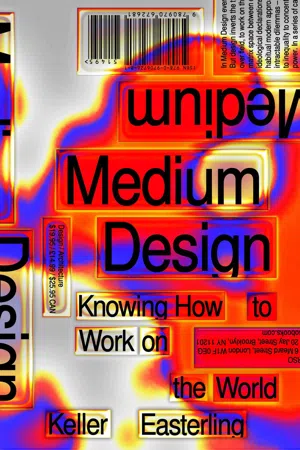
Everyone is a designer. But while many practitioners may be looking for solutions or ideological certainties, Easterling argues that solutions are mistakes and ideologies are unreliable markers. Instead, Medium Design speaks to anyone looking for alternative approaches to the world's unresponsive or intractable dilemmas-from climate cataclysm to inequality to concentrations of authoritarian power. Such an approach joins many disciplines in considering not only separate objects, ideas and events but also the space between them.
In case studies dealing with everything from automation and migration to explosive urban growth and atmospheric changes, Medium Design looks not to new innovations but rather to sophisticated relationships between emergent and incumbent technologies. It does not try to eliminate problems but put them together into productive combinations. And it offers forms of activism for modulating power and temperament in organization of all kinds
- 176 pages
- English
- ePUB (mobile friendly)
- Available on iOS & Android
eBook - ePub
About this book
Information
Topic
ArtSubtopic
Art & PoliticsNotes
Preface
1 François Jullien, The Propensity of Things: Toward a History of Efficacy in China (New York: Zone Books, 1995), 29.
2 Karen Barad, Meeting the Universe Halfway: Quantum Physics and the Entanglement of Matter and Meaning (Durham and London: Duke University Press, 2007).
Introduction
1 See climate.nasa.gov; noaa.gov/news-features; climatecentral.org/news/new-analysis-global-exposure-to-sea-level-rise-flooding-18066; climatecrocks.com.
2 Kendra Pierre-Louis, “Greenhouse Gas Emissions Accelerate like a ‘Speeding Freight Train’,” New York Times, December 5, 2018.
3 Keller Easterling, Extrastatecraft: The Power of Infrastructure Space (London: Verso, 2014).
4 See unhcr.org/en-us/figures-at-a-glance.html.
5 UN-Habitat, “Streets as Public Spaces and Drivers of Urban Prosperity” (Nairobi, United Nations Human Settlement Program, 2013), 22; Atlas of Urban Expansion (Cambridge, MA: Lincoln Institute of Land Policy, 2012), atlasofurbanexpansion.org.
6 See webtv.un.org/%C2%BB/watch/joan-clos-un-habitat-on-land-use-and-urban-expansion-press-conference/5013631178001.
7 Vilém Flusser, Towards a Philosophy of Photography, trans. Anthony Mathews (London: Reaktion Books, 2000), 3–4.
8 Francis Fukuyama, “The End of History?” The National Interest 16 (Summer 1989), 3–18.
9 Stanley Fish, Winning Arguments: What Works and Doesn’t Work in Politics, the Bedroom, the Courtroom, and the Classroom (New York: Harper Collins, 2016).
10 For another discussion of the concept of active form, see: Keller Easterling, Extrastatecraft: The Power of Infrastructure Space (New York: Verso, 2014).
11 Johan Galtung, “Violence, Peace, and Peace Research,” Journal of Peace Research 6, no. 2, 1969; Rob Nixon, Slow Violence and the Environmentalism of the Poor (Cambridge, MA: Harvard University Press, 2011).
12 Jacques Rancière, The Politics of Aesthetics (London: Continuum, 2004), 85.
Interlude One
1 “#KAEC King Abdullah Economic City 2015,” YouTube (January 19, 2015), youtube.com/watch?v=cjyn5BP38_4; “New City Lazika,” YouTube (January 16, 2013), youtube.com/watch?v=fKa3qgnZLpw; “Aras Free Zone,” YouTube (July 27, 2009), youtube.com/watch?v=P199kZcBAq0.
2 A video of North Korea on its special economic zones was uploaded to YouTube on May 30, 2015. The channel was later deleted as described in Solon, Olivia, “YouTube Shuts Down North Korean Propaganda Channels,” Guardian, September 9, 2017.
3 Coronavirus Task Force, Press Briefing Transcript, March 21, 2020, 50:41, rev.com/transcripteditor/shared/o4S5_
D20KKAy1hJuf1d8E3SugmZlTg_Se0YIsVJ4YOd9
F0ZtJqfWys1RNPrHuKEc78JfjwtJ9xYeGsu3
QSVck6iSsM?loadFrom=PastedDeeplink&ts=3041.81
D20KKAy1hJuf1d8E3SugmZlTg_Se0YIsVJ4YOd9
F0ZtJqfWys1RNPrHuKEc78JfjwtJ9xYeGsu3
QSVck6iSsM?loadFrom=PastedDeeplink&ts=3041.81
Chapter One
1 Gilbert Ryle, The Concept of Mind (Chicago: University of Chicago Press, 1949), 27–32.
2 Ryle, Concept of Mind, 25–61, 43; and Keller Easterling, Extrastate-craft: The Power of Infrastructure Space (New York: Verso, 2014).
3 Ryle, Concept of Mind, 33.
4 Michael Polanyi, The Tacit Dimension (Chicago: University of Chicago Press, 1966, 2009), 7, 4, 20, 78.
5 Polanyi, Tacit Dimension, 7, 4, 20, 78.
6 Referencing Michael Polanyi, Donald Schön, a philosopher and professor of urban planning at MIT, was a proponent of “tacit knowing” in design practices. Donald Schön, The Reflective Practitioner: How Professionals Think in Action (New York: Basic Books, 1983), 52; youtube.com/watch?v=Ld9QJcMiNMo.
7 Karl Polanyi, The Great Transformation: The Political and Economic Origins of Our Time (Boston: Beacon Press, 1944, 1957, 2001); Philip Mirowski and Dieter Plehwe, eds., The Road from Mont Pèlerin (Cambridge, MA: Harvard University Press), 21.
8 Michel Foucault, “The Confession of the Flesh,” a roundtable interview from 1977, in Power/Knowledge: Selected Interviews and Other Writings, 1972–1977, ed. Colin Gordon (New York: Vintage Books, 1980), 194, 197.
9 Foucault, “The Confession of the Flesh,” 194, 197.
10 Ibid.
11 Gilles Deleuze, “What Is Dispositif?” in Timothy Armstrong, trans., ed., Michel Foucault Philosopher (New York: Routledge, 1991), 162.
12 Giorgio Agamben, “What Is an Apparatus?” in “What is an Apparatus?” and Other Essays, (Redwood City, CA: Stanford University Press, 2009), 2–3, 7, 10, 14. Agamben uses the phrase “family of terms” in a related text: Giorgio Agamben, “What Is a Dispositor?” 2005, online lecture transcript by Jason Michael Adams, eclass.upatras.gr/modules/document/file.php/
ARCH213/Agamben%20Dispositor.pdf, accessed December 18, 2019, unpaginated.
ARCH213/Agamben%20Dispositor.pdf, accessed December 18, 2019, unpaginated.
13 Michel Foucault, “Governmentality,” in The Foucault Effect: Studies in Governmentality, edited by Graham Burchell, Colin Gordon, and Peter Miller (Chicago: University of Chicago Press, 1991), 92, 93. Foucault writes that governance is “essentially concerned with answering the question of how to introduce economy—that is to say, the correct manner of managing individuals, goods and wealth within the family (which a good father is expected to do in relation to his wife, children and servants) and of making the family fortunes prosper—how to introduce this meticulous attention of the father towards his family into the management of the state.”
14 Giorgio Agamben, “What Is an Apparatus?,” 14. Agamben translates as “network” [le réseau] the phrase “system of relations” that appears in the Power/Knowledge translation of “The Confession of the Flesh.”
15 J. J. Gibson, “The Theory of Affordances,” in The Ecological Approach to Visual Perception (London: L. Erlbaum, 1979), 127–41. The first book in which Gibson mentions the idea of affordance is J. J. Gibson, The Senses Considered as Perceptual Systems (London: Allen and Unwin, 1966).
16 Gibson, “The Theory of Affordances,” 134, 127, 128, 129.
17 One of the first uses of the word in relation to design appeared in Don Norman, The Design of Everyday Things (New York: Basic Books, 2013, revised and expanded edition). The book was first published in 1988 with the t...
Table of contents
- Cover Page
- Halftitle Page
- Title Page
- Copyright Page
- Contents
- Preface
- Introduction: Designing Is Entangling
- Interlude One
- Interlude Two
- Interlude Three
- Interlude Four
- Interlude Five
- Afterword: You Know How to Be Unreasonable
- Acknowledgements
- Notes
- Index
Trusted by 375,005 students
Access to over 1.5 million titles for a fair monthly price.
Study more efficiently using our study tools.
Frequently asked questions
Yes, you can cancel anytime from the Subscription tab in your account settings on the Perlego website. Your subscription will stay active until the end of your current billing period. Learn how to cancel your subscription
No, books cannot be downloaded as external files, such as PDFs, for use outside of Perlego. However, you can download books within the Perlego app for offline reading on mobile or tablet. Learn how to download books offline
Perlego offers two plans: Essential and Complete
- Essential is ideal for learners and professionals who enjoy exploring a wide range of subjects. Access the Essential Library with 800,000+ trusted titles and best-sellers across business, personal growth, and the humanities. Includes unlimited reading time and Standard Read Aloud voice.
- Complete: Perfect for advanced learners and researchers needing full, unrestricted access. Unlock 1.5M+ books across hundreds of subjects, including academic and specialized titles. The Complete Plan also includes advanced features like Premium Read Aloud and Research Assistant.
We are an online textbook subscription service, where you can get access to an entire online library for less than the price of a single book per month. With over 1.5 million books across 990+ topics, we’ve got you covered! Learn about our mission
Look out for the read-aloud symbol on your next book to see if you can listen to it. The read-aloud tool reads text aloud for you, highlighting the text as it is being read. You can pause it, speed it up and slow it down. Learn more about Read Aloud
Yes! You can use the Perlego app on both iOS and Android devices to read anytime, anywhere — even offline. Perfect for commutes or when you’re on the go.
Please note we cannot support devices running on iOS 13 and Android 7 or earlier. Learn more about using the app
Please note we cannot support devices running on iOS 13 and Android 7 or earlier. Learn more about using the app
Yes, you can access Medium Design by Keller Easterling in PDF and/or ePUB format, as well as other popular books in Art & Art & Politics. We have over 1.5 million books available in our catalogue for you to explore.