In 2003 Néstor Kirchner took power in a country still reeling from financial meltdown. He set out to reverse the extreme neo-liberal policies of the 1990s, and ruled through heady years of unprecedented economic growth. Néstor was one half of a political couple -- his wife Cristina Fernández de Kirchner won the race for the top job in 2007 and they swapped roles. In 2011 she was voted in for a second term with the highest support ever obtained in a presidential election. And yet in 2015 she was voted out on vague promises of 'change'. During the Kirchners' administrations inequality had fallen, per capita income had nearly doubled, the economy had grown as never before – so what did people want to change? Why did they vote for the first ever democratically elected right-wing government? How was society torn apart into two vitriolic and equal opposing halves? The legacy of Kirchnerism offers key lessons for progressive politics everywhere – and points to the challenges of taking on resurgent conservative forces in Argentina and around the world.
- English
- ePUB (mobile friendly)
- Available on iOS & Android
eBook - ePub
Argentina under the Kirchners
About this book
Information
Subtopic
Global Development StudiesIndex
Social SciencesCHAPTER THREE
Cristina Fernández de Kirchner, CFK (2007-2015) Advances and conflicts
The Kirchners were a team: a formidable political duo that worked closely together. They had few peers and decisions were taken around what was popularly known as a ‘small table’, with carefully-chosen advisers. When Néstor announced that he was not standing for re-election in 2007 and Cristina was standing instead, there was little surprise and a promise of continuity. In the end, in spite of the popularity of Néstor and his government’s policies, it was a hard-fought election. CFK won the election in the first round with 45 per cent of the vote, but the opposition was split and the next two candidates between them polled 40 per cent of the vote.1
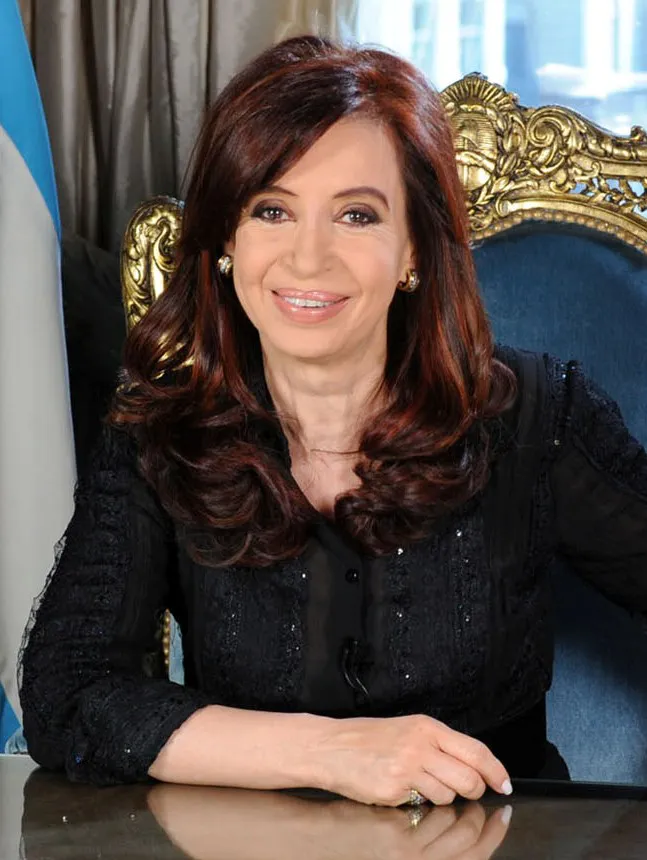
Cristina Fernández de Kirchner
Victor Bugge. Creative Commons Attribution 2.0 Generic
The continuity of policies was assured by the number of the ministers she re-appointed from the previous mandate. Carlos Tomada remained in charge of the Ministry of Work; Néstor’s sister Alicia Kirchner remained at the head of the Social Development Ministry; Julio de Vido remained in charge of infrastructure at the Ministry for National Planning. Yet although many of the same advisers remained and Néstor himself was still heavily involved in decisions, CFK marked a change of style in wielding power.
CFK’s approach to establishing her position was to be bold and explicit about her opinions. She became known for long, improvised speeches made to the nation on state-controlled media, in which she set out her policies. International profiles tended to describe her as the ‘wife of’ President Néstor Kirchner, but they overlooked the fact that her political career went back as far as his; that she had been elected to both houses of Congress in the 1990s and that politics had been her life since her student days. She may have been voted into the presidency in 2007 to succeed her husband as part of a political couple, but her re-election in 2011, following his death, proved that the electorate responded to her leadership.
Her inaugural speech in 2007 contained two memorable narratives: the first was that she was the product of the free state education system. This took her from a working class family in La Plata to a law degree and on to the highest office in the land. She made pointed references to being the first woman elected to the highest political office in Argentina, and seemed to assume that she would meet more resistance to her authority. That was the second strand of her speech, that she would put all her effort into the job, particularly because ‘everything will be harder for me because I’m a woman’. This last became the headline in the newspapers the following day. It was an acknowledgement that society was not used to women in authority and that her ability and her judgement would be more closely questioned than a man’s. She clearly meant this as a challenge rather than a passive acknowledgement. She was comfortable highlighting her sex when she announced that she wanted to be known as ‘la presidenta’, which is grammatically unnecessary. At first the debate inspired by her title and who used ‘la presidente’ o ‘la presidenta’ provided a map of who supported and who opposed her. Yet over time she won that battle: she was increasingly only known as ‘la presidenta’.
Her power base in 2007 was a solid one. Both Néstor and Cristina had worked hard between 2005 and 2008 to consolidate their position. They had working majorities in Congress; Néstor was now leading the Peronist party, the PJ, making best use of its local reach; provincial governors and local governments were aligned with their leadership; the unified trade union confederation was a partner in annual negotiations; social organizations felt listened to and human rights organizations continued to lend the highest moral standing to the government. The media was generally positive about policies carried out under Néstor’s mandate and welcomed Cristina’s as a continuation of efforts that had seen unparalleled economic growth, a reduction in debt for the first time in decades, and a widespread feeling of progress and optimism.
Taxing times
Néstor Kirchner had inherited emergency taxation measures from Duhalde, and retained them: a tax on all bank transactions, for example, and export taxes on the lucrative agribusiness products that constitute Argentina’s main exports, such as soya. In parallel, the push to create jobs in the formal economy translated into more income from taxes and social security, thus expanding the tax base. In a country where tax evasion at all levels of society is taken for granted, the increase was unprecedented. The poor pay consumer taxes but are less likely to pay social security or tax from commercial transactions, as cash is the norm in their daily transactions; whereas the rich, and this includes much of the upper middle class, have perfected multiple ways to keep their money outside of Argentina.
In 2008, CFK’s new economy minister proposed a sliding scale system of taxes on grain exports, including soya. This would increase the rate of tax from 33 to 44 per cent depending on international prices. In 2012 Argentina was the world’s fifth largest producer of soya, yet accounted for half of all world exports. Not surprisingly, these exports constituted a large proportion of Argentina’s revenues. Some economists went so far as to explain the success of Kirchner’s administration as ‘export-oriented populism’, the first successful combination of boosting exports and investing the returns in the urban poor.2 This was politically possible because the main export, soya, had no significant internal market. In the past, Argentina’s main exports, wheat and beef, had also been consumed inside the country, so that international prices affected internal supply and set up a conflict between internal consumption prices and international profits.
CFK expected resistance to paying more tax from the producers, but the fact that she might encounter difficulties rarely stopped her from taking unpopular decisions. However, she was not expecting the drawn-out conflict that mobilized thousands of people in 2008 and led to the defeat of her proposals in Congress. In the process, the best selling newspaper in the country, Clarín, went from supporting the Kirchners to becoming their strongest and most vocal opposition. It was the beginning of an enmity that would grow in intensity and vitriol on both sides.
Clarín, the power of the word
Héctor Magnetto, the visible face of Clarín media holdings, is infamous for having told President Carlos Menem that his public office was only the second most important job in the land, or put in other words, he reminded everyone that, ‘Governments come and go, but Clarín remains.’ Clarín is powerful because it has the largest circulation of any paper in the country, but also because it is much more than that: it controls radio stations and TV channels, internet access and for decades it controlled newsreel production. The paper’s front cover is only the tip of an enormous media iceberg.
Magnetto’s relationship with the Kirchners went through two very different stages. Between 2003 and 2007, cordiality reigned. Clarín’s front pages endorsed government actions and opinion pieces were broadly positive. Favour was a two way street; in 2005 Néstor Kirchner passed a decree giving the media group automatic renewal of licenses for TV, radio and cable. They were also the recipient of between 15 and 23 per cent of official advertising revenue from the government across different media. In 2007 Kirchner approved another decree allowing the Clarín group to become the largest provider of cable TV, with 58 per cent of viewers. The relationship was felt to be mutually useful.
But Magnetto’s historic threat that ‘no government can stand three negative Clarín covers’ was always there in the background. During the 2008 rural lockout, Clarín began to be more critical of the government and the relationship began to sour. During CFK’s first year in power they still received the greatest share of official publicity: over 50 million pesos. But after 2008 it dropped to minimal amounts and CFK was less accommodating and more confrontational. In 2009, when disputes arose between the Argentinian Football Association and the cable companies, CFK took the opportunity to involve the state in televising football, known as Futbol para Todos (Football for Everyone), depriving the Clarín group of significant income. But the real battle ground was a new Media Law, passed in 2009 (see Box p.75) which aimed to democratize access to the media and was felt to be a significant threat to Clarín’s hegemony.
Clarín’s response was not half-hearted. They ran not three negative covers but over 80 during the campaign for CFK’s re-election in 2011. Magnetto also brought together other powerful business leaders to unite against the government3. CFK proved Magnetto wrong, winning the election in the first round, with the largest proportion of the vote ever recorded, 54 per cent. The battle lines were drawn and Magnetto reverted to the long game – negative coverage of CFK and the government continued throughout her second term and became more strident as time went on.
For the first time since 2003 there were protests against the government on the streets. Landowners affected by the tax proceeded to organize a lockout - a producers’ strike with road blockades that lasted four months. It was surprising that a sector that involved relatively few people – landholdings in Argentina are immense, and mainly worked with machinery, rather than people – could mobilize people in the cities. Many middle class protesters had no stake in agribusiness. What brought them out onto the streets? Their grievances revolved around the high-handed way in which the measure had been announced and a growing resentment at being told what was good for them. CFK’s forceful insistance that she was right played into the hands of Clarín who portrayed her as authoritarian. The way of she communicated became a growing focus for discontent, immediately revealing how different reactions were to strong leadership from a woman.
The way the new taxes were communicated to the public was confrontational and the government’s response to the protests showed no concern for explaining the redistributive potential of the proposal. One of the practical problems of the proposed legislation was that it lumped together large and small producers. CFK said she was aiming to tax the extraordinary profits being generated by high commodity prices for an agribusiness sector that worked as a financial market offering enormous returns. It was hard to disagree with that. Yet in her heated defence of the measure, CFK referred to the whole sector as one - the draft law also sought to restrict the export of beef and grains in order to maintain supplies for the internal market and keep prices from rising, a measure affecting smaller producers. By lumping them together, the government ignited the ire of smaller producers, who in turn mobilized urban dwellers. Trying to create a measure for the whole agricultural sector and attacking them as one for being more concered with extraordinary profit rather than paying taxes turned out to be the wrong political line in the sand for the government. Clarín’s newly critical front pages calling CFK authoritarian also explained some of the urban discontent.
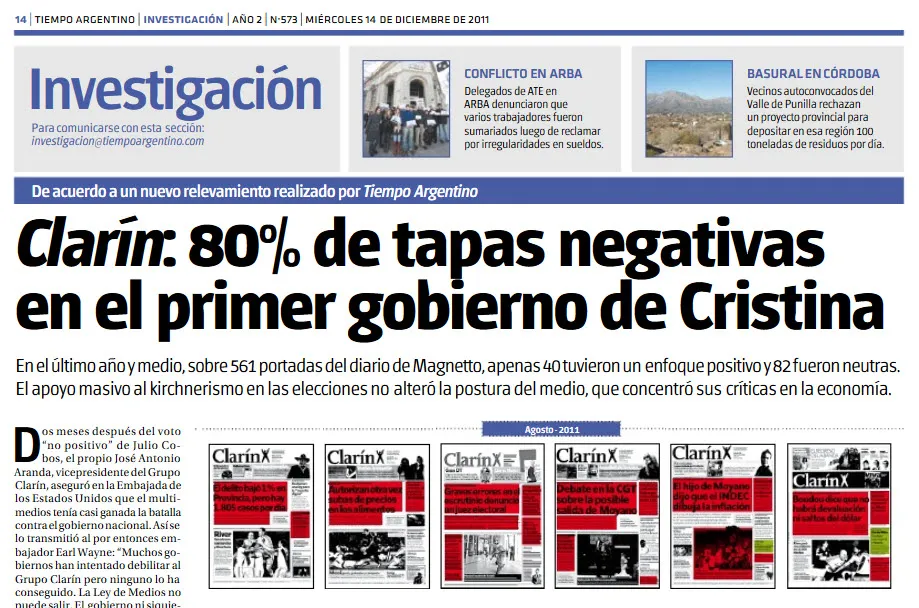
Research by the magazine Tiempo Argentina showed that 80 per cent of the front-pages of the newspaper Clarín were hostile to Cristina Kirchner during her first government.
Screenshot taken from report published by Tiempo Argentino. https://www.scribd.com/doc/75702519/clarin-80
A dividing line could be seen across society, which over time became a gap and then an abyss, leaving no middle ground. In 2013, a journalist who was critical of CFK’s government termed it ‘la grieta’, the break or crack, a split in society that became ever deeper, while a silent majority watched it worsen.4 Public debate became increasingly polarized, lacking any nuance or measure. Those who complained of the president’s high-handedness were vociferous in their personal attacks on her. The press, which during Néstor Kirchner’s tenure had been cautiously positive, at this point became part of the opposition.
CFK inherited Néstor Kirchner’s ‘us and them’ approach to politics, identifying the enemy as the traditional economic interests in the country. Even though soya profits were mediated by financial speculation and short-term investments, the owners of the land remained a small landowning elite, little changed since in a century. In Argentina land had been given in large ‘gifts’ to those who cleared it of indigenous people through military campaigns in the nineteenth century, or otherwise provided political service. This concentration of land ownership was never reformed. In theory, it should have been easy to convince the majority of the population to tax a tiny, wealthy minority, so the support the landowners were able to mobilize was an early sign of the problems created by the language of confrontation and measures designed with no public consultation and presented as a fait accompli.
The vote in Congress came after months of protests. Support and opposition to the project began to define the political landscape that would shape CFK’s time in office. ‘Resolution 125’ as it was known, was finally defeated in Congress by one vote. The deciding vote against was cast last, by CFK’s vice-president, a politician from the Unión Cívica Radical, Julio Cobos. It made for gripping TV, as the country’s political fracture lines were revealed in real time. Cobos had been asked to be her vice president in a bid to garner the non-Peronist vote. When he said ‘my vote is not positive’ he delivered a shock. In a country were loyalty is paramount it made him a political pariah.
The defeat of Resolution 125, the enmity of the most lucrative economic sector, criticism in the media, and the mobilization of sectors of society rarely moved to protest on the streets...
Table of contents
- Cover
- Title Page
- Copyright
- Contents
- Introduction: Populism, Peronism and the rift
- Néstor Kirchner (2003-2007): A new kind of Peronist
- Cristina Fernández de Kirchner, CFK (2007-2015): Advances and conflicts
- Afterword: End of an era
Trusted by 375,005 students
Access to over 1.5 million titles for a fair monthly price.
Study more efficiently using our study tools.
Frequently asked questions
Yes, you can cancel anytime from the Subscription tab in your account settings on the Perlego website. Your subscription will stay active until the end of your current billing period. Learn how to cancel your subscription
No, books cannot be downloaded as external files, such as PDFs, for use outside of Perlego. However, you can download books within the Perlego app for offline reading on mobile or tablet. Learn how to download books offline
Perlego offers two plans: Essential and Complete
- Essential is ideal for learners and professionals who enjoy exploring a wide range of subjects. Access the Essential Library with 800,000+ trusted titles and best-sellers across business, personal growth, and the humanities. Includes unlimited reading time and Standard Read Aloud voice.
- Complete: Perfect for advanced learners and researchers needing full, unrestricted access. Unlock 1.5M+ books across hundreds of subjects, including academic and specialized titles. The Complete Plan also includes advanced features like Premium Read Aloud and Research Assistant.
We are an online textbook subscription service, where you can get access to an entire online library for less than the price of a single book per month. With over 1.5 million books across 990+ topics, we’ve got you covered! Learn about our mission
Look out for the read-aloud symbol on your next book to see if you can listen to it. The read-aloud tool reads text aloud for you, highlighting the text as it is being read. You can pause it, speed it up and slow it down. Learn more about Read Aloud
Yes! You can use the Perlego app on both iOS and Android devices to read anytime, anywhere — even offline. Perfect for commutes or when you’re on the go.
Please note we cannot support devices running on iOS 13 and Android 7 or earlier. Learn more about using the app
Please note we cannot support devices running on iOS 13 and Android 7 or earlier. Learn more about using the app
Yes, you can access Argentina under the Kirchners by Marcela Lopez Levy in PDF and/or ePUB format, as well as other popular books in Social Sciences & Global Development Studies. We have over 1.5 million books available in our catalogue for you to explore.