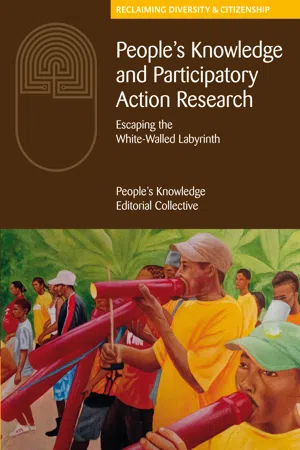
The world of research run by universities and other institutions is dominated by a culture that is white, upper-middle class and male. When people from communities that have previously been excluded are asked to take part in research – even participative research -- they are seldom able to do so on equal terms. Instead of being supported to draw on the expertise that they have gained from their life experience, they find themselves trapped in a 'white-walled labyrinth'.People's Knowledge and Participatory Action Research opens up a new realm of understanding, one that has been created by authors who are mainly non-academics, and who bring their own perspectives on the production and validation of knowledge. The book attempts to address some of the tensions between traditional and more participatory approaches to research by exploring three questions: What kinds of oppression can take place when people who experience exclusion work with professional researchers? How can knowledge be truly co-produced in a spirit of mutual learning and respect? What are the most promising approaches to build future alliances for creating a 'people's knowledge' that treats equally the professional researcher and those whose expertise comes from their life experience?The book ends with some signposts for transforming participatory and action-orientated approaches to research in order to achieve social and environmental justice.This book should be read by all those interested in research for social and environmental justice in general, and participatory and action approaches to research in particular, including in the fields of: community development; health and medicine; international development; education; local and national government; anti-racism; human rights; women's studies; citizen science; and community arts. The Reclaiming Diversity and Citizenship Series seeks to encourage debate outside mainstream policy and conceptual frameworks on the future of food, farming, land use and human well-being. The opportunities and constraints to regenerating local food systems and economies based on social and ecological diversity, justice, human rights, inclusive democracy, and active forms of citizenship are explored in this book series. Contributors to the Reclaiming Diversity and Citizenship Series are encouraged to reflect deeply on their ways of working and outcomes of their research, highlighting implications for policy, knowledge, organizations, and practice.
eBook - ePub
People's Knowledge and Participatory Action Research
- English
- ePUB (mobile friendly)
- Available on iOS & Android
eBook - ePub
People's Knowledge and Participatory Action Research
About this book
Information
CHAPTER 1
Learning at the University of Armageddon
Abstract
Who documents the difficulties and obstacles encountered when non-academics collaborate with academics in the pursuit of social justice? This chapter is a compilation of responses to an open call for people to submit, anonymously, stories of negative experiences of working with universities. People from diverse backgrounds, including grassroots activists, researchers, and a funding officer, briefly documented their experiences, and the chapter reflects on and aims to learn from their responses to the call.
Keywords: co-production, collaborative research, tokenism, social justice, research council
Introduction
There was no golden age of universities, at least in the UK. The silencing of voices that speak against the mainstream began long before the last decade when universities embraced neoliberalism. Prime Minister Harold Wilson established a new wave of higher education institutions in the 1960s. It saw a dozen new universities set up across the country that were meant to foster radical thinking and promote social justice. But those put in charge of many of these institutions often could not stand critical thinkers, for fear that they might stir up trouble. Those who taught in the traditions of Paulo Freire, or who sympathized with those who did, were sometimes quietly removed from their positions.
University managements have been accused of eroding the freedom of their researchers, as most academics are coerced into publishing in highly specialized publications that often filter out elements – if there were any present – that might help people take action on issues of injustice. Less widely known is the paradox whereby many universities are using the language of public engagement, community participation, and collaborative inquiry for the public good, whilst at the same time preventing schemes that might allow research to take place inclusively. This happens at the same time as researchers feel under increasing pressure to publish only ‘successful’ research, whereas in the real world everyone knows that we learn much more from mistakes than triumphs. Combined with the pressure to produce ‘results’ – and on a timescale that does not allow good relationships to develop between researchers in academic institutions and those who work outside their walls – these tendencies risk making the barriers between these groups insurmountable.
This chapter is a compilation of responses to an open call, as part of the UK Arts and Humanities Research Council’s Connected Communities programme, for people to submit, anonymously, stories of negative experiences to a fictional institution named the University of Armageddon. Our aim is to reflect on and learn from the eight vignettes that resulted from this call. People from diverse backgrounds, including grassroots activists, participatory (and non-participatory) researchers, and even funders, wrote the following short accounts of their experiences. Some names have been changed.
Not refugee enough
Inspired by the experience of attending a research council symposium, we jumped at the opportunity to submit an abstract to an international conference held by Oxford University’s Refugee Studies Centre entitled Refugee Voices. This conference promised to take a new perspective on refugee issues, giving voice to the real lived experiences of people with refugee backgrounds. We found it refreshing to hear about a conference that was concerned with the voices of people from refugee communities as well as the voices of academic researchers. This resonated deeply with us as, in our experience, young people from refugee backgrounds are always expected to be the subject of research rather than the authors of their own knowledge.
We submitted an abstract which focused on exploring power, representation, and voice, looking at: the extent to which the voices of individuals/groups of people who are from refugee communities are being heard in the academic world; to what degree these communities have control of how they are defined and represented; and the analysis of their experiences.
We were delighted that our abstract was selected for presentation at the conference, but were unable to attend because we were expected to pay a fee to do so. The negotiations with Oxford University that ensued were frustrating. They failed to recognize the importance of our collective research approach, and were only interested in one ‘author’ coming to present. Eventually, the University conceded and said that we could attend just to present our own workshop, but could not go to the rest of the conference. We initially agreed to this, but later declined when they started making intrusive demands about people’s immigration status and identification documents. We felt that they had missed the point of our contribution entirely, which was all about how important it is not to define people by their immigration status, and how being a refugee is an experience – and not necessarily an identity people want displayed in public. The experience highlighted for us the difficulty of trying to engage with an academic world which is very closed and exclusive.
Collaborative research for social injustice
One day, a group of academics started circulating an invitation to other professionally trained researchers as well as to people whose expertise came from practical experience as researchers and activists in their communities. Would they like to write something about what it was like when communities tried to generate knowledge alongside academics? They were asked to write a short summary – the so-called abstract. If this were accepted they would be paid a modest fee to write 2,000 words, and be invited to a workshop at which they would meet academic researchers. Together they would write a book, which would be available for free.
Jan was a retired community-based worker on social justice issues. They had built up considerable knowledge of a particular local area. In these streets, and in the city more generally, they were respected by the whole community, even by those with whom they had been in dispute over the years. They refereed for a local football team as a way of bringing excluded local youth together. An excellent writer, they submitted an abstract and it was accepted. They then wrote the longer article for the book and turned up with anticipation to the event, held at a country hotel.
The workshop included eight people from community and activist backgrounds and 20 academics. The organiser had never hosted such a mixed group before. As soon as the workshop got underway it was clear that the academic style of discussion was going to dominate. Even the ‘getting-to-know-you’ game involved a competitive element, as to who had brought the most interesting object to represent their work.
Despite most of the professional academic participants having had little or no experience of working on equal terms with collaborators whose expertise came from practical experience, they were paired up with them to discuss their respective papers. The common theme of the book was meant to be ‘co-production of knowledge for social justice’, but the way people interpreted this brief was left to them.
From debriefing with them afterwards, the community-based experts-through-experience did not, as a rule, feel valued by this process. Their experiential knowledge was often viewed as mere anecdote. Their lack of background in academic theory meant they lacked the vocabulary and conceptual tools to discuss the work in a way the academics found interesting. Their practical expertise in undertaking community-based research was ignored or even denigrated.
At one point the workshop leader suggested that everyone should think about their contribution in terms of how it related to ‘theories of change’. It came across as implying that activists don’t think, they just act. Yet Jan had demonstrated that they, along with the members of the civil rights movement in which he was immersed, did have a theory of change, as they had used one to achieve some of their desires for change. Another participant was an action researcher involved in regional social movements in Latin America.
The academics present gained esteem from attending the event, particularly as it was sponsored by a research council. They used the event for networking with each other, scoping out future collaborations and discussing new grant proposals. Lacking a professional status or institution, non-academics were not in a position to use the meeting for these purposes.
Community-based experts had come on the understanding that the meeting was a necessary stage in a process that would lead to their contribution being published in a book – one that would be of interest to community activists and other non-academics involved in grassroots-led research projects. Yet, as the meeting came to a close and discussion turned to the event’s outputs, it became clear that this original objective had been jettisoned. Jan took part in a final plenary session, during which they were involved in the following exchange with two of the event’s academic organizers, Dan and Bobby.
Jan: ‘I have not understood most of the discussion here. Lots of long academic words have been used that mean nothing to me. I understood that we were here to get a book produced. Is that still the plan?’
Dan: [ignoring Jan] ‘I think it’s becoming clear that there is interest in producing a book as a guide on how to do co-produced research – a guide for the next generation of researchers.’
Bobby: ‘By this I hope we mean a guide aimed at being useful to the whole of the next generation of researchers, not just PhD students. Otherwise, where is the social justice?’
Dan: ‘C’mon, Bobby – get real!’
In subsequent discussion and emails following the workshop Dan made clear that the audience for the book would be early-career academics: PhD students and others working at the postgraduate level. It would be published by a traditional academic publisher and would not be free. None of the community-based researchers or activists were approached about having their contributions included, nor were they involved in the editing process. To the best of our knowledge, no non-academics were involved in the publication process. Yet everything that took place at the meeting was undertaken using public money, on the basis that community-based researchers and academics were going to collaborate together.
Stories from a funder’s perspective
I worked at a senior level for one of the top three largest providers of grants of social research in the UK for many years. On a different day I might theme these stories slightly differently. There’s an infinite way of cutting the cake, but the essential tastes and ingredients are there. These are my experiences. Different funders or managers might have different experiences … and some of them are as much a problem as problematic academics.
Cheerleaders
As a funder, I saw many partnership proposals coming in from academics and communities/users. After a number of mistakes we learned how to spot the fake ones, for example: the proposal didn’t provide a name and address for the community contact; there was no money set aside to pay a consultancy fee for individuals who were based in communities and could not be expected to work for free; the academics confused focus groups with real involvement; the community only had the lowly tasks of interviewing – they were not involved from the start and would not be involved in the conclusions/recommendations.
The token individual
Sometimes our projects would have one disabled person, an older person, and someone from a black and minority ethnic (BME) perspective on the team. Sometimes as the funder we tried to encourage an academic proposing the project to add this into their proposal. This was usually a mistake, because if the academic didn’t propose it from the start themselves, then they would probably not take it seriously. Often, these token individuals were only appointed after the project had been funded. In most cases, either the token individual ran the risk of being isolated within the team, or their own individual voice became too strong – there was no support for their role in linking back to the community in a way that would allow them to represent perspectives other than their own.
Numbers, power, plans, and meetings
Usually if the academic team says ‘thanks so much for your contributions, now we’ll go away and make sense of it’, you can detect the exact moment when partnership fails. Unless meaning and leadership are negotiated throughout the whole process, then it’s fake. There are generally indicators of where the power lies in a research project: the balance of numbers in the room between the researcher and the participants; the involvement of users/communities in setting aims and in planning; the number and nature of meetings. Participation with users/communities is almost always about contested knowledge and contested power. If there isn’t an argument – or at least a frank dialogue – about these issues, then that usually means that someone’s voice is not being heard.
The ‘so what’?
BME older people told us that academics were still asking the same questions they had asked 20 years ago. The answer to these questions, very often, was ‘so what?’ They were the wrong questions then and they were the wrong questions now. For the academics the partnership was all about producing peer-reviewed articles and journals – but the older people wanted something different. They wanted to see results that the community valued, not simply what academics wanted. People with learning difficulties in a particular town in the English Midlands said that some academic work could be quite useful, but for the most part it didn’t really relate to their lives and the changes they wanted to see.
The funder
The funder is often the hidden partner and the hidden power. The funder’s priorities often don’t reflect what communities actually want, but communities (and their academic allies at times) try to bend their needs to fit in with the funder’s priorities. This can be a bad strategy in that it brings funding, but takes away energy and purpose. A group of black women said that, from their own experience, if the funder couldn’t adapt to meet their issues then they’d rather not have the money. A group of people with learning difficulties in Lancashire accepted the offer of seed-fund support, but only on condition that they could interview the consultants first.
A user view
There’s a brilliant presentation from Jackie Downer (MBE, a campaigner for people with lea...
Table of contents
- Cover
- Title Page
- Copyright
- Contents
- List of illustrations
- Dedication
- About the People’s Knowledge Editorial Collective
- Acknowledgements
- Introduction
- 1. Learning at the University of Armageddon
- 2. Making connections in the ‘white-walled labyrinth’
- 3. Examining our differences
- 4. Cultivating an anti-racist position in post-race society
- 5. Poems
- 6. A puzzling search for authenticity within academia
- 7. Community media and cultural politics on Tyneside
- 8. A civil rights activist reflects on research
- 9. LIVErNORTH: combining individual and collective patient knowledge
- 10. The original citizen scientists
- 11. Signposts for people’s knowledge
- Glossary
Trusted by 375,005 students
Access to over 1.5 million titles for a fair monthly price.
Study more efficiently using our study tools.
Frequently asked questions
Yes, you can cancel anytime from the Subscription tab in your account settings on the Perlego website. Your subscription will stay active until the end of your current billing period. Learn how to cancel your subscription
No, books cannot be downloaded as external files, such as PDFs, for use outside of Perlego. However, you can download books within the Perlego app for offline reading on mobile or tablet. Learn how to download books offline
Perlego offers two plans: Essential and Complete
- Essential is ideal for learners and professionals who enjoy exploring a wide range of subjects. Access the Essential Library with 800,000+ trusted titles and best-sellers across business, personal growth, and the humanities. Includes unlimited reading time and Standard Read Aloud voice.
- Complete: Perfect for advanced learners and researchers needing full, unrestricted access. Unlock 1.5M+ books across hundreds of subjects, including academic and specialized titles. The Complete Plan also includes advanced features like Premium Read Aloud and Research Assistant.
We are an online textbook subscription service, where you can get access to an entire online library for less than the price of a single book per month. With over 1.5 million books across 990+ topics, we’ve got you covered! Learn about our mission
Look out for the read-aloud symbol on your next book to see if you can listen to it. The read-aloud tool reads text aloud for you, highlighting the text as it is being read. You can pause it, speed it up and slow it down. Learn more about Read Aloud
Yes! You can use the Perlego app on both iOS and Android devices to read anytime, anywhere — even offline. Perfect for commutes or when you’re on the go.
Please note we cannot support devices running on iOS 13 and Android 7 or earlier. Learn more about using the app
Please note we cannot support devices running on iOS 13 and Android 7 or earlier. Learn more about using the app
Yes, you can access People's Knowledge and Participatory Action Research by The People's Knowledge Editorial Collective in PDF and/or ePUB format, as well as other popular books in Social Sciences & Global Development Studies. We have over 1.5 million books available in our catalogue for you to explore.