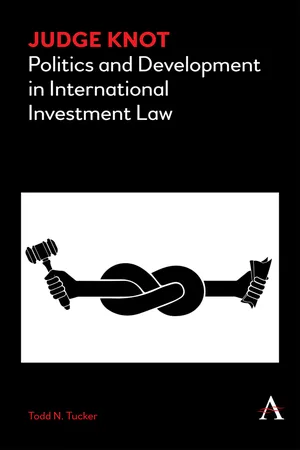
'Judge Knot' explores the biggest and the most controversial success story in international law: investor-state dispute settlement, or ISDS. Since 1990, investors have launched hundreds of claims against government regulation. This exclusive inside look explains what makes the system tick: its poorly understood centuries-old origins, why corporations demand investment law solutions to political problems, how arbitrators supply these solutions, and why the system lasts despite the many politicians and citizens unhappy with it. Building off of an unprecedented set of interviews with the arbitrators who actually decide the cases, 'Judge Knot' brings together the best of political science, law and development economics scholarship and offers a concrete alternative to ISDS that leverages what works about the system and discards what does not, so that international law can be more supportive of democracy and development goals.
eBook - ePub
Judge Knot - Politics and Development in International Investment Law
Politics and Development in International Investment Law
- 226 pages
- English
- ePUB (mobile friendly)
- Available on iOS & Android
eBook - ePub
Judge Knot - Politics and Development in International Investment Law
Politics and Development in International Investment Law
About this book
Information
Chapter One
ENTERING THE JUDGE KNOT
A company was able to sue a country over a public health measure through an international court. How the fuck is that possible? […] You’ve got to give it to them. That’s impressive. Someone should really give those lawyers a pat on the back. And, a punch in the face. But […] a pat on the back first. Pat, then punch. Pat, punch. They need a pat, punch. Little pat, big punch. That’s what they need.
—Comedian John Oliver (2015)
All Tangled Up
Did you hear the one about the billionaire, the nun and the lawyers? It is not a joke, but a story that reveals the enormous complexities of our international system for governing cross-border investment. The tale will take us from Manhattan to Missouri, from the Cayman Islands to Peru and back to the United States, showing us how any local investment dispute has the potential to go global.
Meet Ira Rennert. Once banned from the US securities brokerage business for taking excessive risks with his clients’ money, the American financier went on to become one of the country’s foremost buyers of distressed businesses. From smelters in Missouri to coal-pulverizing plants in Kentucky to magnesium pits in Utah, Rennert had an eye for finding floundering businesses and buying them up at bargain-basement prices. He financed the deals through junk bonds—loans in the newly acquired company’s name (Thornton 2003). This brought cash in the door quickly but saddled the companies he acquired with heavy debt burdens for years to come. Rennert would gradually strip down and sell these companies’ useable assets. Sooner or later, these businesses’ stock prices would plummet or they would go into bankruptcy, and Rennert would jump ship and move onto the next deal (Elstein 2011; Shinkle and Lambrecht 2002).
His business acumen made him fabulously wealthy. According to Forbes Magazine (2017), he is worth more than $4 billion, making him one of the richest men in the world. His house in the Hamptons on Long Island is the largest private residence in the United States, valued at $500 million and taking up more than 100,000 square feet. The mansion boasts a dining room table the length of a baseball diamond, 21 bedrooms, and a Broadway-size theater (Crowe 2015). He gives generously to Jewish charities and Republican political candidates but avoids media attention and rarely gives interviews (Hiles 2007). From his vast influence, to his thick wallet, he is the perfect representative of the 0.01 percent upper crust of American society.
Few towns in America have experienced the good and bad of Ira Rennert like Herculaneum, Missouri, located 30 miles south of downtown Saint Louis. In the 1870s, the St. Joseph Lead Company began drilling for minerals in the area and gradually grew into a major regional smelting operation. The company was renamed Doe Run in the 1980s and acquired by Rennert’s holding company in 1994 (Doe Run 2017). The smokestack is the most prominent sight in this company town, taller than even the Washington Monument. The massive structure casts a shadow over Main Street and Herculaneum High School, known for the Black Cats football team. Most of the city’s 3,500 residents either worked at the smelter or knew someone who did before Rennert acquired the company and eventually shuttered it.
Doe Run gave to Herculaneum, but it also took away—before and after the acquisition. The company’s operations came at a huge cost to the local environment. Smelting produces substantial lead pollution, which can severely impair children’s mental and physical development. In 2001, a few years after Rennert purchased Doe Run, pollution had reached emergency levels. The US government considers 1,200 parts per million of lead in the air to require urgent remediation, dropping much lower if the area has residences with small children. Some parts of Herculaneum had lead levels of 300,000 parts per million—well over the urgency level. This environmental crisis forced the company to reach deep into its wallet and buy outright most of the uninhabitable homes that fell within a half mile radius of the smelter. Eventually, Doe Run would be forced to pay tens of millions of dollars to Missouri workers who claimed health damages (Thorsen 2014).
For years, Doe Run was hit with one government sanction after another. Herculaneum was declared a federal Superfund site, which gives the government special powers to push for companies to clean up communities on an expedited basis. On top of this, the Environmental Protection Agency (EPA) accused the company of violating the Clean Air Act, Clean Water Act and Missouri state law—charges that Doe Run settled for millions of dollars in fines (Nelson 2010). Finally, in 2010, rather than install pollution-control technologies demanded by the EPA, Rennert closed Doe Run. It was the last major lead smelter in the United States (Worstall 2013), and its shuttering delivered a major economic blow to a region that had long suffered the flight of industry and crippling job losses.
An almost identical showdown was happening more than 3,400 miles away at another Rennert company. In 1997, he bought up a privatized metal smelter in La Oroya, Peru. This town of 33,000 people, nestled in the highlands of the Andes mountains, is a four-and-a-half hours’ drive northeast from the coastal capital of Lima. Founded by Spanish miners in the 1500s, the town’s development trajectory began in earnest with the 1893 construction of the Lima–La Oroya railway. For nearly 100 years, this was the world’s highest standard gauge railway.
Rennert had purchased La Oroya’s smelter through a Cayman Islands shell company, which in turn was owned by a New York holding company, which in turn was owned by a Missouri company, which in turn was owned by The Renco Group, Inc., Rennert’s personal holding company in New York (Doe Run 1998). Despite this opaque financial ownership web, he renamed the Peruvian smelter after his business back in Herculaneum: Doe Run Peru.
Like Herculaneum, La Oroya’s economy is almost totally dependent on smelting jobs, with a giant smelter visible throughout the town. Like Herculaneum, La Oroya’s environment is also badly damaged. The town was named one of the Top 10 worst polluted sites on Earth—right alongside the nuclear disaster site Chernobyl in Ukraine. In 1999, Peru’s health ministry found that 99.1 percent of La Oroyan children had lead poisoning, with 20 percent in need of urgent medical attention. An in-depth scientific study from 2002 by the Inter-American Association for Environmental Defense noted several disturbing trends at La Oroya (Cederstav and Barandiaran 2002):
•Sulfur dioxide concentrations that exceeded World Health Organization (WHO) recommended limits by a factor of two or three on average, and by a factor of ten during the morning work hours. Sulfur dioxide “damages the respiratory system, aggravates existing respiratory illnesses (especially bronchitis), and diminishes the capacity of the lungs to expel foreign particles such as heavy metals,” the report read. “It leads to a higher mortality rate, particularly when combined with the presence of elevated levels of particulate material.” The study found that sulfur dioxide levels doubled in the years after Rennert’s acquisition of the complex.
•Cadmium levels that exceeded WHO recommendations by as much as 40 times, which risks damage to the lungs, kidneys and digestive tract.
•Levels of arsenic, which has been associated with various types of cancer and reproductive problems, were many times greater than developed-country cities.
•Levels of lead above WHO standards, which can cause convulsions, comas, brain death, learning and behavioral disorders, memory loss, nausea, anemia, hearing loss, fatigue, colic, hypertension and myalgia.
Word of these horrors started making their way back to Missouri. Fernando Serrano, an Ecuadorian-born scientist, was conducting his doctoral work at Jesuit-affiliated Saint Louis University. One day, he received a call from a Presbyterian church group in Herculaneum that wanted him to hear missionaries’ stories of Doe Run’s impact on La Oroya. His academic focus was on the long-term effects of lead poisoning. He saw in the Peruvian saga an opportunity to both do good and do good research. Armed with a grant from the university’s graduate program, he took a small team of scientists to La Oroya, where they confirmed many of the conclusions of the nonprofit group’s earlier study. It was not an easy trip. La Oroyans feared the effects of lead poisoning, but they feared job losses from a publicity-driven smelter shutdown even more. A mob tried to prevent Serrano and his team from collecting soil samples. The protestors’ efforts backfired, attracting even more attention to the research (Otto 2007).
Serrano wanted to help put La Oroya’s economic and health future on sounder footing. He reached out to Sister Kate Reid, a nun with the Adorers of the Blood of Christ order in St. Louis. A longtime social justice activist who worked with immigrant women, Reid was outraged upon hearing about Serrano’s findings. After looking into Missouri law with a local law firm, the two of them determined that La Oroyans could sue the Missouri-incorporated Doe Run in state courts. Having identified 137 young La Oroyans harmed by the smelter, they brought a claim in 2007 on the children’s behalf, accusing the company of negligence and conspiracy, and demanding an award of punitive damages.
Rennert lawyered up fast. A local Missouri jury would be populated by people like the residents of Herculaneum, who were similarly in the throes of discovering how bad Doe Run’s local operations were fouling their community and their health. These local workers and parents would probably have lots of sympathy for arguments against his company. Rennert’s defense would live or die by his ability to get a different venue to hear the case. So, Renco twice sought to have the case moved to federal courts.
Enter Judge Catherine Perry. An Oklahoma native, she settled in Missouri for law school and developed a reputation as a fair but no-nonsense lawyer. When a federal judgeship opened up in 1994, then-US House Majority Leader Richard Gephardt put her name forward for consideration. The Clinton White House nominated her, and she was unanimously confirmed by the Senate (Bryant 1994; US Congress 1994). As the judge assigned to Renco’s federal removal request, she found the company’s approach untenable. The children’s lawyers allege “only state law claims of negligence, civil conspiracy, and strict liability,” she wrote. “I conclude that the plaintiffs’ claims arise under state law and that this court lacks subject-matter jurisdiction […] even if foreign relations are implicated by the defense in this case” (Perry 2008). She sent the case back to Missouri state court. Undeterred, Renco tried again. For a second time, Perry rejected them.
Doe Run was stuck. It looked like the company might have to answer in their own polluted US backyard for pollution it had dumped in patches of South America. Stuck, that is, until their lawyers chanced upon a brilliant legal strategy. Under a long string of case law, federal courts had jurisdiction on cases that related to international arbitration disputes. If Renco’s legal team could turn their La Oroya problems into a formal arbitration, then they could force Judge Perry to take up their case.
As it happened, the United States had implemented a trade agreement with Peru just after Perry’s rulings, in the final days of the George W. Bush administration in 2009. The pact provided for US investors to bring any disputes they had with the Peruvian government to international arbitration. Just days before New Year’s Eve 2010—the same year Renco would close its Missouri smelting operations—the company became the first US firm to use this new pact’s rights, arguing that the Peruvian government either owed them $80...
Table of contents
- Cover
- Half Title
- Series Information
- Title Page
- Copyright Page
- Contents
- Illustrations
- Introduction
- Chapter One Entering the Judge Knot
- Chapter Two Historicizing Investment Law
- Chapter Three Why Investors Demand Investment Law
- Chapter Four Why Arbitrators Supply Investment Law
- Chapter Five Why Investment Law Lasts
- Chapter Six Toward Global Popular Constitutionalism
- Appendix
- Index
Trusted by 375,005 students
Access to over 1.5 million titles for a fair monthly price.
Study more efficiently using our study tools.
Frequently asked questions
Yes, you can cancel anytime from the Subscription tab in your account settings on the Perlego website. Your subscription will stay active until the end of your current billing period. Learn how to cancel your subscription
No, books cannot be downloaded as external files, such as PDFs, for use outside of Perlego. However, you can download books within the Perlego app for offline reading on mobile or tablet. Learn how to download books offline
Perlego offers two plans: Essential and Complete
- Essential is ideal for learners and professionals who enjoy exploring a wide range of subjects. Access the Essential Library with 800,000+ trusted titles and best-sellers across business, personal growth, and the humanities. Includes unlimited reading time and Standard Read Aloud voice.
- Complete: Perfect for advanced learners and researchers needing full, unrestricted access. Unlock 1.5M+ books across hundreds of subjects, including academic and specialized titles. The Complete Plan also includes advanced features like Premium Read Aloud and Research Assistant.
We are an online textbook subscription service, where you can get access to an entire online library for less than the price of a single book per month. With over 1.5 million books across 990+ topics, we’ve got you covered! Learn about our mission
Look out for the read-aloud symbol on your next book to see if you can listen to it. The read-aloud tool reads text aloud for you, highlighting the text as it is being read. You can pause it, speed it up and slow it down. Learn more about Read Aloud
Yes! You can use the Perlego app on both iOS and Android devices to read anytime, anywhere — even offline. Perfect for commutes or when you’re on the go.
Please note we cannot support devices running on iOS 13 and Android 7 or earlier. Learn more about using the app
Please note we cannot support devices running on iOS 13 and Android 7 or earlier. Learn more about using the app
Yes, you can access Judge Knot - Politics and Development in International Investment Law by Todd N. Tucker in PDF and/or ePUB format, as well as other popular books in Law & Law Theory & Practice. We have over 1.5 million books available in our catalogue for you to explore.