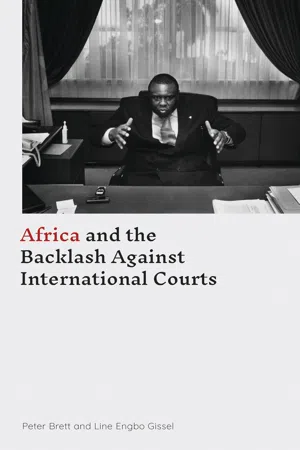
At the start of the twenty-first century the story of Africa's engagement with international law was one of marked commitment and meaningful contributions. Africa pioneered new areas of law and legal remedies, such as international criminal law and universal jurisdiction, and gave human rights jurisdiction to a number of new international courts. However, in recent years, African states have mobilised politically and collectively against the regional courts and the International Criminal Court, contesting these institutions' authority and legitimacy at national, regional and international levels.
Africa and the Backlash Against International Courts provides the first comprehensive account of this important phenomenon, bringing together original fieldwork, empirical analysis and a critical overview of the diverse scholarship on both international and African regional courts. Moving beyond conventional explanations, Brett and Gissel use this remarkable research to show how the actions of African states should instead be seen as part of a growing desire for a more equal global order; a trend that not only has huge implications for Africa's international relations, but that could potentially change the entire practice of international law.
- 288 pages
- English
- ePUB (mobile friendly)
- Available on iOS & Android
eBook - ePub
Africa and the Backlash Against International Courts
About this book
Information
INTRODUCTION
1 Introduction
In 1976, there was only one international court with compulsory jurisdiction, but today there are 21 (Alter 2014a, 82–84). Some measure of backlash was perhaps inevitable. The last decade has seen states across the world seek to constrain and renounce international courts for a wide variety of reasons. The United Kingdom’s (UK) refusal to implement a European Court of Human Rights (ECtHR) judgment has led its cabinet to debate denouncing the European Convention on Human Rights (ECHR), and has seen it successfully coordinate states’ efforts to give national institutions greater say over human rights in the Council of Europe (Bates 2015; Madsen 2018). Much parliamentary support for Brexit has been justified by referencing a need to escape the jurisdiction of the European Court of Justice (ECJ) (e.g. Ringeisen-Biardeaud 2017). Russia now allows its Constitutional Court to overturn ECtHR decisions (Chaeva 2016). The Eurasian Economic Union (EAEU), which it dominates, has a new Court of Justice with less powers than its predecessor (Madsen, Cebulak and Wiebusch 2018, 197). President Duterte has withdrawn the Philippines from the International Criminal Court (ICC), and threatens to arrest any of its prosecutors who come to his country (Gutierrez 2019; Reuters 2018). Venezuela’s withdrawal from the Inter-American Human Rights System in 2013 inspired similar kinds of resistance by sympathetic states elsewhere in Latin America (Sandholtz, Bei and Caldwell 2018, 159–164). President Trump, meanwhile, has blocked all new appointments to the World Trade Organization (WTO) Appellate Body, part of his administration’s broader shift towards bilateralism in foreign policy (Patrick 2019).
In Africa, most attention has focused on the recent backlash against the ICC. Burundi has become the first country to withdraw, and South Africa and the Gambia (under former President Jammeh at least) have declared similar intentions. Kenya, for its part, has attempted to coordinate a mass exit, and in 2017 helped persuade the African Union (AU) Summit to adopt an ‘ICC Withdrawal Strategy’ drafted by 28 states (including 15 non-states parties). Regional and subregional courts have, however, also come under fire. In 2012, the Southern African Development Community (SADC) Tribunal became the first ever international court to have its jurisdiction curtailed as a direct result of one its rulings.1 A ruling it made in favour of expropriated white farmers in Zimbabwe saw it lose its human rights jurisdiction (see Chapter 3, this volume). Elsewhere, Rwanda and Tanzania have stopped individuals and non-governmental organisations (NGOs) from approaching the African Court on Human and Peoples’ Rights (ACtHPR), and the East African Community (EAC) has successfully constrained the East African Court of Justice (EACJ) (see Chapter 5, this volume).
The study of this phenomenon is still in its infancy (Alter, Gathii and Helfer 2016; Madsen, Cebulak and Wiebusch 2018; Sandholtz, Bei and Caldwell 2018). To date, however, only scholars of backlash against the ICC have engaged with the Africanist international relations literature (e.g. Branch 2019; Clark 2019; Murithi 2019; Mutua 2016). In this book, we will use this literature to capture some of the many distinctive features of Africa’s relationship with all international courts. The debates surrounding the ICC illuminate Africa’s understanding of itself and its place in the world, but the scholarly focus on this particular court has nonetheless become staggeringly disproportionate. As of August 2018, it had been mentioned in 14,100 academic articles for every conviction obtained ((in)famously, all three of those convicted were Africans). Africa’s busiest human rights court, by contrast – the Economic Community of West African States (ECOWAS) Community Court of Justice (ECCJ) – has received 80 times less coverage.2 Our first objective is therefore to help redress this imbalance.
Our second objective is, of course, to improve upon existing explanations. Much of the journalistic and policy literature describes backlash simply in terms of authoritarian regimes seeking to ‘claw back’ their lost sovereignty (e.g. Gumede 2018). The academic literature, meanwhile, either ignores or systematically downplays the justifications that African states give for their conduct – assuming that these simply serve to conceal real interests or are of no consequence.3 Both literatures tend to depict African states as being peculiarly attached to their formal legal independence, and to understand backlash as a consequence of ‘expansionist decision-making’ by judges (e.g. Gathii 2018, 332; for a useful critique of the latter assumption, see Helfer and Alter 2013). It is a central contention of this book, however, that African states have not been able to coordinate backlash when their sovereignty or interests (traditionally understood) have come under threat. Explanations of this type have two main weaknesses. They fail, first, to explain why the ICC, in particular, has proved so controversial, compared to other international courts with equal or higher sovereignty costs (see generally Hafner-Burton, Mansfield and Pevehouse 2015). And they provide no account of why African states created so many international courts only to then turn against them. The rest of this introduction examines each flaw in more detail before outlining our response.
2 Ideas
2.1 Contrasting the ICC and Regional Courts
The first difficulty with stressing sovereignty or authoritarian instincts is that this leaves us unable to explain why backlash against the ICC has not translated into backlash against other international courts. Some regional courts, such as the ECCJ, have in fact escaped sanction despite judicial activism and numerous encroachments on sovereignty. Backlash against the EACJ, meanwhile, has been almost entirely unrelated to the activism of its bench. This is not to say, of course, that such courts have elicited compliance. And nor is it to say that regional courts have remained immune to political threat. But as we will see in Chapters 3–5 of this volume, backlash has generally emerged when it could be justified in terms of region-specific norms or local legitimation strategies. It has not been the product of any ubiquitous attachment to sovereignty.4
This account contrasts with that found in the best account to date of backlash against regional courts. Alter, Gathii and Helfer (2016) compare Zimbabwe’s successful backlash against the SADC Tribunal in 2012 with the Gambia’s failed backlash against the ECCJ in 2009, and Kenya’s moderately successful attempt to constrain the EACJ in 2006–2007. They explain these states’ different levels of success by pointing to different levels of mobilisation in defence of courts by civil society and the staff of regional organisations. Where mobilisation was strong, as in West Africa, the ECCJ was saved and strengthened. Where mobilisation was weak, as in Southern Africa, the SADC Tribunal was first suspended and then neutered. Alter, Gathii and Helfer (2016) thus go out of their way to deny precisely what we affirm: that states’ justifications, and the identity of those making them, mattered. For us, it was decisive that Zimbabwe was able to rationalise its interests in terms of an ever-more powerful region-specific ‘liberation narrative’ about land in Southern Africa. And we can find no way to downplay the importance of the Gambia’s status as local pariah for its failure to persuade other West African states to constrain the ECCJ.
Backlash against the ICC, by contrast, has been successfully justified by pointing towards in...
Table of contents
- Cover
- About the Authors
- Title Page
- Copyright Page
- Dedication Page
- Table Of Contents
- List of Illustrations
- Abbreviations and Acronyms
- Acknowledgements
- Preface
- Introduction
- 1 Africa and International Law After the Cold War
- 2 Africa and the International Criminal Court
- 3 Land in Southern Africa 56
- 4 Legality in West Africa
- 5 Regional Legacies in East Africa
- Conclusion
- Notes
- Bibliograpy
- Index
Trusted by 375,005 students
Access to over 1.5 million titles for a fair monthly price.
Study more efficiently using our study tools.
Frequently asked questions
Yes, you can cancel anytime from the Subscription tab in your account settings on the Perlego website. Your subscription will stay active until the end of your current billing period. Learn how to cancel your subscription
No, books cannot be downloaded as external files, such as PDFs, for use outside of Perlego. However, you can download books within the Perlego app for offline reading on mobile or tablet. Learn how to download books offline
Perlego offers two plans: Essential and Complete
- Essential is ideal for learners and professionals who enjoy exploring a wide range of subjects. Access the Essential Library with 800,000+ trusted titles and best-sellers across business, personal growth, and the humanities. Includes unlimited reading time and Standard Read Aloud voice.
- Complete: Perfect for advanced learners and researchers needing full, unrestricted access. Unlock 1.5M+ books across hundreds of subjects, including academic and specialized titles. The Complete Plan also includes advanced features like Premium Read Aloud and Research Assistant.
We are an online textbook subscription service, where you can get access to an entire online library for less than the price of a single book per month. With over 1.5 million books across 990+ topics, we’ve got you covered! Learn about our mission
Look out for the read-aloud symbol on your next book to see if you can listen to it. The read-aloud tool reads text aloud for you, highlighting the text as it is being read. You can pause it, speed it up and slow it down. Learn more about Read Aloud
Yes! You can use the Perlego app on both iOS and Android devices to read anytime, anywhere — even offline. Perfect for commutes or when you’re on the go.
Please note we cannot support devices running on iOS 13 and Android 7 or earlier. Learn more about using the app
Please note we cannot support devices running on iOS 13 and Android 7 or earlier. Learn more about using the app
Yes, you can access Africa and the Backlash Against International Courts by Peter Brett,Line Engbo Gissel in PDF and/or ePUB format, as well as other popular books in Politics & International Relations & International Law. We have over 1.5 million books available in our catalogue for you to explore.