Comparative anatomy helps to define among surgical procedures, those that are able to restore early walking function using really useful structures, without necessarily respecting the normal anatomy.
This book proposes an original vision based on the following ideas:
The cure is complete only if it occurs quickly, which is vital for vulnerable patients.
The surgical goal isn't the anatomical restitution ad integrum, but to resore the fonction, that of the permanent terrestrial human bipedalism. To identify it, put it back into its evolutionary context and compare it to the anatomo-functional models of our closest relatives, the great apes.
Achieving this dual objective through new surgical techniques (percutaneous and minimally invaseve), associated with biomechanical data for immediate and total support.
1 Comparison: The Key to Understanding Human Specificity
1.1. Comparison, a source of clarity
It is difficult to understand the specificity of an object or a function, if we do not compare it with a model that resembles it. Highlighting differences will allow us to grasp their distinctiveness. The smaller the difference, the more difficult it is to detect if it is isolated from a similar environment, but the more it characterizes the specificity of the object being studied.
This easy-to-understand approach when comparing color, from blue to green via emerald, for example, is more complex when it comes to functional anatomy models. Our understanding of specificity cannot be dissociated from the effort of classification and the establishment of phylogeny.
Indeed, by carefully establishing derived and ancestral characteristics, it is possible to establish differences and then classify according to the principle of parsimony. According to Aristotle, let us “search for relations between apparently independent things and search for similarities between things that are dissimilar in the eyes of the common man”. Knowing things makes it possible to see them acutely; verbalizing them makes it possible to think about them.
1.2. Different models of the foot and ankle throughout evolution
Locomotion involves a variety of movements adapted to different environments and lifestyles.
Identical morphological organization and processes common to all vertebrates are implemented, but thanks to original anatomical elements, animals can move with highly sophisticated means and respond, each in their own way, to the constraints of their environment.
Among the many elements involved in the musculoskeletal system’s function, the foot and ankle (crurotarsal or talocrural joint) were chosen because they undergo the most spectacular and elaborate transformations during adaptation to different types of locomotion: running, trotting, tree climbing, etc. Mammals have anatomical adaptations that reflect their specific mode of locomotion.
1.2.1. Evolution of the chiridial limb
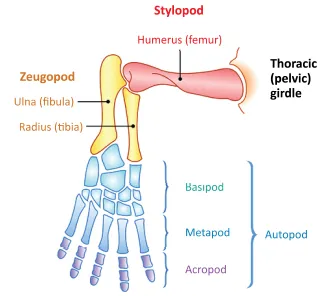
The chiridial limb represents the general limb structure of tetrapods. There are significant differences between mammalian classes, but the general pattern is identical, as shown in Figure 1.1.
The foot represents the autopod (Figure 1.1); succeeding the leg sector which constitutes the zeugopod. The autopod consists of three parts: the tarsus (basipod), the metatarsus (metapod) and the phalanxes (acropod).
Figure 1.1.The chiridial limb: general structure of a tetrapod’s limb. For a color version of the figure, see www.iste.co.uk/cazeau/foot.zip
The typical shape is pentadactyl and almost always has a locomotor function.
When our gait is increased or semi-increased, the foot is plantigrade, with five complete segments numbered from 1 to 5, from the tibial (medial) side to the fibular (lateral) side. In quadrupedal gait, the hands and feet have similar functions. The number of segments is reduced, four in the digitigrade of carnivores and even less in unguligrades.
Let us quickly put the tarsus and the zeugo-autopodal joint into context.
The appearance of the chiridial limb in the Late Devonian period (370 million years ago) was a fundamental acquisition that enabled the transition from aquatic to terrestrial life. Anatomically speaking, it was the transition from an aquatic fin to a limb that enabled the conquest of continents. Seventy million years after its alleged disappearance, the famous missing link, the coelacanth fish, was caught in 1938 in the Comoros. Its fin seemed to have the anatomical shape of a section with the chiridial limb.
The structure is as follows (Figure 1.1): the proximal segment or stylopod is represented by the arm (humerus) or thigh (femur), the middle segment or zeugopod is the forearm (radius and ulna) or leg (tibia and fibula) and the distal segment or autopod, consisting of three parts, is the hand or foot. The basipod corresponds to the tarsus (and the carpus), the metapod to the metatarsus (metacarpus) and the acropod to the phalanxes.
Here, we are interested in the ankle (zeu...
Table of contents
Cover
Table of Contents
Title page
Copyright
Foreword
Introduction
1 Comparison: The Key to Understanding Human Specificity
2 The Aim of Surgery: Restore Function
3 Rapid Healing Through Immediate Use of the Operated Foot: A Purpose
Conclusion
References
Index
End User License Agreement
Trusted by 375,005 students
Access to over 1.5 million titles for a fair monthly price.
Study more efficiently using our study tools.
Frequently asked questions
Yes, you can cancel anytime from the Subscription tab in your account settings on the Perlego website. Your subscription will stay active until the end of your current billing period. Learn how to cancel your subscription
No, books cannot be downloaded as external files, such as PDFs, for use outside of Perlego. However, you can download books within the Perlego app for offline reading on mobile or tablet. Learn how to download books offline
We are an online textbook subscription service, where you can get access to an entire online library for less than the price of a single book per month. With over 1.5 million books across 990+ topics, we’ve got you covered! Learn about our mission
Look out for the read-aloud symbol on your next book to see if you can listen to it. The read-aloud tool reads text aloud for you, highlighting the text as it is being read. You can pause it, speed it up and slow it down. Learn more about Read Aloud
Yes! You can use the Perlego app on both iOS and Android devices to read anytime, anywhere — even offline. Perfect for commutes or when you’re on the go. Please note we cannot support devices running on iOS 13 and Android 7 or earlier. Learn more about using the app
Yes, you can access Foot Surgery Viewed Through the Prism of Comparative Anatomy by Cyrille Cazeau in PDF and/or ePUB format, as well as other popular books in Medicine & Physiology. We have over 1.5 million books available in our catalogue for you to explore.