eBook - ePub
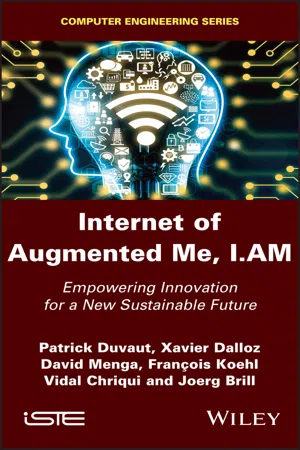
Internet of Augmented Me, I.AM
Empowering Innovation for a New Sustainable Future
- English
- ePUB (mobile friendly)
- Available on iOS & Android
eBook - ePub
Internet of Augmented Me, I.AM
Empowering Innovation for a New Sustainable Future
About this book
I.AM catalyzes the "convergence for good" of the biological, physical and digital worlds, helping us to better tackle the toughest challenges of the 2020s: climate change, resource depletion, an aging population, social inclusion, the empowerment of people, health crises and the post-pandemic world, as well as new issues emerging in relation to economical, societal and everyday life. This book dives into disruptive concepts of I.AM such as: Trust as a Service, Business as a Game, ATAWAD (AnyTime, AnyWhere, Any Device), PCE (Productivity of Collaborative Exchange), Unimedia, Shazamization of everything, decentralization of everything, BOTization and Build to Order for Me, Blockchain and Empowerment of Me, edge computing, augmented industry, augmentation value chain and empowering innovation, etc. The fluid, easy-to-read style of this book targets the broadest scope of readers, from purpose-driven and business-oriented individuals, to students, researchers, experts, innovators, consultants, managers and politicians, all eager to empower people to work towards a more sustainable future.
Information
1
With the Internet of Augmented Me, a New Wave of Innovation is Coming, Which Will Change Everything
“We always overestimate the change that will occur in the next two years and underestimate the change that will occur in the next ten.
Don’t let yourself be lulled into inaction.”
Bill Gates
1.1. The Internet of Augmented Me: new technologies, new jobs, new business
The IoT (Internet of Things) universe is exploding. Just look around and see the smart gadgets, clothing, cameras and virtual assistants that populate homes and are carried by people on their travels. The number of IoT devices connected to broadband networks is already significant, but it is far from having reached its maximum.
According to the main forecasts, 22 billion devices will be connected to the Internet by 2025, which is three times their number today.
For companies, the goal is to get a competitive advantage using these objects with the network effect: increasing the number of people or participants who are exposed to the objects or service can increase the value of the company, goods or services.
The explosion of this market has a very positive side as it will provide consumers with new services and commodities. However, it will also bring new business models, as well as a new complexity and security risks, which could prove to be devastating for millions of people who will, increasingly, rely on digital services and networks in their daily lives.
In this context, all connected objects must have their own digital representations, i.e. digital twins, with the following properties:
– unicity of identification of each object:
- the possibility of identifying each object is a fundamental notion of the IoT. Each object should own and know its identity in order to evolve in the network,
- each object should be a legal actor in its own right,
- the assignment of identifiers should be programmable;
– suitability for its environment and its context of use:
- an object must be able to report its status and communicate data collected about its environment: temperature, humidity, vibration level, noise or geolocation;
– this new infrastructure should be proactive, seamless and “scalable”:
- objects must be permanently connected to the Internet, if possible, or at least when a connection is available,
- TaaS (Trust as a Service) is at the heart of this infrastructure. The Internet will be a trusted third party;
– the digital twin of an object must combine its real and virtual aspects (be “phygital”). The aim is to have the best aspects from each space to create a much more complete and satisfying customer experience:
- a twin is constructed so that it can receive input from sensors, gathering data from a real world counterpart. This allows the twin to simulate the physical object in real time, and, in the process, to offer insights into performance and potential problems,
- a twin embodies the possibility for a program to act on behalf of a physical object to which it is attached and of which it is perfectly aware,
- a twin should evolve with each transaction,
- twins will be integrated in a “smart wallet”, i.e., a software application that serves as an electronic version of a physical wallet;
– autonomy based on a decentralization of everything:
- objects will behave like robots,
- objects are treated individually from an isolated point and are operated independently of a remote control,
- there must be no central intelligence controlling the totality of individual objects in a totalitarian way. On the contrary, each object is in some way autonomous and independent, with the ability to be interrogated and to interact with other network objects when necessary. In short, objects in the IoT should be independent and communicating agents (in the sense of AI and operating systems).
The Internet of Augmented Me (I.AM) is necessary for the business model of the IoT. The characteristics are perfectly described with the following Chinese proverb:
– Tell me and I’ll forget. This is at the heart of mass marketing.
– Show me and I’ll remember. This is at the heart of segmented marketing.
– Involve me and I’ll understand. This is at the heart of the business model of the IoT. Every customer is a market. The dialogue between the companies and their clients becomes real, and ethics are at the heart of the winning business models. The companies cannot lie anymore.
With the Internet of Augmented Me, the complexity of devices plays a secondary role because users work with their own digital assistants for all their daily tasks, which cover both the physical and digital worlds.
So hyper-personalization and citizen/consumer involvement are at the heart of the Internet of Augmented Me business model. The answer to the hidden expectations of the consumer citizen is at the center of value creation (contextual marketing). In this context, there will be a massive decentralization of collaboration between citizens/consumers, the AI environment (enhanced intelligence) and secure transactions with the blockchain to facilitate this involvement and training just in time.
A new wave occurs in the digital world every 10 years, with new innovations, breakthroughs, applications and new issues that concern a wider audience each time:
– 1944: the first computer;
– 1954: the first mainframe;
– 1964: the first mini-computer;
– 1974: the first microcomputer;
– 1984: the Macintosh;
– 1994: the first navigator with Mosaic;
– 2004: social networks;
– 2014: the Internet of Augmented Me;
– 2024: the brain to X (interaction of the brain with its environment).
The main features of the Internet of Augmented Me are as follows:
– goal:
- hyper-personalization and citizen/consumer involvement are at the heart of the Internet of Augmented Me business model;
– how:
- anticipation: answering to the latent expectations of the consumer citizen is at the center of value creation (contextual marketing);
– method:
- (1) key role of the massive decentralization of collaboration between citizens/consumers, (2) AI environment (enhanced intelligence) and (3) securing transactions with the blockchain to facilitate this involvement and training just in time;
– competitive advantage lies in collaboration and data sharing:
- collaboration is everywhere. It is at the intersection of humans and machines, between machines, and between humans. Humans and machines must work better together: P2P, M2M, M2P, B2M, etc.,
- citizen/consumer access to all the services they need, when they want, wherever they are and with the available equipment. This equipment can be a computer, a TV, a phone, a tablet, a watch, a game console or a multimedia device;
– valuable creation:
- key role of brands, whose valorization is the result of collaboration, which can only make sense if the parties involved are interdependent in one way or another. Their effectiveness depends on a compromise between the actors concerned to produce solutions that none of them could obtain if working independently. In this way, the actors all depend on each other to find mutually beneficial solutions. The goal is to improve the productivity of these exchanges. The PCE (Productivity of Collaborative Exchange) will be a very strategic indicator of the quality of this collaboration;
– business model:
- it resides in the capacity to create intangible capital and to have an apparent financial surface more important than it is, with regard to the results;
- key role of data and algorithms:
- the algorithms go to the data and not the other way around.
With the Internet of Augmented Me, the asymmetry of information has been equalized in the sense that it becomes favorable to the citizen/consumer who gains bargaining power. Tools such as blogs, forums and recommendation sites give viewers access to more information, especially the buying experience of citizens/consumers.
With the Internet of Augmented Me:
– a c...
Table of contents
- Cover
- Table of Contents
- Title Page
- Copyright Page
- Forewords
- Introduction
- About the Authors
- Acknowledgements
- 1 With the Internet of Augmented Me, a New Wave of Innovation is Coming, Which Will Change Everything
- 2 The Patterns of the Internet of Augmented Me
- 3 Edge Computing for Processing and Connectivity in the World of Internet of Augmented Me
- 4 Blockchain for New Flows of Value and the Empowerment of Me
- 5 Internet of Augmented Industry
- 6 The “AugmentChain”: Sustainable Augmentation Value Chain for Intangible Assets
- References
- Index
- Other titles from ISTE in Computer Engineering
- End User License Agreement
Trusted by 375,005 students
Access to over 1.5 million titles for a fair monthly price.
Study more efficiently using our study tools.
Frequently asked questions
Yes, you can cancel anytime from the Subscription tab in your account settings on the Perlego website. Your subscription will stay active until the end of your current billing period. Learn how to cancel your subscription
No, books cannot be downloaded as external files, such as PDFs, for use outside of Perlego. However, you can download books within the Perlego app for offline reading on mobile or tablet. Learn how to download books offline
Perlego offers two plans: Essential and Complete
- Essential is ideal for learners and professionals who enjoy exploring a wide range of subjects. Access the Essential Library with 800,000+ trusted titles and best-sellers across business, personal growth, and the humanities. Includes unlimited reading time and Standard Read Aloud voice.
- Complete: Perfect for advanced learners and researchers needing full, unrestricted access. Unlock 1.5M+ books across hundreds of subjects, including academic and specialized titles. The Complete Plan also includes advanced features like Premium Read Aloud and Research Assistant.
We are an online textbook subscription service, where you can get access to an entire online library for less than the price of a single book per month. With over 1.5 million books across 990+ topics, we’ve got you covered! Learn about our mission
Look out for the read-aloud symbol on your next book to see if you can listen to it. The read-aloud tool reads text aloud for you, highlighting the text as it is being read. You can pause it, speed it up and slow it down. Learn more about Read Aloud
Yes! You can use the Perlego app on both iOS and Android devices to read anytime, anywhere — even offline. Perfect for commutes or when you’re on the go.
Please note we cannot support devices running on iOS 13 and Android 7 or earlier. Learn more about using the app
Please note we cannot support devices running on iOS 13 and Android 7 or earlier. Learn more about using the app
Yes, you can access Internet of Augmented Me, I.AM by Patrick Duvaut,Xavier Dalloz,David Menga,Francois Koehl,Vidal Chriqui,Joerg Brill in PDF and/or ePUB format, as well as other popular books in Computer Science & Computer Engineering. We have over 1.5 million books available in our catalogue for you to explore.