Process Industries 2 first discusses bio-industries and analyzes the development of products of microbial origin. It then studies all the stages of industrialization that facilitate the progress from research to the production of a finished product, as well as industrial management techniques. Using concrete examples, this book presents the instruments of the digital revolution (artificial intelligence, virtual reality, augmented reality, the Internet of Things, digital twins), while analyzing their impact on the supply chain and operators. Boxes within the book, written by recognized specialists, invite both students and professionals, who are faced with a changing world, to reflect on the industry and the world of tomorrow.
eBook - ePub
Process Industries 2
Digitalization, a New Key Driver for Industrial Management
- English
- ePUB (mobile friendly)
- Available on iOS & Android
eBook - ePub
Process Industries 2
Digitalization, a New Key Driver for Industrial Management
About this book
As a result of knowledge exchange between the academic and industrial worlds, this book analyzes the process industries impacted by the digital revolution that accompanies the ongoing energy and environmental transitions.
Information
1
Bio-industry in the Age of the Transition to Digital Technology: Significance and Recent Advances
Chapter written by Philippe JACQUES.
1.1. Introduction
Bio-industry involves living organisms, mainly microorganisms, bacteria*1 and fungi*, and develops products for the agrifood industry (yeasts*, lactic ferments*, enzymes*, etc.), the pharmaceutical industry (vaccines, antibiotics, etc.), agriculture (biopesticides*, biostimulants*, etc.), the environment (microorganisms for water, air and soil depollution, etc.), chemical industries (synthons*, biodegradable polymers, biosurfactants*, etc.). The markets concerned by these products are steadily increasing by several percent each year. For example, fine chemicals originating from fermentation were estimated at $24 billion in 2017, with a yearly increase of 3.4% over the 2017–2022 period (source: BCC).
The beginnings of bio-industry are probably in brewing beer in Mesopotamia, about 6,000 years ago, and wine production in Egypt as early as the Middle Predynastic period, more than 5,000 years ago (Figure 1.1). Over thousands of years, microorganisms have been used to produce (alcoholic beverages) or preserve (fermented products) numerous foods and have been used in processes such as flax retting (an operation that involves exploiting the production capabilities of hydrolytic enzymes in soil microorganisms to isolate the fibers of flax stems) without the people utilizing them even noticing their existence.
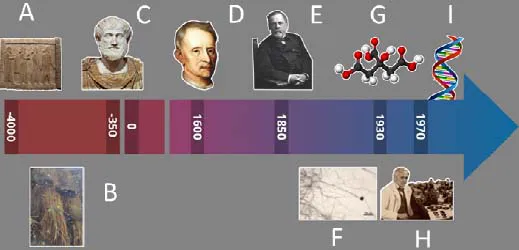
Figure 1.1. Evolution of industrial microbiology. For a color version of this figure, see www.iste.co.uk/dalpont/process2.zip
COMMENT ON FIGURE 1.1.– The beginnings of industrial microbiology probably date back to the brewing of the first beers in Mesopotamia, some 6,000 years ago (A). During millennia, microorganisms have been exploited without knowledge of their existence, for example in flax retting (B). The spontaneous generation theory devised from Aristotle (C) to Van Helmont (D) has even been a major impediment to the demonstration of this form life invisible to the naked eye. This was definitively demonstrated due to the works of Antoni Van Leeuwenhoek and Louis Pasteur (E) during the 18th and 19th Centuries. During the first part of the 20th Century, various industrial applications involving microorganisms were created, such as for the production of amylase, citric acid (G) or penicillin, discovered by Fleming (H), using fungi (F). The discovery of DNA (I) in 1953 opened the field of genetic manipulation of microorganisms.
This period precedes the works of Antoni Van Leeuwenhoek (1632–1723) and Pasteur (1822–1895). The first, through the invention of a tool, the microscope, capable of visualizing microscopic living beings, was able to highlight the presence of these microorganisms in many environments. The second has definitively demonstrated their role in the processes of processing organic matter and thus put an end to the theory of spontaneous generation (appearance of living beings from nonliving matter) defended for centuries by renowned scientists.
Subsequently, researchers, now aware of the existence of life at the microscopic scale, were able to consider diversifying its exploitation for the production of organic acids, enzymes or antibiotics such as penicillin. The latter was discovered by chance in 1928 by a Scottish physician and bacteriologist, Sir Alexander Fleming. It was, in fact, following contamination of his samples by a fungus called Penicillium notatum that he was able to identify a substance capable of inhibiting the growth of pathogenic bacteria under laboratory conditions. Fleming’s work was pursued by an Australian and a German, Florey and Chain in 1939, who demonstrated the potential of penicillin to fight bacterial infections in animals. Penicillin was then produced in industrial quantities during World War II and thus saved thousands of lives on the battlefield. Fleming, Florey and Chain received the Nobel Prize for this discovery in 1945.
The discovery of deoxyribonucleic acid* (DNA) by Watson and Crick in 1953 and the development of molecular biology techniques have allowed the manipulation of the genetic heritage of microorganisms to increase the synthesis potential of enzymes and vaccines, among others. These technologies are probably reaching their peak today with the development of synthetic biology. The latter aims to design new microorganisms by modifying more or less profoundly the metabolic pathways of a natural microorganism. These microorganisms, which are true cell factorie...
Table of contents
- Cover
- Table of Contents
- Title page
- Copyright
- Foreword by Laurent Baseilhac
- Foreword by Vincent Laflèche
- Foreword by June C. Wispelwey
- Introduction
- 1 Bio-industry in the Age of the Transition to Digital Technology: Significance and Recent Advances
- 2 Hydrogen Production by Steam Reforming
- 3 Industrialization: From Research to Final Product
- 4 Operations
- 5 The Enterprise and the Plant of the Future at the Age of the Transition to Digital Technology
- 6 And Tomorrow
- List of Authors
- Index
- Summary of Volume 1
- End User License Agreement
Trusted by 375,005 students
Access to over 1.5 million titles for a fair monthly price.
Study more efficiently using our study tools.
Frequently asked questions
Yes, you can cancel anytime from the Subscription tab in your account settings on the Perlego website. Your subscription will stay active until the end of your current billing period. Learn how to cancel your subscription
No, books cannot be downloaded as external files, such as PDFs, for use outside of Perlego. However, you can download books within the Perlego app for offline reading on mobile or tablet. Learn how to download books offline
Perlego offers two plans: Essential and Complete
- Essential is ideal for learners and professionals who enjoy exploring a wide range of subjects. Access the Essential Library with 800,000+ trusted titles and best-sellers across business, personal growth, and the humanities. Includes unlimited reading time and Standard Read Aloud voice.
- Complete: Perfect for advanced learners and researchers needing full, unrestricted access. Unlock 1.5M+ books across hundreds of subjects, including academic and specialized titles. The Complete Plan also includes advanced features like Premium Read Aloud and Research Assistant.
We are an online textbook subscription service, where you can get access to an entire online library for less than the price of a single book per month. With over 1.5 million books across 990+ topics, we’ve got you covered! Learn about our mission
Look out for the read-aloud symbol on your next book to see if you can listen to it. The read-aloud tool reads text aloud for you, highlighting the text as it is being read. You can pause it, speed it up and slow it down. Learn more about Read Aloud
Yes! You can use the Perlego app on both iOS and Android devices to read anytime, anywhere — even offline. Perfect for commutes or when you’re on the go.
Please note we cannot support devices running on iOS 13 and Android 7 or earlier. Learn more about using the app
Please note we cannot support devices running on iOS 13 and Android 7 or earlier. Learn more about using the app
Yes, you can access Process Industries 2 by Jean-Pierre Dal Pont,Marie Debacq in PDF and/or ePUB format, as well as other popular books in Technology & Engineering & Environmental Science. We have over 1.5 million books available in our catalogue for you to explore.