eBook - ePub
Entrepreneurship and Development
Realities and Future Prospects
- English
- ePUB (mobile friendly)
- Available on iOS & Android
eBook - ePub
About this book
In analyzing the complex link between entrepreneurship, innovation and development in the context of the emerging world, this book offers a holistic reading of this triptych based on a theoretical foundation that is itself subject to controversy: the national system of innovative entrepreneurship. The "emerging" nature of the studied countries provides specific insights, and allows the theoretical developments to be fine-tuned to the current issues. In a context that makes competitive advantages transient, emerging markets can provide a real test case for responding in a structural and innovative way to social and economic challenges, thus ensuring the sustainable performance of their innovative entrepreneurial system. Entrepreneurship and Development advocates for the integration of the social and cultural history of a given country within the framework of public policies, and proposes more targeted actions for innovative entrepreneurial activities. Moreover, the education system must integrate the entrepreneurial culture and foster multidisciplinarity to support the transfer of knowledge to markets.
Information
PART I
Innovative Entrepreneurship and Economic Dynamics
1
Entrepreneurship and Competitiveness in Literature
1.1. Introduction
Although competitiveness is a ubiquitous term in economic research, it remains a complex concept with regards to the specific scope and the scale it addresses, whether for a company, a country or a region. Indeed, at country level, policy-makers who analyze the pillars of the economic competitiveness focus on the specificities of their own industries, while business managers focus on the ability of their respective firms to compete in specific markets (Ferreira et al. 2017). But the importance of competitiveness remains historically linked to events that have emerged particularly in the 1970s, in the context of the trade battle between the United States and Japan (Wziatek-Kubiak and Magda 2005), when each country sought to develop new sources of comparative advantage in order to ensure their long-term economic growth.
Several macroeconomic research studies have focused on growth in a dynamic perspective by using the traditional factors that sustain the production function such as labor and capital, particularly by analyzing the localized determinants of attractiveness that favor investment in activities that are sources of comparative advantage.
This has revealed a pattern in some countries to develop specializations in competitive industries requiring greater involvement of the factors of production traditionally available in the country and thus ensuring competitive advantages at the international level (Alexandros and Metaxas 2016). Other approaches have taken sectoral analysis angles, notably through innovative ecosystems or at the firm level, to analyze market structures, competitive positions, internal processes that promote innovation and the efforts made by players to remain competitive.
The Schumpeterian approach to competitiveness is both original and instructive, in that it integrates competitiveness within the framework of innovation-based entrepreneurial theory. The ability of the business owner to create innovations will affect his economic added value and this results in his competitive advantage. From a dynamic perspective, Schumpeter (1934) links entrepreneurship and growth through the process of “creative destruction”. The entrepreneur will seek the innovative opportunities that make a sector competitive (Kirzner 1973). The entrepreneur becomes price competitive by exploiting new production activities, as opportunities for profit.
Further works have explored the relationship between competitiveness and innovation, including the contributions of Porter (1990) on the competitive advantage of nations, in which he suggests that a nation’s competitiveness depends on its ability to innovate and to keep up with technological advances. His work laid the foundation of regional economy and development by analyzing the determinants of competitiveness. Porter (1990) suggests that competitiveness is not a national heritage, but rather is created by economic actors. Through his “diamond” model, he explains how firms in a given sector are more competitive than others in national and international markets. To be competitive, companies must constantly improve the productivity of their products, through price and quality, but should at the same time seek out strategic positions through innovation.
In addition, Porter links the determinants of competitiveness to the stage of development of a country, the latter measured by the degree of sophistication of production patterns and by targeting transition towards an economy based on new knowledge creation. He identifies first a factors-driven stage of development where countries compete with each other through low-cost and low value-added products. Second, an efficiency-driven stage, where countries target efficient production practices in large markets that allow firms to exploit economies of scale. Finally, an innovation-driven stage, in which countries invest in innovation in order to reach the technological frontier and knowledge-based position. At this ultimate stage, the economy is a producer of innovation and a source of new knowledge creation and new technologies production (see Figure 1.1).
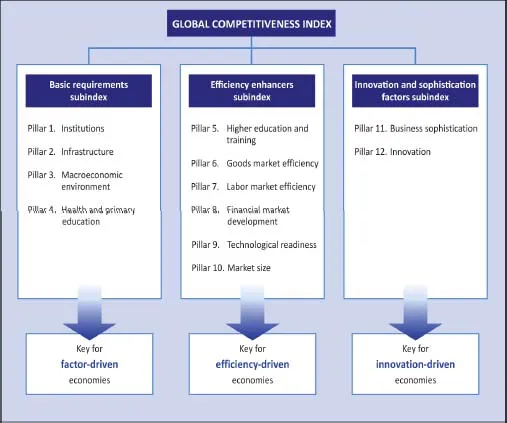
Figure 1.1. Pillars of competitiveness according to the stage of development of the countries (source: adapted from the “Global competitiveness report 2012–2013”)
Innovation becomes a continuous challenge for the creation and commercialization of new ideas, new knowledge. The interaction between the market conditions and the returns on investment in innovation can contribute to economic development (Ferreira et al. 2017).
Entrepreneurship and innovation do not happen by chance, nor are they equitably distributed among industries or even countries. The explanation lies in the “national attributes” (Porter 1998) that might play a crucial role in fostering the entrepreneurial activities allowing marketable innovations to emerge. This means that the structure of the local environment and the existence of local factors and circumstances foster investment and favor the development of new opportunities for innovation. They are therefore the “drivers” of competitiveness. Porter (1998) illustrates this situation by analyzing the example of the wave of foreign entrepreneurs who immigrated to the United States and who contributed greatly to the country’s economic development, relying on the existence of a hospitable and welcoming environment that is ripe for entrepreneurship and innovation.
Nevertheless, Porter’s contributions have two main limitations. First, there is a lack of clarification about the place of entrepreneurship and innovation in the competitive system. The second limitation concerns the ambiguity of evident links (direct or indirect) between entrepreneurship, innovation and competitiveness. In a recent contribution, Porter and Stern (2001) have provided new insights on the cross-cutting factors that foster innovation, in particular investment in human capital, the financing of scientific progress, and the level of technological sophistication, as well as the incentive and protection mechanisms for innovation. However, the link between entrepreneurship, innovation and competitiveness remains unclear.
Porter’s view of competitiveness is akin nowadays to being incomplete to explain the business environment and thus economic development (Siudek and Zawojska 2014), and has attracted much criticism, notably from Paul Krugman (1994), who stresses the need to distinguish firm-level competitiveness from national competitiveness and to avoid confusing the determinants of performance in the analysis. In this perspective, he emphasizes that the concept of competitiveness is a “dangerous and confusing obsession” if we assess competitiveness of a given country as a firm competing with other firms-countries in a global market.
When a company is no longer competitive in a market, when it cannot improve its performance and therefore cannot pay its employees, suppliers and creditors, it will disappear. This cannot naively be transposed to the case of a country. The latter cannot disappear because it is not performing or solvent. Moreover, countries do not compete with each other as companies do. The companies’ customers are not usually their own workers, whereas in the case of a country, goods and services are mostly produced for the local market and the export share represents only a small part of its usage.
Krugman (1994) suggests a more humanistic approach to competitiveness, according to which national competitiveness is based on the economy’s ability to transform the results of productive activities to improve income levels, to create employment and to enhance welfare. But, once again, the role of the entrepreneur remains unclear in his approach, particularly in terms of the links between entrepreneurship and competitiveness of an economy, compared to the emphasis on innovation and its determinants.
The international economic change and technological evolution that have characterized the last 20 years, particularly the rapid and continuous pace of progress and the renewal of technology, result in a new shift of firms’ activities and a new mode of development, with an increasing prevalence towards small businesses that contribute the most to economic growth. Since the 1990s, we have witnessed the development of new technology sectors, particularly information technology and telecommunications, that have turned entire industries upside down, redefined some sectors and contributed to the emergence of new sectors. This economic and structural shift has even affected the international positioning of some countries with regard to technological innovation.
This disruptive shift has captured the researchers’ interests towards exploring the role of the entrepreneur in economic growth (Wennekers and Thurik 1999) and thus breaking with the established view that has prevailed for a long time, both in innovation and development theories as well as at the country level and the market level. For a long time, large firms have dominated economic theories in the sense that they are the main source of innovation, given their size, their financial strength and experience in coping with risk. The recent changes in economic and business landscapes have fostered academic interests towards exploring the new determinants of growth and innovation and thus the extent to which small innovative structures contribute to economic development.
Nowadays, it is no longer appropriate to differentiate the macroeconomic level from the microeconomic perspective when it comes to analyzing motivations, or even individual behaviors and actions, leading to innovation, in an economic system. The accelerating pace of communication technologies and digitalization lead us to rethink the systemic innovation process including a framework that integrates entrepreneurial behaviors and actions and its interaction with the environment in which entrepreneurial actions evolve.
Several institutional studies have explored the new potential pillars of economic development and growth by combining both microeconomic and macroeconomic factors of development and growth performance. The Global Entrepreneurship Monitor (GEM) follows this perspective and has the merit of providing an integrative framework which links entrepreneurial behavior and attitudes to macro-economic dimensions.
This framework has fostered further multi-dimensional studies and complementary approaches. Various recent studies have been conducted under this framework including the analysis of the influence of level of development on dynamic entrepreneurship (Wennekers et al. 2005), the relationship between entrepreneurial activities and economic change (Gries and Naudé 2010; Acs and Naudé 2013), the analysis of entrepreneurship under a systemic framework at the country level (Acs et al. 2014; Autio et al. 2014), the links between intrinsic and extrinsic knowledge aspects of entrepreneurship and innovation and competitiveness (Ferreira et al. 2017), the regional and local economic level of development and their effects on the type of entrepreneur...
Table of contents
- Cover
- Table of Contents
- Title page
- Copyright
- Foreword
- PART 1: Innovative Entrepreneurship and Economic Dynamics
- PART 2: An Innovative Entrepreneurial System in Emerging Countries
- Conclusion
- Appendix
- References
- Index
- End User License Agreement
Trusted by 375,005 students
Access to over 1.5 million titles for a fair monthly price.
Study more efficiently using our study tools.
Frequently asked questions
Yes, you can cancel anytime from the Subscription tab in your account settings on the Perlego website. Your subscription will stay active until the end of your current billing period. Learn how to cancel your subscription
No, books cannot be downloaded as external files, such as PDFs, for use outside of Perlego. However, you can download books within the Perlego app for offline reading on mobile or tablet. Learn how to download books offline
Perlego offers two plans: Essential and Complete
- Essential is ideal for learners and professionals who enjoy exploring a wide range of subjects. Access the Essential Library with 800,000+ trusted titles and best-sellers across business, personal growth, and the humanities. Includes unlimited reading time and Standard Read Aloud voice.
- Complete: Perfect for advanced learners and researchers needing full, unrestricted access. Unlock 1.5M+ books across hundreds of subjects, including academic and specialized titles. The Complete Plan also includes advanced features like Premium Read Aloud and Research Assistant.
We are an online textbook subscription service, where you can get access to an entire online library for less than the price of a single book per month. With over 1.5 million books across 990+ topics, we’ve got you covered! Learn about our mission
Look out for the read-aloud symbol on your next book to see if you can listen to it. The read-aloud tool reads text aloud for you, highlighting the text as it is being read. You can pause it, speed it up and slow it down. Learn more about Read Aloud
Yes! You can use the Perlego app on both iOS and Android devices to read anytime, anywhere — even offline. Perfect for commutes or when you’re on the go.
Please note we cannot support devices running on iOS 13 and Android 7 or earlier. Learn more about using the app
Please note we cannot support devices running on iOS 13 and Android 7 or earlier. Learn more about using the app
Yes, you can access Entrepreneurship and Development by Sonia Ben Slimane,Hatem M'henni in PDF and/or ePUB format, as well as other popular books in Business & Entrepreneurship. We have over 1.5 million books available in our catalogue for you to explore.