- English
- ePUB (mobile friendly)
- Available on iOS & Android
eBook - ePub
About this book
It is a complete training in digital communications in the same book with all the aspects involved in such training: courses, tutorials with many typical problems targeted with detailed solutions, practical work concretely illustrating various aspects of technical implementation implemented. It breaks down into three parts. The Theory of information itself, which concerns both the sources of information and the channels of its transmission, taking into account the errors they introduce in the transmission of information and the means of protect by the use of appropriate coding methods. Then for the technical aspects of transmission, first the baseband transmission is presented with the important concept and fundamental technique of equalization. The performance evaluation in terms of probability of errors is systematically developed and detailed as well as the online codes used. Finally, the third part presents the Transmissions with digital modulation of carriers used in radio transmissions but also on electric cables. A second important aspect in learning a learner's knowledge and skills is this book. It concerns the "Directed Work" aspect of a training. This is an ordered set of 33 typical problems with detailed solutions covering the different parts of the course with practical work. Finally, the last aspect concerns the practical aspects in the proper sense of the term, an essential complement to training going as far as know-how. We propose here a set of 5 practical works.
Information
Part 1
Theory of Information
Introduction to Part 1
Transmitting information between two entities, commonly referred to as the “source of information” for the first and the “recipient” or “user” for the second, assumes that this information is represented in a common and understandable form by both parties. It is also necessary that the amount of information exchanged does not exceed the transmission capacity of the channel. Lastly, it is desirable that the disturbances (modifications of all kinds) in the transmission channel have, if possible, little or, ideally, no effect on the information delivered to the recipient or user.
All this is studied, analyzed and treated in what is called the “theory of information”, the theoretical basis of different techniques of communication.
In a schematic way, the problems raised and treated by this are the following:
- – quantitative measurement of information;
- – representation of common information between sender and recipient: code;
- – source coding: adapting the source rate to the capacity of the transmission channel;
- – channel coding: protecting against transmission errors.
The block diagram of Figure I1.1 shows at what levels of the communications chain these problems are, both on the side of the emission of the information (transmitter) as on the side of the reception of the information (receiver).
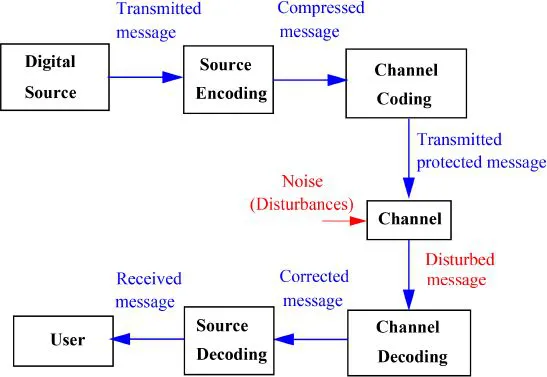
Figure I1.1. General structure of a digital communications system and its problems. For a color version of this figure, see www.iste.co.uk/assad/digital1.zip
We have divided this first ...
Table of contents
- Cover
- Table of Contents
- Title page
- Copyright
- Foreword
- Part 1: Theory of Information
- Part 2: Baseband Digital Transmissions and with Carrier Modulation
- References
- Index
- End User License Agreement
Trusted by 375,005 students
Access to over 1.5 million titles for a fair monthly price.
Study more efficiently using our study tools.
Frequently asked questions
Yes, you can cancel anytime from the Subscription tab in your account settings on the Perlego website. Your subscription will stay active until the end of your current billing period. Learn how to cancel your subscription
No, books cannot be downloaded as external files, such as PDFs, for use outside of Perlego. However, you can download books within the Perlego app for offline reading on mobile or tablet. Learn how to download books offline
Perlego offers two plans: Essential and Complete
- Essential is ideal for learners and professionals who enjoy exploring a wide range of subjects. Access the Essential Library with 800,000+ trusted titles and best-sellers across business, personal growth, and the humanities. Includes unlimited reading time and Standard Read Aloud voice.
- Complete: Perfect for advanced learners and researchers needing full, unrestricted access. Unlock 1.5M+ books across hundreds of subjects, including academic and specialized titles. The Complete Plan also includes advanced features like Premium Read Aloud and Research Assistant.
We are an online textbook subscription service, where you can get access to an entire online library for less than the price of a single book per month. With over 1.5 million books across 990+ topics, we’ve got you covered! Learn about our mission
Look out for the read-aloud symbol on your next book to see if you can listen to it. The read-aloud tool reads text aloud for you, highlighting the text as it is being read. You can pause it, speed it up and slow it down. Learn more about Read Aloud
Yes! You can use the Perlego app on both iOS and Android devices to read anytime, anywhere — even offline. Perfect for commutes or when you’re on the go.
Please note we cannot support devices running on iOS 13 and Android 7 or earlier. Learn more about using the app
Please note we cannot support devices running on iOS 13 and Android 7 or earlier. Learn more about using the app
Yes, you can access Digital Communications 1 by Safwan El Assad,Dominique Barba in PDF and/or ePUB format, as well as other popular books in Computer Science & Computer Engineering. We have over 1.5 million books available in our catalogue for you to explore.