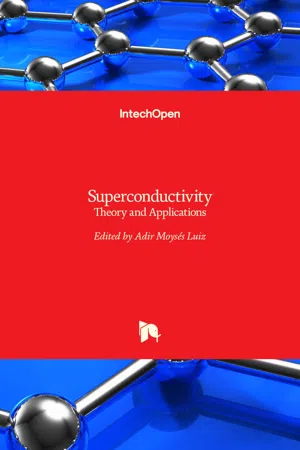
Superconductivity was discovered in 1911 by Kamerlingh Onnes. Since the discovery of an oxide superconductor with critical temperature (Tc) approximately equal to 35 K (by Bednorz and Muller 1986), there are a great number of laboratories all over the world involved in research of superconductors with high Tc values, the so-called "High-Tc superconductors". This book contains 15 chapters reporting about interesting research about theoretical and experimental aspects of superconductivity. You will find here a great number of works about theories and properties of High-Tc superconductors (materials with Tc > 30 K). In a few chapters there are also discussions concerning low-Tc superconductors (Tc < 30 K). This book will certainly encourage further experimental and theoretical research in new theories and new superconducting materials.
- 360 pages
- English
- PDF
- Available on iOS & Android
eBook - PDF
About this book
Information
Table of contents
- Superconductivity - Theory and Applications
- Contents
- Preface
- Chapter 1 Room Temperature Superconductivity
- Chapter 2 Unconventional Superconductivity Realized Near Magnetism in Hydrous Compound Nax(H3O)zCoO2 · yH2O
- Chapter 3 Coherent Current States in Two-Band Superconductors
- Chapter 4 Nonlinear Response of the Static and Dynamic Phases of the Vortex Matter
- Chapter 5 Energy Dissipation Minimization in Superconducting Circuits
- Chapter 6 Electronic Transport in an NS System with a Pure Normal Channel - Coherent and Spin-Dependent Effects
- Chapter 7 Effects of Impurities on a Noncentrosymmetric Superconductor - Application to CePt3Si
- Chapter 8 Foundations of Meissner Superconductor Magnet Mechanisms Engineering
- Chapter 9 Properties of Macroscopic Quantum Effects and Dynamic Natures of Electrons in Superconductors
- Chapter 10 FFLO and Vortex States in Superconductors with Strong Paramagnetic Effect
- Chapter 11 Development of Josephson Voltage Standards
- Chapter 12 Critical State Analysis Using Continuous Reading SQUID Magnetometer
- Chapter 13 Current Status and Technological Limitations of Hybrid Superconducting-normal Single Electron Transistors
- Chapter 14 Photonic Band Structure and Transmittance of the Superconductor Photonic Crystal
- Chapter 15 Electrodynamics of High Pinning Superconductors
Trusted by 375,005 students
Access to over 1.5 million titles for a fair monthly price.
Study more efficiently using our study tools.
Frequently asked questions
Yes, you can cancel anytime from the Subscription tab in your account settings on the Perlego website. Your subscription will stay active until the end of your current billing period. Learn how to cancel your subscription
No, books cannot be downloaded as external files, such as PDFs, for use outside of Perlego. However, you can download books within the Perlego app for offline reading on mobile or tablet. Learn how to download books offline
Perlego offers two plans: Essential and Complete
- Essential is ideal for learners and professionals who enjoy exploring a wide range of subjects. Access the Essential Library with 800,000+ trusted titles and best-sellers across business, personal growth, and the humanities. Includes unlimited reading time and Standard Read Aloud voice.
- Complete: Perfect for advanced learners and researchers needing full, unrestricted access. Unlock 1.5M+ books across hundreds of subjects, including academic and specialized titles. The Complete Plan also includes advanced features like Premium Read Aloud and Research Assistant.
We are an online textbook subscription service, where you can get access to an entire online library for less than the price of a single book per month. With over 1.5 million books across 990+ topics, we’ve got you covered! Learn about our mission
Look out for the read-aloud symbol on your next book to see if you can listen to it. The read-aloud tool reads text aloud for you, highlighting the text as it is being read. You can pause it, speed it up and slow it down. Learn more about Read Aloud
Yes! You can use the Perlego app on both iOS and Android devices to read anytime, anywhere — even offline. Perfect for commutes or when you’re on the go.
Please note we cannot support devices running on iOS 13 and Android 7 or earlier. Learn more about using the app
Please note we cannot support devices running on iOS 13 and Android 7 or earlier. Learn more about using the app
Yes, you can access Superconductivity by Adir Moyses Luiz in PDF and/or ePUB format, as well as other popular books in Physical Sciences & Chemistry. We have over 1.5 million books available in our catalogue for you to explore.