Bicycle Engineering and Technology is a primer and technical introduction for anyone interested in bicycles, bicycling and the bicycle industry. With insight into how bicycles are made and operated, the book covers the engineering materials used for their manufacture and the technicalities of riding. It also discusses ways in which the enthusiast may wish to get involved in the business of working with these fantastic machines, which are now being aided with electrical power.
The bicycle is a significant factor in transportation around the world and is playing an increasingly crucial role in transport policy as we collectively become more environmentally conscious. To celebrate the importance of the bicycle on the world stage, a brief history is included along with a detailed timeline showing the development of the bicycle with major world events.
Previous knowledge of engineering or technology is not required to enjoy this text, as all technical terms are explained and a full glossary and lists of abbreviations are included. Whether you are a bicycling enthusiast, racer, student or bicycle professional, you will surely want to read it and keep it on your shelf as a handy reference.
Hobby Horse to balance bike—a brief history of bicycles and bicycling
A wise person will always do research, that is, looking what others have done in a particular field before starting on a new project. Although, to the untrained eye, cycles are seen as simple mechanical machines within the field of engineering, they cut across many other academic fields and, therefore, both the bicycle and bicycling history are tied up with the history and development in other fields.
The purpose of this chapter is to give you an insight into the history and heritage of bicycles and bicycling to help put this activity of ours into the context of the wider development going on in the world.
In all the fields of engineering and technology, there is always more than one person or organization working on design and development in any area. They tend to work alone, or in small groups to keep a technological and financial advantage over others. Sometimes new technology is not made available until after the death of the inventor. UK Government research is often kept under the Official Secrets Act for 30 years before being made available to the wider public. Because of this situation, it is often not clear who invented or developed any particular item or feature first.
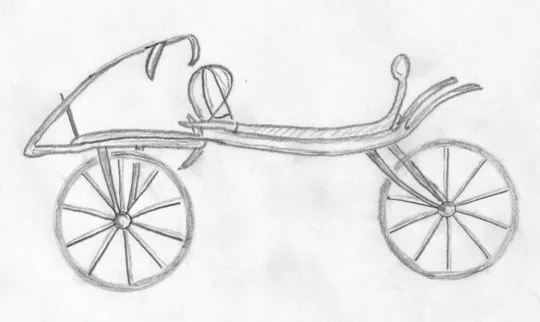
Figure 1.1Draisienne or Hobby Horse.
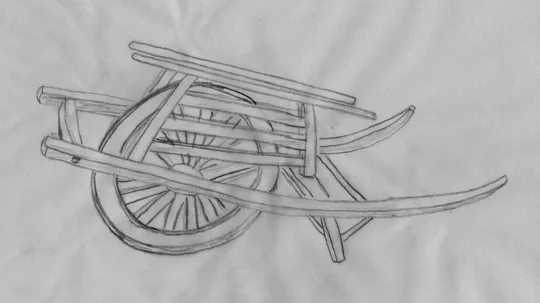
Figure 1.2Chinese wheelbarrow.
The historical timeline is an attempt to place the development of bicycles and bicycling in both a chronological order, and in relationship to other events going on in the world.
A good historical example of the transfer of skills and knowledge from one field to another is illustrated by the company Lines Bros. Ltd. The two brothers are perhaps better known by their range of children's cycles called Tri-ang, now defunct, but still often seen in use. The Lines Brothers inherited a toy business from their uncle, one of the brothers studied woodwork at evening classes and later architectural design. The business grew producing a large range of toys, mainly from pressed steel. When World War II broke out, the British troops used American Thompson sub-machine guns, The Thompson factory was unable to meet the volume demanded by the British Army. The Lines Brothers stepped in, redesigning a British machine gun, so that it could be made in their toy factory using the machine tools and assembly lines which had been used for toy making. They made over a million STEN machine guns and 14,000,000 parts for Spitfires. After the war, this production was converted to making children's bicycles.
The development of the bicycle is also interlinked with the development of cars and motorcycles; but perhaps more importantly with the social and political changes in the world, and the development of materials and engineering production techniques.
NEEDS AND WANTS
When we talk about historical events and technological developments, we should remember that these are always developed to either satisfy a need or because somebody had a particular desire to do something special. When we look at cycle developments, this is exactly the case. It is also worth noting that most advances in science and engineering technology have been made either by upper-class people with time and money to investigate their interests, or hard-working poor people trying to resolve a social situation or a particular achievement.
Bicycles would never have been invented and developed if there wasn't a need or want for one. Let's have a look at what happened and how it happened. Let's go back to about the year 1700. London had started to recover from the bubonic plague, or black death, caused by rats. It killed 70,000 people in London and about half the population in India too. The great fire of London had destroyed the old City of London, doing a job of slum clearance and getting rid of the rats. So, in 1700, re-building work was underway in London and life was changing. The Bank of England was newly established and insurance was now available through Lloyds of London. Similar things were happening in the rest of the world. It was the start of the Georgian period—the Kings of England were all called George for the next 130 years.
At this point nobody wanted a bicycle, there was no need for one. However, things were changing. The next 100 years saw the American War of Independence, a revolution for self-rule and the French Revolution. Both with lots of bloodshed, but the most important revolution was about to follow—the Industrial Revolution. The building of factories and steam powered machinery changed how people lived and worked. This led to a need for transport, especially internal transport, for moving goods and people around the growing towns and between the towns.
EARLY BICYCLES
Let's have a look at how the bicycle developed over what was really a very short period of time. The industrial revolution had kicked in across the whole developed world at the start of the 19th Century. The engineering technology existed to build most things out of metal, and it was becoming fairly common place. Workshops were being set-up to make machines and tools. Engineering was becoming a profession with more people studying mathematics and mechanics both at university and in the growing number of municipal mechanics institutes in the provincial towns.
Tech note
Mechanics in this sense refers to the physical sciences, it is the correct name for the amalgam of pure physics and engineering science. Mechanics institutes, these are what have now become technical colleges, ran evening and weekend courses for mainly men who wanted to progress in the engineering and manufacturing trades and professions. They learnt the mathematics and mechanics of machines and how to make and repair them.
Draisienne or Hobby Horse
This is accepted as probably being the first bicycle. How it actually came about is subject to conjecture and propositions, but the story which is told seems very plausible. Baron Karl von Drais, who lived in the town of Mannheim in what is now Germany, studied mathematics, mechanics and architecture at Heidelberg University. It is worth noting that Heidelberg is the oldest university in Germany. Heidelberg University was the setting for the operetta The Student Prince, very much the place to be for young clever people, so we can suspect that Baron Karl von Drais was of such a class, and interestingly Mannheim is the town where the Diesel engine was invented. The two towns are about 15 miles apart—the journey would take a little over an hour in a carriage then, 15 minutes now. There was a gigantic volcanic eruption in 1816, so much so that it became known as the year without a summer all across central Europe. This sent the prices of food up, meaning that oats for horses were very expensive and people were looking for other forms of transport. Hence the invention of the Draisienne. When I read about this the first time, I had a problem of actually picturing the use of a Draisienne. I couldn't see it on the cobbled streets of Burnley. However, now I live in a sea-side town in Kent, I see all sorts of contraptions being ridden on the smooth surface of the promena...
Table of contents
Cover
Half Title
Title
Copyright
Dedication
Contents
Foreword
Preface
Abbreviations and symbols
1 Brief history of bicycles and bicycling: Hobby Horse to balance bike—a brief history of bicycles and bicycling
2 Holding it together—the frame
3 Road holding—wheels and tyres
4 Making it go—gears and drive
5 Stopping—brakes and braking
6 Let's get comfortable—saddles and handle bars
7 Electrical power
8 Add-ons and kit
9 Materials for bicycles
10 Soldering, brazing and welding
11 Reinforced composite materials
12 Data
13 Health, safety, security and the environment
14 The bicycle industry
15 Science terminology
16 Service and repair
Glossary
Index
Trusted by 375,005 students
Access to over 1.5 million titles for a fair monthly price.
Study more efficiently using our study tools.
Frequently asked questions
Yes, you can cancel anytime from the Subscription tab in your account settings on the Perlego website. Your subscription will stay active until the end of your current billing period. Learn how to cancel your subscription
No, books cannot be downloaded as external files, such as PDFs, for use outside of Perlego. However, you can download books within the Perlego app for offline reading on mobile or tablet. Learn how to download books offline
Perlego offers two plans: Essential and Complete
Essential is ideal for learners and professionals who enjoy exploring a wide range of subjects. Access the Essential Library with 800,000+ trusted titles and best-sellers across business, personal growth, and the humanities. Includes unlimited reading time and Standard Read Aloud voice.
Complete: Perfect for advanced learners and researchers needing full, unrestricted access. Unlock 1.5M+ books across hundreds of subjects, including academic and specialized titles. The Complete Plan also includes advanced features like Premium Read Aloud and Research Assistant.
Both plans are available with monthly, semester, or annual billing cycles.
We are an online textbook subscription service, where you can get access to an entire online library for less than the price of a single book per month. With over 1.5 million books across 990+ topics, we’ve got you covered! Learn about our mission
Look out for the read-aloud symbol on your next book to see if you can listen to it. The read-aloud tool reads text aloud for you, highlighting the text as it is being read. You can pause it, speed it up and slow it down. Learn more about Read Aloud
Yes! You can use the Perlego app on both iOS and Android devices to read anytime, anywhere — even offline. Perfect for commutes or when you’re on the go. Please note we cannot support devices running on iOS 13 and Android 7 or earlier. Learn more about using the app
Yes, you can access Bicycle Engineering and Technology by Andrew Livesey in PDF and/or ePUB format, as well as other popular books in Technology & Engineering & Industrial Design. We have over 1.5 million books available in our catalogue for you to explore.