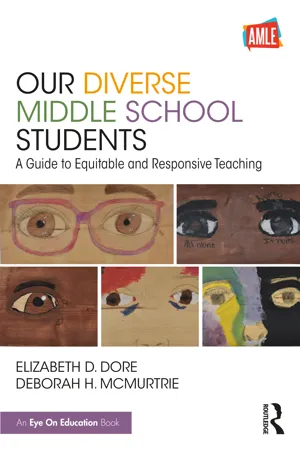
Learn how to be more responsive to the diversity among your middle schoolers. This important book, co-published with the Association for Middle Level Education (AMLE), helps you understand racial, ethnic, linguistic, socioeconomic, gender, intellectual, and social aspects of diversity, and consider how they relate to the unique needs and development of young adolescents. Each chapter begins with a brief case study, followed by background information, questions to consider, practical strategies, and appendices with additional resources. With the helpful advice in this book, you'll be better prepared to create a more equitable learning environment for all.
eBook - ePub
Our Diverse Middle School Students
A Guide to Equitable and Responsive Teaching
- 140 pages
- English
- ePUB (mobile friendly)
- Available on iOS & Android
eBook - ePub
Our Diverse Middle School Students
A Guide to Equitable and Responsive Teaching
About this book
Trusted by 375,005 students
Access to over 1.5 million titles for a fair monthly price.
Study more efficiently using our study tools.
Information
Topic
EducationSubtopic
Education General1
Who Are Middle School Students?
Case Study
Ms. Kelly had always dreamed of being a second-grade teacher. Unfortunately, when she graduated from college, there were no elementary school jobs to be had. The day before school started, she finally got a job offer. It was for a seventh-grade social studies position at Westside Middle School, a high-need, low-income school. She was terrified, but she desperately needed the job so she accepted the offer.
On the first day of school, when the homeroom bell rang, Ms. Kelly looked out at the sea of faces in her classroom. She noticed some of the girls were tall and physically mature, while many of the boys were short and looked very young. Some of the students were dressed in new, trendy clothing, while others wore shabby hand-me-downs. One student near the front of the class wore a hearing aid, while another student with special needs required his own shadow. Some students looked her straight in the eye, but others looked down. A small group of girls spoke quietly in Spanish in the back of the room. More than half of her students were African American. A handful were Asian. One girl wore a hijab; the rest of her students were Latino.
Ms. Kelly, who was white, realized none of the students in the room looked like her. She wondered about the students' backgrounds. What were their families like? What challenges did they face at home and at school? She wondered about their abilities, interests, and needs. She asked herself, “How will I be able to engage, challenge, and support such a diverse group of students?”
Chapter Content
Young adolescents in the 10–15-year-old age group face a period when their lives are surrounded by confusion, disorder, turmoil, chaos, and change. Middle-level students are acutely aware of the smallest differences between their peers and themselves. They undergo rapid changes—physical, social, emotional, and cognitive. One day a young person may be absolutely sure of everything and the next day not sure of anything. Young adolescents find themselves in situations where they are treated neither as children nor as adults. They find themselves wanting to identify as individuals yet routinely conform to dress, attitude, and activities of their peer groups.
Increasingly, young adolescents have to deal with less support from traditional sources. Many times, a single parent has more than one job just to make ends meet; “latchkey kids,” with no adult at home after school, are more and more common. Because of the transient nature of families today, there are fewer opportunities for extended family members to provide support for young adolescents. Combine this lack of support with the rapid changes and constant peer pressure young adolescents experience, and it is easy to see the bewildering choices this new stage of life has thrust upon them.
In this book we will discuss a variety of different issues and how they affect young adolescents during a time of great growth. When reflecting on these characteristics, we need to understand the importance of diversity when discussing young adolescents. Just as tadpoles change to frogs, so do our middle schoolers change from young children to young adolescents, and then, to beautiful people. But, they are diverse, each with his or her own kind of beauty.
Young adolescents, who are in schools or classes comprising only one cultural group, need to learn about other cultures and ethnicities in order to be prepared for the world outside their own. As difficult as it is to imagine, there are young people who have never seen anyone who looks different or who thinks differently, until they go away to college or enter the military. Isn't this all the more reason to raise awareness of many types of diversity? When students with physical or intellectual disabilities are mainstreamed in regular classes, both those with and without disabilities learn from each other. Students learn to be more caring, understanding, and aware of individuals and how they can be different; they also learn about their own strengths and weaknesses and how to work and learn together. But, cultures and physical and intellectual abilities and disabilities are not the only qualities which make people diverse. Family makeup—single parents, same-sex parents, adoptive parents, grandparents, parents who work outside the home, family expectations for the young adolescent, and opportunities available to the student—all are diverse situations. Sexual orientation, learning modalities and abilities, and even geographical location and accent may also be included.
One way to help young adolescents learn to accept differences of all kinds—physical, social, emotional, and cognitive—is to make them aware of books and films that can help them understand their own and other cultures. At the same time, they must be careful not to reinforce misconceptions and stereotypes.
No longer are the majority of classrooms filled with students who all live in the same neighborhood, go to the same church, and eat the same food. Students whose second language is English, who wear different clothes, and have different traditions are moving into previously all white neighborhoods at a rapid pace. Teaching approaches and school curricula must be adapted to address this change.
Characteristics of Young Adolescents
- They are bright and curious.
- They are sensitive and aware of how they are perceived.
- They struggle with issues around ethnicity, race, and gender.
- They respond to support and exhortations to improve.
- Many assume tremendous responsibilities in their families and church communities, causing them to be more adult-like than many adults expect.
- They have high aspirations and want well-paying jobs; they do not know the instrumental steps to reach their goals.
- They are loyal, care about what significant others think of them, and do not want to disappoint these people.
- They respond to discipline, structure, and consistency.
- They respond to caring, firm, friendly adults who they trust and respect and by whom they feel cared for and respected.
- They work when what they are doing has meaning in their daily lives and will help them achieve a goal or a dream.
- They learn and achieve when taught as if this is expected.
- Their parents and families are concerned, and use suggestions and respond to coaching from teachers.
- Their parents and extended families are proud when they do well and support their efforts and achievements.
Questions to Consider
- Describe six or more dimensions of diversity in today's middle school classrooms. Include individual differences and group differences.
- Visit a middle school classroom. How would you describe the students in terms of racial, ethnic, and socioeconomic (SES) dimensions or differences?
- How do the teachers at this school demonstrate they value and respect diversity?
- If the students are grouped by “ability,” what does a gifted and talented classroom look like? What does a special education classroom look like? How are the different races represented in advanced vs. remedial classes?
- Who are the exceptional and culturally different students in your school? What are the characteristics or factors which make them exceptional and culturally different?
Strategies for Teachers
- Listen to your middle school students—REALLY listen.
- Learn who they are and what they are about.
- What are their hobbies, special abilities, and dreams?
- What is their home life like?
- What strengths and talents do they bring to the classroom?
- Provide opportunities for physical, social, and emotional development.
2
Racial and Ethnic Diversity
Case Study
Diane Parker was a 55-year-old white female who had grown up during the Civil Rights era. As a child, Diane lived in an all-white neighborhood, attended segregated schools, and had limited contact with people of color. Although she didn't like to talk about it, she grew up in a home which explicitly used racist language. This experience, coupled with negative and violent stereotypes of people of color she had seen in the media, reinforced the stereotype—African Americans were poor, uneducated, and deficient.
After staying home to raise three children, Diane had returned to college to finish her degree. She had recently accepted a teaching position at a local middle school, and it was her first day. The culture of this school was foreign to her. In her opinion, the students were loud and disrespectful. They had difficulty sitting still. By the end of third period, she was contemplating quitting. Then, her fourth period class—a gifted and talented (GT) group—arrived. What a difference! These students listened well, spoke ‘proper’ English, and stayed in their seats. Suddenly, Mrs. Parker realized all of the students in this GT class were white. Later, she asked one of the other teachers about it.
“It seems my classes are all either disproportionately black and brown or white,” she said. “Are your classes like that too?”
“Yes,” replied the other teacher. “The kids in your lower sections are going to be your discipline problems. Don't hesitate to write them up. After three detentions, those kids will get in-school suspension. Once they are out of your classroom, your job will be much easier.”
“Doesn't it seem a bit unfair?” asked Mrs. Parker. “I mean, if they're not in the classroom, they can't learn.”
“Do you really want to deal with them?” asked the other teacher.
“I'm not sure,” said Mrs. Parker. “I want to help them, but I just don't know how.”
Chapter Content
Although many people think racism is a thing of the past, it continues to rear its ugly head, sometimes in insidious ways.
Racism is a system of oppression which is pervasive, restrictive, and hierarchal (Bell, 2010). Racism functions “not only through overt, conscious prejudice and discrimination but also through the unconscious attitudes and behaviors of a society that presumes an unacknowledged but pervasive white cultural norm” (Bell, 2010, p. 24). Thus, racism creates and maintains a dominant power structure.
Perhaps the most urgent challenge facing the nation is “providing high-quality schooling for all students, especially those presently underserved by the educational system, including students of color, low-income students, English language-learners and students in rural and urban settings...
Table of contents
- Cover
- Half Title
- Series
- Title
- Copyright
- Dedication
- Contents
- List of Tables
- Introduction
- 1 Who Are Middle School Students?
- 2 Racial and Ethnic Diversity
- 3 Linguistic Diversity
- 4 Socioeconomic Diversity
- 5 Family Structures
- 6 Physical Diversity
- 7 Gender and Sexual Diversity
- 8 Intellectual Diversity
- 9 Emotional Diversity
- 10 Social Diversity
- 11 Geographical Diversity
- 12 Religious Diversity
- 13 Developing a Diverse Curriculum
- 14 Differentiating Instruction
- Conclusion
- Appendix A: Recommended Adolescent Literature (Current)
- Appendix B: Recommended Adolescent Literature (Classics)
- Appendix C: Association for Middle Level Education Standards
- Appendix D: AMLE Essential Attributes and Characteristics
Frequently asked questions
Yes, you can cancel anytime from the Subscription tab in your account settings on the Perlego website. Your subscription will stay active until the end of your current billing period. Learn how to cancel your subscription
No, books cannot be downloaded as external files, such as PDFs, for use outside of Perlego. However, you can download books within the Perlego app for offline reading on mobile or tablet. Learn how to download books offline
Perlego offers two plans: Essential and Complete
- Essential is ideal for learners and professionals who enjoy exploring a wide range of subjects. Access the Essential Library with 800,000+ trusted titles and best-sellers across business, personal growth, and the humanities. Includes unlimited reading time and Standard Read Aloud voice.
- Complete: Perfect for advanced learners and researchers needing full, unrestricted access. Unlock 1.5M+ books across hundreds of subjects, including academic and specialized titles. The Complete Plan also includes advanced features like Premium Read Aloud and Research Assistant.
We are an online textbook subscription service, where you can get access to an entire online library for less than the price of a single book per month. With over 1.5 million books across 990+ topics, we’ve got you covered! Learn about our mission
Look out for the read-aloud symbol on your next book to see if you can listen to it. The read-aloud tool reads text aloud for you, highlighting the text as it is being read. You can pause it, speed it up and slow it down. Learn more about Read Aloud
Yes! You can use the Perlego app on both iOS and Android devices to read anytime, anywhere — even offline. Perfect for commutes or when you’re on the go.
Please note we cannot support devices running on iOS 13 and Android 7 or earlier. Learn more about using the app
Please note we cannot support devices running on iOS 13 and Android 7 or earlier. Learn more about using the app
Yes, you can access Our Diverse Middle School Students by Elizabeth D. Dore,Deborah H. McMurtrie in PDF and/or ePUB format, as well as other popular books in Education & Education General. We have over 1.5 million books available in our catalogue for you to explore.