The piling industry has, in recent years, developed a variety of press-in piling technologies with a view to mitigate noise & vibration nuisance. This book focuses on the "Walk-on-Pile" type press-in piling system, which offers an alternative engineering solution for piling works. This type of piling has unique features, including the application of the compact piling machine using pre-installed piles as a source of reaction force to jack in a new pile by hydraulic pressure. Moreover, the machine can walk along the top of piles already installed, thus enabling piling in a limited space and headroom with minimum disruption to social functions and services of existing infrastructure. These features are opening up a new horizon in piling, leading to novel application of embedded walls previously considered impossible.
This introductory book provides a historical development of press-in piling and various challenging applications worldwide as well as scientific research outcomes, forming a valuable source of reference for readers who are unfamiliar with press-in piling, including project owners, design engineers, practical engineers as well as researchers and students.
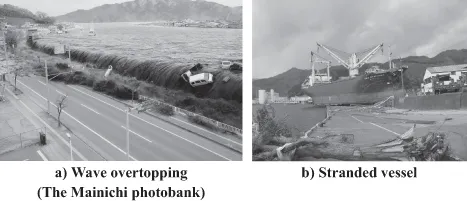
The Great East Japan Earthquake with a moment magnitude (M) of 9.0 occurred along a subduction zone in the Pacific Ocean on March 11, 2011, and the earthquake triggered enormous tsunami disasters as shown in Figure 1.1. The maximum height of over 21 m was recorded at Fukushima Prefecture. Intensive investigation of damage to structures demonstrates significant advantages of embedded structures over gravity-type structures against tsunami disasters.
Figure 1.1 Tsunami disasters caused by the Great East Japan Earthquake. (a) Wave overtopping (the Mainichi photobank). (b) Stranded vessel.
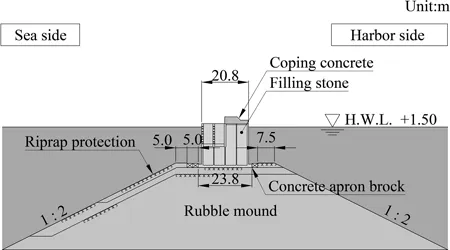
A typical gravity-type structure is a breakwater caisson constructed on a rubble mound, as illustrated in Figure 1.2.
Figure 1.2 Typical breakwater caisson on a rubble mound.
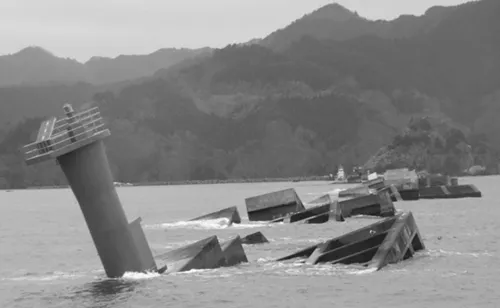
Figure 1.3 is a view of the failed caisson-type breakwater constructed on a rubble mound in Kamaishi Port, of which the depth is −63 m, the Deepest Breakwater according to Guinness World Records. Twelve out of 22 caissons were damaged.
Figure 1.3 A view of failed breakwater in Kamaishi Port. (Tohoku Regional Development Bureau, MLIT Japan).
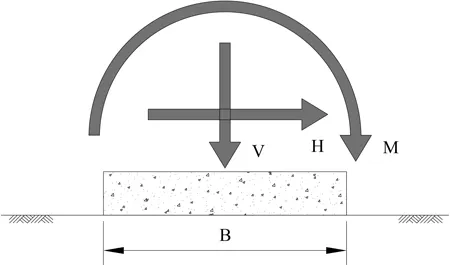
Gravity-type structures must meet three stability requirements: (i) stability of vertical bearing capacity, (ii) sliding stability, and (iii) overturning moment stability. The situation may be idealized as a footing with a width of B resting on the ground surface subjected to combined loads of vertical load (V), horizontal load (H), and moment (M) as illustrated in Figure 1.4.
Figure 1.4 Footing subjected to combined loads.
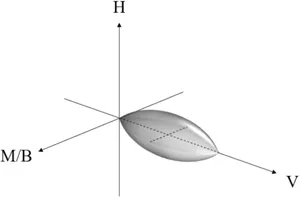
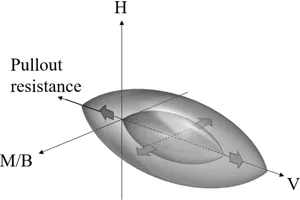
Theoretical and experimental evidence on the failure of the footing can be summarized in a three-dimensional form of failure envelope shown in Figure 1.5. Working load conditions must be within the failure envelope for safe operation.
Figure 1.5 Failure envelope of a footing.
Tsunami flow reduces the effective self-weight of the structure due to the buoyancy force, which is generally considered to increase the safety against vertical bearing failure, although the bearing capacity may decrease to some extent when the tsunami flow generates seepage in a rubble mound. The buoyancy force, in turn, decreases frictional resistance at the base of the footing, and the tsunami flow also increases the horizontal force acting on the foreside wall of the structure due to the water level difference between the sea side and the harbor side. These two combined effects would decrease the safety against sliding failure. The tsunami flow also greatly increases the overturning moment because the moment arm from the base to the point of resultant horizontal forces becomes longer, and meanwhile the horizontal force also increases in magnitude. These resultant effects lead to a decrease in safety against overturning failure. Failure modes, therefore, may vary with the loading conditions to which the structure is subjected.
When a tsunami overflows a breakwater, it causes scouring of the mound below the structures which may then tilt or topple. Hydraulic engineers also point out that negative pressure generated on the backside of the structure under a tsunami overflow causes horizontal destabilizing forces to increase based on laboratory experiments.
Another typical example of gravity-type structure is buildings with spread foundation. A number of buildings and residential houses with spread foundations were swept away due to tsunami flows, as shown in Figure 1.6.
Figure 1.6 Overturned building with spread footing.
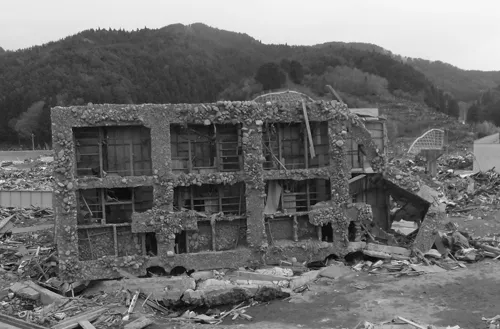
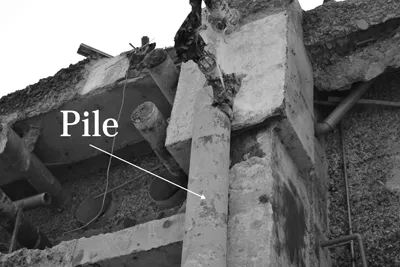
Figure 1.7 is a toppled four-story, steel frame building supported by a friction pile foundation consisting of pre-stressed concrete piles with a diameter of 300 mm. In Figure 1.7, it is seen that one pile is hanging from its foundation. Building engineers consider that the combined effects of buoyancy forces and horizontal forces may be the main reason for the damage. Insufficient embedment may mean that piled foundations are not sufficiently resilient against strong tsunami flows. Some geotechnical engineers suspect that soil liquefaction may have occurred prior to the arrival of the tsunami flow at this particular location, reducing the pullout resistance of the friction piles.
Figure 1.7 Toppled four-story building with pile foundation (Tamura, 2012).
However, properly embedded structures can be considered to be resilient against even a severe tsunami. The embedment effects increase the vertical bearing capacity largely due to overburden pressure, and increase the pullout resistance (negative vertical bearing capacity) due to frictional resistance along the periphery of the embedded parts of the structure. The embedment effects also increase the horizontal resistance mainly due to the mobilization of passive earth pressure on the side walls of the embedded elements of the structure. Similarly, the moment resistance increases benefitted by the mobilization of passive earth pressure as well as frictional resistance at the side walls and at the base of the structure.
Referring to the rugby ball-shaped failure envelope shown in Figure 1.5, the embedment effects significantly enlarge the size of the failure envelope and create additional pullout resistance, as illustrated in Figure 1.8.
Figure 1.8 Effect of embedment on failure envelope.
When the structure is firmly embedded, and the failure envelope becomes sufficiently large relative to working loads, an unconfined failure mechanism is virtually impossible to form and the structure behaves in a resilient manner.
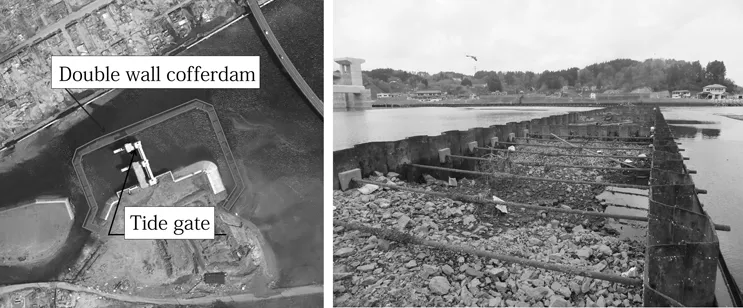
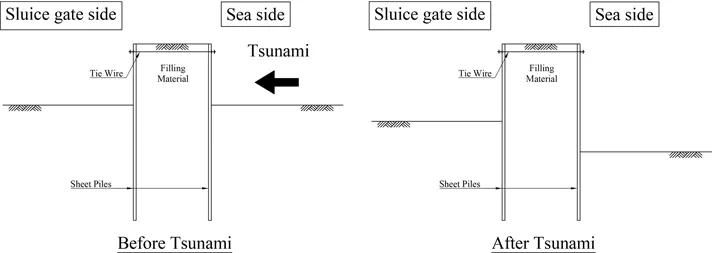
Figure 1.9 is a view of a temporary double-walled cofferdam comprising two parallel rows of steel sheet piles driven into the ground and connected together by a system of tie rods at one level. The space between the walls was filled with granular materials such as sand, gravel, or broken rock. Figure 1.10 illustrates the situations before and after the tsunami, indicating about 2 m depth of erosion on the sea side.
Figure 1.9 Double-walled cofferdam with no structural damage.
Figure 1.10 Situations before and after tsunami.
As shown in Figure 1.9, no structural damage was observed either at the steel sheet piles or of the tie rods, although the upper part of the backfill materials was scoured and washed away to about 1 m depth. This example clearly demonstrates that embedded structures are resilient and have advantages over gravity-type structures against tsunami disasters. A sufficiently embedded structure may be designated an “implant structure”.
1.2 Steel as a construction material
Steel is a ductile material with high tensile strength in comparison with other major construction materials such as soil, rock, and concrete. Steel makers supply steel for a wide range of engineering applications, including civil engineering applications such as foundations, for port and harbor structures, and for forestry conservation.
Geotechnical engineers have long been familiar with U-shaped steel sheet piles for temporary retaining construction and coffering as well as permanent structures. Steel tubular piles are also widely used for civil engineering structures, such as retaining walls, foundations, port and harbor facilities, countermeasures for landslides, and more recently liquefaction countermeasures for river and coastal levees.
According to the statistics of the year 2014 published by the Japan Iron and Steel Federation, demand for steel sheet piles in Japan was as much as 597,000 tons in total, in which 361,000 tons were for permanent structures and 236,000 tons for temporary structures. Major areas of applications were forestry conservation and flood control (279,000 ton), port and harbor structures (38,000 tons), and others (44,000 tons).
Embedded structures using steel sheet piles/steel tubular piles offer resilient structures. The Japanese Association for Steel Pipe Piles and Steel Sheet Piles conducted damage investigations on structures after the Great East Japan Earthquake, covering river levees with seismic countermeasures, river revetments, road retaining structures, and cofferdams. All the structures adopted steel sheet piles. The investigation confirmed that no damage or minor damage was observed and all the structures remained sound. As demonstrated in Figure 1.9 as an example, the temporary double-walled cofferdams comprising two parallel rows of steel sheet piles survived against the Great East Japan Earthquake.
1.3 Design and construction requirements
Many developing countries with an increasing population have been experiencing urbanization at an accelerating rate. Existing urban infrastructure in these regions is insufficient to accommodate an increasing social pressure, both in terms of volume of demand and in terms of quality of de...
Table of contents
Cover
Half Title
Title Page
Copyright Page
Table of Contents
List of figures
List of tables
Preface
1 Introduction
2 Construction by press-in piling
3 Innovative applications
4 Emerging applications
5 Responses of piles installed by the press-in piling
Appendix: List of related publications
Index
Trusted by 375,005 students
Access to over 1.5 million titles for a fair monthly price.
Study more efficiently using our study tools.
Frequently asked questions
Yes, you can cancel anytime from the Subscription tab in your account settings on the Perlego website. Your subscription will stay active until the end of your current billing period. Learn how to cancel your subscription
No, books cannot be downloaded as external files, such as PDFs, for use outside of Perlego. However, you can download books within the Perlego app for offline reading on mobile or tablet. Learn how to download books offline
Perlego offers two plans: Essential and Complete
Essential is ideal for learners and professionals who enjoy exploring a wide range of subjects. Access the Essential Library with 800,000+ trusted titles and best-sellers across business, personal growth, and the humanities. Includes unlimited reading time and Standard Read Aloud voice.
Complete: Perfect for advanced learners and researchers needing full, unrestricted access. Unlock 1.5M+ books across hundreds of subjects, including academic and specialized titles. The Complete Plan also includes advanced features like Premium Read Aloud and Research Assistant.
Both plans are available with monthly, semester, or annual billing cycles.
We are an online textbook subscription service, where you can get access to an entire online library for less than the price of a single book per month. With over 1.5 million books across 990+ topics, we’ve got you covered! Learn about our mission
Look out for the read-aloud symbol on your next book to see if you can listen to it. The read-aloud tool reads text aloud for you, highlighting the text as it is being read. You can pause it, speed it up and slow it down. Learn more about Read Aloud
Yes! You can use the Perlego app on both iOS and Android devices to read anytime, anywhere — even offline. Perfect for commutes or when you’re on the go. Please note we cannot support devices running on iOS 13 and Android 7 or earlier. Learn more about using the app
Yes, you can access New Horizons in Piling by Malcolm D. Bolton,Akio Kitamura,Osamu Kusakabe,Masaaki Terashi in PDF and/or ePUB format, as well as other popular books in Technology & Engineering & Civil Engineering. We have over 1.5 million books available in our catalogue for you to explore.