eBook - ePub
Skin Reactions to Drugs
- 192 pages
- English
- ePUB (mobile friendly)
- Available on iOS & Android
eBook - ePub
About this book
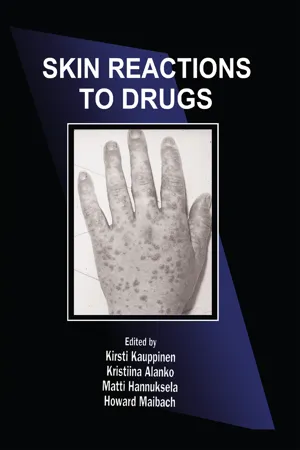
Skin reactions to drugs are a ubiquitous problem-the most commonly observed drug sensitivity observed in a wide range of specialties. Skin Reactions to Drugs emphasizes the mechanisms and clinical and laboratory proof of a cause-and-effect relationship between drugs and adverse reactions. It discusses the technique of drug challenge, which has been extensively developed in Finland, but not commonly practiced in the rest of the world.
In this textbook, 12 of the most common drug eruptions are described both clinically and histologically. It features a chapter on systemic contact dermatitis and also addresses cutaneous adverse drug reactions that appear in HIV-infected patients. 40 full-color photographs provide vivid examples of the reactions being discussed. A highly practical resource for practicing physicians and other health care workers, Skin Reactions to Drugs represents the platinum standard of research conducted on the causation of certain adverse reactions of skin.
Information
1____________________________
Introduction
Kirsti Kauppinen
Side-effects of drugs cannot be avoided. Neither in vitro nor animal tests prior to the clinical use are usually useful in predicting probable hypersensitive reactions to drugs. In addition, clinical trials cannot identify those drugs that cause adverse reactions only in a small number of users or after prolonged and recurrent administration.1 Interactions of drugs ingested simultaneously may also be unexpected and an individual response to a drug is often unpredictable.
Adverse effects of drugs are mediated by different pathomechanisms and many organs such as lungs, kidneys, liver, and bone marrow can be involved. Skin reactions are the most frequent manifestation of drug sensitivity.2 Hypersensitivity reactions are dose dependent as has been stated in reports of drug challenge.3,4
Since the drugs in current use may vary between countries and also in time, lists of the most common drugs causing eruptions may not be valid for long. However, the drugs that cause the most frequent and most severe adverse reactions are eventually globally abandoned but usually only after several years.
The incidence of adverse reactions specific to a drug will generally be related to the frequency of a drug prescribed and the total amount of it used. Some drugs, however, are more prone to provoke side effects than others. For example sulfonamides, especially the long-acting products, have been incriminated for inducing severe mucocutaneous eruptions for decades. Thus, at present their use is greatly diminished, and the frequency of Stevens-Johnson syndrome and toxic epidermal necrolysis caused by sulfonamides has also remarkably decreased (see Table 1).3,5,6,7 In a series of 1426 patients from 1961 to 1990, antimicrobial agents, non-steroidal anti-inflammatory drugs (NSAIDS), and drugs acting on the central nervous system were the main groups of causative drugs over the years.3,5,6,7 Skin manifestation is usually the only sign of drug sensitivity, but it may be accompanied by general symptoms such as fever and malaise. In severe cases different organs may also be involved.
Follow-up years |
Stevens-Johnson syndromea |
Toxic epidermal necrolysisa |
Ref. |
|---|---|---|---|
1961–70 |
11/16 |
28/36 |
3 |
1971–80 |
3/8 |
7/8 |
5 |
1981–90 |
0/2 |
1/3 |
6,7 |
a Cases caused by sulfonamides/total number of cases.
Distinguishing the origin of an eruption by a clinical picture is usually not possible because similar skin reactions may also be caused by various infections. Moreover, it is impossible to prove that a certain drug is responsible for a skin reaction by inspection alone.4
Incidence of skin reactions per dose is difficult to estimate because mild and transitory eruptions are not reported to the monitoring agencies. In contrast, some reports may be falsely attributed to drugs.
In this textbook, 12 of the most common drug eruptions have been described both clinically and histologically. The chapter of systemic contact dermatitis is included for the first time in a textbook concerning skin reactions to drugs. In addition, attention has been paid to cutaneous adverse drug reactions appearing in HIV-infected patients. New diagnostic methods, having been poor previously, are developed continuously. Studies on both skin testing and in vitro tests are in progress. However, a drug challenge is, thus far, the most reliable method to confirm a causative agent. It is relatively safe when performed rationally and with caution.4
REFERENCES
1. Breathnach, S. and Hintner, H., Adverse Drug Reactions and the Skin, Blackwell Scientific Publications, Oxford, 1992, 3.
2. Sherman, W. B., Drug allergy, S Med J, 64, 22, 1971.
3. Kauppinen, K., Cutaneous reactions to drugs with special reference to severe bullous mucocutaneous eruptions and sulphonamides. Acta Derm Venereol (Stockh.), 52, suppl. 68, 1972.
4. Kauppinen, K. and Alanko., K., Oral provocation: Uses, Semin Dermatol, 8, 187, 1989.
5. Kauppinen, K. and Stubb, S., Drug eruptions, causative agents and clinical types, a series of in-patients during 10-year period, Acta Derm Venereol (Stockh.), 64, 320, 1984.
6. Alanko, K., Stubb, S., and Kauppinen, K., Cutaneous drug reactions, clinical types and causative agents, Acta Derm Venereol (Stockh.), 69, 223, 1989.
7. Stubb, S., Heikkilä, H., and Kauppinen, K., Cutaneous reactions to drugs, a series of in-patients during a five-year period, Acta Derm Venereol (Stockh.), 74, 289, 1994.
2____________________________
Epidemiology of Severe Cutaneous Drug Reactions
Maja Mockenhaupt and Erwin Schöpf
CONTENTS
2.1 Introduction
2.2 Definition of the Diseases and Diagnostic Criteria
2.2.1 Terminology and Type of Skin Lesions
2.2.2 Consensus Definition of Severe Skin Reactions
2.2.3 Mucosal Involvement
2.2.4 Sequelae
2.2.5 Histopathology
2.2.6 Differential Diagnoses
2.3 Pathogenetic Approaches
2.4 Epidemiology
2.4.1 Incidence and Demography
2.4.2 Etiologic Factors and Risk Estimation
References
2.1 INTRODUCTION
A variety of cutaneous adverse reactions, leading from mild maculo-papular rashes to life-threatening conditions, may be caused by drugs. Erythroderma, exfoliative dermatitis, and acute generalized exanthematic pustulosis (AGEP) as well as blistering diseases such as pemphigus vulgaris, bullous pemphigoid, generalized bullous fixed drug eruption (GBFDE), Stevens-Johnson syndrome (SJS) and toxic epidermal necrolysis (TEN) are often drug-induced. For several decades mainly case reports and case series were published, whereas more recently epidemiologic studies have been undertaken, allowing presentation of reliable data on the incidence, demography, as well as the etiology of severe skin reactions. The pre-condition for these studies and the analysis of data was a consensus definition of the clinical classification of severe, mainly drug-induced skin reactions in the spectrum of Stevens-Johnson syndrome and toxic epidermal necrolysis.
2.2 DEFINITION OF THE DISEASES AND DIAGNOSTIC CRITERIA
2.2.1 Terminology and Type of Skin Lesions
In general, S...
Table of contents
- Cover
- Half Title
- Title Page
- Copyright Page
- Preface
- The Editors
- Contributors
- Table of Contents
- Chapter 1 Introduction
- Chapter 2 Epidemiology of Severe Cutaneous Drug Reactions
- Chapter 3 Mechanisms of Drug Reactions
- Chapter 4 Clinical Manifestations and Histological Characteristics
- Chapter 5 Systemic Contact Dermatitis
- Chapter 6 Cutaneous Adverse Drug Reactions in HIV-Infected Persons
- Chapter 7 Diagnosis of Drug Eruptions: Clinical Evaluation and Drug Challenge
- Chapter 8 Skin Testing in Drug Hypersensitivity
- Chapter 9 Patch Testing in Systemic Drug Eruptions
- Chapter 10 In Vitro Testing for Adverse Drug Reactions
- Chapter 12 General Aspects of Treatment
- Chapter 13 Treatment of Anaphylaxis
- Chapter 14 Treatment of SJS and TEN
- Chapter 15 Drugs Causing Cutaneous Reactions
- Index
Trusted by 375,005 students
Access to over 1.5 million titles for a fair monthly price.
Study more efficiently using our study tools.
Frequently asked questions
Yes, you can cancel anytime from the Subscription tab in your account settings on the Perlego website. Your subscription will stay active until the end of your current billing period. Learn how to cancel your subscription
No, books cannot be downloaded as external files, such as PDFs, for use outside of Perlego. However, you can download books within the Perlego app for offline reading on mobile or tablet. Learn how to download books offline
Perlego offers two plans: Essential and Complete
- Essential is ideal for learners and professionals who enjoy exploring a wide range of subjects. Access the Essential Library with 800,000+ trusted titles and best-sellers across business, personal growth, and the humanities. Includes unlimited reading time and Standard Read Aloud voice.
- Complete: Perfect for advanced learners and researchers needing full, unrestricted access. Unlock 1.5M+ books across hundreds of subjects, including academic and specialized titles. The Complete Plan also includes advanced features like Premium Read Aloud and Research Assistant.
We are an online textbook subscription service, where you can get access to an entire online library for less than the price of a single book per month. With over 1.5 million books across 990+ topics, we’ve got you covered! Learn about our mission
Look out for the read-aloud symbol on your next book to see if you can listen to it. The read-aloud tool reads text aloud for you, highlighting the text as it is being read. You can pause it, speed it up and slow it down. Learn more about Read Aloud
Yes! You can use the Perlego app on both iOS and Android devices to read anytime, anywhere — even offline. Perfect for commutes or when you’re on the go.
Please note we cannot support devices running on iOS 13 and Android 7 or earlier. Learn more about using the app
Please note we cannot support devices running on iOS 13 and Android 7 or earlier. Learn more about using the app
Yes, you can access Skin Reactions to Drugs by Kirsti Kauppinen, Kristiina Alanko, Matti Hannuksela, Howard I. Maibach, Kirsti Kauppinen,Kristiina Alanko,Matti Hannuksela,Howard I. Maibach in PDF and/or ePUB format, as well as other popular books in Medicina & Dermatologia. We have over 1.5 million books available in our catalogue for you to explore.