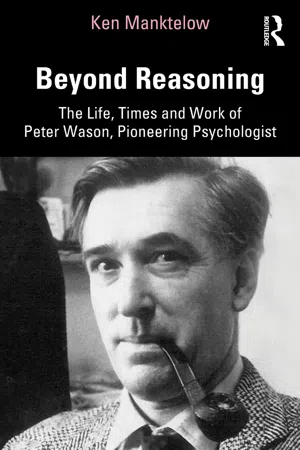
This book tells the story of Peter Cathcart Wason, offering unique insights into the life of the pioneering research psychologist credited for establishing a whole new field of science: the psychological study of reasoning. And this was just one of the major contributions he made to psychology.
Covering much more than Wason's academic work, the author, Ken Manktelow, paints a vivid and personal portrait of the man. The book traces Wason's eclectic family history, steeped in Liberal politics and aristocratic antecedents, before moving through his service in the Second World War and the life-changing injuries he sustained at the end of it, and on to his abortive first attempt at a career and subsequent extraordinary success as a psychologist. Following a chronological structure with each chapter dedicated to a significant transition period in Wason's life, Manktelow expertly weaves together personal narratives with Wason's evolving intellectual interests and major scientific discoveries, and in doing so simultaneously traces the worlds that vanished during the twentieth century.
A brilliant biography of one of the most renowned figures in cognitive psychology, this book will be of interest not only to students and scholars in thinking and reasoning, but to anyone interested in the life and lasting contribution of this celebrated scholar.
Trusted by 375,005 students
Access to over 1.5 million titles for a fair monthly price.
Peter Cathcart Wason was a remarkable man, and in 1966, at the age of 42, he did a remarkable thing. He was a research psychologist. He had been invited to contribute a chapter to a modest little paperback called New Horizons in Psychology, a collection of 21 surveys of the latest in psychological research, and he produced one, with the single-word title of ‘Reasoning’. There were several ways in which this was a remarkable thing to do. For a start, Wason was not at that time an eminent psychologist; he was not even a regular university academic, but a research associate attached to a university department, on a temporary contract paid for by an outside funding agency. Then, hardly any of his own publications had even been on reasoning. In fact, there was very little psychological work on reasoning by anyone to report on at that time, as Wason acknowledges in the very first sentence of his chapter; but as this was a book about ‘new horizons’, perhaps that would have been expected. He reviews such psychological work as had been done to that point, which included his own: a single publication that had appeared six years before.
The second of these first-person bits was tucked away in a two-page section headed ‘Errors in Deductive Reasoning’, and this is the most remarkable thing of all. It is a rather vague description of a novel reasoning task that Wason had invented some years earlier, along with a number-free report of some results, and a tentative hypothesis to account for them. Within a very short time, this little report was followed by a more formal scientific paper from Wason, then more and more, from him and from others, all using this new problem. Hundreds upon hundreds of studies followed, by scientists all around the world; the problem is still being used today. Wason’s chapter became one of the most influential book chapters in the history of psychological research, and led to insights which have permeated not just the research community, but general knowledge about how the human mind works.
This was neither the beginning nor the end of Wason’s inventiveness either: his first ever published research paper was featured on the front page of a national newspaper; his early research on language influenced government policy and also made the national press; he introduced two ideas that have not only influenced psychology but have permeated our collective consciousness; and he came up with several other novel techniques and ideas as well, both before and after this new problem, all fired by his lifelong, insatiable curiosity about the human mind.
We are all curious about how the mind works, and in that sense, we are all psychologists, of some kind. We spend a large part of our mental lives trying to explain, predict and influence what other people think, do and say. We even try to do this with our own thoughts and actions: remember those times when you have wondered to yourself, why did I do, or say, or think that? But you cannot actually call yourself a psychologist (in many parts of the world) unless you officially are one: it is a legally protected title, usable in a professional capacity only by those who have a recognised qualification. It takes a lot for official psychologists to influence the rest of us, but that is what Wason did.
Research psychologists do just what I’ve said that we all do: study and try to explain the human mind and human behaviour. But they do something extra. The difference is that they have a set of skills and conventions, in the shape of methods and theories and modes of communication, which enable them to do it systematically. A systematic approach is necessary if you want good explanations, because not all good explanations are available to everyday observation or intuition. In other words, you need to employ some science. Psychological research, therefore, is a branch of science, concerned, like any other, with finding things out, explaining them and testing those explanations to produce good theories that not only account for the observed facts, but predict new ones.
Only rarely do the theories and ideas that emerge from science cross an invisible but sturdy barrier into the wider culture and consciousness. Occasionally, when they do, people’s ideas about humanity, and even about themselves, are changed profoundly as a result. Think of Charles Darwin’s theory of evolution by natural selection, published in 1859, which changed the ‘folk biology’, the everyday understanding of the living world that people who are not biologists carry around with them, for instance; or, from closer to home, Stanley Milgram’s experiments on obedience a century later, which showed, against the expectations of both laypersons and experts, that large proportions of people can be led gently into acts of cruelty for no good reason.
More recently, and less disturbingly, a view has begun to seep into the collective consciousness, our ‘folk psychology’, that we have two distinct and different ways of thinking, perhaps even two minds battling it out inside the one head. It is known by psychologists as the dual-process or dual-system theory of thought. This view was given its greatest recent boost by the publication in 2011 of a best-selling book by the Nobel prize-winning economic psychologist Daniel Kahneman, called Thinking, fast and slow. The book’s title sums up the idea of the two minds: a quick, intuitive, automatic process and a slower, reflective, effortful process.
The emergence in present-day psychology of the idea of the two thinking processes, fast and slow, is interesting because firstly, it is not really a new idea at all: it can be traced back a long way, even as far as the ancient Greek philosophers of over 2,000 years ago. Plato, for example, discussed the familiar experience of akrasia, or weakness of the will: you know you shouldn’t have that extra drink, or that you should clean out the catbox, and yet you decide to have another one, or to find something else to do instead. There is the decision about the deed on the one hand (the need to do or not do it), and your thoughts about what you actually did (that what you ended up doing was not what you should have done) on the other. Of course, it’s not always negative: we can choose something and then, on reflection, be glad we did. The point is that the two thoughts – the initial decision and its later evaluation – are two quite distinct processes. So distinct, indeed, that we may not have any awareness of what made us make the initial choice at all. To compound the problem for our folk psychology, only the slow reflective process tends to be conscious; the fast process often happens without our being aware that the mind is doing anything: it is effortless and automatic.
The difference between ancient Greece and the present day as far as the dual-process idea is concerned is that since the 1970s, it has been subject to extensive scientific testing, as well as theorising, such that we can now have whole books and college courses on the subject. That didn’t happen in classical Athens. The scientific study of two-minds thinking in the modern era began with the work of Peter Wason, and it used the little problem he outlined in 1966. Even the term ‘dual processes’ in this context is a Wason coinage. There is another point worth noting that arises from an account of Wason’s singular importance in our contemporary understanding of the human mind: nowhere in Kahneman’s book does the name of Wason appear. This fact has caused something approaching outrage in some quarters.
The aim of this book is not just, or not even, to put right this egregious wrong; academic credit wars in any case only tend to exercise those directly involved. Wason was remarkable not only for this particular contribution to human understanding, although that would be reason enough to admit him to a scientific hall of fame. As would his other discoveries, inventions and ideas. But apart from this – quite a big ‘apart’ – he was a singular character from an extraordinary background, who lived in turbulent times and did things which changed the lives of many people. He lived a large life and his whole story will be told here, not just that of his science. His science was characterised by extraordinary creativity, to a degree that is very rare. Creativity retains a certain mystery, even though psychologists have studied it intensively. We know quite a lot about the conditions that foster it, but the nature of the creative spark itself remains intangible. Wason’s character, background and history enable us to get somewhere near an understanding of how he did what he did, and why. That history begins before him.
Family matters
Just like everybody else, Peter Wason came to realise, as he went out into the world beyond home and school, that his home and schools, along with his family and origins, were not typical. In fact, he came to see that he had lived, as he later put it, an upstairs–downstairs existence, with himself and his people decidedly ‘up’. There is no getting away from the issue of class if you are British, particularly if you are English, and Wason’s awareness of class, which came upon him with a thump in his late teens, would influence his outlook profoundly.
His paternal line (see Appendix 1 for this part of a detailed family tree) was steeped in Liberal politics, although this was an aspect that had faded away by the time of Wason’s infancy, and he would not follow it. His father, Eugene Monier Wason, was a quiet man who worked as a civil servant, a Divisional Inspector, at the Ministry of Agriculture in Bath, Somerset. He would go around the local farms checking the livestock for disease. He liked nothing more than to be left alone in his home workshop, turning out well-crafted pieces of oak furniture, and also passed his time reading history. As was pretty common in those days, in the early 20th century, he did not communicate easily with his children – three sons – and they did not feel close to him. He despaired of his youngest, Peter’s, complete lack of practical skill, at woodwork or anything else. Monier, as he was known in the family, liked to cultivate a rather down-at-heel appearance, and once, when he took a wrongly delivered letter to the house next door, he was dismissed with a curt “Not today, thank you” – having been mistaken for a tradesman. Wason himself, years later, in his 60s, had a similar experience when trying to buy a shoe brush: the shop assistant immediately said, “I’ll go downstairs and see if there’s a cheaper one.” Wason found this hilarious, perhaps in part because of the reminder of his father’s experience, which had passed into family legend. Wason’s own look in later life was more rumpled academic than studiedly shabby, it should be said, although the resemblance to his father’s sartorial preferences – Wason was a very reluctant suit-wearer – is clear.
Monier Wason seems not have been politically engaged at all, but the opposite applies to his immediate forebears. His own father was Eugene Wason; or rather, the Right Honourable Eugene Wason, Liberal MP for Ayrshire South, elected in 1885, and later for Clackmannan and Kinross. Eugene retired from the Commons in 1918 at the age of 72, but not before he had been appointed as Privy Councillor, which brought the ‘Rt Hon.’ title with it; the Privy Council is a body of establishment figures, largely but not exclusively political, set up to advise the monarch, since then as now, all Acts of Parliament must obtain the monarch’s formal approval, the Royal Assent. Membership of the Privy Council is by appointment only, by the King or Queen on the advice of the Government, and it is likely that Eugene’s appointment was as a result of his being a highly active parliamentarian: he spoke in the House on numerous occasions, and also served on select committees with the likes of Winston Churchill and Andrew Bonar Law, who would both become Prime Minister. The Liberal Party was in government for much of the time he was in the House, and won a landslide majority in the general election of 1906 – the last time it would form a majority government.
Eugene Wason had a brother, John Cathcart Wason, always known as Cathcart. He too was a Liberal MP, also in Scotland, for Orkney and Shetland. He was elected in 1900, the year of his 52nd birthday. This sounds quite late to be a newly elected MP, but the date is deceptive: he had certainly lived a life, and a political life at that, before then. Around his 20th birthday, he moved to New Zealand and bought a tract of land on which to build a ‘model’ farm and village, and a mansion. He named it after Corwar, his father’s Ayrshire estate. His aspirations for this model community were scuppered when the railway that he expected to be built nearby did not materialise. In the meantime, he had been elected to the New Zealand parliament. He had various spells as a representative before leaving in 1899, selling up his landholdings and returning to Scotland the following year. He was married, to Alice Seymour Bell, but they had no children. Unlike his brother, he did not make many contributions to parliamentary debates, and never ascended to the same Establishment heights. Perhaps this also had something to do with his reputed habit of spending his time in the House knitting. Cathcart’s eccentricities were a source of comment in Parliament: a note from him to Winston Churchill on the subject of Irish Home Rule and passed to the Prime Minister, Herbert Asquith, was annotated by the PM with the words “he is well known not to be quite sane”. Both men were hard not to notice in the House at the time, being both around 6ft 6in (2m) tall. Eugene was also stocky with it – he must have been a giant – but Cathcart was slim. A cartoon by the famous caricaturist F.H. Townsend in the now defunct magazine Punch, from 1913, depicts the pair of them dancing a Hogmanay jig on a table (see Figure 1.1). That such a thing exists attests to the impression they made.
FIGURE 1.1 ‘The Brothers Wason’ cartoon, by F.H. Townsend. The caption accompanying it read: “HOGMANAY IN LONDON. At the New Year’s Eve Supper, given by the Senior Liberal Whip by way of consolation to the Scottish Members, the Brothers Wason bring down the house.” Courtesy of Armorer Wason.
Eugene’s and Cathcart’s father, the Scottish Corwar estate holder, was Peter Rigby Wason, known as Rigby, himself an MP, this time for the English constituency of Ipswich, in the early 19th century. He was also a barrister. Rigby’s time in Parliament was chequered: elected in 1831, he held the seat until 1837, but along the way he was defeated in the general election of 1835, although that result was declared void; Rigby was returned in the consequent by-election. After defeat in 1837, he stood again in the election of 1841, and won, but that election was also declared void (these were interesting times to be an MP), whereupon Rigby appears to have taken the hint: he did not stand again, but reverted to his station as a Scottish landowner.
Wason was proud of his family background, and liked to talk about his forebears, especially when, as an academic, he took overseas trips to conferences, universities and so on. But he was not much impressed by his grandfather, Eugene, despite – or perhaps because of – his political achievements and Establishment credentials. He was much more taken with his great-uncle Cathcart, especially with his eccentricity: the knitting in Parliament comes to mind. He did, however, particularly admire their father, Rigby, for his radicalism in advocating for the working class 200 years ago. This was not a common political position, before the advent of the Labour Party in the early 20th century. Wason became a Labour supporter, and regarded himself as a radical, on the left of the party. He kept a portrait of Rigby in his study.
There is one other historical note about Rigby Wason that we cannot let pass. In 1836, at this time of political ferment in Britain, a group of Whigs and Radicals gathered to set up a social and dining club to act as a counterbalance to the Carlton Club, the social centre of the Tory Party. It was to be called the Reform Club; membership depended on one’s support for the Great Reform Act of 1832, which abolished the ‘rotten boroughs’ – some had only a dozen electors – and extended the franchise to all male householders living in dwellings worth at least £10 per annum. This was the first time a general franchise rule had been instituted in England. Initially, Whigs had been barred from membership, but they later joined forces with the Radicals to form what became the Liberal Party. Rigby Wason was one of the Whigs involved in establishing the Reform Club. While today it no longer requires members to be loyal to the Liberal (or Liberal Democrat) party, “it continues”, its website says, “to maintain its liberal and progressive traditions.” That would explain why it started admitting female members in 1981, only 145 years after its founding; to be fair, this put it ahead of most of London clubland. It is located on Pall Mall in London, just off Trafalgar Square and hence a short trot to the Houses of Parliament. St James’s Palace is at the other end. It is a nice area. Should you find the idea of joining appealing, you will need to be proposed and seconded by current members, and then succeed in being elected. The joining and annual fees are not cheap, I think it’s fair to say. You will be in good company, though: members have included political magnates such as Winston Churchill and David Lloyd George, literary luminaries Arthur Conan Doyle and Henry James, broadcasting titan David Attenborough – and less happily, one of the Cambridge spies, Guy Burgess. Wason recalled dining there on several occasions, although he was not a member, and his father and grandfather, and the eccentric Cathcart, did too.
We have not heard the last of people called Rigby, Cathcart or Eugene Wason.
Peter Cathcart Wason – as he got older, he increasingly took to using his illustrious middle name on his publications – struck everyone who met him, especially abroad, as almost the very model of an old-style English gent, and, to complete the stereotype, an eccentric one at that. Already we have seen that in reality, one half of his ancestry was not English but Scottish, so on this score alone, he might more properly be thought of as British. He himself was a decided internationalist in his outlook, and took a great interest in world affairs in his adult life. In fact, this internationalism had some of its antecedents in the other side of his family history.
In 1911, Monier Wason married Kathleen Jessica Woodhouse. The Hon. Kathleen Woodhouse, that is: she was the daughter of Sir James Thomas Woodhouse, former Liberal MP for Huddersfield in Yorkshire from 1895 to 1906 and senior civil servant thereafter, who was made the first Baron Terrington in 1918, and Jessica (Jessie) Reed, known to Wason as Grandmother Terrington (see Appendix 2 for details of the maternal line of Wason’s family). The barony is hereditary: it passed to Sir James’s eldest son, Harold Woodhouse, on his death in 1921. Harold was married, to Vera, one of the first female MPs (a Liberal, again) to sit in the House of Commons, but they had no children, so the title passed to his brother, Horace Marton Woodhouse. Wason knew him as Uncle Horace. Horace, the third Baron, had two sons, and in an echo of the previous generation, the title passed from the elder, James, to the younger, Christopher Montague (Monty) Woodhouse. This time, it was because o...
Table of contents
Cover
Half Title
Title Page
Copyright Page
Contents
List of figures and tables
Preface and style notes
1 Creation
2 Hell and heaven
3 End of a world
4 Service
5 The most important moment
6 Oxford to London, via Scotland
7 Curiosity pays
8 Life and chess
9 Clearing the fog
10 As easy as 2-4-6
11 Hits of the sixties
12 Moving on
13 Fruits of the field
14 Working with the problem
15 Two minds
16 Reading and writing
17 New problems
18 Turning tides
19 The final chapter
Appendix 1 Wason’s family tree: Paternal line
Appendix 2 Wason’s family tree: Maternal line
Appendix 3 Wason’s Publications: Chronological list
Notes and sources
Subject Index
Name Index
Frequently asked questions
Yes, you can cancel anytime from the Subscription tab in your account settings on the Perlego website. Your subscription will stay active until the end of your current billing period. Learn how to cancel your subscription
No, books cannot be downloaded as external files, such as PDFs, for use outside of Perlego. However, you can download books within the Perlego app for offline reading on mobile or tablet. Learn how to download books offline
Perlego offers two plans: Essential and Complete
Essential is ideal for learners and professionals who enjoy exploring a wide range of subjects. Access the Essential Library with 800,000+ trusted titles and best-sellers across business, personal growth, and the humanities. Includes unlimited reading time and Standard Read Aloud voice.
Complete: Perfect for advanced learners and researchers needing full, unrestricted access. Unlock 1.5M+ books across hundreds of subjects, including academic and specialized titles. The Complete Plan also includes advanced features like Premium Read Aloud and Research Assistant.
Both plans are available with monthly, semester, or annual billing cycles.
We are an online textbook subscription service, where you can get access to an entire online library for less than the price of a single book per month. With over 1.5 million books across 990+ topics, we’ve got you covered! Learn about our mission
Look out for the read-aloud symbol on your next book to see if you can listen to it. The read-aloud tool reads text aloud for you, highlighting the text as it is being read. You can pause it, speed it up and slow it down. Learn more about Read Aloud
Yes! You can use the Perlego app on both iOS and Android devices to read anytime, anywhere — even offline. Perfect for commutes or when you’re on the go. Please note we cannot support devices running on iOS 13 and Android 7 or earlier. Learn more about using the app
Yes, you can access Beyond Reasoning by Ken Manktelow in PDF and/or ePUB format, as well as other popular books in Psychology & Social Science Biographies. We have over 1.5 million books available in our catalogue for you to explore.