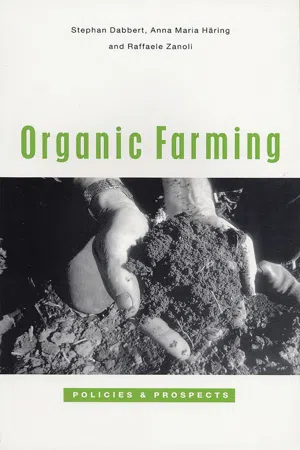
Consumers are more and more concerned with the health of the food they eat. While great public anxiety about genetically engineered foodstuffs and BSE in cattle has developed in Europe, on the positive side there has been a rapidly rising demand for organic produce. Food retailers, including supermarkets, have responded, and the organic sector has moved from a being marginal production fad to a serious subject of policy concern for politicians and public servants involved in European agricultural policy. In this book, three leading authorities on organic farming have for the first time produced a serious and scientific overview for the lay person of the state of organic farming and policy towards it in Europe.
Based on a review of a huge body of scientific research into all aspects of the sector, the authors provide in accessible terms a balanced, up-to-date and policy relevant overview of:
· The position of organic farming today - the size of the sector, its markets, where research is conducted, and current policies towards the sector.
· Assessment of its possible contributions to the environment, food quality, farmers' incomes, and rural development generally.
· Explanation of the key factors that will impinge on the organic farming sector in future and policy towards it as a result of the enlargement of the EU, ongoing negotiations at the World Trade Organisation, and Agenda 2000.
· Detailed recommendations for future organic farming policy.
Most people recognise that European agricultural policy has to change, involving further fundamental reform of the Common Agricultural Policy. This unique book will be of immense value to all those concerned with the issue, as well as of intense interest to those actually involved in the organic farming sector. Educationalists in agricultural universities and institutes will find the book a useful teaching tool.
- English
- ePUB (mobile friendly)
- Available on iOS & Android
eBook - ePub
About this book
Information
CHAPTER 1
Organic farming: grassroots movement or policy directive?
In the twentieth century we have witnessed dramatic technological changes in agriculture which have completely transformed the rural landscape and the habits of rural populations. The key element of this technological revolution, which still continues in many parts of the world today, was the substitution of on-farm by off-farm resources. It became economically profitable to replace farm labour with machinery, and soil fertility could easily be enhanced by buying chemical fertilisers. This reduces the use of farming systems which rely on the internal preservation and production of soil fertility. The invention of a variety of chemical pesticides allowed harvests to be protected from pests and led, at the same time, to simplified agricultural systems that were based on regular applications of these pesticides while abandoning various prophylactic non-chemical measures that were formerly an integral part of farming. The tendency to detach agriculture from its natural roots, which was inherent in these technological developments, became especially visible in some forms of animal husbandry, such as the housing of laying hens in batteries where they are completely separated from anything that might resemble a natural environment.
In the industrialised countries like those of Western Europe, where these developments are especially strong, a number of key advantages were associated with the new forms of agriculture. Labour and soil productivity increased and food became abundant and cheap for the consumer. The labour force that left agriculture could be productive in other areas of society and thus increase total wealth.
However, there are also a number of major problems associated with these developments. In many cases modern agricultural technologies had a very negative impact on the natural environment, with a massive build-up of nutrient surpluses in some regions and intensive use of pesticides in others. Animal welfare became a major issue in societies, not only because of the advent of methods of animal rearing that closely resemble industrial production but also because the more affluent societies became very concerned about animal welfare. The loss of heritage landscapes and biodiversity, which in many cases had been created by earlier forms of agriculture and were now being destroyed by modern forms, became further areas of concern. The decline of the agricultural population in rural areas meant major structural change and was often accompanied by above-average unemployment rates and difficult social conditions in formerly agricultural regions.
Organic agriculture is a system that had been developed in Europe long before the impact of the major technological revolution in agriculture, described above, became obvious. Its pioneers’ idea was to develop the farm as a system which makes use of its own resources as far as possible and only draws on external resources when necessary and appropriate. The key idea of organic farming is to use modern technology selectively and avoid those elements which are inherently risky or environmentally damaging, or which might lead to the separation of farming from its natural environment. This idea was developed largely outside the agricultural research establishment and went largely unnoticed by the public for decades.
In Europe, organic farming underwent dynamic development during the last decade of the twentieth century. In the European Union (EU), the organically farmed area increased five-fold from 1993 to 2000 (Lampkin 2002), and the concept of organic farming is becoming increasingly familiar to the general public. Not only are consumers more aware of organic products, but policies which influence organic farming have also become a key element in the toolbox of agricultural policy makers.
In this book, we generally take the EU as our region of reference. The reason for this is simple: in terms of organic farming policy, the EU leads the world. European regulations on organic farming have exercised a strong influence on the development of rules in other parts of the world. Support policies have now been in place for 15 years, and the European organic farming regime came ten years before equivalent US legislation, which was only implemented in 2002. So we believe that there is much to learn from this wealth of experience with organic farming policy. It is obvious that some of the lessons learned from highly industrialised Western Europe (the 15 member states of the EU) are most useful for other industrialised countries with high income levels and a commitment to a proactive agricultural policy. However, with EU enlargement, these policies will also become relevant for new member states with a very different history of agricultural development. We thus believe that the ideas and policies we discuss have obvious relevance beyond the EU in its current form. We do not explore in any depth the potential contribution of organic farming to improving productivity in countries and regions where external inputs are hard to obtain and where self-sufficiency and subsistence are important, an issue which has recently been covered in more depth by the Food and Agriculture Organisation (FAO) (2002).
Agricultural policy provides the regulatory framework for all economic and political measures designed to influence the agribusiness sector. The nature of these interventions has a significant impact on the development of agribusiness. The first Europe-wide policy intervention in organic farming is as recent as the beginning of the 1990s. A state-supervised certification system for organic products was established (Council Regulation 2092/91) (EC 1991) and subsidies for organic production were introduced. For the first time, a formal system of certification guaranteed to the consumer that products labelled as organic had genuinely been produced organically. The EU definition of organic farming involves holistic production systems for crops and livestock based, where possible, on cultural, biological and mechanical methods instead of synthetic materials. A more detailed description is given by the Codex Alimentarius (CA) adopted by the FAO (see Box 1.1).
Box 1.1 What is organic farming? (CAC 2001)
Organic agriculture is based on holistic production management systems which promote and enhance agro-ecosystem health, including biodiversity, biological cycles, and soil biological activity. It emphasises the use of management practices in preference to the use of off-farm inputs, taking into account that regional conditions require locally adapted systems. This is accomplished by using, where possible, cultural, biological and mechanical methods, as opposed to synthetic materials, to fulfil any specific function within the system. An organic production system is designed to:
a) Enhance biological diversity within the whole system;
b) Increase soil biological activity;
c) Maintain long-term soil fertility;
d) Recycle wastes of plant and animal origin in order to return nutrients to the land, thus minimising the use of non-renewable resources;
e) Rely on renewable resources in locally organised agricultural systems;
f) Promote the healthy use of soil, water and air as well as minimising all forms of pollution that may result from agricultural practices;
g) Handle agricultural products with emphasis on careful processing methods in order to maintain the organic integrity and vital qualities of the product at all stages;
h) Become established on any existing farm through a period of conversion, the appropriate length of which is determined by site-specific factors such as the history of the land and the type of crops and livestock to be produced.
Of course, these government measures were not the beginning of organic farming. Organic farming dates back to the first quarter of the twentieth century – before the widespread use of synthetic pesticides and soluble nitrogen fertilisers which has characterised agriculture over the last five decades. The basic philosophy of organic farming has been around since the start of the twentieth century. Box 1.2 gives an impression of how broadly the concept of organic farming is defined. Equally broad is the range of terms used. We prefer the use of organic farming which is, however, synonymous with ecological, biological, eco- or bio-farming.
In the 1970s, organic farming managed to raise sympathies within the environmental movement. These were translated into a desire to give political support to organic farming and paved the way for the growth in demand for organic products in later years. Until the 1980s, however, organic farming was a social movement which defined itself as being ‘in opposition’ not only to conventional farming but also to much of the institutional setting of agriculture in general, with regard to both education and policy making. Similarly, the established institutions tended to ignore the existence of organic farming or viewed it as a backward technology practised by a tiny ‘lunatic fringe’.
Box 1.2 Philosophy of organic farming (Lampkin et al. 1999a)
Organic farming can be seen as an approach to agriculture where the aim is to create integrated, humane, environmentally and economically sustainable agricultural production systems. The term ‘organic’ is best thought of as referring not to the type of inputs used, but to the concept of the farm as an organism, in which all the components – the soil minerals, organic matter, microorganisms, insects, plants, animals and humans – interact to create a coherent, self-regulating and stable whole. Reliance on external inputs, whether chemical or organic, is reduced as far as possible. In many European countries, organic agriculture is known as ecological or biological agriculture, reflecting the reliance on ecosystem management rather than external inputs.
This situation changed completely at the end of the 1980s and the beginning of the 1990s as a result of two developments. At that time, the absence of a clear legal framework meant that conventional products could be sold to the consumer as ‘organic’, and terms such as natural, ecological or biological could be used for conventional products. This market non-transparency and lack of consumer protection justified political action.
Second, the environmental movement gained considerable political influence during the 1980s. Although the environmental movement and the organic farming movement were not identical in terms of organisation and objectives, growing public interest in environmental matters led to greater sympathy for organic farming which translated into a desire to give it political support for environmental reasons.
It was the first of these developments that led to an attempt to standardise what was meant by organic farming and – most importantly – what was meant by ‘organic food’. The second development led to the introduction of support programmes in some countries (Denmark, Germany) in the late 1980s and in the EU as part of the 1992 Common Agricultural Policy (CAP) reform.
From the organic movement’s perspective, this formal political recognition was a landmark in the development of organic farming in Europe. Organic farming suddenly became an agricultural policy instrument – after being ‘in opposition’ to the agricultural policy establishment for many years. The power to define the concept of organic farming has shifted as well. Today, the question ‘What is organic farming?’ is defined legally by institutions like the EU that were opposed to organic farming for decades. However, this only holds true for the minimum definition. The organic sector still strongly influences this minimum definition and can establish stricter rules above this legal minimum through the private standards and regulations set by the organic farming organisations. Within the organic movement, the shift towards an institutionalised definition of the basic concept has sparked considerable protest.
For policy makers, defining this concept was a new sphere of action and several difficulties resulted, especially because the organic farming movements in different countries were not unified in their approaches to practical details, despite agreement on principles. While organic farming had always centred on the key concept of ‘the farm as a closed system’, the European regulation which defined the term in 1991 referred only to plant production and thus left an important part of organic farming outside its definition. Having organic plant production but conventional animal production conflicts with organic principles. In many member states standards on animal production already existed, but very different structural, climatic and cultural conditions meant that many years passed before a commonly accepted framework for organic animal production could be agreed. In 1999 the European regulation on animal production in organic farming came into effect, after nearly a decade of working with a definition that was a mere shadow of the original concept of organic farming.
Today, in the view of some observers, policy is acquiring greater influence on the organic farming sector than the organic farming movement itself. This development was probably inevitable for a number of reasons:
• The EU policy-framing bodies are organised in a more centralised way. The power to define organic farming lies in the hands of one organisation and the resulting definition of organic farming is binding on an EU-wide level. In contrast, the organic farming movement is made up of a wide range of producer organisations, certifying bodies, etcetera. In some countries, there may even be a number of interest groups or organisations. Little imagination is required to picture the organisational power of a social movement compared with an official policy organisation.
• Policy makers are becoming more aware of the basic concepts of organic farming and the development and characteristics of the organic food market, not least because administrations at all levels became more deeply involved with organic farming during the last decade of the twentieth century.
As a result, the organic movement has begun to recognise the need to respond to this policy influence. Closer cooperation with official bodies is increasingly considered an integral part of lobbying strategy. Given the oppositional nature of the social movement during its early stages, cooperation with the agricultural establishment was not high on the agenda, and communication was poor. This lack of communication was probably the reason why so much policy making was based on ignorance (Michelsen et al. 2001).
Although policy is gaining influence over the legal definition of organic farming in the EU, the International Federation of Organic Agriculture Movements (IFOAM) is a leader in this debate. A key question is how to define a broader, more holistic concept of organic farming that also sets minimum social standards for the people involved in organic farming.
The public debate on organic farming centres around the justification of the system in comparison with conventional or other alternative farming systems. A distinction between organic farming and other alternative farming systems – such as integrated farming – is seen in the existence of detailed production standards and certification procedures (IFOAM 1996, for example) to draw a clear dividing line. In contrast to other sustainable farming systems, this allows the use of the market to support the environmental, social and animal welfare objectives (Lampkin et al. 1999a).
The arguments most commonly used in favour of organic farming are its potential contribution to society’s needs, such as safe food and a clean environment. Opponents of organic farming consider it a farming system preferred by romantics who stick to a nineteenth-century approach to agriculture without seeing that the world has changed. Several arguments are related to the lower yields in organic agriculture due to the rejection of external inputs. Critics are concerned about the ability of organic farming to produce sufficient food for everyone, the necessity of increasing imports, the high prices of organic food and potential fraud. Moreover, these critics doubt whether the quality of organic food is any different and whether the environmental effects are indeed less detrimental than those of other farming systems.
Organic farming has become a key instrument in policy-making toolboxes over the last decade. It is therefore worth reflecting on the various aspects of organic farming and how it can be treated b...
Table of contents
- Cover
- About the Authors
- Title
- Copyright
- Contents
- List of Boxes
- List of Tables
- List of Figures
- Glossary
- Abbreviations
- Acknowledgements
- Preface
- 1 Organic farming: grassroots movement or policy directive?
- 2 Organic farming in Europe at the dawn of the new millennium
- 3 Organic farming's contribution to policy objectives
- 4 A changing policy environment
- 5 Recommendations for future organic farming policy
- References
- Organisations with Interest in Organic Farming
- Index
Trusted by 375,005 students
Access to over 1.5 million titles for a fair monthly price.
Study more efficiently using our study tools.
Frequently asked questions
Yes, you can cancel anytime from the Subscription tab in your account settings on the Perlego website. Your subscription will stay active until the end of your current billing period. Learn how to cancel your subscription
No, books cannot be downloaded as external files, such as PDFs, for use outside of Perlego. However, you can download books within the Perlego app for offline reading on mobile or tablet. Learn how to download books offline
Perlego offers two plans: Essential and Complete
- Essential is ideal for learners and professionals who enjoy exploring a wide range of subjects. Access the Essential Library with 800,000+ trusted titles and best-sellers across business, personal growth, and the humanities. Includes unlimited reading time and Standard Read Aloud voice.
- Complete: Perfect for advanced learners and researchers needing full, unrestricted access. Unlock 1.5M+ books across hundreds of subjects, including academic and specialized titles. The Complete Plan also includes advanced features like Premium Read Aloud and Research Assistant.
We are an online textbook subscription service, where you can get access to an entire online library for less than the price of a single book per month. With over 1.5 million books across 990+ topics, we’ve got you covered! Learn about our mission
Look out for the read-aloud symbol on your next book to see if you can listen to it. The read-aloud tool reads text aloud for you, highlighting the text as it is being read. You can pause it, speed it up and slow it down. Learn more about Read Aloud
Yes! You can use the Perlego app on both iOS and Android devices to read anytime, anywhere — even offline. Perfect for commutes or when you’re on the go.
Please note we cannot support devices running on iOS 13 and Android 7 or earlier. Learn more about using the app
Please note we cannot support devices running on iOS 13 and Android 7 or earlier. Learn more about using the app
Yes, you can access Organic Farming by Stephan Dabbert,Anna Maria Haring,Raffaele Zanoli in PDF and/or ePUB format, as well as other popular books in Biological Sciences & Environmental Conservation & Protection. We have over 1.5 million books available in our catalogue for you to explore.