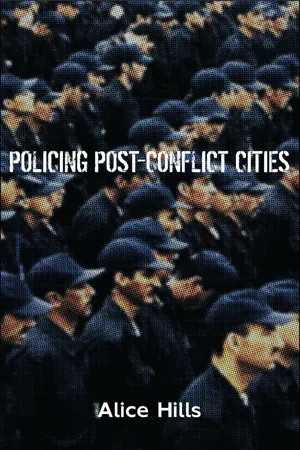
How and why does order emerge after conflict? What does it mean in the context of the twenty-first century post-colonial city? From Kabul, Kigali and Kinshasa to Baghdad and Basra, people, abandoned by the state, make their own rules.With security increasingly ghettoised, survival becomes a matter of manipulation and hustling.
In this book, Alice Hills discusses the interface between order and security. While analysts and donors emphasise security, Hills argues that order is much more meaningful for people's lives. Focusing on the police as both providers of order and a measure of its success, the book shows that order depends more on what has gone before than on reconstruction efforts and that tension is inevitable as donors attempt to reform brutal local policing.
Policing Post-Conflict Cities provides a powerful critique of the failure of liberal orthodoxy to understand the meaning of order.
- English
- ePUB (mobile friendly)
- Available on iOS & Android
eBook - ePub
Policing Post-Conflict Cities
About this book
Trusted by 375,005 students
Access to over 1.5 million titles for a fair monthly price.
Study more efficiently using our study tools.
Information
1
ORDER IN AN URBAN CENTURY
Almost every post-conflict city experiences acute insecurity. Baghdad, Kabul, Mogadishu, Monrovia and Sarajevo all saw an increase in looting, revenge attacks, armed robbery and kidnappings. Street-level security was minimal as factional leaders positioned themselves, occupying militaries protected themselves, and indigenous police burned their uniforms, or hid in their neighbourhoods. Later, Western attempts to reconstruct indigenous security forces on democratic lines ended in failure. Yet none of these cities has disappeared. Some were partially destroyed and their inhabitants displaced, but none experienced anarchy, and all offered business opportunities to men such as Osman Ato, who in the early 1990s controlled much of Mogadishu’s qat trade, provided many of the vehicles used by the militias and owned most of the houses rented by NGOs.1 This book is about the re-emergence of order in such cities, and the challenges of managing it.
It is impossible to explain how and why order re-emerges after conflict without considering cities, for they have a political, cultural and physical significance that rural areas lack. Above all, cities are significant because their known history means that they offer a laboratory in which to trace the social and political continuities moulding the re-emergence of order. They represent units of analysis for examining the interface between order and security, which is typically made visible by the activities of their police, and they offer discrete case studies of order and security; of who provides it, and how, and whose needs are prioritised. Based on developments in a range of cities, I argue that – and this is my central thesis – order and security are interwoven, but that, while security facilitates order, order is necessary for meaningful security. In other words, security is best understood as a process and a variable within order, rather than its end.
The topic is given urgency by the failure of US-led operations in Afghanistan and Iraq, but it is of broader relevance than this suggests. Not only do these issues present themselves acutely in cities, but also their development suggests explanations for the meaning of security, the nature of policing, and the relationship between security and development more broadly. And they emphasise the extent to which Western understanding remains rooted in historically specific forms of Westphalian order: law and order are invariably seen as the primary means for managing post-conflict disorder and insecurity.
To see how the processes of order and security relate to one another and are managed in major cities that are emerging from conflict (hereafter ‘post-conflict cities’), we need first to relate developments to the broader urban environment; that is, to the context in which order and security are to be created. This chapter offers an overview of cityscapes before considering what is meant by security and order, and their supporting concepts of power and stability.
CITIES
Contemporary conflicts display an urban bias. Although most wars are fought in rural areas where the state has little oversight or presence, and where the infrastructure is easily destroyed, cities are usually a target for belligerents, and the size and density of their population and its associated infrastructure mean that the political significance and societal impact of conflict are typically greater in them than in rural areas.
All wars are brutal, and some of the most appalling operations of recent years have taken place in jungles and villages out of sight of the international media, yet urban war seems to have a particularly vicious logic of its own, especially when (as in Algiers, Grozny and Haditha) it involves military forces acting as police in internal security operations (Hills 2002). Many professional soldiers believe that urban operations are merely a subclass of tactics and do not deserve special attention, yet it is generally agreed that many aspects of operating in cities are unique. Also, current military thought, decision-making and logistics are designed for (and work best in) open area operations of the type conducted in the countryside, and operating in a man-made physical terrain superimposed onto natural terrain exacerbates existing tactical and logistical challenges. More importantly, cities are rarely empty, so securing a city means troops must operate among civilians to a far greater extent than they would in open countryside. Further, short-term tactical advantage usually lies with the side having least regard for casualties. Consequently, urban war is not only the most operationally and politically challenging of all military operations, but also it is the closest that most conventional militaries come to pre-industrial forms of conflict. The traditional core capability of aggressive close combat – the hunter-killer philosophy of ‘What I find, I can kill’ – remains essential for successful operations, and casualties are usually high. Lastly, urban war is special because of the stakes involved: cities are important political prizes in a way that villages, forests, lakes and deserts are not.
Today’s emphasis on urban operations is unsurprising, for one of the most notable transformations of recent years has been the change from a predominantly rural world to an urban one: there are more cities today and they are getting bigger. It has been estimated that in 2015 the world’s population will be 7.2 billion; that is, 1.1 billion more than in 2000 (Nichiporuk 2000).2 Approximately 95 per cent of the increase will be in developing countries and almost all of it will occur in cities, making urbanisation one of the major developmental challenges of the twenty-first century (IBRD 2000: 47). And rapid or large-scale urbanisation often prompts conflict. Urbanisation implies social relationships, but also it means tensions and inequality. Civil wars, famine and poverty push people to cities, which lack the resources to absorb them, while the institutions, social capital and politics that served a dispersed rural population rarely transfer. Expectations rise, and second- and third-generation urban residents begin to organise themselves and make demands of governments that do not have the political and social mechanisms to meet them (Milbert 2006). A rapidly expanding population, inadequate access to basic services, declining standards of infrastructure, bigger slums, social exclusion, criminalisation, and ethnic and sectarian tensions can lead to disorder and insecurity. In most cases, urbanisation is associated with demographic changes – youthful but alienated populations are linked to instability from Northern Ireland through the Middle East and West Africa to South Asia – and growth is commonly accompanied by crime, corruption, pollution and urban decay.3
There are no standard definitions of cities, and countries define them according to a range of administrative criteria, population size and density, or economic characteristics. The World Bank, for example, states:
The formal definition of urban areas describes them as concentrations of nonagricultural workers and nonagricultural production sectors. Most countries call settlements with 2,500–25,000 people urban areas. The definition varies from country to country and has changed over time … A city has a certain legal status (granted by the national or provincial government) that is generally associated with specific administrative or local government structures. (World Bank 1999: 127)
Technically, ‘city’ denotes a statistical grouping of people in a single area, while ‘urban’ refers to the patterns of social and cultural behaviour that appear to be unique to city life.
The dominant features of cities are easier to identify, being their man-made construction, high population density and urban nature. Physically, most differ more in degree and style than in structure. In some cities elites have taken over the centre and the poor are pushed out to the suburbs; in others the middle class live in the suburbs and abandon the city centre to the poor. Most (including Mogadishu and Kinshasa, capitals of Somalia and the Democratic Republic of Congo, DRC) have – or had – European characteristics such as central boulevards, combination street patterns, high-rise buildings of reinforced concrete and a framed construction in a city core, residential suburbs, and distinct economic, social and ethnic sectors (Hills 2002). Many have shantytowns of one-roomed shacks without running water, sanitation or electricity where the state has never had a presence even though they encroach on central districts. Even before the US invasion of 2003, areas of south-west Baghdad resembled Kinshasa, complete with sewage, filthy rubbish, beggars and flea markets.
SPECIAL FEATURES
Regardless of definitional issues, major cities are special. They are symbols of national existence or religious identity, and visible expressions of states, governments and ethnic groups. They are destination points for extremists and criminals, and sanctuaries or battle spaces for insurgents and terrorists. They are a focus for national and international attention because politicians live in them, and foreign troops, officials and journalists are based there. This can make cities in conflict-prone regions either safer or dangerously insecure.
Take the case of Freetown, Sierra Leone’s capital, in the late 1990s. Sierra Leone had for long been divided into Freetown and the rest of the country. During the 1970s and 1980s power became concentrated in the hands of the president, so all decisions were taken in Freetown, and all resources were distributed within it. By the late 1980s there were no state institutions in the provinces (the notoriously authoritarian and corrupt Sierra Leone Police collapsed), and the presidency became the prize. After the war, the UK focused its attention on Freetown because that was where the government of its protégé, President Ahmad Kabbah, was based. Contrast the situation in Afghanistan. The Taliban’s tactical focus on bombing buses and markets in Kabul was straightforward: ‘Kabul is the capital city and the foreign troops are concentrated there’ (BBC 21 June 2007).
Cities are not neutral environments. They can exacerbate existing tensions because they introduce ‘a set of characteristics – proximate ethnic neighbourhoods, territoriality, economic interdependency, symbolism, and centrality – not present to such an extent on wider geographic scales’ (Bollens 2000: 326). Also, they are political organisms. Not only do political elites live in them, but also they contain production and storage facilities, seaports, airports, ground transportation hubs and financial centres. Cities in the South (where most contemporary conflicts occur) hold most of a country’s economic resources, infrastructure and flows of development aid. Dili, capital of Timor Leste, is a case in point. Around 40 per cent of the population lives on less than 55 US cents a day (this is the UNDP’s poverty line for the country). In theory, relieving poverty should be easy – Timor receives energy revenues of some $158 million a year – but the government spends most of that money in Dili, and less than a fifth of state-provided goods and services go to the rural areas where most people live. Cities are often links in the global production chain too. They are targets for foreign investment, and account for an increasing share of national income; typically they generate around 55 per cent of gross national product (GNP) even in low-income countries in conflict-prone regions.4 They are prizes worth fighting over.
And cities are notoriously violent even in peacetime. Take the case of Brazil’s main cities. Levels of violence and crime are especially high in the favelas, or temporary shantytowns, which lack all basic services and are inhabited mainly by black, mixed-race or internal migrants from the poor north-east of the country. The favelas’ socially excluded inhabitants are caught between the criminal violence exercised by drug gangs, the violence imposed by groups of vigilantes offering alternative justice, and the violence used by the police. For example, in June 2007, 1,300 police entered the slum stronghold of a prominent gang of drug dealers in Rio de Janeiro, where more than 100,000 people live (BBC 28 June 2007). The operation was officially part of a move to make the city safer before it hosted the Pan-American games, but it actually formed part of a recurring pattern whereby the police’s main contact with slums takes the form of violent invasions. In this case, officers were supported by guns, grenades, armoured vehicles and helicopters. Policing in such circumstances is a high-risk occupation, with inadequately trained and resourced officers regularly confronting heavily armed criminal gangs. Against that, police kill about 2,000 people a year in Rio de Janeiro and São Paulo, many of them by extrajudicial execution and torture (Amnesty International 2005).
The reluctance of most police to enter shantytowns except on raids or in search of bribes results in security voids that are commonly filled by gangs, vigilantes and militia groups. One consequence is that some big cities see war-like levels of violence between territorially based gangs. It is true that cities are insecure places even in peacetime, but powerful weapons are easier to access in a post-conflict city such as Belgrade or Beirut, and there is a greater readiness to use them. Even so, the distinction between pre-conflict and post-conflict conditions may not mean much, especially in a city such as Brazzaville in the Republic of the Congo. In the mid-1990s, more than 62 per cent of Congo’s 3 million population lived in urban areas, but roads were scarce and urban infrastructure was at best fragile.5 The fighting of 1997, which was confined to the capital and its surrounding suburbs, was effectively ‘conventional mob warfare’ (Geibel 1998: 17–20), but it resulted in widespread destruction because major weapon systems such as tanks, helicopter gunships and fighters had been used in addition to the more usual rocket-propelled grenades (RPGs), mortars and artillery. Yet for many people the end of conflict made little difference to everyday levels of security.
As this suggests, it is difficult to develop a baseline against which to judge conditions once conflict ends. Assessments are skewed by the significance of the city concerned, the extent of its physical destruction, social and ethnic tensions, international advocacy, or by media reports. Some cities are destroyed, but others emerge relatively unscathed. In some places the routines of daily life remain structured while elsewhere social hierarchies and control mechanisms are destroyed. Nevertheless, one thing is clear: the need for physical security dominates life. With it, people can rebuild their lives, houses, businesses and institutions. Without it, occupying troops overreact, policemen hide and ordinary people are not safe in their houses, let alone outside them. Finding food, earning a living, seeking medical assistance, staying cool or keeping warm, avoiding kidnappers, all become difficult or impossible when gangs or militias control the streets, hospitals are looted and power-generation plants are destroyed. Fear and violence destroy not only the physical security of individuals but also the social networks and technical infrastructure sustaining cities. That is, their order.
SECURITY
Anyone considering post-conflict cities is struck by the extent to which security is the central point around which debate and competition take place: security dominates despite being absent. At its most basic, security means that inhabitants are not forcibly displaced, raped, robbed, kidnapped, mutilated, tortured or killed. Definitions of security are now commonly stretched beyond this to incorporate a range of meanings that include food, water, health and environmental issues. Security is undoubtedly a multifaceted social phenomenon, incorporating individual and public aspects and spaces, so today’s broader understanding offers a useful corrective to traditional definitions relying on statist notions. Also, security is always defined situationally and contextually, and its meaning shifts to reflect contingencies. This happened in Gaza City a few days after Hamas overran Fatah strongholds in June 2007. Concerns about physical safety were quickly replaced by worries about food supplies, and Gazans began stockpiling food after Israel closed the crossing points that are Gaza’s supply lines, only for fears to swing back at the first sign of renewed fighting. Nonetheless, the fact remains that notions such as ‘human security’ (considered in more detail in Chapter 3) are derived from, and possible only in the absence of, physical violence. This makes their application in post-conflict cities of questionable value, for the principal political weapons in most post-conflict cities are intimidation and violence. Threats are usually physical, and to...
Table of contents
- Cover
- Title
- Copyright
- Contents
- Acknowledgements
- Acronyms and Abbreviations
- 1. Order in an urban century
- 2. Controlling cities
- 3. International policing
- 4. Ghetto security
- 5. Social continuities and the production of order
- 6. Making their own rules
- 7. Re-emergent order
- 8. Challenging orthodoxy
- Notes
- References
- Index
Frequently asked questions
Yes, you can cancel anytime from the Subscription tab in your account settings on the Perlego website. Your subscription will stay active until the end of your current billing period. Learn how to cancel your subscription
No, books cannot be downloaded as external files, such as PDFs, for use outside of Perlego. However, you can download books within the Perlego app for offline reading on mobile or tablet. Learn how to download books offline
Perlego offers two plans: Essential and Complete
- Essential is ideal for learners and professionals who enjoy exploring a wide range of subjects. Access the Essential Library with 800,000+ trusted titles and best-sellers across business, personal growth, and the humanities. Includes unlimited reading time and Standard Read Aloud voice.
- Complete: Perfect for advanced learners and researchers needing full, unrestricted access. Unlock 1.5M+ books across hundreds of subjects, including academic and specialized titles. The Complete Plan also includes advanced features like Premium Read Aloud and Research Assistant.
We are an online textbook subscription service, where you can get access to an entire online library for less than the price of a single book per month. With over 1.5 million books across 990+ topics, we’ve got you covered! Learn about our mission
Look out for the read-aloud symbol on your next book to see if you can listen to it. The read-aloud tool reads text aloud for you, highlighting the text as it is being read. You can pause it, speed it up and slow it down. Learn more about Read Aloud
Yes! You can use the Perlego app on both iOS and Android devices to read anytime, anywhere — even offline. Perfect for commutes or when you’re on the go.
Please note we cannot support devices running on iOS 13 and Android 7 or earlier. Learn more about using the app
Please note we cannot support devices running on iOS 13 and Android 7 or earlier. Learn more about using the app
Yes, you can access Policing Post-Conflict Cities by Alice Hills in PDF and/or ePUB format, as well as other popular books in Politics & International Relations & Political Freedom. We have over 1.5 million books available in our catalogue for you to explore.