The UN is able to recognize key global challenges, but beset by difficulties in trying to resolve them. In this, it represents the current global political balance, but is also the only international institution that could move it forward.
Civil society can be a catalyst for this kind of change. In this book, Nora McKeon provides a comprehensive analysis of UN engagement with civil society. The book pays particular attention to food and agriculture, which now lie at the heart of global governance issues. McKeon shows that politically meaningful space for civil society can be introduced into UN policy dialogue. The United Nations and Civil Society also makes the case that it is only by engaging with organizations which legitimately speak for the 'poor' targeted by the Millennium Development Goals that the UN can promote equitable, sustainable development and build global democracy from the ground up.
This book has strong ramifications for global governance, civil society and the contemporary debate over the future of food.
eBook - ePub
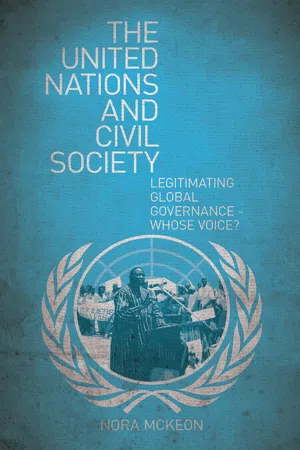
The United Nations and Civil Society
Legitimating Global Governance – Whose Voice?
- English
- ePUB (mobile friendly)
- Available on iOS & Android
eBook - ePub
About this book
Information
1
Setting the Stage
The past two decades have seen so rapid an evolution in the space and pace of world affairs that it is difficult to discuss them in a straight-forward fashion. A whole industry of disposable terminology has cropped up, with ‘globalization’ heading the catalogue, whose products seem shopworn and outmoded before they reach home. New, border-crossing problems such as pandemics twine incestuously with old ones like poverty. Individuals and communities are called upon to process vastly expanded ranges of information and experience, most often without the tools they need to exercise discernment but draw the line at judgmental discrimination. Political ideologies of different kinds have loosened their grasp on people’s interpretations of reality. Problems may be understood to be complex, responsibilities diffuse, solutions all but self-evident. But fundamentalist sectarianisms, self-protective individualisms, pseudo-hedonisms move in to fill the ideological gap. Basic shared values and consensus on a concept of common goods have never seemed more needed, more elusive, more difficult to enforce. Multilateralism is besieged by public and private unilateralisms, like a lovable but ineffectual beast bumbling along the path to extinction.
By design or by default, the United Nations (UN) system finds itself invested with the thankless responsibility for refereeing this global match. The gap is noteworthy between what is needed in the way of worldwide clout and the UN’s capabilities, given its design, authority and resources. A memorable documentary some years back panned from compelling shots of human suffering in a war-torn country somewhere in the southern hemisphere to suited and tied diplomats in a soft-lit, plush-carpeted meeting room negotiating the placing of a comma. It was an unfair image, given the range of efforts and people that the UN deploys between the two extremes and on the front line of misery itself, but an effective illustration of the disproportion between ends and means.
These discrepancies, between ends and means, between people’s expectations and the UN’s capabilities, between a rapidly changing world and institutions set in their ways, are a source of the dialectic that has fuelled the interaction between the UN system and civil society over the past 15 years. This study will seek to tell a piece of the story and to say something about how it is impacting on the UN. To what degree and in what ways is the UN adapting to accommodate a range of actors who can help to strengthen its focus on the values on which it was founded and to defend them in a complex and evolving global context?
The thesis defended here is that the UN system has indeed opened up to civil society voices since the early 1990s, most significantly in the exceptional setting of the global summits, but that it has failed thus far to move from generic and often episodic participation to meaningful incorporation of these actors into global political process. The bases for such incorporation are far more solid than they were a decade and a half ago, particularly in terms of the structures and capacities of civil society organizations (CSOs) and the thickness and quality of their networking. At the same time, however, the geopolitical and economic powers that have underwritten the neoliberal agenda that these civil society actors contest are more determined than ever to defend their interests. The challenge before the UN is to provide a terrain – or rather a series of intercommunicating terrains – on which meaningful confrontation and negotiation can take place, as it did 60 years ago when the Universal Declaration of Human Rights was crafted around a table fractured by the cold war. The political context and the cast of actors have changed, but the significance of this role and the urgency of assuming it masterfully and authoritatively are unaltered.
Scope and Methodology
This study attempts to assess the longer-term dynamics of change that the global summits, as strong mobilizing moments in a broader process of interaction between the UN and civil society, have helped to set in motion.1 We trace the ground that has been covered since the early 1990s and identify the present challenges faced by both the UN and its civil society interlocutors, exploring the following parameters in particular:
• What impact has interaction between civil society and the UN system had in terms of changing development discourse within the UN system? How has it influenced the issues that find their way onto the global agenda, the way in which they are framed and – more profoundly – the paradigms on which agenda setting is based?
• To what degree has this interaction contributed to institutional change within the UN – both formal and informal – to accommodate civil society input into global policy debate and normative work? What new political spaces have opened up, and for what kinds of CSOs?
• How is the UN system performing in terms of building two-way links between global policy dialogue and action at country level to implement summit outcomes, and how is civil society being involved in this vital task?
We address these questions in three steps. First, in Chapter 2, we take an in-depth look at a specific terrain of UN–civil society interaction, that of the Food and Agriculture Organization of the United Nations (FAO) and global governance of food and agriculture issues. This focus is motivated by several considerations. The World Food Summit process of 1996 and 2002 is the least documented among the UN international conferences of the 1990s so far as the involvement of civil society is concerned.2 And yet the food and agriculture nexus of issues plays an exceedingly important role in the world policy arena. Food is perhaps the most basic human need. Agriculture provides a livelihood for most of the world’s population and the majority of the poor who have been the object of so much summit attention. The geopolitical and corporate interests that revolve around these issues are enormous, as demonstrated by the difficulties encountered during the World Trade Organization (WTO) Doha Round negotiations and by the food crisis that erupted on the global scene in 2008. For these reasons, the World Food Summit and its follow-up have attracted considerable attention on the part of organizations representing social movements of the South, a highly significant category of civil society that has been underrepresented in most other summit processes. Finally, the FAO has been the locus since the mid-1990s of an innovative experiment in UN–civil society relations, one that figures forward some of the principles and practices on which more effective UN outreach to civil society could be based.
Chapter 3 sets the FAO case study into a broader context. It reviews how the practices and procedures of the UN system as a whole are evolving as a result of interaction with civil society in a changing political context in which the summit processes constitute valuable observation posts. This review is based on several sources of information, underwritten by many years of personal experience, observation and analysis. It draws on the views of UN system practitioners themselves through an inquiry which asked them to discuss how their organizations are handling civil society involvement in global policy dialogue and in country-level action, and what links exist between the two levels. This inquiry is supplemented by the insights emerging from a series of interagency exchanges organized by the United Nations Non-Governmental Liaison Service (UN-NGLS) over the past few years, of which the most valuable for the purposes of this study are the informal ‘off-the-record’ networking meetings which enable participants to speak freely, without concern for institutional face-saving. Chapter 3 also draws on the growing body of literature which the summits have spawned outside of the UN itself.
The chapter takes a look at system-wide efforts to ensure integrated implementation of summit outcomes through the Millennium Development Goals (MDGs), and approaches being adopted to involve civil society in these efforts through the Millennium Campaign. Finally, it reviews the implications of steps taken by the UN since the mid-1990s to reform rules, procedures and practices governing relations with civil society, culminating with the report of the Panel of Eminent Persons on United Nations–Civil Society Relations appointed by Kofi Annan (United Nations 2004a) and its follow-up under the reign of a new UN Secretary-General.
Finally, in Chapter 4 we draw out conclusions regarding the state of play in the democratization of global governance. We identify important principles to be respected in UN–civil society interaction, promising tendencies and practices to be pursued, challenges for the future and areas meriting further research. Our consideration of these issues is enriched by the body of analytical work that has been built up over recent years by students both of social movements and of international relations,3 work to which we refer throughout this study. The literature to date has focused above all on the more exciting of the two members of the couple we are examining, civil society. It has a lot to say about the phenomenon of transnational civil society networks, how they are organized, the dynamics of their relations to national protest movements, the conditions under which they are most likely to emerge and to be effective, the repertoire of frames and actions on which they draw, their strategies and targets.4 Our study corroborates many existing hypotheses. It also, however, adds some new dimensions, stemming in particular from the fact that the civil society network at which we take an in-depth look in the FAO chapter is one of the rare instances in which it is people’s organizations and social movements in the South that call the shots.
At the same time, we take a closer look at the less researched ‘poor sister’ in the interaction, the UN system.5 Observers sympathetic to the aims of civil society advocacy assess the political opportunities the UN affords in terms that cover a range of options. ‘Why bother?’ is the verdict of some (see Bullard 2005). Others have taken a selective approach by identifying certain frames, such as human rights, and certain activities, such as international norm setting, as congenial both to global civil society objectives and to what has been called a ‘boomerang’ effect on national situations (see, for example, Keck and Sikkink 1998 and Smith 2008). Still others hold out for wholesale ‘democratization’ of UN governance through the institution of a world parliament (as in Falk 2005). The FAO case study and the cross-system review, both strongly grounded in a perspective internal to the institutions, contribute a more nuanced understanding of hindrances to, and opportunities for, change in the UN system than is current in the literature. It is important to match up this area of understanding with the relatively thorough exploration of transnational civil society networking that is already available if we want to capture the full richness of the potential dynamics of interaction between the two spheres.
A World Context in Flux: Re-examining Global Governance
When 50 nations gathered in San Francisco in 1945 to witness the birth of the United Nations, the most compelling motivation for embarking on a new experiment in world governance following the failure of the League of Nations was ‘to save succeeding generations from the scourge of war’.6 The ‘We the Peoples of the United Nations’ posited at the opening of the UN Charter as the authors and the actors of this intention were assumed to exercise their agency through the sovereign states that represented them or, in the case of the millions of people whose countries had not yet reached independence, through the colonial powers who ruled over them.7 One major transformation of the world political scene since that founding moment was the decolonization of the vast majority of these countries by the mid-1960s, an evolution which multiplied and diversified the membership of the UN and shifted problems of development and North–South inequalities from the dockets of individual metropolitan powers to the heart of the world agenda. Another, some 25 years later, was the end of the cold war and the profound recasting of the dynamics that had governed international politics for decades.
Awareness of the need to re-examine the architecture of world governance mounted rapidly during the early 1990s. Among the most comprehensive proposals were those that emerged from the Commission on Global Governance, an independent group of 28 eminent individuals that started its work in 1992 with the endorsement of UN Secretary-General Boutros-Ghali.8 In its report (Commission on Global Governance 1995:26–7),9 the commission predicated its advocacy of global governance on the belief that the world was ready to accept ‘a global civic ethic’ based on ‘a set of core values that can unite people of all cultural, political, religious, or philosophical backgrounds’ (Commission on Global Governance 1995:26–7). Painting the backdrop for its recommendations, the report recalled that
When the United Nations system was created, nation-states, some of them imperial powers, were dominant … Thus the establishment of a set of international, intergovernmental institutions to ensure peace and prosperity was a logical, welcome development.
Moreover, the state had few rivals. The world economy was not as closely integrated as it is today. The vast array of global firms and corporate alliances that has emerged was just beginning to develop. The huge global capital market, which today dwarfs even the largest national capital markets, was not foreseen. The enormous growth in people’s concern for human rights, equity, democracy, meeting basic material needs, environmental protection, and demilitarization has today produced a multitude of new actors who can contribute to governance (Commission on Global Governance 1995:26–7).10
What was – and is – at stake is a major recasting of the world governance system. An authoritative United Nations University study (Rittberger 2001) suggests that core governance goals in the present world context can be considered to include ensuring people’s security, livelihoods, and legal certainty, defending the natural environment, promoting channels of participation that facilitate the development of a sense of collective civil society, and correcting inequalities resulting from markets. International governance, essentially intergovernmental,11 finds it increasingly difficult to attain these goals, prompting a transition to global governance ‘characterized by the decreased salience of states and the increased involvement of non-state actors in norm- and rule-setting processes and compliance monitoring’ (Rittberger 2001:2).12 Three factors are frequently cited as key contributors to the crisis of international governance. The technological revolution, particularly in information and communications, enables citizens and CSOs to enter the stage of world politics directly, as in the case of the ‘anti-MAI campaign’.13 Globalization has widened the gap between rich and poor and altered the relationships among states, market forces and civil society actors, necessitating corrective action to ensure balanced and equitable participation in governance processes. Finally, the end of the cold war has enlarged the scope of action of all three actors and potentially enhanced the autonomy of the UN itself as a fashioner of world polity no longer subservient to a paralysing polarized conflict between a few powerful members (Rittberger 2001:23).
Yet fulfilling this potential has not been an easy or automatic process. In the field of peace and security, multilateralism is threatened by the unilateralism of the world’s superpower and its closest allies. The economic and social objectives of the UN mobilize only tepid levels of political interest as compared with the financial and trade agendas. The UN system in the strict sense is felt by many to be increasingly sidelined by the international financial and trade institutions governed by a neoliberal policy consensus and limited, weighted-vote forms of multilateralism.
The crisis of governance also affects the level of national governments, the building block of UN legitimacy. What has been termed a ‘democracy deficit’ (see United Nations 2004a:24) is not limited to Southern countries whose political systems may be weak or authori...
Table of contents
- Cover
- About UNRISD
- About the author
- Title
- Copyright
- Contents
- List of Tables and Boxes
- List of Abbreviations
- Foreword
- 1 Setting the Stage
- 2 The FAO, Civil Society and the Global Governance of Food and Agriculture
- 3 UN–Civil Society Relations: A Comparative Look
- 4 Conclusions and Ways Forward
- Notes
- Bibliography
- Annex • Cross-System Survey Responding Entities
- Index
Trusted by 375,005 students
Access to over 1.5 million titles for a fair monthly price.
Study more efficiently using our study tools.
Frequently asked questions
Yes, you can cancel anytime from the Subscription tab in your account settings on the Perlego website. Your subscription will stay active until the end of your current billing period. Learn how to cancel your subscription
No, books cannot be downloaded as external files, such as PDFs, for use outside of Perlego. However, you can download books within the Perlego app for offline reading on mobile or tablet. Learn how to download books offline
Perlego offers two plans: Essential and Complete
- Essential is ideal for learners and professionals who enjoy exploring a wide range of subjects. Access the Essential Library with 800,000+ trusted titles and best-sellers across business, personal growth, and the humanities. Includes unlimited reading time and Standard Read Aloud voice.
- Complete: Perfect for advanced learners and researchers needing full, unrestricted access. Unlock 1.5M+ books across hundreds of subjects, including academic and specialized titles. The Complete Plan also includes advanced features like Premium Read Aloud and Research Assistant.
We are an online textbook subscription service, where you can get access to an entire online library for less than the price of a single book per month. With over 1.5 million books across 990+ topics, we’ve got you covered! Learn about our mission
Look out for the read-aloud symbol on your next book to see if you can listen to it. The read-aloud tool reads text aloud for you, highlighting the text as it is being read. You can pause it, speed it up and slow it down. Learn more about Read Aloud
Yes! You can use the Perlego app on both iOS and Android devices to read anytime, anywhere — even offline. Perfect for commutes or when you’re on the go.
Please note we cannot support devices running on iOS 13 and Android 7 or earlier. Learn more about using the app
Please note we cannot support devices running on iOS 13 and Android 7 or earlier. Learn more about using the app
Yes, you can access The United Nations and Civil Society by Nora McKeon in PDF and/or ePUB format, as well as other popular books in Politics & International Relations & International Relations. We have over 1.5 million books available in our catalogue for you to explore.