In the global North the commoditization of creativity and knowledge under the banner of a creative economy is being posed as the post-industrial answer to dependency on labour and natural resources. Not only does it promise a more stable and sustainable future, but an economy focused on intellectual property is more environmentally friendly, so it is suggested.
Contested Powers argues that the fixes being offered by this model are bluffs; development as witnessed in Latin American energy politics and governance remains hindered by a global division of labour and nature that puts the capacity for technological advancement in private hands. The authors call for a multi-layered understanding of sovereignty, arguing that it holds the key to undermining rigid accounts of the relationship between carbon and democracy, energy and development, and energy and political expression. Furthermore, a critical focus on energy politics is crucial to wider debates on development and sustainability.
Contested Powers is essential reading for those wondering how energy resources are converted into political power and why we still value the energy we take from our surroundings more than the means of its extraction.
eBook - ePub
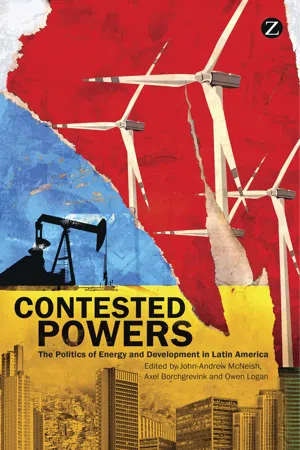
Contested Powers
The Politics of Energy and Development in Latin America
- English
- ePUB (mobile friendly)
- Available on iOS & Android
eBook - ePub
Contested Powers
The Politics of Energy and Development in Latin America
About this book
Trusted by 375,005 students
Access to over 1.5 million titles for a fair monthly price.
Study more efficiently using our study tools.
1 | INTRODUCTION: RECOVERING POWER FROM ENERGY – RECONSIDERING THE LINKAGES BETWEEN ENERGY AND DEVELOPMENT
John-Andrew McNeish and Axel Borchgrevink
A country without energy has no future. Simply put, a country without energy remains paralyzed; in a country where they fail to develop energy generation there are no investments … Without energy they cannot publish the newspapers that are circulated in our country. Without energy they cannot transmit television programs, sports, culture, soaps, films, and politics … nothing on television. Without energy there would be no radio in our country. The country would be completely silent … (Daniel Ortega, president of Nicaragua, 20 March 2010)
Peru has enormous wealth in the mountain ranges because of the rainfall. It is estimated that 800 billion cubic meters of water fall on the mountains every year and flow down in the rivers towards the Pacific and Atlantic oceans. How can we make the most of it? Now that the price of oil has increased and will continue to increase, we should think of hydroelectric energy, which is renewable, almost unlimited, and clean … it has to be done by large private or international capital that needs very long-term security to invest billions and to be able to recover the investment. But the dog in the manger says, ‘Why should they make money off our waterfalls?’ (Alan Garcia, former president of Peru, 28 October 2007)1
Extractivism is not a destiny, but may be the point of departure to conquer it. Certainly it can be found condensed in all of the world’s territorial divisions – much of which is colonial. And to break with this colonial subordination it is not enough to fill the mouth with insults against this extractivism, to stop producing and sink the population into further misery, to return to rights without modification and partial satisfaction of the basic needs of the population. This is precisely the trap of inflexible critique in favor of opposing extractivism … (Alvaro Garcia Linera, vice-president of Bolivia 2012: 106–7)
Introduction
This book examines how energy has been converted into political and economic power in recent times in Latin America, and the consequences this mode of acquiring power has for society, politics and economics in the region. As may be gleaned from the statements above, struggles over the extraction and exploitation of energy resources to a large extent define the controversial nature of contemporary Latin American politics. Reflecting on societal development, we are particularly conscious of the ways in which our environments and natural resources structure our societies and the way societies also change the environment. It is not merely technology, but the politics, social struggle and institutional formations that occur in the dynamic relationship between humans and the environment which are transformative.
In suggesting this, Contested Powers challenges the orthodox treatment of energy resources in development studies on two levels. This volume demonstrates that contests over natural resources refract the international, national and sub-national fault-lines of sovereignty. Indeed we see that in many cases these contests involve attempts to define the character of popular sovereignty, in Latin America and elsewhere. The case studies in subsequent chapters cast light on the historical meanings and socio-economic values which underpin and articulate what we call resource sovereignty. Secondly, we argue that it is vital to see the varied articulations of resource sovereignty in the larger context of a global division of labour and nature.
The model of an economy based on knowledge and creativity popularized by market economics is the polar opposite of resource sovereignty insofar as it disguises more complex dependencies on labour and natural resources at home and abroad. Given these insights, the book calls into question simplistic assumptions, i.e. that the exploitation of energy resources equals development and modernity, and the opposite idea, that natural resource wealth is a ‘curse’ on national development. We argue that these overly optimistic and overly pessimistic assumptions are two sides of the same technocratic coin. At a time when fossil fuel extraction and use are widely recognized as factors promoting global warming, it is crucial to arrive at a more realistic understanding of the dynamics of energy struggles.
Contested Powers is also intended as a necessary corrective to the slogan ‘think globally act locally’. Our research in Latin America leads us to stress the constraints of local environments and cultural habitus (Wacquant 2005). Transformations at the local level need to be understood in relation to expressions of power at an international level. The book is structured to reflect this critical theoretical orientation. As such it moves progressively between the fractured politics of citizenship at the sub-national level and on to efforts to make states more socially and politically coherent. Historically, states and political systems have used energy infrastructures as a means to make nations more coherent (Mitchell 2011). We argue that a pivotal issue for the fate of nations in the twenty-first century will be the dynamic interaction between local and international politics surrounding the production and consumption of energy.
This introductory chapter presents the theoretical foundation of the book (and the joint research project on which it is based). It starts by outlining our position, in contrast to other more mainstream approaches. In order to ground the theoretical discussion, this is followed by a broad overview of energy struggles in Latin America. Thereafter, we review existing literature relevant to our project, with emphasis on the two bodies of literature we have found to be particularly inspiring: anthropological approaches to the study of energy and the recent development of critical institutionalism. The introductory chapter ends by describing the research project on which the book is based and giving a brief outline of the remaining chapters.
Resource sovereignties
There are several powerful discourses directly and indirectly applied to the field of energy development and resource management.2 In the following we refer to three of them, i.e. the ‘energy equals development’ perspective, the ‘resource curse’ thesis, and lastly the ‘creative economy’ model. These three perspectives yield radically different conclusions about the importance of and potential for using energy resources for sustainable development. Yet we take issue with all three – for being technocratic, for having too simplistic a view of politics and for misrepresenting the relationship between the political and the material.
While policy documents and business statements often recognize the paradoxical risks that come with resource wealth, the overwhelming emphasis made by today’s policy-makers and business leaders is that increased energy extraction should not be a matter for political discussion (Schaffer 2009). In assessing the merits of various pipeline and energy production projects, companies and governments consistently warn their counterparts to stick to ‘commercial considerations’ (ibid.: 1). Despite concerns about peak oil and the diminishing supply of other carbon resources such as coal, on the one hand, and the threats of global warming stemming from our carbon-dependent economy on the other, research centred on ‘energy efficiency’ and exploration sustains the notion that solutions lie in technical innovation. Indeed, in most policy discourses and industry statements there is a common tendency to conflate energy and development uncritically,3 thereby reducing the challenge of development to a technological problem of developing the scientific and institutional capacity for effective energy production. In this sense the route to energy development is one of investment, of technical expertise and institutional establishment and stability. Insofar as this model of development also seeks to avoid, or to replace, fundamental political conflicts over the exploitation of natural resources it is technocratic – the goal of technocracy being to increase efficiency within the existing structures of power.
Yet underlying the production of energy a number of complex and incendiary political issues are evident. First among them is a variant of social territorialism expressed in what we call resource sovereignty, namely the controversial and uncertain ability of nation-states, or emergent polities within them, which seek sovereignty over territory to manage territorial resources in the public interest (McNeish and Logan 2012). Controversially the public interest in this context is not always identical to that of energy consumers either within or beyond such territorially based polities. More problematically still, the desire for resource sovereignty, whether seen in an increasingly dis-United Kingdom, a dangerously fragmented post-colonial Nigeria or a pluri-national Bolivia, is often at odds with the state’s governing structures, and this means that state structures of power and accountability need to be devolved, rebargained or officially pluralized if national sovereignty is not to be called into fundamental question. In this sense resource sovereignty may often be regarded as a jagged proto-nationalism capable of threatening the officially sanctioned nationalism of states with significantly different formative histories, including of course those at the two ends of imperialism – colonizing and colonized powers (Blom Hansen and Stepputat 2001).
We argue that it is vital to see varied articulations of resource sovereignty in the larger context of a global division of labour and nature (Coronil 2000). As we suggested above, the model of an economy based on knowledge and creativity popularized by market economics since the 1990s is the polar opposite of our perspective on resource sovereignty. The commoditization of creativity and knowledge beneath the banner of a creative economy is proposed by governments and regeneration consultants alike as the post-industrial answer to dependency on labour and natural resources. It is argued that an economy increasingly focused on creativity, knowledge and intellectual property is also a more environmentally friendly economy. The core of this perspective is strongly expressed by the regeneration guru Richard Florida. He claims that ‘Knowledge and creativity have replaced natural resources and the efficiency of physical labour as the sources of wealth creation and economic growth’ (Florida 2005: 49). Looked at critically, however, Florida’s diminishment of dependency on natural resources and manual labour, either at home or abroad, is extremely difficult to sustain (Peck 2005: 757). In Contested Powers we argue that the quick fixes offered by discourses of creativity and knowledge are bluffs, and in their own right will not lead to a greener economy. Rather, these discourses rearticulate the deeply inequitable global division of labour and nature which continues to hinder technological development in the global South by putting the capacity for important technological advancements – not least in energy production and consumption – in private hands.
Likewise we take issue with the technocratic and rational-choice foundations of another popular understanding, the so-called resource curse thesis. While research has provided considerable evidence that natural-resource abundance is often associated with various negative development effects, the relationship is nowhere near as conclusive, or as direct, as the terminology of a ‘curse’ suggests (Rosser 2006). Researchers have been too quick to posit a limited set of variables for understanding and responding to the dynamics surrounding resource governance. As a result an overly deterministic relationship has been characterized between natural resource abundance, Homo oeconomicus pathologies and various negative development outcomes. In responses to resource challenges, ‘resource curse’ theorists appear to ignore issues of ideology, history and political feasibility to account for the role of social forces and external political and economic environments in shaping development outcomes.
Recognizing the weaknesses of the resource curse thesis, and in particular the technocratic weakness of key writers in this field, e.g. Collier (2000, 2010), efforts are now being made to expand political ecology and political economy perspectives on resource governance so that they truly capture the political relationships involved in resource wealth governance, and acknowledge the social complexities and importance of historic grievances in shaping the present (Omeje 2008; Stevens and Dietsche 2008; Rosser 2006). An extension of theory and methodology away from rational-actor models and beyond quantitative research also heralds a return to a consideration of power and social class, and of imperialist relations and discourses. Importantly, parallels can also be made here between the ‘non-renewable’ literature focused on the operation of the resource curse, and the more ‘renewables’-oriented research focused on the role of institutions in environmental governance. Indeed, the recent critique of the resource curse mirrors to a large degree the theoretical and policy-oriented moves that have been made in recent years from ‘mainstream’ to ‘new’ and more recently ‘critical institutionalism’ perspectives on environmental governance (Cleaver 2012). Below we give a brief review of this evolution in approaches. Here, it is sufficient to point out that the coincidence between developments in the resource curse and environmental governance literatures not only provides support for a critique of technocratic and rational-actor perspectives, but is suggestive of the need to extend the theory and practice surrounding resource and energy governance in a similar direction. They are mutually supportive of the importance not only of individual agency, but social agency over time and of a movement away from rational-actor theory to social constructivism. Moreover, critiques of the resource curse thesis and of institutionalism in governance are also indicative of possible directions needed to improve analysis and practice.
We stress that our critical focus on energy politics is crucial to wider debates about modes of development and sustainability. This is because energy resources are converted into political power in complex ways. Chapter 11 will return to this issue. Here it is worth pointing out that only some of the conversions of energy resources into political power are immediately obvious. For example the rise to power of the late Hugo Chávez, a political movement strongly underpinned by the radical redistribution of Venezuela’s national hydrocarbon patrimony. Yet in Venezuela too, where a clear social contract was formed and its basis personified by President Chávez, it is evident that the possession of hydrocarbon reserves or other energy sources was not in itself a source of power. Other socio-economic forces are at work to compound their political value (Strønen 2014). Resource sovereignty is part of a political sequence, the ends of which will always be uncertain.
In his book Carbon Democracy (2011), Mitchell demonstrates that energy extraction and the development of governance structures are mutually constitutive in the course of history. He argues that no nation escapes the political consequences o...
Table of contents
- Cover
- About the Editors
- Title
- Copyright
- Contents
- Tables and figures
- 1. Introduction: recovering power from energy – reconsidering the linkages between energy and development
- 2. Oil extraction and territorial disputes in the Maya Biosphere Reserve
- 3. Gracias a díos y al gobierno: electric power struggles in Nicaraguan politics
- 4. Wind at the margins of the state: autonomy and renewable energy development in southern Mexico
- 5. Oil and environmental injustice in Venezuela: an ethnographic study of Punta Cardón
- 6. ‘Everything moves with fuel’: energy politics and the smuggling of energy resources
- 7. The continuous negotiation of the authority of oil- and gas-dependent states: the case of Bolivia
- 8. Passive revolution? Social and political struggles surrounding Brazil’s new-found oil reservoirs
- 9. Doing well in the eyes of capital: cultural transformation from Venezuela to Scotland
- 10. Latin America transformed?
- 11. From the King’s Peace to transition society
- About the authors
- Index
Frequently asked questions
Yes, you can cancel anytime from the Subscription tab in your account settings on the Perlego website. Your subscription will stay active until the end of your current billing period. Learn how to cancel your subscription
No, books cannot be downloaded as external files, such as PDFs, for use outside of Perlego. However, you can download books within the Perlego app for offline reading on mobile or tablet. Learn how to download books offline
We are an online textbook subscription service, where you can get access to an entire online library for less than the price of a single book per month. With over 1.5 million books across 990+ topics, we’ve got you covered! Learn about our mission
Look out for the read-aloud symbol on your next book to see if you can listen to it. The read-aloud tool reads text aloud for you, highlighting the text as it is being read. You can pause it, speed it up and slow it down. Learn more about Read Aloud
Yes! You can use the Perlego app on both iOS and Android devices to read anytime, anywhere — even offline. Perfect for commutes or when you’re on the go.
Please note we cannot support devices running on iOS 13 and Android 7 or earlier. Learn more about using the app
Please note we cannot support devices running on iOS 13 and Android 7 or earlier. Learn more about using the app
Yes, you can access Contested Powers by John-Andrew McNeish, Axel Borchgrevink, Owen Logan, John-Andrew McNeish,Axel Borchgrevink,Owen Logan in PDF and/or ePUB format, as well as other popular books in History & Latin American & Caribbean History. We have over 1.5 million books available in our catalogue for you to explore.