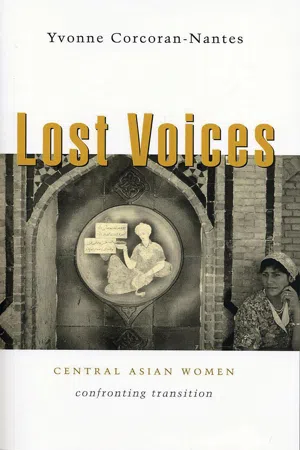
In 1991 the collapse of the Communist Party and the dissolution of the Soviet Union launched the republics of Uzbekistan, Kyrgyzstan and Kazakhstan into an unexpected self-declared independence and a precarious, uncertain future. Emerging from almost seventy-five years of Soviet tutelage all three republics embarked on a process of radical change. Central Asian women's lives have been profoundly affected during the huge upheavals of sovietization in the 1920s and democratisation in the 1990s, but their experiences have gone unresearched and undocumented. If Central Asia was generally considered to be the forgotten world of the Soviet Union, Central Asian women constitute the 'lost voices' of Central Asia.
Yvonne Corcoran-Nantes offers a timely analysis into the lives of Muslim women during the Soviet era, and considers the impact of the shift from Soviet communism to Western capitalist ideals and its impact on gender relations in the region. The uneasy synthesis between socialism and Islam under the Soviet regime offered many women considerable status and personal freedom in public life but these gains have been rapidly eroded in the process of 'democratization'. Opportunities for women have entered into serious decline in terms of employment, education and socio-political status. Unlike many commentators, she offers a convincing argument that the main threat to the socio-political status of women in Central Asia is not Islamic fundamentalism, but the imposition of free market principles and Western 'liberal democratic' ideals. Woven into the text is a also subtle and nuanced analysis of the ways in which Central Asian women negotiate feminism, whether ushered in by Soviet women during sovietization, or by western NGOs in the region today.
As a special consultant to UNESCAP, the author was one of the first researchers to undertake substantial research in the republics of Kazakhstan, Kyrgyzstan and Uzbekistan in the post-independence period and this book is based on her interviews with women from the region from all sections of Central Asian society.
- English
- ePUB (mobile friendly)
- Available on iOS & Android
eBook - ePub
About this book
Trusted by 375,005 students
Access to over 1.5 million titles for a fair monthly price.
Study more efficiently using our study tools.
Information
1 | Seeing through Western eyes and the sound of Western voices: women, feminism and debate post-perestroika
After the implementation of perestroika in 1985 the Soviet Union opened up to greater intellectual and cultural exchange. The opportunity for women to meet and exchange experiences, research and information at conferences and during academic sabbaticals exceeded that for all forms of contact in the preceding sixty-one years. For the first time it was possible to ask the ‘real’ questions and receive ‘honest’ answers – or was it? This was a discourse emanating from the ideological rubrics of systems, liberalism vis-à-vis Marxism, essentially and equally economically driven, in which comparisons are seemingly ubiquitous. The language used, the medium of exchange, was inevitably sustained by a different understanding of basic terms such as equality, democracy, representation and civil society, shaped by the exchangees’ socialization in very different value systems (Funk 1993: 3–4; Penn 1998: 50).1 Moreover, one of the major disadvantages of the exchange itself is that it continues in the wake of the Soviet model in which women of the former Soviet Union and other post-communist states are disempowered in what will be a protracted transition period.
The fall of the Soviet Union led to the realignment of political and economic forces in what is now Russia and the former Soviet republics which would displace a centrally planned economy run on socialist principles with a managed transition to a free market economy based on capitalist ones, albeit in many different forms. Within this conjuncture a concomitant pressure has been exerted to change the political landscape of the region with international support, financial and otherwise, insisting on a requisite commitment to the democratization of the political system along Western lines.2 This welcoming of post-communist states into the international fold was not merely a question of opening up new markets; implicit within it was an ideological conversion embarked upon with considerable fervour by international experts, development agencies, financial institutions and business consultants, which descended upon the former Soviet Union and its former republics after 1991.3 The philosophy was the same as that promulgated in the 1960s with respect to the so-called Third World – that with the cultural diffusion of Western economic and technological processes post-communist states would also experience a concomitant Westernization of social and cultural institutions. For the former Soviet republics of Central Asia this was anathema after almost sixty years of Soviet domination.4
Clearly post-communist states represent a different developmental phenomenon to the majority of developing countries in the southern hemisphere, but the prescription for economic development remains virtually the same. Kate Manzo likens this Eurocentric and ethnocentric approach to ‘development’ to that of a parent–child relationship. In the case in point the West would be the ‘healthy adults’ and the post-communist states the ‘infants’: ‘recently released from the wombs of their colonial “mothers”, these “children” must rely on the largesse of their beneficent “parents” to nurture, support and educate them until the day they are able to take their place in adult society. That the offspring will eventually resemble their parents in all aspects can of course be assumed for “normal” children generally do’ (Manzo 1991: 14–15).
In this way, transitional economies are disempowered in the ongoing process of the globalization of Western experience. The claim that the ‘failure’ of the Soviet model of socialist development represents a conclusive and irreversible victory of liberalism over Marxism (Fukuyama 1992), although strongly contested,5 merely confirms the influence of what Mohanty argued, some years previously, was an ‘implicit assumption of the “west” (in all its complexities and contradictions) as the primary referent in theory and praxis’ (Mohanty 1988). It is this assumption which exacerbates the unequal power relationship among women both nationally and internationally in the debate on the ‘woman question’ post-perestroika.
The problem remains that feminist intellectual debate on an international level continues to be dominated by American and European feminisms emanating from women’s experience within stable liberal democracies. This has created considerable conflict and debate at every UN Conference for Women since 1975, and this was no less evident at the recent conference in 1995. Cultural and religious differences, while given greater consideration at these and other international conferences, remain the crux of disagreement on setting agendas and constructing a programme for action. In the past women from the communist states were, to a certain extent, empowered at these events. They could put hard statistics on the table, demonstrating the level of gender equality achieved in the communist bloc in the areas of work, education and health, which made so-called achievements under the Western political paradigm look less than adequate.6 The response, in general, was twofold – either that the ‘evidence’ was unreliable or that the price of ‘gender equality’ in the communist bloc was too high. At Beijing in 1995, after the break-up of the Soviet Union, the representatives of Russia and the former Soviet republics presented a very different agenda, highlighting the radical decline in the status of women in the transition period and underlining those problems that the previous system had failed to resolve. Bereft of the ideological framework that had shaped their debates and critiques within the former system, and searching for more appropriate analytical categories, many were still unable or unwilling to embrace a feminist paradigm that would be tantamount to acquiescing to the pressures of Western cultural imperialism and adopting the language of the privileged to explain the circumstances of women who had become dispossessed.
It is not merely the multifarious nature of feminist ideology which creates problems in the ongoing debate in international women’s forums but the lack of convergence with respect to the prioritization of specific issues that will represent the interests of the majority of women. In the past the incongruity between the political agenda of Western feminism and that of women in the developing world has fractured communication and discourse between the two.7 Nevertheless, there are few female academics, political representatives or women’s organizations in the southern hemisphere who would deny the important role of Western feminism in consistently mainstreaming gender issues in international political and economic debate. This phenomenon, however, has in the past led to the hijacking of specific causes related to women’s oppression in the developing world, leaving the women concerned disempowered in the course of international disclosure/denunciation. It has also undermined the struggle of endogenous women’s organizations that seek to challenge the traditional and legal sanction of certain practices or forms of women’s oppression (Amos and Parmar 1984). When Western women become the self-appointed spokespersons for and representatives of the interests of women of other cultures in the name of global sisterhood it is not an act of solidarity, however well intentioned, but another lost opportunity in the cause of presenting different female voices and perspectives to be listened to and considered.
Since the 1990s, with the opening up of contact and cultural exchange between Western feminists and women from the post-communist states, how much have we learned from the critiques made of such exchanges? Do we still lead the discourse or are we led? Can we put ourselves in ‘listening mode’ as Cockburn (1991) so aptly puts it or does such a mode merely supply information that we reinterpret from a particular ideological standpoint, paraphrasing the words and political position of our peers in the post-communist states? All these questions can be answered in the affirmative and the negative.
The critique of Western feminists by women of the developing world – that we are selective in whom we speak to, whom we promote within and present to the Western intellectual community – is also being made by female politicians, women’s organizations and women’s NGOs in the post-communist states.8 This creates a situation whereby the voices of one group of women are privileged over others, and it is often claimed that these voices have a far wider audience in the West than in their country of origin, where they have little or no grass-roots support (Adamson 1999: 21–2). Yet in America and Europe Western feminisms have never claimed to represent anything but a minority view, and it seemed natural, if not inevitable, that Western feminists should seek out their peers in the post-communist states, researchers and academics who, if not self-declared feminists, have been influenced by and engage with Western feminists’ writings in their work on the situation of women. This influence is apparent in the way they reflect on the past and analyse the present. The net result of this is to make women who were once outsiders in the international feminist community insiders, but within their own country this status often creates a situation whereby they become outsiders in the growing representation of women in NGOs and social movements led by women.
The principal problem is that in the widening debate on the failure of the ‘Soviet model’ certain voices might be muted or excluded due to the fact that the perceived price of entrance, ‘the knowledge’, which is a feminist paradigm, might be one that some women object to or are unprepared to pay at this point in time. There is significant evidence available to show that since the 1970s Western feminist writing and ideologies have exerted an influence on small groups of Soviet women concerned with the ‘woman question’ within a communist system (Molyneux 1990; Waters 1993). Nevertheless, the majority of women remain cautious in the use of the word feminism and most especially reject any reification of Western feminist ideology and praxis as a measure of the advancement of women’s political consciousness in the context of post-communist systems. This position has been far more noticeable among eastern European women than Russian women (Funk and Mueller 1993; Posadskaya 1994b). It is the divergence between the two positions which sets the parameters of the debate on the status of women in a post-Soviet era.
Considering this debate and its ramifications for analysing the situation of women in the post-Soviet era is important for the purposes of this book. The aim is to move away from more general presentations of women in the post-communist states and consider the cultural specificity of their experience and status before the break-up of the Soviet Union and now in the period of transition. In this way the debate can be developed to consider and understand the often very different ways in which women are disempowered in different systems and the ways in which they have empowered themselves in both. Moreover, often what is not stated in the writing on post-communist states is as illuminating as what is; for example, in the case of the former Soviet Union there is little focus on ethnicity or emphasis on regional difference. This is most pertinent when we consider that the spokespersons for Central Asian women, who are the subject of this book, have, in the past, been Russian women, and this perspective remains pertinent in the context of analysing the status of women in Central Asia.
Debating the ‘woman question’ post-perestroika
An important part of the process of debate at an international level has been the publication of edited collections and articles which ‘showcase’ the analyses and perspectives of women from eastern Europe and Russia.9 This has been an important role that Western feminist academics have played in getting the work of non-Western women published in the mainstream academic press. Yet in this particular case it has, to a certain extent, shaped the analysis and argument of the writers. Written for a Western audience, the analysis of the situation of women under communism is almost overwhelmingly negative but offers a more perspicacious view of the present transition period.10 To a certain extent this is entirely understandable and can be interpreted as an attempt to address the overwhelmingly positive view of women in communist states presented, in the past, by the respective governments. One author puts forward an effective argument that it is this image, and the uncritical acceptance of it in the past by some Western feminists, which is effectively responsible for sustaining an essentially false image of the situation of women at the present time (Toth 1993; Watson 2000). It could be argued that before there was any substantial contact between women of the East and West an equally erroneous image of the situation of Western women prevailed among women of the East. Existing preconceptions on both sides continue to colour the exchange between the two, and this has not been helped in many cases by the realization that women from both sides of what was the Iron Curtain have far less in common than either side anticipated (Cockburn 1991; Funk 1993).
For women from the post-communist states this intellectual exchange with Western feminists is part of a process of reflection and a search for an appropriate framework for a gender-centred analysis, be that feminist or ‘womanist’ (Walker 1990). Yet what followed was a powerful debate which, predicated on a critique of the communist system, offered an insight into the similarities and differences not only between women of the post-communist states themselves but also between them and Western feminists. There was a clear juxtaposition of the analyses offered by those who are influenced by Western feminist ideology and those who reject totally the adoption of ‘alien’ ready-made concepts to inform political debate and social analysis in the post-communist states. It is the analyses of the former which have tended to be synthesized by Western feminists whose principal concerns focus on the emergence of indigenous feminisms and the need of an ‘independent’ women’s movement to demand greater gender equality in the post-Soviet era (Waters 1993; Molyneux 1991b). Seeking out a...
Table of contents
- Cover
- About the Editors
- Title
- Copyright
- Contents
- Acknowledgements
- Introduction
- 1 Seeing through Western eyes and the sound of Western voices: women, feminism and debate post-perestroika
- 2 Gender, Islam and nationalism: subterfuge and resistance in the Soviet era
- 3 The private and public face of economic emancipation: gender, work and education
- 4 A healthy generation: women, environment and reproductive health
- 5 Faith, community and fire: women, Islam and the family
- 6 Climbing the political mountain – female empowerment and disempowerment in a post-Soviet era
- Bibliography
- Index
Frequently asked questions
Yes, you can cancel anytime from the Subscription tab in your account settings on the Perlego website. Your subscription will stay active until the end of your current billing period. Learn how to cancel your subscription
No, books cannot be downloaded as external files, such as PDFs, for use outside of Perlego. However, you can download books within the Perlego app for offline reading on mobile or tablet. Learn how to download books offline
Perlego offers two plans: Essential and Complete
- Essential is ideal for learners and professionals who enjoy exploring a wide range of subjects. Access the Essential Library with 800,000+ trusted titles and best-sellers across business, personal growth, and the humanities. Includes unlimited reading time and Standard Read Aloud voice.
- Complete: Perfect for advanced learners and researchers needing full, unrestricted access. Unlock 1.5M+ books across hundreds of subjects, including academic and specialized titles. The Complete Plan also includes advanced features like Premium Read Aloud and Research Assistant.
We are an online textbook subscription service, where you can get access to an entire online library for less than the price of a single book per month. With over 1.5 million books across 990+ topics, we’ve got you covered! Learn about our mission
Look out for the read-aloud symbol on your next book to see if you can listen to it. The read-aloud tool reads text aloud for you, highlighting the text as it is being read. You can pause it, speed it up and slow it down. Learn more about Read Aloud
Yes! You can use the Perlego app on both iOS and Android devices to read anytime, anywhere — even offline. Perfect for commutes or when you’re on the go.
Please note we cannot support devices running on iOS 13 and Android 7 or earlier. Learn more about using the app
Please note we cannot support devices running on iOS 13 and Android 7 or earlier. Learn more about using the app
Yes, you can access Lost Voices by Yvonne Corcoran-Nantes in PDF and/or ePUB format, as well as other popular books in Politics & International Relations & Politics. We have over 1.5 million books available in our catalogue for you to explore.