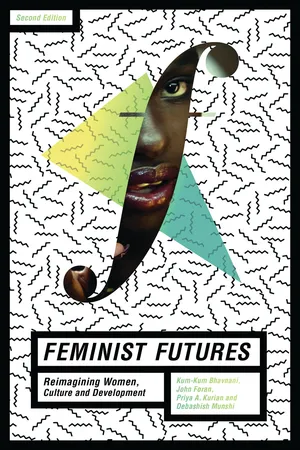
Straddling disciplines and continents, Feminist Futures interweaves scholarship and social activism to explore the evolving position of women in the South.
Working at the intersection of cultural studies, critical development studies and feminist theory, the book's contributors articulate a radical and innovative framework for understanding the linkages between women, culture and development, applying it to issues ranging from sexuality and the gendered body to the environment, technology and the cultural politics of representation.
This revised and updated edition brings together leading academics, as well as a new generation of activists and scholars, to provide a fresh perspective on the ways in which women in the South are transforming our understanding of development.
eBook - ePub
Feminist Futures
Reimagining Women, Culture and Development
- English
- ePUB (mobile friendly)
- Available on iOS & Android
eBook - ePub
Feminist Futures
Reimagining Women, Culture and Development
About this book
Information
1 | AN INTRODUCTION TO WOMEN, CULTURE AND DEVELOPMENT
Kum-Kum Bhavnani, John Foran and Priya A. Kurian
At the close of the twentieth century, there were clear indications that women in the Third World and the poor suffered the dire consequence of global (mal)development. This debilitating malaise continues into the new century. Its most recent symptoms include: the attack on the World Trade Center in New York on 11 September 2001; the US-initiated war on Afghanistan shortly thereafter; the use of the discourse of terrorism by the governments of India and Pakistan that threatens to spill over into a nuclear stand-off; the continued Israeli occupation of the West Bank that regularly escalates the cycle of violence; the US government’s targeting of Iraq, Iran and North Korea as an ‘axis of evil’; the Enron débâcle, in which a large US transnational corporation went bankrupt despite making millions of dollars for its chief officers through, among other things, the provision of expensive electricity for parts of India and investments in China. These examples continue to dominate public discussion, while the crises of HIV/AIDS, the impact of (and resistance to) IMF- and World Bank-directed structural adjustment policies, and the consequences of environmental destruction worldwide seem to have receded from public view. It is in this context that we feel an urgent need to reflect on development, culture and women.
In reading the outpouring of opinion from the left and among liberals urging progressives to think more deeply about the events of 11 September, often circulated on e-mail or posted on the internet,1 it becomes quite clear that missing in these responses to the attacks on the World Trade Center is a recognition that there is torment and strife in many parts of the world – that the attacks on the US need to be seen in the root context of global (mal)development, with particular implications for women and culture. Indeed, we believe that a misplaced emphasis on modernization strategies for the past half century is central to understanding why development has not led to a greater decrease in inequality between Third and First Worlds. In other words, development has failed the Third World.2 Although many explanations have been advanced, this failure is exacerbated by the end of the Cold War and the rise of projects of globalization, bringing with them an increasingly feminized poverty, an alarming process of environmental degradation and extremely elusive conditions for peace and security. What is less often recognized (although sometimes acknowledged in a sub-clause, phrase or equivocal footnote) is that women’s contributions and a regard for culture are key elements in a meaningful development that aims to improve living conditions of all poor people in the South.3
Women in the Third World face multiple challenges, among them poverty, unemployment, limited access to land, legal and social discrimination in many forms, sexual abuse and other forms of violence. Though similar in form to those faced by women in the First World, there are specificities of history, political economy and culture that make these realities differentially oppressive and exploitative for Third World women (see Amadiume 2000). But the women of the Third World are not victims. As ‘subaltern counterpublics’ (see Fraser 1997a), women in the Third World meet these challenges and confront them actively, often in remarkably creative and effective ways. In other words, there is far more to their lives than a set of interlocking ‘problems’ – there are many deeply fulfilling experiences, powerful emotions, beautiful creations and enduring relationships, sometimes born through struggles waged against the terms of existence. As Light Carruyo puts it in this volume: for WCD, development is not ‘something that is “done to” the Third World; instead, there is an acknowledgement that Third World actors, elite and non-elite, male and female, organized and not organized, contribute to the construction of the discourse and practice of development’.
The purpose of our book is therefore to assess the situation of women across many sites in the Third World in order to elaborate a fresh vantage point that relies on aspects of both earlier and more recent approaches (such as Sen and Grown 1987, Mohanty 1991, Tsing 1993, Braidotti et al. 1994, Marchand 1995, Snyder and Tadesse 1995, Ong 1997, Fagan, Munck and Nadasen 1997, Marchand and Runyan 2000, and Bergeron 2001, among many others) and at the same time suggest a new lens through which to look at women in the Third World and the ways women resist and celebrate the circumstances of their lives. We are certainly not proposing something no-one else has done before – we are merely trying to focus attention on and give a term and platform to an emerging approach that we think is a way forward out of the impasse in development studies. This volume represents an effort to suggest the shape of a new paradigm for development studies, one that puts women at its centre, culture on a par with political economy, and keeps a focus on critical practices, pedagogies and movements for social justice.
It has been argued that work within development studies has shifted from an emphasis on political economy to now include area studies and environmental studies, along with a greater interest in gender relations (Hoogvelt 1997). However, despite this shift, overly structural and economistic approaches to development predominate, as espoused by international aid agencies such as the World Bank. The 1992 World Bank Report argued that ‘Women must not be regarded as mere recipients of public support. They are, first and foremost, economic agents’ (World Bank 1992: 60). The Bank’s stated commitment to women’s participation in economic development is a fundamental part of its neoliberal strategy for improving economic productivity (see World Bank 1994), involving the embodiment of Third World poor women as able workers and entrepreneurs while ignoring their other roles as wives, partners, mothers, citizens and activists – roles that form the backbone of all societies, but which are difficult to discern, let alone comprehend, within conventional economic analyses. As such, the World Bank has not been able to engage with the actual realities of people’s lives, including gendered realities. For example, women plantation workers in Sri Lanka not only pick tea leaves, but they also have to organize their paid work in relation to their daily domestic responsibilities such as feeding the household. This responsibility can mean, therefore, that it is the husbands who have to collect the daily wages for the women’s work. These are paid at just the time when cooking tasks have to begin, with a consequent lack of control by the women over their wages. Patterns such as this demonstrate how the economic agency of women is layered by a complex set of realities.
Most recently, globalization, transnationalization and internationalization are posing important issues for scholarly debates as well as for activists’ practices, yet these terms often ignore the ways in which interdisciplinary thinking – and here we explicitly include work in the humanities – can contribute to an understanding of the present social and cultural conjuncture. We note that the adjective ‘global’ usually centres on the First World (Western Europe, North America, Australia and New Zealand), thereby continuing to privilege the First World even as it analyses global relationships, which turns the analytic gaze away from the Third World and the agency of people living in it. Our book aims to rectify that bias by placing Third World women firmly at the centre of inquiry. Even as we do this, we are aware that the ‘Third World’ denotes a heterogeneous set of places, cultures and societies. Yet, in centring Third World women, we intend also to participate in debates over the desirability of bringing together many diverse experiences under one rubric, just as the categories ‘woman’ (Butler 1997a, Halberstam 1998) and ‘Third World’ do.
For some time now, there has been considerable discussion about the gendered dynamics of development (e.g. Boserup 1970, Benería and Sen 1981, Tinker 1990, Kabeer 1994, Porter and Judd 1999). These discussions are essential to our argument. However, we offer this volume to demonstrate what could happen when Third World women are placed at the centre of development and global processes. This not only transforms the projects of development, along with their underlying discourses of modernization, but, in addition, starts to make culture(s) visible. For example, in her study of the migration of Filipinas as servants/labourers, Parreñas (2001) shows the centrality of community and family, alongside the nation-state and the labour market, for understanding the textures of the women’s lives. That is, in order to engage with gender, as distinct from merely acknowledging its presence, it is necessary to discuss culture.
However, simply attending to gender in an explicit manner is not enough. It is here that Raymond Williams’s famous notion of ‘culture’ as lived experience is helpful. Williams argues for an understanding of culture not simply as a set of habits or traditions, but as a way to comprehend how people actually live their lives – a ‘structure of feelings’. In other words, culture as lived experience insists on an agentic notion of human beings and is thus understood as a dynamic set of relationships through which inequalities are created and challenged, rather than as a singular property that resides within an individual, group or nation (Williams 1960; see Hall et al. 1980 for a further development of this argument). We do this in counterpoint to the structuralism of much of the ‘cultural turn’ in social theory, which is often devoid of agency, subjectivity, consciousness or emotion. A ‘structure of feeling’ is meant to denote the blend of pattern and agency we feel should characterize cultural analysis.
WID, WAD, GAD … WCD
There is a rich history of theoretical, applied and policy work on how best to tackle the relationship between women and development studies. This is now discussed almost canonically as the progression from WID to WAD to GAD (Rathgeber 1990, Moser 1993, Razavi and Miller 1995). Boserup’s 1970 work – considered an early example of an academic, policy-oriented book that noted women’s exclusion from development projects in the Third World – was taken seriously partly because the development community began to realize that the ‘trickle down’ approach to development had not been effective (Braidotti et al. 1994). Boserup’s work is often taken as signalling the origins of the women in development (WID) approach by pointing to women’s invisibility and exclusion from development (Moser 1993). WID was a way of ‘mainstreaming’ women (Martinussen 1997: 305) through arguing that they should be treated on equal terms with men – the ‘equity approach’ that gained ground in the 1970s. WID then shifted its underlying discourse from equity to anti-poverty to efficiency in the mid-1980s. The anti-poverty discourse complemented the 1970s’ ‘basic needs’ approach to development, whose solutions included income-generation strategies ...
Table of contents
- Cover
- About the editors
- Title page
- Copyright
- Contents
- Acknowledgements and dedications
- About the contributors
- Abbreviations
- Preface to the second edition
- 1 | An introduction to women, culture and development
- Part One. Sexuality and the gendered body
- Part Two. Environment, technology, science
- Part Three. The cultural politics of representation
- Postscript. A conversation about the future of women, culture and development
- Bibliography
- Index
Trusted by 375,005 students
Access to over 1.5 million titles for a fair monthly price.
Study more efficiently using our study tools.
Frequently asked questions
Yes, you can cancel anytime from the Subscription tab in your account settings on the Perlego website. Your subscription will stay active until the end of your current billing period. Learn how to cancel your subscription
No, books cannot be downloaded as external files, such as PDFs, for use outside of Perlego. However, you can download books within the Perlego app for offline reading on mobile or tablet. Learn how to download books offline
Perlego offers two plans: Essential and Complete
- Essential is ideal for learners and professionals who enjoy exploring a wide range of subjects. Access the Essential Library with 800,000+ trusted titles and best-sellers across business, personal growth, and the humanities. Includes unlimited reading time and Standard Read Aloud voice.
- Complete: Perfect for advanced learners and researchers needing full, unrestricted access. Unlock 1.5M+ books across hundreds of subjects, including academic and specialized titles. The Complete Plan also includes advanced features like Premium Read Aloud and Research Assistant.
We are an online textbook subscription service, where you can get access to an entire online library for less than the price of a single book per month. With over 1.5 million books across 990+ topics, we’ve got you covered! Learn about our mission
Look out for the read-aloud symbol on your next book to see if you can listen to it. The read-aloud tool reads text aloud for you, highlighting the text as it is being read. You can pause it, speed it up and slow it down. Learn more about Read Aloud
Yes! You can use the Perlego app on both iOS and Android devices to read anytime, anywhere — even offline. Perfect for commutes or when you’re on the go.
Please note we cannot support devices running on iOS 13 and Android 7 or earlier. Learn more about using the app
Please note we cannot support devices running on iOS 13 and Android 7 or earlier. Learn more about using the app
Yes, you can access Feminist Futures by Kum-Kum Bhavnani, John Foran, Priya A. Kurian, Debashish Munshi, Kum-Kum Bhavnani,John Foran,Priya A. Kurian,Debashish Munshi in PDF and/or ePUB format, as well as other popular books in Social Sciences & Gender Studies. We have over 1.5 million books available in our catalogue for you to explore.