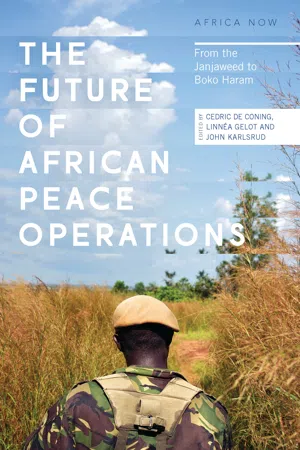
Facing threats ranging from Islamist insurgencies to the Ebola pandemic, African regional actors are playing an increasingly vital role in safeguarding peace and stability across the continent. But while the African Union has demonstrated its ability to deploy forces on short notice and in difficult circumstances, the challenges posed by increasingly complex conflict zones have revealed a widening divide between the theory and practice of peacekeeping. With the AU's African Standby Force becoming fully operational in 2016, this timely and much-needed work argues that responding to these challenges will require a new and distinctively African model of peacekeeping, as well as a radical revision of the current African security framework.
The first book to provide a comprehensive overview and analysis of African peace operations, The Future of African Peace Operations gives a long overdue assessment of the ways in which peacekeeping on the continent has evolved over the past decade. It will be a vital resource for policy makers, researchers and all those seeking solutions and insights into the immense security challenges which Africa is facing today.
eBook - ePub
The Future of African Peace Operations
From the Janjaweed to Boko Haram
- English
- ePUB (mobile friendly)
- Available on iOS & Android
eBook - ePub
The Future of African Peace Operations
From the Janjaweed to Boko Haram
About this book
Trusted by 375,005 students
Access to over 1.5 million titles for a fair monthly price.
Study more efficiently using our study tools.
Information
1 | Towards an African model of peace operations
Introduction
Highly complex and dynamic conflict systems are placing significant demands on African peace and security institutions. In response, new practices and cooperative models are emerging in an attempt to try to shape a more peaceful and stable continent. This book takes stock of how African peace operations have evolved over the past decade – from protecting internally displaced persons in Darfur from the Janjaweed militias to supporting coordinated operations by countries in the Lake Chad Basin region in their fight against Boko Haram insurgents. In the process we call for institutionalizing a new African peace operation model to better reflect the kind of short-duration, high-intensity, multi-actor stabilization operations that have become the norm.
African regional actors have during the last decade shown their indispensability as partners and as leading actors in international efforts to enhance peace and security in Africa (Brosig 2013; Engel and Porto 2014; Gelot 2012; Weiss and Welz 2014). The UN Security Council (UNSC) relies on proactive regional interventionism to sustain the reach and access of UN agencies to violence-affected populations in Africa as well as to prepare the ground for a transition to comprehensive UN-led peace operations. To this effect, the UNSC commends the growing role of the African Union (AU) in peace and security in its region and stresses the need for a stronger and more cohesive partnership between the UN and the AU in conflict prevention and resolution, rapid response to emerging crises, protection of children and peacebuilding (UNSC 2014; Boutellis and Williams 2013). While the UNSC in the 2005–10 period stressed the role of regional organizations, especially the AU, in responding to mass atrocities (UNSC 2006), the UNSC and the ‘P3’ – the United Kingdom, the United States and France – have since 2010 more actively aligned around the objective of closer cooperation with African regional actors to enable rapid reaction to counter contemporary regional and global security threats, among them criminal and terrorist networks, piracy, human trafficking and radicalized, armed non-state actors (UNSC 2014, 2015).
From experiences to date, a pattern of complex hybridity emerges. On the one hand, the UNSC relies on the AU and the Regional Economic Communities/Regional Mechanisms (RECs/RMs) to act as first responders to emerging crises, and employ a generous interpretation of Chapter VIII of the UN Charter. An enduring trend in this regard is the UN’s inability to generate troops and police in sufficient numbers and to deploy them rapidly enough to meet the demands made on it. Structural constraints, for example bureaucratic rationales and security and safety rules, as well as normative constraints, including the UN’s core principles regarding impartiality, consent of all parties to the conflict, and non-use of force except in self-defence and in the defence of the mandate, have also resulted in a cautious posture. On the other hand, African regional actors rely on the UNSC’s legitimacy for their actions and on financial and other types of assistance from international partners as well as African states and institutions, without which the African peace operations to date could not have occurred (Gelot 2012; Badmus 2015). African institutions are also developing and institutionalizing their peace and security mechanisms concurrently with peace operations being deployed, tested and assessed, given the complex conflict scenarios on the continent (De Coning 2014). Additionally, African institutions have ever closer and more complex relations with a multitude of actors – creating new relations of opportunity and dependency. Bilateral relations with conventional as well as new partners such as China and Russia, relations with diverse funding bodies, private sector partnerships, civil society participation, etc., are all necessary albeit accompanied by problematic challenges such as inter-institutional rivalry, incoherence and unaccountability (Tardy and Wyss 2014).
Box 1.1 Background on the African Union and its peace and security architecture
The African Union (AU) was established in 2002 to reorganize and revitalize the Organization for African Unity (OAU), which was founded in 1963. While the OAU was based on principles of national liberation and decolonization, the AU is founded on principles of accelerated political and socio-economic integration between the Union’s member states and its geographical regions. The transition from the OAU to the AU was made to envision an African future characterized by integration, prosperity and peace, which would be driven by the African people in order to become an influential voice within the international community (African Union Commission 2015: 10). In the peace and security realm the transition from the OAU to the AU broadened the security concept from state security to human security. One of the most significant shifts in this regard is the shift from non-interference (OAU) to non-indifference (AU) in that the Peace and Security Protocol of the AU provides for AU intervention in member states in cases of mass atrocities, war crimes and crimes against humanity.
At the core of the AU is the Assembly, made up by the heads of state from all fifty-four AU members, which is the highest level of decision-making within the Union (ibid.: 14). The Assembly can delegate tasks to either its Executive Council, which coordinates and monitors the implementation of adopted policies by the Assembly (ibid.: 22), or its Peace and Security Council (PSC), which is mandated to decide on interventions in or sanctions against member states in order to prevent, manage and resolve conflicts within Africa. The African Peace and Security Architecture (APSA) includes the Continental Early Warning System (CEWS), the Panel of the Wise, the African Standby Force (ASF), the Military Committee and the Peace Fund.
The Permanent Representatives Committee (PRC) supports both the Assembly and the Executive Council (ibid.: 28) and is responsible for the day-to-day business, together with the AU Commission (AUC). The AUC functions as the AU’s secretariat with approximately 1400 staff members managing the various AU programmes and initiatives in coordination with all of the different AU bodies (ibid.: 62).
Having individually developed outside of the AU/OAU structure, the Regional Economic Communities (RECs) are geographical groupings created to facilitate economic integration across the African continent. There are eight separate RECs which are recognized by and closely integrated with the AU: the Arab Maghreb Union (UMA), the Common Market for Eastern and Southern Africa, the Community of Sahel-Saharan States (CEN-SAD), the East African Community (EAC), the Economic Community of Central African States (ECCAS), the Economic Community of West African States (ECOWAS), the Intergovernmental Authority on Development (IGAD), and the Southern African Development Community (SADC) (ibid.: 116).
Adapted from African Union Commission (2015)
The emerging ASF is illustrative of a key component of the APSA that is simultaneously being refined, constructed and evaluated. This volume grapples with the realization that the doctrine of the ASF is out of sync with the challenges faced by African peace operations on the ground. The foundations for the ASF were laid over a decade ago. The existing doctrine has been developed around traditional principles of multidimensional UN peace operations. It will now have to adapt so that the ASF can deploy in high-intensity ‘non-permissive’ situations that the UN peace operation model was not originally designed for. Working assumptions and principles are in the process of being reconsidered, while the revised deadline for full operational capability (FOC) has remained the same, set for December 2015.1
As reflected in this volume in the chapters by Solomon Dersso and Jide Okeke (Chapters 3 and 7), the key question is how best to develop the Rapid Deployment Capability (RDC) concept, i.e. a process-based debate, and not how to, strictly speaking, operationalize the ASF on time. From recent discussion in the UNSC it is clear that the Western powers as well as emerging powers see a strategic value in supporting the development of an African rapid response capability (African Union 2015a). It is widely recognized that Africa will need an RDC to mitigate the worst effects of erupting conflicts and to bridge the time it takes the APSA and other international actors to discuss strategic objectives and to plan and deploy more comprehensive missions (Badmus 2015).
Against the background of the gap between current conflict scenarios and the ASF concept, Dersso and Okeke discuss one such proposal and its ambiguous standing within the APSA today, the ‘African Capacity for Immediate Response to Crises’ (ACIRC). Now considered an interim measure, supported by around fifteen African states, the ACIRC comprises tactical battle groups of 1,500 military personnel deployed by a lead nation or a group of AU member states. Volunteer states/coalitions would pledge to sustain troops in the field for a minimum of thirty days. Its purpose is to conduct stabilization and enforcement missions, neutralize terrorist groups, and provide emergency assistance to AU member states. Unlike the ASF regional standby forces, the ACIRC is a purely military capability without police or civilian elements. Rapid reaction and stabilization demands have taken centre stage, reflecting a sense of urgency within the APSA communities, against the backdrop of complex crises in Mali, Central African Republic (CAR) and elsewhere.
In this volume, chapters discuss the factors that led to an emergent hybrid global–regional partnership in peace and security matters against the background of global order change. We discuss how the perceptions of a changed security landscape and the related perception of an urgent need to act have sparked processes of adaptation and response within an evolving APSA. Sometimes the chapters treat the AU or the RECs/RMs as coherent actors, yet in keeping with recent scholarship on the APSA (Brosig 2013; Engel and Porto 2014; Tardy and Wyss 2014; Badmus 2015) the intense overlap and institutional relations between institutions and policy communities as well as the various and changing interests within the components of the APSA and between the APSA and the member states are also recognized. For instance, de Coning argues (Chapter 9) that most of the AU peace operations to date are better understood as coalitions of the willing, rather than as multinational-led and -deployed operations as foreseen in the ASF.
A theme that also underpins the chapters is the ways in which subregional organizations negotiate political autonomy and craft for themselves a distinct profile or niche competence. Regularly, the APSA becomes an institutional setting for subregional actors and state leaders to join forces and contest the argument that outside/global actors should interfere with sovereignty and local politics. Facing transnational security challenges, the RECs/RMs need close inter-institutional linkages with the APSA to strengthen the joint capacity to respond. Yet within their own subregions institutions and regional states claim first-response authority. There are thus processes of convergence and alignment as well as divergence or friction.
The APSA provides institutional space for African states and policy-makers to make the collective case at the global level that African regional powers and institutions are providing regional security goods and thus shouldering international responsibilities. Following on from that, they argue that growing influence on international security should translate into recognition and representation in global governance fora (Wallensteen and Bjurner 2015). The chapters also grapple with the implications of the APSA’s financial dependency on external funding and discuss initiatives to increase African internal sources of funding. The literature on African security has consistently argued that dependency on financial assistance challenges the principle of ownership (De Coning 1997; Boutellis and Williams 2013), and even that on occasion a funding institution or partner may appear as an actor of equal significance to the APSA on matters of peace and security (Brosig 2013).2
The context: the contemporary African security landscape
African peace operations, in collaboration with international partners, are responding to a highly complex and dynamic environment. To meet rapidly changing conflict patterns and security trends, a rich variety of institutional interlinkages and hybrid partnership models have emerged, but these models are often poorly developed or institutionalized. There is a need to develop both resilient African models and collaborative approaches.
As Kwesi Aning and Mustapha Abdallah (Chapter 2) highlight, asymmetric and hybrid security challenges, religious extremism and transnational criminal networks intersect in several countries, creating new challenges for the APSA and resulting in calls for rapid action. Thanks to intensive efforts, piracy off the Horn of Africa has waned – but is on the rise in other areas such as the Gulf of Guinea. Militant groups and jihadist terrorist networks are changing their modus operandi; and in some areas, collusion between criminal or militant actors, business actors and state structures brings additional challenges. However, while religious extremism and terrorism are important factors, they should not be overemphasized or allowed to mask deeper political and socio-economic challenges that are at risk of becoming ‘securitized’.3
Pandemics such as Ebola, as Aning and Abdallah also note, pose immense challenges to areas with weak state authority or widespread poverty. With the Ebola pandemic in West Africa as an example, discussion has begun on whether rapid intervention may be needed also in cases of instability or pandemics, and not only in extreme cases of mass atrocities and crimes against humanity. The most extreme cases are covered under Article 4(h) of the AU Constitutive Act and may trigger military intervention by the AU on a member state’s territory, even finally without its consent (Engel and Porto 2013).
Complex intercommunal conflicts with regional and transnational dimensions pose threats to the protection of civilian populations and require careful responses by African institutions. At the same time, prefixes such as ‘asymmetric’ or ‘novel’ applied to threats mask the fact that conventional threats to security continue to exist in parallel with unpr...
Table of contents
- Cover
- About the editors
- Title
- Copyright
- Contents
- Acknowledgements
- Abbreviations and acronyms
- 1 Towards an African model of peace operations
- 2 Confronting hybrid threats in Africa: improving multidimensional responses
- 3 Stabilization missions and mandates in African peace operations: implications for the ASF?
- 4 The relationship between the AU and the RECs/RMs in relation to peace and security in Africa: subsidiarity and inevitable common destiny
- 5 The strategic relationship between the African Union and its partners
- 6 Mission support for African peace operations
- 7 United in challenges? The African Standby Force and the African Capacity for Immediate Response to Crises
- 8 What roles for the civilian and police dimensions in African peace operations?
- 9 Adapting the African Standby Force to a just-in-time readiness model: improved alignment with the emerging African model of peace operations
- 10 African peace operations: trends and future scenarios, conclusions and recommendations
- About the contributors
- Index
Frequently asked questions
Yes, you can cancel anytime from the Subscription tab in your account settings on the Perlego website. Your subscription will stay active until the end of your current billing period. Learn how to cancel your subscription
No, books cannot be downloaded as external files, such as PDFs, for use outside of Perlego. However, you can download books within the Perlego app for offline reading on mobile or tablet. Learn how to download books offline
Perlego offers two plans: Essential and Complete
- Essential is ideal for learners and professionals who enjoy exploring a wide range of subjects. Access the Essential Library with 800,000+ trusted titles and best-sellers across business, personal growth, and the humanities. Includes unlimited reading time and Standard Read Aloud voice.
- Complete: Perfect for advanced learners and researchers needing full, unrestricted access. Unlock 1.5M+ books across hundreds of subjects, including academic and specialized titles. The Complete Plan also includes advanced features like Premium Read Aloud and Research Assistant.
We are an online textbook subscription service, where you can get access to an entire online library for less than the price of a single book per month. With over 1.5 million books across 990+ topics, we’ve got you covered! Learn about our mission
Look out for the read-aloud symbol on your next book to see if you can listen to it. The read-aloud tool reads text aloud for you, highlighting the text as it is being read. You can pause it, speed it up and slow it down. Learn more about Read Aloud
Yes! You can use the Perlego app on both iOS and Android devices to read anytime, anywhere — even offline. Perfect for commutes or when you’re on the go.
Please note we cannot support devices running on iOS 13 and Android 7 or earlier. Learn more about using the app
Please note we cannot support devices running on iOS 13 and Android 7 or earlier. Learn more about using the app
Yes, you can access The Future of African Peace Operations by Cedric De Coning, Linnéa Gelot, John Karlsrud, Cedric De Coning,Linnéa Gelot,John Karlsrud in PDF and/or ePUB format, as well as other popular books in Politics & International Relations & Geopolitics. We have over 1.5 million books available in our catalogue for you to explore.