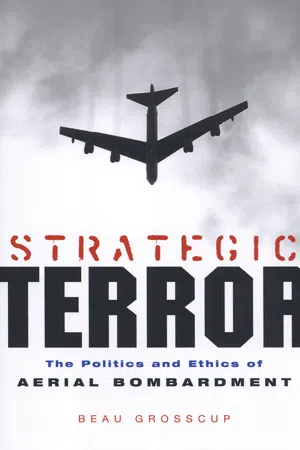
Presenting a global history of aerial bombardment, this book shows how certain European powers initiated aerial bombardment of civilians after World War I, and how it was an instrument of choice in World War II. Beau Grosscup shows that such methods, used initially as a means of terrorizing native populations in Africa and the Middle East, have become the primary form of terrorism in more recent decades.
While such 'strategic terror' is not classed as 'terrorism' in the West, this reflects an unwillingness to confront the human costs and immorality of aerial bombardment. Grosscup argues that if terrorism is to be diminished, the role of aerial bombing in sustaining global violence must be recognized.
- English
- ePUB (mobile friendly)
- Available on iOS & Android
eBook - ePub
1 Shock and Awe!! Shock and Awe!!
In early March 2003, the United States Defense Department formally introduced Shock and Awe, its war plan for the impending attack on Iraq.1 The idea was to blast the so-called ‘axis of evil’ nation with 3,000 bombs and missiles over 48 hours for the purpose of ‘shocking the Iraqi leadership into submission quickly.’2 Almost overnight the phrase ‘Shock and Awe’ held a prominent place in the US lexicon. On the Internet, late-night television programs and among political pundits, the catchy slogan was evoked to make fun of or draw attention to people or events. Soon, there was virtually nothing that couldn’t be ‘Shocked and Awed.’ According to Tonight Show host Jay Leno, ‘John Kerry finally cleared up his position on military action in Iraq. He said he voted yes on shock, no on awe.’ The website military.com unabashedly offered a new feature, ‘SHOCK and AWE,’ showing ‘raw battle footage on video, gritty photos from the front lines, the latest on military games and simulations, and stories and intel you won’t get anywhere else.’ To this day, the prominent place of Shock and Awe in political and commercial imagery appears secure. ‘Dick Cheney’s Shock and Awe’ referred to a revealing photo of the Vice President on the 2004 campaign trail ‘that leaves little to the imagination.’ British citizens were described as being in a collective state of ‘Shock and Awe’ after the London bombings of 7 July 2005. The Winx Club, a new product for children, is marketed as five girl dolls who ‘kick booty’ and encourage kids to get ready to ‘Shock and Awe.’
The public and pundits may have chortled over the slogan, but to the war planners and their critics Shock and Awe was serious business. For Pentagon officials, the ‘cleanest’ and quickest way to win their ‘necessary’ war was ‘to have such a shock on the system that the Iraqi regime would have to assume early on the end was inevitable.’3 Pentagon officials briefed the particulars of the plan to newspaper reporters with the following statements:
US Air Force B-2s, F-1117As, B-52s, F-15Es and RAF Tornados will be in the first wave: ‘Their targets in the first hours have been chosen to lessen destruction of Iraq’s infrastructure but maximize the destruction of Saddam Hussein’s family, military and political machine.’ ‘B-52 bombers flying out of Diego Garcia and B-2 stealth bombers will attack the barracks and bases of the elite Republican Guard and government offices … Amid the noise and horror of this initial onslaught, …4
By the time Iraqis see the dawn at the end of the first night, their country’s military and political infrastructure is likely to have been shattered, say analysts. Key leaders will have disappeared, entire military units will have been obliterated, power supplies will have been shut down but the visible damage will be surprisingly small, according to the attack plan.5
If by this time Saddam is still resisting, military planners have factored in a short political pause to allow his capitulation. If no white flag is seen, the assault on Baghdad will begin … At this stage, the political imperative to keep civilian casualties to a minimum will have to be put to one side. The attack on Baghdad will use overwhelming force.6
In reality, said one Pentagon official to CBS News, ‘There will not be a safe place in Baghdad.’7
Critics of the war plan included Pentagon officials and anti-war activists. Questioning the effectiveness of the plan, a senior Pentagon official referred to it as a ‘bunch of bull.’8 According to anti-war organizer Bill Hackwell, ‘The Bush administration is preparing to turn the US war machine, the biggest armada in history, on a poor country and cause a bloodbath like we have never seen.’9
Though Pentagon officials declared, ‘The sheer size of this has never been seen before, never been contemplated before,’ there wasn’t anything new about Shock and Awe. It was merely a restatement of the doctrine of strategic bombing; a theory articulated at the end of World War One asserting that air power alone could and should win wars. Though its basic assumptions have remained, the application of the doctrine has gone through various reformulations. In 1996, the theory of Rapid Dominance, or Shock and Awe as it was soon anointed, became the latest version.
Primarily the brainchild of retired Air Force General Charles Horner and defense expert Harlan K. Ullman of the National Defense University, ‘Shock and Awe’ builds on the ideas of Sun Tzu and Karl von Clausewitz. They pictured war as ‘a deception’ with elements of ‘fog, friction and fear.’10 Writing in classic strategic bombing (and gendered) terms, the architects of Shock and Awe present the central aim as:
… to destroy, defeat, and neuter the will of an adversary to resist. … to affect the will, perception, and understanding of the adversary to fit or respond to our strategic policy ends through imposing a regime of Shock and Awe. … Our intent, however, is to field a range of capabilities to induce sufficient Shock and Awe to render the adversary impotent. This means that physical and psychological effects must be obtained … The target is the adversary’s will, perception, and understanding.11
The key objective is to have the same impact on the enemy’s will using conventional weapons as the atomic bombing of Hiroshima and Nagasaki had on Japanese civilians and leadership. As Horner and Ullman write: ‘The Japanese simply could not comprehend the destructive power carried by a single airplane. This incomprehension produced a state of awe.’12
‘SHOCK AND AWE’ AND TERRORISM
In assessing the description of Horner and Ullman, Edward Spannaus, law editor of Executive Intelligence Review, argues that ‘Shock and Awe’ is nothing more than a sanitized version of the mass terror tactics used in World War II.’13 Noam Chomsky also associated Shock and Awe with terrorism, asserting: ‘we saw this repeated again in the attack on Iraq, spun as “Shock and Awe”, which is simply a niceified phrase for Causing Terror.’14 Though sparsely, the connection was also to be found in Internet discourse. For example, Nathan Newman urged, ‘let’s end the hypocrisy of labeling attacks on civilians by enemies “terrorism” and our own use of it “shock and awe.” ’15
By invoking the word ‘terror’ to describe past and present Western bombing policy, Spannaus, Chomsky and a few others took a rare and brave step. Rare in that since the inception of strategic bombing, government and military elites from the bombing nations have adamantly avoided and effectively excluded from ‘legitimate’ public discourse any connection between terrorism and their use of air power. It is a brave step as historically those who dared to make the link found their ideas derided as unpatriotic in public discourse and unwanted in the corridors of power.
In the post-9/11 context the ‘war on terrorism’ dominates the Western mindset. The ‘global scourge of terrorism’ is universally condemned and billions of dollars are spent on ‘counter-terrorism’ endeavors. This being the case, why is it then that those who find the United States and its bombing allies culpable in the ‘scourge of terrorism’ are abruptly dismissed with either silence or angry disdain? More specifically, why is a plan that proposes to attack a whole society with a massive bombardment and warns that ‘the political imperative to keep civilian casualties to a minimum will have to be put to one side’ greeted with humor, indifference or applause? Why is the plan not openly and universally castigated at least as ‘wrongheaded’ or, more important, as a morally and politically repugnant strategy of terrorism?
To address these important questions, this inquiry focuses on the theoretical roots of Shock and Awe and the political and moral controversies surrounding the historical use of air power. Throughout, the primary question is: does strategic bombing constitute terror from the skies? But first, to introduce the many issues and controversies surrounding strategic bombing, the inquiry begins with the Shock and Awe experiment of Operation Iraqi Freedom.
THE POLITICAL CULTURE OF ‘SHOCK AND AWE’
‘Baghdad is burning. … What more can we say’ 16
Shock and Awe was launched on 21 March 2003. US and British bombs and missiles slammed into Pentagon-designated strategic ‘military’ targets throughout Iraq, including targets in downtown Baghdad and other cities. With noticeable glee and satisfaction, Fox News reported that ‘Baghdad took a terrific pounding from Allied missiles, which rained bombs throughout the city. Huge fireballs rocked the heart of the capital, and the sky filled with smoke.’17 Government buildings in densely populated neighborhoods along the Euphrates River and Saddam Hussein’s palaces were bombed repeatedly. Numerous Wal-Mart-like shopping malls and food markets were also ‘precisely’ hit.18 Colonel John Warden, a major architect of the 1991 Persian Gulf air war, identified the 3,000-pound penetrating-warhead and enhanced Guided Bomb Unit-27 (GBU-27) ‘smart’ bombs launched from B-52 and F-117 jets respectively, as the ordnance of choice. Warden also boasted that the United States possessed other bombs that if needed could ‘get down as far as the Iraqis can dig. It is probably that simple.’19
To the chagrin of the war planners and viewers of the ‘light and fireworks show’ on live television, in the wake of the initial massive air attack the anticipated collapse of the Iraqi regime did not occur. As ground operations joined the aerial campaign, TV pundits, military media consultants and viewers expressed disappointment that the carnage from the ‘precision’ application of modern weaponry fell far short of the expectations raised over the previous two months of Shock and Awe hyperbole. Within military circles, the staying power of the Iraqi government and its people renewed the bitter debate about whether or not air power alone could win wars. Army and navy officials noted with obvious relief that once again the claims of the strategic bombers had been proven false. Airpower advocates responded, arguing that Shock and Awe was not a true test of strategic bombing theory as the level of violence was far below that required to ‘shock the system’ into capitulation. Unfazed, they looked eagerly to the next war, hoping a politically ‘unrestrained’ aerial attack would finally permit a true test of their theory.
The disappointment in and enthusiasm for Shock and Awe underscore the West’s historic passion for the ‘technological fix’ and a militaristic imperial mentality. At the core of both is callous disdain for ‘other’ peoples believed to be less sophisticated or not quite civilized. Together, they have produced a military doctrine that assumes modern weaponry will quickly and ‘cleanly’ crush the enemy’s spirit to resist. The experience of twentieth century wars has found this military doctrine wanting and steeped in political and moral controversy. Yet, in planning for the war on Iraq, the architects of Shock and Awe doggedly stuck to this prescription. Success in Iraq simply required upping the level of ‘shock’ with ‘high tech’ firepower. The initial targets were the leadership and ‘strategic’ infrastructure. If necessary, the weapons would then be turned directly on civilians until the ‘awed’ Iraqis’ breaking point was reached. If doing so proved controversial, raising accusations of terrorism from ‘adversarial’ quarters (whether foreign or domestic), a time-tested system of denial and rationalization, coupled with the ‘patriotic media,’ would easily silence them. After all, the post-9/11 War on Terrorism was a just cause, requiring ‘special tactics.’ And international law, embodied in the Hague Resolutions and Geneva Conventions, permitted them to do all things ‘militarily necessary’ to win. Though the immediate bloodshed would be appalling, morality was on their side, as a quick end to the war would mean saving lives of both friend and foe. Even if victory required a combination of air and ground war, the architects of Shock and Awe were confident that the historically cultivated US callousness toward enemy noncombatants, pointedly reinvigorated with the 9/11 attacks, would sustain the near-rabid public support for the Bush Administration’s ‘whatever it takes’ approach to any designated enemy. After all, the bombing of Afghanistan had produced high public approval ratings. Thus it was likely ‘whereas the tragic loss of life on 11 September 2001 precipitated a blank check for President Bush to hunt down terrorists, and even wage war in Iraq, Americans are not, in turn, willing to grant Iraqis, for example, the same right to indignation and fury.’20
Much of the public and official enthusiasm for Shock and Awe stems from the assertion that now, more than ever, air war is amazingly ‘high tech.’ As the implications of Shock and Awe became clear, Bush Administration officials assured the public and major media that the latest generation of taxpayer-funded weapons were more precise and accurate than ever. Now it really was possible to bomb military targets ‘cleanly’ while ‘minimizing’ civilian suffering. The claims of ‘precision’ and ‘minimal’ suffering are a constant in bombing lore, as is the military’s refusal to define what they mean. The Shock and Awe bombing of Iraq continued this tradition. The new weapons were said to be not only ‘smart’ but indeed ‘brilliant,’ with the sensor capacity ‘to tell if a spot on the ground is a tank or a farm tractor.’21 For his part, Deputy Defense Secretary Paul Wolfowitz was delighted with the new technology and the role it played in his military’s ability at last to wage a moral war. He asserted, ‘This was not a bombing of Baghdad. It was a bombing of the Iraqi regime and it was done with extraordinary precision. We never in history have been able to do it with that kind of precision. As a result we made enormous effort to distinguish between military targets and the civilian population.’22
In advance of the bombing, Pentagon officials vowed they were using an ‘excruciating amount of time’ to do ‘everything humanly possible’ to keep ‘collateral damage minimal.’23 While adamantly refusing to quantify ‘minimal’ or ‘acceptable’ civilian casualties, they did offer some specific measures. For example, any air strike thought likely to cause over 30 civilian casualties would require the personal approval of Defense Secretary Donald Rumsfeld. When the aerial assault began, Rumsfeld rarely hesitated to give his permission to bomb. He authorized fifty such strikes between 19 March and 18 April 2003. Utilizing the Pentagon’s own calculations means Rumsfeld’s approvals purposely placed approximately 1,500 Iraqi civilians (about half of the total number of 9/11 victims) in harm’s way. In most of the strategic bombing there were no such...
Table of contents
- Cover
- About this Book
- About the Author
- Title
- Copyright
- Contents
- Dedication
- Acknowledgements
- List of Abbreviations
- Prologue
- 1 Shock and Awe!! Shock and Awe!!
- 2 The Origins of Strategic Bombing
- 3 Who Is to Be Bombed? The Self and Other in Imperial Culture
- 4 Strategic Bombing Comes of Age
- 5 Cold War Strategic Bombing: From Korea to Vietnam
- 6 Terrorists in the Bombsights
- 7 Strategic Bombing in the 1990s
- 8 Bombing to Win: 9/11 and the War on Terrorism
- 9 Dodging the Terrorism Label
- 10 Terror from the Skies
- Notes
- Select Bibliography
- Index
Trusted by 375,005 students
Access to over 1.5 million titles for a fair monthly price.
Study more efficiently using our study tools.
Frequently asked questions
Yes, you can cancel anytime from the Subscription tab in your account settings on the Perlego website. Your subscription will stay active until the end of your current billing period. Learn how to cancel your subscription
No, books cannot be downloaded as external files, such as PDFs, for use outside of Perlego. However, you can download books within the Perlego app for offline reading on mobile or tablet. Learn how to download books offline
Perlego offers two plans: Essential and Complete
- Essential is ideal for learners and professionals who enjoy exploring a wide range of subjects. Access the Essential Library with 800,000+ trusted titles and best-sellers across business, personal growth, and the humanities. Includes unlimited reading time and Standard Read Aloud voice.
- Complete: Perfect for advanced learners and researchers needing full, unrestricted access. Unlock 1.5M+ books across hundreds of subjects, including academic and specialized titles. The Complete Plan also includes advanced features like Premium Read Aloud and Research Assistant.
We are an online textbook subscription service, where you can get access to an entire online library for less than the price of a single book per month. With over 1.5 million books across 990+ topics, we’ve got you covered! Learn about our mission
Look out for the read-aloud symbol on your next book to see if you can listen to it. The read-aloud tool reads text aloud for you, highlighting the text as it is being read. You can pause it, speed it up and slow it down. Learn more about Read Aloud
Yes! You can use the Perlego app on both iOS and Android devices to read anytime, anywhere — even offline. Perfect for commutes or when you’re on the go.
Please note we cannot support devices running on iOS 13 and Android 7 or earlier. Learn more about using the app
Please note we cannot support devices running on iOS 13 and Android 7 or earlier. Learn more about using the app
Yes, you can access Strategic Terror by Beau Grosscup in PDF and/or ePUB format, as well as other popular books in History & Military & Maritime History. We have over 1.5 million books available in our catalogue for you to explore.