Whilst the world's poor are clearly hit hardest by climate change impacts, so too do they hold many of the solutions for how best to cope with its impacts, and at times reduce greenhouse gas emissions to zero.
In this wide-ranging book, Hannah Reid offers a rich compendium of real life scenarios and brings home the realities of how poor people are suffering from and coping with climate change impacts today.
Drawing on case studies gathered by the UP in Smoke group - a powerful coalition of global environment and development organizations including Greenpeace, Oxfam, Practical Action and the WWF - this book provides new models for human development in a climate-change-constrained future as well as positive solutions to tackling climate change at the macro-level with proposals from luminaries such as Professors Wangari Maathai, Manfred Max-Neef and Jayati Ghosh.
- English
- ePUB (mobile friendly)
- Available on iOS & Android
eBook - ePub
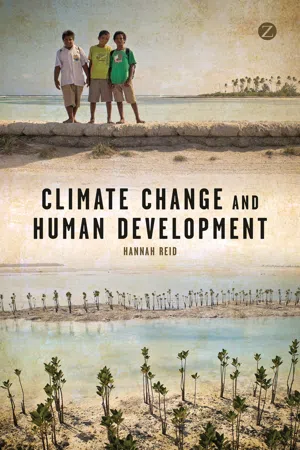
Climate Change and Human Development
1
Climate change: what to expect
For the next two decades we can expect global warming of about 0.2°C per decade. After this time, what happens to changes in temperature depends a great deal on how much we keep filling the atmosphere with greenhouse gases. The best estimates from a range of models predict temperature increases of between 2 and 4°C by 2100 compared to 1980–99 levels. As a result of this global warming, scientists expect the following regional climate change impacts over the coming years:1
• Observed warming will be greatest over land areas and at high northern latitudes, and least over the Southern Ocean and parts of the North Atlantic Ocean.
• Contraction of areas covered by snow, increases in the depths of thaw experienced over most permafrost regions, and decreases in the extent of sea ice. Some scientists expect Arctic late-summer sea ice to disappear almost entirely by the latter part of the twenty-first century.
• Very likely increase in the frequency of hot extremes, heatwaves and heavy precipitation.
• Likely increase in the intensity of tropical cyclones, but possible decreases in their number.
• Poleward shifts of extra-tropical storm tracks, with consequent changes in wind, precipitation and temperature patterns.
• Very likely precipitation increases in high latitudes and likely decreases in most subtropical land regions.
Estimates of sea-level rise have concluded that this will most likely be 50–140 cm above 1990 levels by the year 2100,2 and that even 200 cm is theoretically possible,3 particularly in view of the fact that ice sheets in Greenland and Antarctica are melting at ever-increasing rates.
Climate change is an uncertain science. Although scientists are getting better at predicting long-term regional trends, it is difficult to predict accurately what to expect over short timescales and in specific locations. Some areas of climate science have more uncertainty associated with them than others. For example, the properties and roles of clouds in limiting global warming, and the extent to which CO2 uptake by land and oceans will change future atmospheric greenhouse gas concentrations, are poorly understood.4 Scientists are in agreement, however, that greenhouse gas emissions are warming the planet, and will continue to do so for many years. Complete certainty about the detailed mechanisms for this and its implications are not needed before we take action. If 98 per cent of doctors say your son is sick and needs treatment, and 2 per cent say he is fine, wouldn’t you take precautions and go with the majority view, especially if the consequences of ignoring the majority view could be dreadful? It is the same with climate change.
Developing countries are the most susceptible to these climate change impacts, which, as the box on Uzbekistan below shows, are already being felt. Their economies are heavily dependent on sectors vulnerable to the climate, such as agriculture, fishing, forestry and hydropower. Many poor countries are also located in vulnerable areas such as drought-prone sub-Saharan Africa, flood-prone Bangladesh and low-lying islands such as Tuvalu. But developing countries are also the least able to cope with the impacts of extreme weather conditions, because they have limited financial resources, few skills and technologies, and high levels of poverty.
The effects that these droughts, cyclones, temperature changes and rises in sea level will have, particularly on the world’s poorest, are described in the following chapters, alongside many of the creative ways in which they are learning to cope.
Projected climate change impacts at the regional level5
AFRICA
• By 2020, between 75 and 250 million people are projected to be exposed to increased water stress due to climate change.
• By 2020, in some countries, yields from rain-fed agriculture could be reduced by up to 50 per cent. Agricultural production, including access to food, in many African countries is projected to be severely compromised. This would further adversely affect food security and exacerbate malnutrition.
• Towards the end of the twenty-first century, projected sea-level rise will affect low-lying coastal areas with large populations. The cost of adaptation could amount to at least 5–10 per cent of gross domestic product (GDP).
• By 2080, an increase of 5–8 per cent of arid and semi-arid land in Africa is projected under a range of climate scenarios.
ASIA
• By the 2050s, freshwater availability in Central, South, East and South-east Asia, particularly in large river basins, is projected to decrease.
• Coastal areas, especially heavily populated mega-delta regions in South, East and Southeast Asia, will be at greatest risk due to increased flooding from the sea and, in some mega-deltas, from the rivers.
• Climate change is projected to compound the pressures on natural resources and the environment associated with rapid urbanisation, industrialisation and economic development.
• Endemic morbidity and mortality due to diarrhoeal disease, primarily associated with floods and droughts, are expected to rise in East, South and Southeast Asia due to projected changes in the hydrological cycle.
LATIN AMERICA
• By mid-century, increases in temperature and associated decreases in soil water are projected to lead to gradual replacement of tropical forest by savanna in eastern Amazonia. Semi-arid vegetation will tend to be replaced by arid-land vegetation.
• There is a risk of significant biodiversity loss through species extinction in many areas of tropical Latin America.
• Productivity of some important crops is projected to decrease and livestock productivity to decline, with adverse consequences for food security. In temperate zones, soybean yields are projected to increase. Overall, the number of people at risk of hunger is projected to increase.
• Changes in precipitation patterns and the disappearance of glaciers are projected to significantly affect water availability for human consumption, agriculture and energy generation.
SMALL ISLANDS
• Sea level rise is expected to exacerbate inundation, storm surge, erosion and other coastal hazards, thus threatening vital infrastructure, settlements and facilities that support the livelihood of island communities.
• Deterioration in coastal conditions, for example through erosion of beaches and coral bleaching, is expected to affect local resources.
• By mid-century, climate change is expected to reduce water resources in many small islands, for example in the Caribbean and Pacific, to the point where they become insufficient to meet demand during low-rainfall periods.
• With higher temperatures, increased invasion by non-native species is expected to occur, particularly on mid-and high-latitude islands.
Observed changes in Uzbekistan
‘In recent years, the change in climatic conditions in all seasons of the year has been sharply felt. Changes in climate often influence agricultural yield; for example, many kinds of grain crops do not have time to ripen. From 2000 to 2003, because of a drought, none of the districts of Karakalpakstan could obtain productivity in grain.’
‘The problem of water facilities, especially drinking water and water for irrigating agriculture, has recently become one of the largest problems … because of the drying of the Aral Sea; on its former coasts the influence of dust storms and sand drifts is strongly felt. Almost in the whole territory of the Republic of Karakalpakstan it is possible to see salt on the ground left over from evaporation. Salinity of the soil negatively affects vegetative cover. In many places, trees and other vegetations are drying out. Huge tracts of land and agricultural fields are covered by copious saline deposits. As a result, productivity drops and quality worsens.’
‘In recent years, as a result of the change in climatic conditions and pollution, the frequency of allergic and bronchial diseases has sharply increased.’
‘Little by little the extinction of not only many kinds of vegetation, animals and rare varieties of fauna fade away.’
Joint Development Associates, Uzbekistan, a partner organisation of Tearfund
2
Food and farming
There are now at least 815 million chronically malnourished people in the world, 95 per cent of them in developing countries.1 Inequitable access to food is a major factor in fuelling world hunger, but global warming is also undermining food security. The World Food Programme estimates that by 2050 the number of people at risk of hunger as a result of climate change will be 10–20 per cent higher than would be expected without it, and that sub-Saharan Africa is likely to be worst affected.2
Poverty, conflict, disease, governance problems, an unjust international trading system, and the burden of unpayable debt hinder the ability of Africa’s communities and nations to handle shocks. Africa’s people and its economies are also highly vulnerable to both flood and drought, both of which are increasingly problematic. The record shows that Africa’s annual rainfall has been decreasing since 1968. During the Mozambique floods in 2000 (the worst for 150 years), the lowlands of the Limpopo river were inundated for up to three months. While short-term flooding can benefit some crops, like rice, the 2000 floods lasted so long that they wiped out the plant resources that local people relied on. Stored food, seed reserves and all field crops were destroyed, forcing farmers to find fresh seeds from far away.
If not addressed, climate change could put an additional 80–120 million people at risk of hunger, 70 to 80 per cent of whom will be in Africa.3 Livelihoods built for generations on particular patterns of farming may quickly become unviable.
Agriculture in sub-Saharan Africa – of which most is rain-fed – accounts for 60 per cent of the employment in the region (excluding South Africa) and 30 per cent of its gross domestic product.4 This compares to 16.3 per cent of working people in Latin America being employed in the agricultural sector.5 While many African farmers have successfully adapted to slow changes in the region’s climate, the level of unpredictability which global warming introduces may overwhelm their capacity to cope.
While some agricultural areas may benefit from increased rainfall, estimates suggest climate change will significantly reduce crop yields in sub-Saharan Africa. Recent models suggest that by mid-century average falls in maize production will be 22 per cent, sorghum and millet 17 per cent, groundnuts 18 per cent and cassava 8 per cent.6 Effects could be even greater in localised regions. Estimates predict a 33 per cent reduction in maize in Tanzania; in Sudan millet production is expected to decrease by between 20 and 76 per cent, and sorghum by between 13 and 82 per cent.7
‘Drought is becoming more and more frequent, leading to drying out of soil and the disappearance of vegetation. The life of an entire population is on hold, waiting for clouds, which promise less and less rain and which finally destroy the hope that cattle breeders and their herds will enjoy healthy pastures. They also destroy people’s hope for a better tomorrow which would usher in an abundant harvest so passionately awaited by farmers and their creditors.’
Malian development group TNT
‘The change in weather has aff...
Table of contents
- Cover
- About the Author
- Title
- Copyright
- Contents
- Acknowledgements
- Preface
- Introduction
- 1 Climate change: what to expect
- 2 Food and farming
- 3 Water
- 4 Health
- 5 Energy
- 6 Disasters
- 7 The natural environment
- 8 Cities
- 9 Women
- 10 Trade
- 11 Migration
- 12 Conflict
- 13 What next?
- Notes
- Bibliography
- Index
Trusted by 375,005 students
Access to over 1.5 million titles for a fair monthly price.
Study more efficiently using our study tools.
Frequently asked questions
Yes, you can cancel anytime from the Subscription tab in your account settings on the Perlego website. Your subscription will stay active until the end of your current billing period. Learn how to cancel your subscription
No, books cannot be downloaded as external files, such as PDFs, for use outside of Perlego. However, you can download books within the Perlego app for offline reading on mobile or tablet. Learn how to download books offline
Perlego offers two plans: Essential and Complete
- Essential is ideal for learners and professionals who enjoy exploring a wide range of subjects. Access the Essential Library with 800,000+ trusted titles and best-sellers across business, personal growth, and the humanities. Includes unlimited reading time and Standard Read Aloud voice.
- Complete: Perfect for advanced learners and researchers needing full, unrestricted access. Unlock 1.5M+ books across hundreds of subjects, including academic and specialized titles. The Complete Plan also includes advanced features like Premium Read Aloud and Research Assistant.
We are an online textbook subscription service, where you can get access to an entire online library for less than the price of a single book per month. With over 1.5 million books across 990+ topics, we’ve got you covered! Learn about our mission
Look out for the read-aloud symbol on your next book to see if you can listen to it. The read-aloud tool reads text aloud for you, highlighting the text as it is being read. You can pause it, speed it up and slow it down. Learn more about Read Aloud
Yes! You can use the Perlego app on both iOS and Android devices to read anytime, anywhere — even offline. Perfect for commutes or when you’re on the go.
Please note we cannot support devices running on iOS 13 and Android 7 or earlier. Learn more about using the app
Please note we cannot support devices running on iOS 13 and Android 7 or earlier. Learn more about using the app
Yes, you can access Climate Change and Human Development by Hannah Reid in PDF and/or ePUB format, as well as other popular books in Economics & Sustainable Development. We have over 1.5 million books available in our catalogue for you to explore.