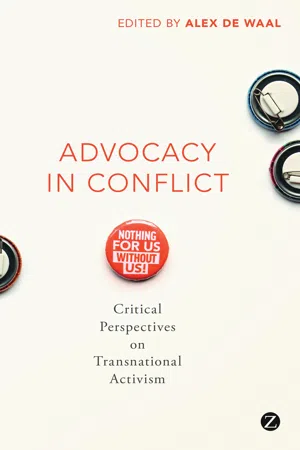
Conflicts in Africa, Asia and Latin America have become a common focus of advocacy by Western celebrities and NGOs. This provocative volume delves into the realities of these efforts, which have often involved compromising on integrity in pursuit of profile and influence.
Examining the methods used by Western advocates, how they relate to campaigns in the countries concerned, and their impact, expert authors evaluate the successes and failures of past advocacy campaigns and offer constructive criticism of current efforts. Taking in a range of high-profile case studies, including campaigns for democracy in Burma and Latin America, for the rights of Palestinians in Gaza, and opposing the Lord's Resistance Army in Uganda, the authors challenge the assumptions set forth by advocacy organizations.
- English
- ePUB (mobile friendly)
- Available on iOS & Android
eBook - ePub
About this book
Information
1 | INTRODUCTION: TRANSNATIONAL ADVOCACY IN CONTENTION
Jennifer Ambrose, Casey Hogle, Trisha Taneja and Keren Yohannes
‘Nothing for us without us’
Activists across time zones, decades and topics have used variations of the slogan ‘nothing for us without us’ to express a key tenet of responsible advocacy: people affected by conflict, rights abuses and other injustices should play the leading role in movements that advocate on their behalf. When repression, silencing or dispersal leaves those people disadvantaged, it places particular responsibilities on Western advocates to act in a way that allows the substantive agenda, targets and goals, media portrayal, and methods to be set in accordance with the articulated priorities of the affected population. Most recently associated with the international disability rights movement of the 1990s, ‘Nothing for us without us’ demands that audiences listen to the self-expressed interests and goals of oppressed people. In the wake of recent advocacy campaigns, such as Invisible Children’s Kony2012 film and the US Campaign for Burma’s ‘It Can’t Wait’ videos – both of which became international sensations more for their tactics and messaging than for the issues they promote – the slogan encourages reflection on the extent to which recent trends in transnational advocacy have deviated from core principles of responsible activism. Hence, the impetus for this book is our recognition of the need to reclaim international advocacy movements to make them more self-reflective and accountable to the people and the evolving situations they represent.
Our focus is on a particular subset of transnational activism, itself a subset of activism more generally, namely professionalized Western advocacy concerned with particular conflicts in other parts of the world. While there is a rich literature on global society and activism (Kaldor 2003; Feher 2007; Reydams 2011), Western-led campaigns that focus on particular conflict-affected countries are dealt with only in passing. While individual campaigns such as Save Darfur have generated both controversy and research (Mamdani 2009; Hamilton 2011), there is little comparative analysis on how these movements fit with broader issues of global civil society. This book targets that gap, and our central argument is that the development of these specific forms of activism, in which advocates have shaped strategies to fit the requirements of marketing their cause to Western publics, and adapted them to score tactical successes with Western governments (especially that of the USA), has led to the weakening or even abandonment of key principles. This is akin to what Mary Kaldor (2003) calls the ‘taming’ of civil society, as social movements transform into professionalized NGOs. The key principles we identify as needing to be asserted or reclaimed include receptivity to the perspectives of affected people and their diverse narratives and attention to deeper, underlying causes, and therefore a focus on strategic change rather than superficial victories.
In March 2012, Invisible Children unveiled its Kony2012 campaign, based on sparse and ill-constructed logic, designed to ‘make Kony famous’. What soon became one of the most viral YouTube videos in history sparked a mad dash by the organization’s target audience of American high school and college students to purchase advocacy kits. With these kits, student activists purportedly possessed the tools needed to pressure the US Congress to take on the responsibility of stopping Joseph Kony (or, to be precise, not ending its support for efforts to stop him). However, the student activists and organizers ignored their obligation to represent the priorities of the affected population, a central tenet of responsible international advocacy. While students stepped up to the task of ‘saving’ the people of central Africa from the terror of the Lord’s Resistance Army (LRA) – without being invited to consider the marginal role Africans themselves were allowed to play – the video’s misleading portrayal of the situation on the ground sparked a widespread counter-movement and hearty discourse in the blogosphere. The Tumblr site most critical of Kony2012, Visible Children, gained thousands of followers, and major television networks began calling on academic experts to articulate their concerns over the campaign.
The Kony2012 video succeeded in propelling Joseph Kony to international stardom. The seemingly black-and-white, for-or-against Kony2012 debate that immediately followed the video’s release provided a platform for everyone opposed to the campaign to name a plethora of reasons why it was bad. Few critics, however, could fully articulate how an international advocacy campaign in the twenty-first century should be conducted in an ethical, responsible and effective way. While Kony2012 made it clear that, with skilful use of media, a mass public campaign on an international issue can make a big splash, it reinforced the need for local leadership and for being conscientious regarding the intricacies of a situation. As Kony2012 began to outshine home-grown advocacy movements and their objectives for Uganda, it also brought up the necessity of ensuring enough space for indigenous and international movements to work together, with local movements setting the agenda and Western groups offering resources, scale and solidarity.
Two years later, in April 2014, a leading instance of ‘hashtag activism’ – the #BringBackOurGirls campaign – demanded the return of the over two hundred Nigerian girls kidnapped from the Chibok girls’ school by the Islamic extremist group Boko Haram. This has interesting echoes of the activism against the LRA, beginning with the way the LRA’s mass abduction of pupils from the Aboke girls’ school in 1996 suddenly provided a focal point for wider awareness and campaigning across Uganda. Similarly, Boko Haram had been killing, abducting and terrorizing for more than two years before Nigeria’s elite or Western actors began to take notice: it took the girls’ kidnapping for this to happen.
The kidnapping sparked the origination of #BringBackOurGirls locally before the campaign was amplified internationally. The Nigerian campaign focused equally on Boko Haram and on the Nigerian government, and its ineptitude, corruption and brutality. It criticizes not only Boko Haram’s devastating actions, but also the environment that has given the group its raison d’être and the ability to conduct such a major attack. Nigerians asked for the return of the Chibok girls, of course, but also for better governance, more security and less corruption. The activist message simplified a complicated story, but it did break through that domestic barrier.
The American narrative, though, diverged significantly from the original Nigerian campaign. Its focus is exclusively on Boko Haram. The Western campaign was not organized around a specific ‘ask’, but some Nigerians worried it would transmute into lobbying for American military action – as that is the default option for US foreign policy and American popular culture (Balogun 2014). However, despite the fact that Boko Haram is identified as a terrorist organization associated with al-Qaeda, the USA has not dispatched its own troops, at the time of writing. It provided surveillance aircraft to assist the Nigerian military, but US government spokespeople were openly critical of the Nigerian army’s record on corruption and human rights (Schmidt and Knowlton 2014).
What accounts for this less interventionist message and outcome? A large part of the reason is likely to be reluctance in the US Department of Defense, translating into a policy decision in the White House not to intervene (ibid.). Insofar as the leading Washington lobbyists on African human rights issues pick up this signal, they are unlikely to advocate for an intervention that would be strongly resisted. A second, related reason is that none of the American ‘advocacy superpowers’ (Carpenter 2014: 40) have taken up the cause, leaving the agenda-setting – by default – to the Nigerians. As a result, the #BringBackOurGirls campaign failed to create a lasting international publicity blitz; its presence on social media platforms rapidly dwindled. The campaign left its Western audience with a short and savvy glimpse into a complicated Nigerian story, having diluted the message and having had almost no international impact (Fisher 2014). Cognizant of the lessons of Kony2012, Nigerian activists may be grateful for this neglect.
Key questions
With these two examples in mind, many questions demand further reflection regarding the future of international activism and how to more closely align efforts with the ‘nothing for us without us’ adage.
The first set of questions is about the legitimacy and accountability of Westerners advocating for geographically and culturally distant issues. If these advocates’ legitimacy is not derived from the people on whose behalf they are advocating, what gives them the right to propose solutions? To whom are advocates accountable, and how are advocates accountable when they do harm?
A closely related question is: how are different advocacy groups to be involved? One of the recurrent themes of this volume is the overlapping cast that is involved in different campaigns: some focused on campaigning through publicity; others through using international organizations, including the platforms and instruments (such as treaties) they provide; others through the mobilization of mass constituencies; and still others through the intellectual labour of defining the issues and narratives. Among all these groups, the people immediately affected may struggle to find their voice, or – a less appreciated but equally significant challenge – to be able to reflect on the issues and define an agenda. Inclusivity means taking to heart the perspective of the affected people, and listening to different voices.
A third recurrent question concerns singularity versus multiplicity of narratives, and the related element of openness to new perspectives and voices. Part of what makes for superficial and easily co-opted advocacy is the singular narrative, which defines the story in a plausible and compelling manner, but prescribes a simplistic solution – which is almost invariably wrong. Inclusivity allows for multiple voices and a complex debate. On the other hand, the narratives with the most resonance are those that allow the faraway individual to make an emotional connection. This is one reason actors are often enrolled as spokespeople for international causes, because they specialize in such vicarious connectivity. New York Times columnist Nicholas Kristof labels and heavily employs such ‘bridge characters’, who are easily relatable to Western audiences, but define the issue through a single lens. A local ‘bridge character’ may also have a ‘Janus face’: she may say one thing to foreign sponsors, and another to her own constituents.
Following from this, more specifically, is a set of questions about the role of academics in activism. Should scholars with an in-depth knowledge of local issues have a say in setting the agenda for activist movements? How should we reconcile academic knowledge with the more practical demands of activism?
A fifth set of questions concerns the targets of activism and the relationship between the local and global. Given that activists cannot hope to change everything at once, how should they prioritize their targets? Should they enlist global power to change local conditions? And if so, on what basis should advocates engage with powerful governments, such as that of the USA, knowing that the governmental agenda will invariably prevail over the activists’ at the end of the day? Should they target global inequities and enlist local power structures in that struggle, knowing that whatever their emancipatory rhetoric, politicians in conflict-affected countries tend towards the venal and brutal? Or should they target both levels of power, aware that activists have limited capacity for enacting real change? These questions recur throughout the case studies in this volume.
Those critical of campaigns like Kony2012 should outline an alternative way forward, creating a model for responsible activism while drawing lessons from successful transnational advocacy movements.
However, it would not be appropriate to suggest a single unchanging model. Each activist campaign unfolds in a different local and international context. As Alex de Waal’s historical overview in Chapter 2 makes clear, today’s transnational advocates operate in very different historical conditions to those that confronted activists a generation ago. The heyday of radical transnational activism was in the 1970s and 1980s. The Cold War was on, the remnants of colonialism were fighting on in southern Africa, and the US government was struggling to assert its legitimacy in the wake of the Vietnam War and Watergate. The gold standard for activism was a mass movement that spanned different countries, even continents, and which could press governments for change using a range of tools including the media, public demonstrations, practical action in support of oppressed peoples, and legal and legislative measures. Veterans of those movements, when they observe today’s Kony2012 or Enough campaigns, feel the label ‘activist’ has been misappropriated by people more interested in celebrity profile and insider politics than in real change.
The world has changed: it is not possible to return to what De Waal calls the ‘anti-colonial solidarity model’ at a time when colonialism is history and the Western democracies’ enemy is terrorism, not communism. For example, in the 1980s, the anti-apartheid campaign made Nelson Mandela its icon: he was a guerrilla commander whom the South African government labelled a ‘terrorist’, but the campaigners burnished his image while also making the irrefutable case that apartheid was wrong. Recent and ongoing occupations, such as those of the USA in Iraq and Israel in the Palestinian Territories, are the focus for more convoluted activism, especially in the USA, in part because the line between ‘terrorist’ and ‘freedom fighter’ has now become much more problematic.
We are cautious about specifying any political or normative agenda that constitutes ‘genuine’ activism. Our concern is more with the process than the issues themselves.
Instead of looking at the complete cloth of a successful activist movement and trying to replicate that, it is better to examine those elements that are positive and durable, and those that are problematic or transient. This challenge recurs throughout the volume and is taken up in the concluding chapter.
Outline of the book
The chapters examine various dimensions of the relationship between Western advocacy and local movements through six regional and three thematic case studies. With the goal of fostering dialogue, readers will have the space to reflect upon how to realize principles of responsible advocacy within their own contexts and roles. Although we primarily focus on conflict-affected countries, we include chapters on transnational issues that reveal different challenges of advocacy around issues that transcend borders.
In Chapter 2, Alex de Waal outlines the historical roots of Western advocacy and examines how current Western activist practices have evolved through particular global circumstances. He frames activism with reference to three abiding impulses: the personal salvation or fulfilment of the activist her- or himself; protection of the social order through charitable assistance to those in need, who might otherwise be subversive of that order; and an ethic of solidarity in support of radical political change. Transnational advocacy is a subset of broader activism, in which the tension between these three principles is often particularly acute, because of the remoteness of the subjects of the activism – in a faraway country, unable to add their voices in a straightforward manner. Drawing upon the ‘boomerang model’ of how local and transnational advocates interact (Keck and Sikkink 1998), De Waal shows how trajectories of initiating and guiding campaigns have changed in response to changing international political circumstance. In particular, he examines the way in which the model of professionalized adversarial advocacy, ‘mobilizing shame’, was utilized by human rights organizations in the 1970s and 1980s, and how this combined with humanitarian organizations’ advocacy for intervention in crisis in the 1990s to generate a new form of specialized Western policy lobbying in Washington, DC, and to a lesser extent in European capitals. This coincided with the US government regaining its own sense of moral authority in world affairs and resulted in a series of campaigns for Western mi...
Table of contents
- Cover
- About the Editors
- Title
- Copyright
- Contents
- Preface
- 1 Introduction: Transnational Advocacy in Contention
- 2 Genealogies of Transnational Activism
- 3 Burma’s Struggle for Democracy: A Critical Appraisal
- 4 The Janus Face of International Activism and Guatemala’s Indigenous Peoples
- 5 Advocacy Delegitimized: The Convoluted Case of Gaza
- 6 Conflict Minerals in Congo: The Consequences of Oversimplification
- 7 ‘Make him Famous’: The Single Conflict Narrative of Kony and kony2012
- 8 Getting Away with Mass Murder: The Spla and its American Lobbies
- 9 From Whose Perspective Anyway? The Quest for African Disability Rights Activism
- 10 Activism and the Arms Trade: Exposing the Shadow World
- 11 A Right to Land? Activism Against Land Grabbing in Africa
- 12 Conclusion: Reclaiming Activism
- About the contributors
- Index
Trusted by 375,005 students
Access to over 1.5 million titles for a fair monthly price.
Study more efficiently using our study tools.
Frequently asked questions
Yes, you can cancel anytime from the Subscription tab in your account settings on the Perlego website. Your subscription will stay active until the end of your current billing period. Learn how to cancel your subscription
No, books cannot be downloaded as external files, such as PDFs, for use outside of Perlego. However, you can download books within the Perlego app for offline reading on mobile or tablet. Learn how to download books offline
Perlego offers two plans: Essential and Complete
- Essential is ideal for learners and professionals who enjoy exploring a wide range of subjects. Access the Essential Library with 800,000+ trusted titles and best-sellers across business, personal growth, and the humanities. Includes unlimited reading time and Standard Read Aloud voice.
- Complete: Perfect for advanced learners and researchers needing full, unrestricted access. Unlock 1.5M+ books across hundreds of subjects, including academic and specialized titles. The Complete Plan also includes advanced features like Premium Read Aloud and Research Assistant.
We are an online textbook subscription service, where you can get access to an entire online library for less than the price of a single book per month. With over 1.5 million books across 990+ topics, we’ve got you covered! Learn about our mission
Look out for the read-aloud symbol on your next book to see if you can listen to it. The read-aloud tool reads text aloud for you, highlighting the text as it is being read. You can pause it, speed it up and slow it down. Learn more about Read Aloud
Yes! You can use the Perlego app on both iOS and Android devices to read anytime, anywhere — even offline. Perfect for commutes or when you’re on the go.
Please note we cannot support devices running on iOS 13 and Android 7 or earlier. Learn more about using the app
Please note we cannot support devices running on iOS 13 and Android 7 or earlier. Learn more about using the app
Yes, you can access Advocacy in Conflict by Alex de Waal in PDF and/or ePUB format, as well as other popular books in Economía & Economía del desarrollo. We have over 1.5 million books available in our catalogue for you to explore.