- English
- ePUB (mobile friendly)
- Available on iOS & Android
eBook - ePub
About this book
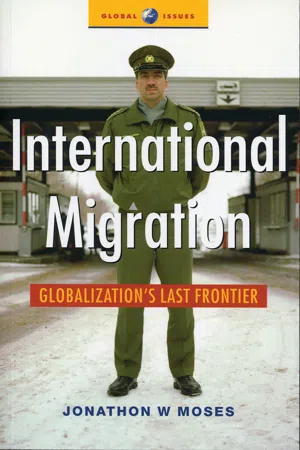
Jonathon Moses makes moral, political and economic arguments in favor of the free mobility of human beings across national borders. Pointing to the importance of immigration to the sucess of many nations, he shows that Europe itself now faces a falling population, and has over the past fifty years actively encouraged huge immigration from other countries. There is near consensus across the political spectrum that the free movement of goods and free movement of capital are good for economies, and therefore should apply to people as well.
Information
I
Introduction
If they can get here, they have God’s right to come.
Melville1
‘Help us, we suffer too much in Africa, help us.’ This simple plea was written in the summer of 1999. While most appeals of this sort go unnoticed, we remember this one for being found on the dead bodies of two young refugees boys, stowed away in the landing gear of an Airbus that had recently departed from Guinea–Conakry. In a world where ideas, capital, goods and services float almost effortlessly around the globe, it remains a crime for two boys to escape their suffering in Africa. Worse yet, it is a crime that hundreds – if not thousands – of people die trying to commit each year.
On the outskirts of the developed world lies a no man’s land littered with the dead bodies of those – like these two boys from Africa – who scramble for a better life. In both Europe and the United States, the death toll that results from today’s restrictive immigration policies is astonishingly high: over the past decade, thousands of people have died trying to make their own private dash for freedom. In a single month, May of 2004, sixteen confirmed deaths occurred along the border separating Mexico from the United States. One of these was a 32-year-old Mexican woman from the state of Veracruz, who was found dead north of Amado on 14 May. Apparently this woman was abandoned by her smuggler (coyote) when she was not able to keep up with a group of immigrants crossing the southern Arizona desert.2
We should not fool ourselves. These deaths are neither isolated events nor dreadful accidents. These deaths, and the many more that go unnoticed, are symptomatic of national policies that restrict immigration to the developed world. While these people deserve sympathy and support, the policies of the developed world encourage its residents to ignore the humanity and suffering of those who flee from the many faces of tragedy. Instead of acknowledging our moral obligation to assist people in dire need, the developed world brands them as a threat to its well-being, treats them as criminals, and forces them into desperate acts that too often result in death.
There is no greater global issue. On nearly every other front, the pace and scope of globalization have impressed all but the most enthusiastic supporters. Under the twin banners of freedom and efficiency, consumers and firms have broken out of their parochial, national contexts to mingle in increasingly global markets. This nexus has brought both opportunity and hardship – unequally distributed across the globe.
For a very fortunate few, the greatest political and economic hardships are softened by exclusive, democratic, welfare states. But the vast majority of the world’s inhabitants are less lucky. Born into poor, unstable and/or authoritarian regimes, billions of people have little possibility of escaping the economic and political oppression into which they are born. For both rich and poor, our political and economic fortunes are determined mostly by fate.
Instead of recognizing the dilemma posed by such global inequalities, we build citadels to separate rich from poor, lucky from unlucky. Like gated communities, the developed world keeps the developing world at bay. But this myopic response cannot hold. As distance in the world recedes with technological, social, demographic and political advances, the demand for international migration will surely grow. In the future it is doubtful that walls can be built high enough to deter the desperate. Today’s status quo is untenable: we need to find a better means for resolving the differences that separate our two worlds.
This book offers a simple solution to these dilemmas: free migration. Because of the radical and provocative nature of the proposed solution, it is developed cautiously along two fronts. On the one hand, it is necessary to show that most claims about the catastrophic political, economic and social consequences of free mobility are unfounded. On the other hand, this book aims to show how free migration can resolve many of the economic and political dilemmas that face individuals and states in an increasingly interconnected global context. In short, the economic, political and social consequences of free human mobility are not as frightening, as threatening or as unrealistic as most pundits suggest. Indeed, a world without borders can be a more just and efficient world – one that enjoys a better distribution of the world’s political and economic bounty.
A timely argument…
Many would question the timing of this sort of argument. The world is enmeshed in a clash of civilizations, and the pace and scope of globalization have provoked an identity backlash in most of the world’s disparate regions. The rise and influence of new religious groups, the spread of sundry secessionist movements, and the popularity of maverick and xenophobic political parties are all evidence of how people today are engaged in a desperate search for their unique identities and places in a shrinking world.
At the same time, there seems to be increased fear about (and hostility to) the subject of international migration in the developed world, especially after the attacks on 11 September 2001. For example, a recent YouGov poll conducted for The Economist found that 74 per cent of British respondents believed there were too many people coming into their country. Most of these respondents were concerned about immigrants putting too much pressure on public services, but there were also concerns about the effect on ‘racial balance’, crime and the domestic job market.3 The concerns of the British public are not unique – each developed country entertains its own anti-immigrant sentiment. In light of these developments and concerns, it may appear as an odd time to forward an argument for free migration.
Actually, the time has never been more appropriate. A broader discussion about the benefits of freer human mobility can show how greater international migration need not threaten. After all, by moving to a world with freer migration we don’t throw ourselves into a chaotic world without political authority, laws and/or community. A simple glance around us reveals that free migration within states doesn’t jeopardize our cultural identity, individual security, or the authority of local political institutions, laws and markets. Any fresh emigrant from Seattle to Selma (or from Stockholm to Seville) can assure us that cultural difference can be maintained in a context of free migration. Indeed, globalization makes it easier to sustain the immigrant’s cultural ties and affinities. Better yet, free migration has the potential to deliver the sort of economic, political and social gains that are necessary for establishing our personal and cultural security while deterring terrorism around the world.
The time is right for this discussion because new (global) economic conditions are diminishing the role of national borders and fundamentally altering the state’s ability to pursue unilateral policies/actions. This constraint on state sovereignty is everywhere recognized but in the realm of immigration policy. How strange it is that states recognize the futility and cost of trying to stop the free flow of information, goods, services and investments, yet respond to immigration in the same old (and futile) way: by sealing off their borders. It does not take a Nostradamus to predict that the time is near when states will have to resolve this contradiction and address the changing roles of borders and governments in a world characterized by economic, political and social integration.
In addressing this issue, we can provide a reality check to an extensive globalization debate. While the globalization literature is bountiful, it focuses rather myopically on those areas of globalization that are most visible and fully developed. We now know a great deal about the economic and political consequences of international capital and trade flows. By focusing on these established global networks, however, we lose sight of how restrictive global exchange appears to the world’s most desperate denizens. The world is hardly a free or unified place for people who are unable to escape from economic, political or social tyranny. For desperate souls like these, today’s opportunity is too often restricted to something like the landing gear of a departing Airbus. Worse, a dearth of studies on labour globalization helps to feed the fear that lies beneath most migration control regimes. There is simply not enough discussion of the potential that free migration offers to the world’s most desperate residents.
The time is also ripe to recognize that today’s migrant control regimes simply don’t work. While many policymakers and analysts claim that ‘uncontrolled immigration is an impossibility’,4 the opposite appears closer to the truth: controlling immigration is an impossibility! More realistic is the recognition by Jean-Pierre Garson, the OECD’s expert on international immigration, that ‘Some politicians shy away from these issues for fear of losing votes, but the facts speak for themselves: zero immigration is just pure fancy.’5 No matter what the political culture and/or particular migration control regime, illegal immigration has only grown in recent decades: all developed countries, and many developing countries, have been forced to deal with it. Consequently, an enormous gap has opened between the intent and the reality of the world’s migration policies. This gap should encourage us to rethink our approach to migration and reconsider the effectiveness (measured in any number of ways) of continued regulatory enforcement.
Indeed, demographic pressures within the developed world will make it difficult (at least costly) to continue ignoring the political and economic potential of international migration. The developed world’s population is both shrinking (in number) and ageing. Across most of Europe, national birth rates are below their replacement rates. Russia and Japan face the same dire situation, while America and Canada are hovering on the brink. Soon there will be too few workers in these countries to pay for their elaborate welfare and social security needs (which they otherwise fight so hard to protect). Without an injection of young immigrant workers, the welfare of the developed world risks being retired along with its population.
Even today, the developed world relies on foreign workers to satisfy its current demand for jobs – at both high and low ends of the skills continuum – and to compensate for its own inability to adjust to rapidly changing market conditions. Former German chancellor Gerhard Schröder was perhaps the most frank among the developed world’s political elites, when he announced that ‘German education with its focus on heavy philosophical concepts does not turn out the people we want.’6 Over the past decade, Europe and the United States have been tripping over themselves in a race to attract highly skilled, information-technology workers from abroad.
Finally, states continue to lose sovereign authority over decisions regarding international migrants, and it is time to recognize as much. An emerging system of international human rights already limits the state’s freedom of action.7 In this new international context, the state is no longer the exclusive subject of international law: states find themselves caught in a web of rights and actors that effectively trap their capacity for sovereign action with respect to immigration decisions.
In particular, resident immigrants already enjoy an expanding set of rights, upheld by receiving countries (often at lower levels of political authority). In effect, we see the emergence of a de facto regime, centred in international agreements and conventions, which limits the state’s role. This is especially obvious in the European Union, where courts have regularly supported, and governments have extended, the rights of resident immigrants. For example, governments in Sweden and the Netherlands fund immigration associations, facilitate home-language learning, promote equal opportunities in the labour market, and allow immigrants to vote in local elections. Similar pressures can be found in the United States, where the federal government finds itself considering amnesty programmes for illegal immigrants on an almost regular basis.
International migration trends, and the decisions that affect them, are already challenging traditional conceptions of national sovereignty. Global economic integration, the economic needs of both sending and receiving countries, a de facto transnationalization of immigration policymaking – all are evidence of the need to reassess the potential of freer human mobility. The time has come to move discussion about migration away from the narrow focus on limits and controls, to a broader political and intellectual terrain that links immigration to the globalization of other factors.
… a good argument …
Once this need is recognized, we will find that there are solid historical, moral, political and economic grounds for arguing that free migration can bring a drastic improvement to today’s social, economic and political conditions. Indeed, these arguments constitute the main (positive) contribution of this book (Chapters 3 to 6).
The economic and political gains from freer labour mobility are similar in nature to the more familiar gains from globalizing capital and trade markets – but these gains can be extended to a much broader spectrum of the world’s population. Of course, the beneficiaries of free human mobility can be found scattered unequally across countries, and around the globe. Residents of both the developing and the developed world stand to gain from free mobility, but these gains vary significantly across social groups and in terms of their size and effect. As a result, this book does not aim to prioritize the interests of developed-world or developing-world citizens – its objective is to show how the effects of international migration spread across the globe in uneven ways, and that the overall sum of these gains is clearly positive.
Having said this, however, it is important to recognize that the greatest resistance to free migration rests in the developed world. Most residents of the developed world assume that there are significant economic, political and social costs associated with liberalizing immigration controls. This resistance is grounded on hysterical arguments that exaggerate both the demand for, and the effect of, international migration. Rather than consider how migration might mitigate world tyranny, shrink world income gaps, resolve intergenerational pension deficits, and so on, the developed world cowers in fear of a pending catastrophe: where tidal gates are opened, allowing a flood of new immigrants that will swamp domestic economies and welfare policies in the richest states.
The truth is less ominous and more complicated: the pages that follow illustrate how free human mobility can benefit residents of the developed world, even when migration questions are framed in terms of narrow economic or political interests. More importantly, they will show that responses to migration can be motivated by a whole range of forces (including, for example, morality and prejudice) and that these forces may sometimes prevail over narrow economic and political interests. For that reason, the argument takes aim at a broad target: one that spans the moral, political, social and economic consequences of freer mobility.
While assessing these disparate arguments – as they play out in both the developed and developing worlds – you may find that one argument is more convincing than the others. This is not odd, as our disparate interests are affected in a variety of ways by international migration. Nevertheless, a reasonable argument can (and will) be made – on historical, moral, economic and political grounds – that a future world with free migration represents a significant improvement on the status quo for most people, in both the developed and the developing worlds.
While there are many political and economic motivations for abolishing border controls, perhaps the strongest argument for their dismantlement is moral in nature. Today’s migration regime is terribly unjust: it distributes opportunity by fate, and has the effect of condemning people to life sentences in their country of birth. As such, the current regime tends to prioritize the rights of an imagined community (the nation), at the expense of sometimes desperate individuals.8 This injustice is recognized by actors who span the political spectrum. For example, Soviet premier Nikita Khrushchev lamented the injustice of Soviet borders in his memoirs:
Why should we...
Table of contents
- Cover
- About this Book
- About the Author
- Praise for this Book
- Title Page
- Copyright
- Contents
- Dedication
- Preface
- 1 Introduction
- 2 Two Paradoxes of Globalization
- 3 Some Historical Perspective
- 4 The Moral Argument
- 5 A Political Argument
- 6 An Economic Argument
- 7 Who Opposes Free Migration?
- 8 Questioning Conventional Wisdom
- 9 Conclusion and Policy Responses
- Notes
- Suggested Reading
- Index
Trusted by 375,005 students
Access to over 1.5 million titles for a fair monthly price.
Study more efficiently using our study tools.
Frequently asked questions
Yes, you can cancel anytime from the Subscription tab in your account settings on the Perlego website. Your subscription will stay active until the end of your current billing period. Learn how to cancel your subscription
No, books cannot be downloaded as external files, such as PDFs, for use outside of Perlego. However, you can download books within the Perlego app for offline reading on mobile or tablet. Learn how to download books offline
Perlego offers two plans: Essential and Complete
- Essential is ideal for learners and professionals who enjoy exploring a wide range of subjects. Access the Essential Library with 800,000+ trusted titles and best-sellers across business, personal growth, and the humanities. Includes unlimited reading time and Standard Read Aloud voice.
- Complete: Perfect for advanced learners and researchers needing full, unrestricted access. Unlock 1.5M+ books across hundreds of subjects, including academic and specialized titles. The Complete Plan also includes advanced features like Premium Read Aloud and Research Assistant.
We are an online textbook subscription service, where you can get access to an entire online library for less than the price of a single book per month. With over 1.5 million books across 990+ topics, we’ve got you covered! Learn about our mission
Look out for the read-aloud symbol on your next book to see if you can listen to it. The read-aloud tool reads text aloud for you, highlighting the text as it is being read. You can pause it, speed it up and slow it down. Learn more about Read Aloud
Yes! You can use the Perlego app on both iOS and Android devices to read anytime, anywhere — even offline. Perfect for commutes or when you’re on the go.
Please note we cannot support devices running on iOS 13 and Android 7 or earlier. Learn more about using the app
Please note we cannot support devices running on iOS 13 and Android 7 or earlier. Learn more about using the app
Yes, you can access International Migration by Jonathon Moses in PDF and/or ePUB format, as well as other popular books in Politics & International Relations & Globalisation. We have over 1.5 million books available in our catalogue for you to explore.