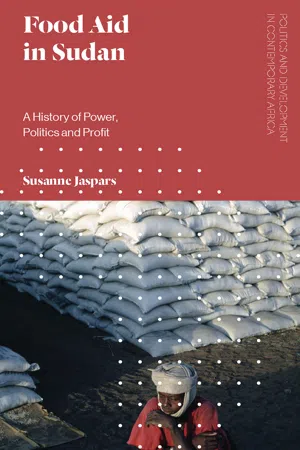
In 2004, the UN's Humanitarian Coordinator for Sudan called Darfur the world's worst humanitarian crisis. A comprehensive food aid programme soon followed, at the time the largest in the world. Yet by 2014, while the crisis continued, international agencies found they had limited access to much of the population, with the Sudanese regime effectively controlling who received aid. As a result, acute malnutrition remains persistently high.
Food Aid in Sudan argues that the situation in Sudan is emblematic of a far wider problem. Analysing the history of food aid in the country over fifty years, Jaspars shows that such aid often serves to enrich local regimes and the private sector while leaving war-torn populations in a state of permanent emergency. Drawing on her decades of experience as an aid worker and researcher in the region, and extensive interviews with workers in the food aid process, Jaspars brings together two key topics of our time: the failure of the humanitarian system to respond to today's crises, and the crisis in the global food system.
Essential reading for students and researchers across the social sciences studying the nature and effectiveness of contemporary humanitarianism, development and international aid.
- English
- ePUB (mobile friendly)
- Available on iOS & Android
eBook - ePub
About this book
Information
1
Introduction: food aid and power
Introduction: food aid and power
The crisis in Sudan
In 2004, the United Nations Humanitarian Coordinator for Sudan called Darfur the world’s worst humanitarian crisis (BBC, 2004). This was soon followed by the World Food Programme’s (WFP) largest food aid operation globally. WFP’s food aid operation in response to the Darfur crisis was not the first time that Sudan had received food aid but was the latest in a long line of regular food distributions. Sudan has received international food aid since 1958. It has experienced an emergency requiring external assistance every year since 1984 and is on the Food and Agriculture Organization (FAO) list of low-income, food-deficit countries (FAO, 2012a, 2012b). In 2013, acute malnutrition levels were above internationally agreed emergency thresholds for most of the country’s population (Federal Ministry of Health, 2014). This makes Sudan one of the longest running recipients of food aid and its crisis one of the most severe and protracted.
The Darfur crisis has been ongoing for almost fifteen years. Violent conflict has caused destruction, death and displacement for large numbers of people and has restricted movement and thus access to land, markets and work. The years since 2013 have seen the highest number of newly displaced people in Darfur since 2004: over 1 million people were newly displaced between 2013 and 2015 (UN OCHA, 2015: 11). New conflicts started in Sudan’s South Kordofan and Blue Nile states in 2011. The UN estimated a total of 5.8 million people to be in need of humanitarian assistance in Sudan in 2016, with the majority being in Darfur, South Kordofan and Blue Nile (ibid.). However, international agencies are unable to access many conflict-affected populations in these areas (UN OCHA, 2016: 16). They risk being attacked or kidnapped and a system of government permits often means that access is denied. The Sudan government closely monitors international agencies because it perceives them as political tools of the West and as threats to national security. International aid programmes have to be managed remotely, which means that national staff, local partners, local authorities, private contractors or community-based organisations (CBOs) implement programmes on the ground, but decision-making remains with international staff (Stoddard et al., 2006). Through these remotely managed programmes, international agencies measure food security status using newly developed quantitative and allegedly universally applicable indicators. As the crisis has become protracted, agencies have decreased the quantity of food aid and have initiated food vouchers and food-for-work and targeted nutrition programmes in attempts to encourage recovery and promote resilience. At the same time, the government has ‘Sudanised’ the aid industry by promoting national non-governmental organisations (NGOs), developing a national strategic grain reserve and distributing government food aid. This is not necessarily a positive move from the perspective of those affected by conflict and humanitarian crisis, as food distributions are in government-held areas and often limited to government employees and supporters. Most people’s options are limited to marginal and precarious activities or, if they are lucky, they will find ways to leave Darfur or to benefit from the war or aid economy. They have been abandoned and forced to become resilient in a context of permanent emergency.
This book is about the abandonment of crisis-affected populations and about the indirect effects of food aid in developing the Sudanese state and its closely aligned private sector. The abandonment has several components. Successive Sudanese governments have concentrated their development efforts on Khartoum and surrounding areas, have used food aid as a way of obtaining political support and have responded to famine, disaster or displacement as security threats. Donors at first supported the Sudanese state, then bypassed it, and most recently have failed to successfully challenge the Sudan government’s denial of access to crisis-affected people in Darfur. Instead, the UN has aligned itself with the government to maintain access to at least some conflict-affected populations, and international NGOs (INGOs) have largely kept quiet for fear of being expelled. The result is limited information which means that programming, such as the move from relief to recovery, is largely based on distant assumptions rather than on evidence of the ongoing threats that conflict-affected people face and their humanitarian consequences.
The abandonment is also a consequence of new food aid practices. Contemporary food aid practices reflect neoliberal strategies of making individuals responsible for their own nutrition and food security problems. Emergency nutrition and food security expertise currently focuses on quantitative measures of household food security, nutritional status, and on treatment and behaviour change. The private sector plays a role in the provision of food-for-voucher programmes, producing specialised nutrition products and new agricultural technologies. In Darfur, these practices form part of attempts to promote resilience amongst communities but have also facilitated the withdrawal of food aid from conflict-affected populations. Resilience approaches require the creation of responsible subjects who can adapt to an environment of permanent emergency, and they lower expectations of material development. Instead, the objective becomes survival in the face of constant danger (Cannon and Muller-Mahn, 2010; Haldrup and Rosen, 2013; Welsh, 2014). From a global perspective, strategies based on universal indicators, behaviour change, technical solutions and private sector engagement offer the possibility of containing the threat posed by permanent food emergencies using remote management technologies. For poor or conflict-affected populations, however, regularly high levels of acute malnutrition or food insecurity no longer result in a general food aid response and social, political and economic causes are not addressed.
Over the fifty years that Sudan has received food aid, it has rarely had its intended effect of improving production, saving lives or supporting livelihoods. It did, however, lead to a semblance of development in that it indirectly provided benefits for the Sudan government, private sector and aid professionals. Duffield (2002a) has used the term ‘actually existing development’ to describe the development that occurs indirectly as a result of, or in spite of, official development efforts. The ‘actually existing development’ resulting from food aid in Sudan also has several components. Fifty years of food aid have enabled the government to develop its own food aid apparatus modelled on the perceived political functions and practices of international food aid. It can use this to maintain or elicit political support, both nationally and internationally. It has also learnt how to control international food aid and the agencies that distribute it, in part by adopting tighter regulations and in part through denials of access. In addition, international food aid has unintentionally provided a valuable source of foreign exchange and has indirectly supported the national strategic reserve and grain traders and transporters in central Sudan. The food response to the Darfur crisis in 2004–05 was an exception in that it successfully prevented famine but it also provided a massive boost to Sudan’s private sector. Politically, food aid enhanced the authority of often newly elected leaders for populations displaced in the early stages of the conflict and humanitarian operation. Later, the reduction of food aid in Darfur from 2008 onwards had different political and economic effects. While aid agencies reduced food aid in order to encourage recovery and promote resilience, this also supported government objectives of encouraging internally displaced persons (IDPs) to leave the camps. Finally, beneficiaries and Sudanese aid workers also learnt from fifty years of food aid. Long-term food aid in Darfur has created a cadre of experienced Sudanese aid professionals and beneficiaries who manage to navigate their way between the expectations of international agencies and the intricacies of local politics. Yet with the increase in remotely managed, medicalised and quantitative practices, their knowledge and experience is less powerful in influencing food aid programmes than those of the government and international aid agencies. Despite fifty years of food aid and today’s positive ideology of resilience, most populations in Sudan’s peripheries are left to follow their own livelihood strategies and adapt to permanent emergency.
The starting point of the book is the context of limited international access and reduced food aid amidst ongoing violence and high levels of acute malnutrition, and at the same time food aid’s indirect effect of benefiting Sudan’s government and private sector. It examines how this situation came about by analysing the evolution of international food aid practices over a period of fifty years, its interactions with local government and private sector, the actual effects of food aid in Darfur, and the perceptions of those who distribute and receive food aid. In this analysis, I consider food aid not simply as a source of nutrients or a gift but also as a technology of governance in that it has the power to change behaviour, attitudes and power relations. Such a historical analysis of food aid and its effects helps explain why the Sudan government views international food aid as so subversive, the inability of aid agencies to negotiate access to conflict-affected populations, the dominance of technical and medicalised approaches to food security and nutrition and the negative consequences for the well-being of most ordinary people in Darfur.
This book is not only about Sudan. It is also about global food aid practices, about nutrition, and about governance. Food aid in Sudan reflects both Sudan’s history and the history and politics of global food aid policy and practice. Sudan’s history, in terms of conflict, political ideologies and changes in the Sudanese state, is revealed in the changing quantities of food aid and how it has been provided. Food aid in Sudan reflects global food aid practices because from the late 1950s the country has received every type of food aid and from the 1980s it has been ‘a laboratory for humanitarian ideas’ (African Rights, 1997a: 2) in response to refugees, conflict and drought. At the same time, this experience in Sudan has informed food aid practice globally: it has frequently been a case study in international conferences and many research studies on famine, aid and the political economy of aid have been carried out in Sudan. In a recent virtual issue on famine by Disasters Journal, which provided the journal’s seminal papers on famine published over thirty years, thirteen out of nineteen articles were either exclusively on Sudan or included information and analysis on Sudan (Pantuliano and Young, 2011). The book is also a story about the changing concepts and ideology in the discipline of emergency nutrition, and how this has influenced food aid and humanitarian assistance more generally. It discusses how and why for a brief period from the late 1980s to the late 1990s nutrition in emergencies came to be seen as a social science and nutritionists examined nutrition within its wider social, economic and political context. Since the early 2000s, however, emergency nutrition practices have been medicalised and de-politicised, which has had the effect of normalising violence and of hiding the political effects of food aid. Finally, the book is about governance, or rather about ways of governing. It examines the power effects of food aid not only by directly strengthening or undermining states or authorities, but also through a variety of techniques and practices such as surveillance, categorisation, comparison to norms, and the calculation of risk and judgements of what is acceptable. As the book will show, these practices have in turn influenced the Sudanese state first in the form of resistance to international food aid practices and later in adaptation. These days, food aid in Sudan exemplifies the protracted crisis and the failing international aid system found in many parts of the world. Analysing food aid policy and practice in Sudan is therefore relevant to food aid policy and practice globally.
What is food aid?
Food aid has been defined as ‘a form of aid which is internationally sourced, has a significant grant element and can be either in the form of food or cash for the provision of food’ (Barrett and Maxwell, 2005: 5). However, food aid is more than a grant or a source of nutrients: food distribution involves a range of activities, institutions and authorities. It is also an industry that employs thousands of people. The process of providing food aid includes procurement, logistics, assessments, ration planning, targeting, distribution and monitoring (Jaspars and Young, 1995: 2). A range of policies, principles, standards and guidelines have been developed to determine who should receive food aid, how much, when, how and for what specific purpose. This includes the professional study of emergency nutrition and food security as subjects which determine what is to be known about food needs and the right response to malnutrition or food insecurity at particular points in time.
The nature of food aid has changed over time. From the late 1950s to the early 1990s food aid was largely programme food aid, direct government-to-government aid provided on concessional credit terms. It was a means of disposing of US and European agricultural surpluses and of promoting foreign policy and trade objectives, as well as supporting state-centred development in recipient countries (Singer et al., 1987; Shaw, 2001). Project food aid has been a form of development food aid since the 1960s and is usually managed by WFP or by NGOs. It is used as payment in labour-intensive public works programmes and in school-feeding or clinic-based programmes which provide food supplements to mothers and young children (Shaw, 2001). Such programmes are now commonly part of protracted emergency food aid operations as ways of targeting or reducing food aid, while WFP development projects have decreased over time (Shaw, 2011).
The main form of international food aid is now emergency food aid, targeted and distributed free of charge to victims of natural or man-made disasters (Clay and Stokke, 2000: 25). It has been, and remains, the largest component of humanitarian assistance (Harvey et al., 2010). In theory, therefore, emergency food aid is provided according to humanitarian principles of humanity (address human suffering wherever it is found), impartiality (provide assistance on the basis of need), neutrality (not take sides in hostilities) and independence (autonomy from political, economic and military objectives) (UN OCHA, 2012). Until the mid-1980s, emergency food aid was intended to save lives and to meet nutritional needs, but it later acquired objectives of livelihood support, conflict prevention, peace-building and humanitarian protection (WFP, 2002; Were Omamo et al., 2010). In WFP’s latest strategic plan, food aid objectives include building resilience by supporting nutrition, by the establishment of safety nets and by working with the private sector (WFP, 2013a). For the past fifty years more than half of global food aid shipments have been US food aid (Harvey et al., 2010: 60), but the agencies and institutions involved in food aid have expanded over time, and now include a range of donors, UN agencies, recipient government authorities and international and local organisations and committees.
From the early 2000s, aid agencies changed from food aid to food assistance. No commonly agreed definitions of food assistance as yet exist, but it can include locally purchased food aid, food vouchers, direct cash transfers, food- or cash-for-work as well as in-kind food aid (food aid shipped from donor countries rather than purchased locally) (Harvey et al., 2010). While seen as a new and innovative approach, it bears some resemblance to the interventions by the British colonial government in Sudan, which included food- or cash-for-work to build airfields, roads and public buildings, free train tickets to enable migration for work and encouragement to grow drought-resistant crops, as well as internationally or locally procured food for famine relief (Singer et al., 1987: 18; African Rights, 1997a: 21–23). The Sudan government’s current food aid projects, such as the establishment of a national strategic grain reserve, the distribution of free or subsidised food or a preferential exchange rate for wheat, could also be considered as food assistance. This book considers both international transfers of food or funds to buy food and Sudan government food interventions as food aid, and distinguishes between them by using the terms international food aid and government food aid.
Emergency nutrition and food aid: a social or medical science?
Emergency nutrition can be...
Table of contents
- Cover
- About the Author
- Title
- Copyright
- Contents
- List of tables and illustrations
- Abbreviations
- Acknowledgements
- Preface
- 1. Introduction: food aid and power
- 2. From managing states and supporting livelihoods to abandoning populations
- 3. Food aid in Sudan: government and private sector response
- 4. The effects of food aid practices in North Darfur
- 5. Perceptions of food aid: politics, dependency and denial of permanent emergency
- 6. Conclusions
- Appendix 1: Chronology of key political events in Sudan
- Notes
- References
- Index
Trusted by 375,005 students
Access to over 1.5 million titles for a fair monthly price.
Study more efficiently using our study tools.
Frequently asked questions
Yes, you can cancel anytime from the Subscription tab in your account settings on the Perlego website. Your subscription will stay active until the end of your current billing period. Learn how to cancel your subscription
No, books cannot be downloaded as external files, such as PDFs, for use outside of Perlego. However, you can download books within the Perlego app for offline reading on mobile or tablet. Learn how to download books offline
Perlego offers two plans: Essential and Complete
- Essential is ideal for learners and professionals who enjoy exploring a wide range of subjects. Access the Essential Library with 800,000+ trusted titles and best-sellers across business, personal growth, and the humanities. Includes unlimited reading time and Standard Read Aloud voice.
- Complete: Perfect for advanced learners and researchers needing full, unrestricted access. Unlock 1.5M+ books across hundreds of subjects, including academic and specialized titles. The Complete Plan also includes advanced features like Premium Read Aloud and Research Assistant.
We are an online textbook subscription service, where you can get access to an entire online library for less than the price of a single book per month. With over 1.5 million books across 990+ topics, we’ve got you covered! Learn about our mission
Look out for the read-aloud symbol on your next book to see if you can listen to it. The read-aloud tool reads text aloud for you, highlighting the text as it is being read. You can pause it, speed it up and slow it down. Learn more about Read Aloud
Yes! You can use the Perlego app on both iOS and Android devices to read anytime, anywhere — even offline. Perfect for commutes or when you’re on the go.
Please note we cannot support devices running on iOS 13 and Android 7 or earlier. Learn more about using the app
Please note we cannot support devices running on iOS 13 and Android 7 or earlier. Learn more about using the app
Yes, you can access Food Aid in Sudan by Susanne Jaspars in PDF and/or ePUB format, as well as other popular books in Social Sciences & Higher Education. We have over 1.5 million books available in our catalogue for you to explore.