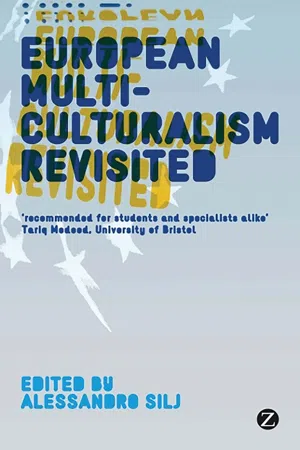
European Multiculturalism Revisited analyses the alleged crises of the main 'models' of multicultural societies experienced by Europe since the end of World War II, based on research conducted by local scholars in the UK, Denmark, the Netherlands, Italy, France and Germany. Each chapter provides an historical account of how the model developed and was implemented in the country in question, followed by an in-depth analysis of the factors that have led to the claim that the model has failed. The questions being, Did it actually fail? And if it failed was it because of some intrinsic weaknesses or external circumstances?
This volume is a groundbreaking contribution to a topic of vital contemporary importance.
- English
- ePUB (mobile friendly)
- Available on iOS & Android
eBook - ePub
European Multiculturalism Revisited
About this book
Information
1
Progressive multiculturalism: the British experience
It is precisely because the ‘multiculturalism’ debate touches on issues that are of profound importance to all British citizens, and not only a small group of minorities, that it is often so heated and politically charged. The public debate about multiculturalism acts as a form of ‘symptomatic politics’.1 As well as raising issues about minority integration, it frequently masks anxieties and confusion about the public identity of all British citizens. Within this form of ‘symptomatic politics’ controversy over historical events such as slavery takes on a particular significance because acts of ‘national remembrance’ are not solely about the past; they are also a vital public discourse in the present that allows individuals to form their identity as public citizens in the here and now. This chapter sets out an overview of the British model of multiculturalism. In the first section I set out some of the distinctive features of the ‘multiculturalism’ as compared with other models for integrating minorities. In the second section I set out a historical overview of the British response to the challenge of integrating minorities. I then move on to an evaluation of British multiculturalism: why is it perceived to have failed; has it failed or succeeded; what risks does it pose; what are its weaknesses?
Multiculturalism as a model for minority integration
What are British values? What are the norms into which minorities are being asked to integrate? These issues are often neglected in an analysis of multiculturalism in favour of a focus on the beliefs and conduct of minorities. This issue is often a hidden assumption in debates about minority integration but it becomes more prominent where multiculturalism is proposed as a model for integration. In addition, a number of other criteria are relevant to issues of minority integration. One broad categorization is the contrast between separation, assimilation and integration. More specifically, other ‘markers’ of integration include, inter alia: social and economic mobility, geographical dispersal, social assimilation and cultural distinctiveness. Racism in the form of anti-Semitism against British Jews and anti-Catholic discrimination is relevant to understanding the treatment of British minorities before the twentieth century.
Different models of integration give weight to different aspects of these criteria. For example, models of integration that assume that assimilation is an appropriate goal will problematize cultural distinctiveness, unlike more pluralist models that seek some accommodation of cultural difference. However, there are dangers in describing the debate in terms of a clash of models, such as ‘British multiculturalism’ versus ‘French integration’. Such a reductionist analysis underestimates the complexity of terms such as ‘multiculturalism’, which have, as set out below, a variety of different meanings. This stark contrast also distorts the way in which a model that has been labelled ‘British multiculturalism’ includes many of the same components as other models which seek ‘integration’ as a more explicit goal.
Multiculturalism: descriptive versus normative
Popular myths about multiculturalism make it more difficult to delineate a precise definition for this form of minority protection. There are a number of ways in which the term can be used. Multiculturalism is used in the British context in two ways. First, at a descriptive level, it is used to describe the factual changes that have occurred in Britain which have resulted in a more marked racial, ethnic and cultural diversity. Second, at a normative level, it is used as a term to describe a state response to this increasing diversity which advocates policies of ‘recognition’ and ‘accommodation of difference’.
At a descriptive level ‘multiculturalism’ refers to the increasing cultural diversity of modern liberal democracies. ‘Culture’ is a term that can include a wide range of attitudes, beliefs and practices. Sometimes the terms ‘diversity’ and ‘multiculturalism’ are used to include differences based on gender or sexuality, or differences that are a fundamental ‘lifestyle’ challenge to the predominant values that govern public life, such as the anti-globalization or environmental movements. This is diversity that is based on different beliefs about lifestyle and values. Bhikhu Parekh sets out a detailed distinction between ‘wide’ definitions of cultural diversity, which include ‘perspectival diversity’ such as challenges to the public structure by feminists or gays and lesbians, and ‘narrow’ definitions, which limit the use of the term ‘multiculturalism’ to a ‘communal diversity’ focusing on factors such as race, ethnicity, religion and language, and groups organized as distinct cultural communities. This chapter focuses on ‘multiculturalism’ in its more narrow sense (Parekh, 2006: 3–4). Here, the word ‘culture’ serves to capture a number of important distinct sources of diversity. First, it includes the traditional sources of ‘difference’ that are associated with marking out a social group as a distinct minority within a larger political community: for example, colour, race and ethnicity, religion and language. These social groups can be recognized as communities that are distinct from the prevailing culture of the nation-state.
There have always been recognizable and distinct cultural communities in Britain; that is, social groups that can be distinguished by reference to criteria such as race and ethnicity, region, religion or language. Prominent and well-established social groups that fall into this category includes Jews, the Roma and also the Celts. Concepts such as ‘cultural pluralism’ and ‘multiculturalism’ are now being deployed to describe such a wide range of phenomena that they are at risk of losing their intellectual power. Nevertheless, these terms convey the important social changes that have taken place in the European liberal democracies in the last fifty years. At a descriptive level ‘cultural pluralism’ or ‘multiculturalism’ usefully describes the increasing diversity of culture, race and religion of citizens in liberal democracies.2 Some, although not all, of this diversity is the result of increased migration into European liberal democracies of people from non-Western cultures. This type of diversity is also encouraged by political liberalism and is an inevitable by-product of modern liberal democracies. John Rawls, for example, writes:
A modern democratic society is characterized not simply by a pluralism of comprehensive religious, philosophical, and moral doctrines but by a pluralism of incompatible yet reasonable comprehensive doctrines. No one of these doctrines is affirmed by citizens generally. Nor should one expect that in the foreseeable future one of them, or some other reasonable doctrine will ever be affirmed by all, or nearly all, citizens.
He is willing to label a doctrine ‘reasonable’ where it does not reject the essentials of a democratic regime, but states that
Of course a society may also contain unreasonable and irrational, and even mad, comprehensive doctrines. In their case the problem is to contain them so that they do not undermine the unity and justice of society. (Rawls, 1993: xvi)
In this normative sense, multiculturalism is one policy response to the presence of increasingly diverse social groups and ‘minorities’ within a political community. At a normative level, therefore, ‘cultural pluralism’ or ‘multiculturalism’ are terms suggesting that the correct legal and political response to the increasing cultural diversity of European citizens is to adopt polices of public accommodation.
Once the distinction between ‘descriptive’ and ‘normative’ multiculturalism is emphasized it becomes clear that multiculturalism is not the only state response to the challenge of increasing cultural diversity. It can be understood as one of three normative policy responses to – that is, models of integration of – increasing diversity: (1) assimilation; (2) liberal toleration and the principle of non-discrimination; and (3) liberal pluralism that encourages the ‘accommodation of difference’ (which can also be called multiculturalism). Minority integration can be said to cluster around these three models: (i) conservative nationalism and assimilation; (ii) traditional liberal tolerance; and (iii) plural liberalism and models of multiculturalism.
Assimilation, the first model, requires that these groups should, wherever possible, give up those characteristics that distinguish them from the mainstream national culture. In some cases, this assimilation could be ‘forced’, where a religious minority is prevented from manifesting the religion in practice or there is a legal requirement to give up speaking a national language in public life.
The principle of ‘liberal toleration’, the second model, allows individuals to manifest their particular difference in the private sphere but organizes public life according to individual civil and political rights. These individual rights (e.g. freedom of religion, freedom of speech) provide a framework within which individuals can manifest some of their ‘differences’ in the public sphere. However, ‘liberal toleration’ treats the public sphere as a neutral space and relegates issues of personal identity to the private sphere. Citizens are free to manifest their private identity in the private sphere, either individually or in association with others, without state interfererence. However, this form of ‘liberal toleration’ remains focused on individuals and treats culture and community as factors that have an ‘instrumental value’ to individuals.3 Therefore models of minority protection based on ‘liberal toleration’, which safeguard individual civil and political rights, seldom provide specific ‘state support’ to ensure that minorities have the resources they need to continue and flourish (Kymlicka, 1989). This strategy of ‘liberal toleration’ has been supplemented by strategies of ‘non-discrimination’ for minorities in key areas such as employment and education. The focus on non-discrimination ensures that, as well as allowing minorities the right to manifest their ‘different’ private identities in the private sphere, they are not also penalized in key areas such as the workplace and education. A move towards a strategy of non-discrimination is significant because it shifts issues concerning private identity and the ‘difference’ of minorities from the private into the public sphere. Moreover, policies of non-discrimination will increasingly impact on majorities in key areas such as the workplace and education. Therefore policies of non-discrimination will increasingly become issues about the appropriate allocation of power and resources between majorities and minorities.
‘Liberal pluralism’, the third model, may include some features of the other two responses but it also goes further than simply tolerating and not discriminating against minorities in one key respect: it argues that some of the most pressing ‘differences’ and distinct needs of minorities can and should be positively accommodated within the public sphere. This additional requirement of ‘accommodation of difference’ generates models of multiculturalism.
Traditional models of citizenship based on ‘conservative nationalism’ define the terms of belonging to a political community according to a range of criteria, such as race, common memories, a dominant culture, language or a majority religion. These criteria favour a definition of national identity and citizenship that is based on history or immutable characteristics, rather than treating it as a matter of choice or negotiation. The descriptive reality of multiculturalism – the increasing cultural diversity in many European liberal democracies, including Britain – means that there are now increasingly large numbers of citizens who will not be able to meet these historical and immutable criteria. The risk in states that are liberal democracies and are also increasing culturally diverse is that the inflexible use of historical and immutable criteria will exclude or coercively assimilate increasingly large numbers of citizens. In liberal democracies, the presence of these citizens who cannot participate in historical or majority definitions of race, religion or language is a permanent barrier to forging a national identity, or definition of citizenship, along the lines advocated by conservative nationalists.
The liberal alternative to conservative nationalism tends to define citizens as members of a political community based on rational, liberal values. Citizenship is constructed through an unmediated relationship between the citizen and the state based on the state’s guarantee to respect key constitutional rights (e.g. civil and political rights or promises of socio-economic welfare). The culture of minorities is safeguarded through their freedom to be involved in voluntary private activities and associations. Traditional liberal responses to minorities have taken the form of ‘toleration’: that is, a minority group is permitted a set of individual rights (e.g. the right to free speech or freedom of religion) but is required to operate in a neutral public sphere which often does not accommodate their cultural needs. This approach of liberal tolerance has been supplemented by a second strategy of non-discrimination against minorities in key public areas such as employment, education and housing. However, neither liberal toleration nor non-discrimination is able to respond to the demands by minorities that some aspects of their private identity should be recognized or accommodated in the public sphere. It is out of this theoretical and practical ‘politics of difference’ that multiculturalism has emerged as an alternative to both conservative nationalism and assimilative liberal tolerance.
Multiculturalism: hard versus progressive
‘Hard multiculturalism’ can be distinguished from its ‘progressive’ variants in a number of ways. ‘Progressive multiculturalism’ can be presented as a requirement rather than a negation of liberal pluralism: it is based on a belief in the incommensurability of values rather than scepticism about the possibility of human values. Liberal political theory and practice have been criticized by a number of writers as being inhospitable to cultural diversity.4 It is also argued that traditional liberal definitions of the nation-state and political community have adopted a reductionist and uncritical assumption that there is only one way (rather than many) to organize private and social life.5 Some writers argue that this bias in favour of ‘uniformity’ helps define modern liberal constitutionalism and renders it inhospitable to claims of cultural accommodation (Tully, 1995: esp. chs 1–3). ‘Liberal pluralism’ goes further than toleration and non-discrimination and favours the public accommodation of minorities in the public sphere (Raz, 1994: ch. 8).6 The inclusion of the term ‘pluralism’ draws on the traditional liberal concern, in the work of writers such as J.S. Mill, with ensuring that there is freedom for different points of view and diversity of lifestyles to flourish in the public sphere of liberal democracies. The arguments in favour of multiculturalism vary considerably, but in their most powerful formulation they also introduce the idea that pu...
Table of contents
- Cover
- Title
- Copyright
- Contents
- Acknowledgements
- Introduction
- 1 Progressive multiculturalism: the British experience
- 2 Crisis and new challenges? French republicanism featuring multiculturalism
- 3 The German Sonderweg: multiculturalism as ‘racism with a distance’
- 4 Multiculturalism in Italy: the missing model
- 5 ‘Making room’: encompassing diversity in Denmark
- 6 Assimilation by conviction or by coercion? Integration policies in the Netherlands
- Conclusion Mistaken models of integration? A critical perspective on the crisis of multiculturalism in Europe
- About the contributors
- Index
Trusted by 375,005 students
Access to over 1.5 million titles for a fair monthly price.
Study more efficiently using our study tools.
Frequently asked questions
Yes, you can cancel anytime from the Subscription tab in your account settings on the Perlego website. Your subscription will stay active until the end of your current billing period. Learn how to cancel your subscription
No, books cannot be downloaded as external files, such as PDFs, for use outside of Perlego. However, you can download books within the Perlego app for offline reading on mobile or tablet. Learn how to download books offline
Perlego offers two plans: Essential and Complete
- Essential is ideal for learners and professionals who enjoy exploring a wide range of subjects. Access the Essential Library with 800,000+ trusted titles and best-sellers across business, personal growth, and the humanities. Includes unlimited reading time and Standard Read Aloud voice.
- Complete: Perfect for advanced learners and researchers needing full, unrestricted access. Unlock 1.5M+ books across hundreds of subjects, including academic and specialized titles. The Complete Plan also includes advanced features like Premium Read Aloud and Research Assistant.
We are an online textbook subscription service, where you can get access to an entire online library for less than the price of a single book per month. With over 1.5 million books across 990+ topics, we’ve got you covered! Learn about our mission
Look out for the read-aloud symbol on your next book to see if you can listen to it. The read-aloud tool reads text aloud for you, highlighting the text as it is being read. You can pause it, speed it up and slow it down. Learn more about Read Aloud
Yes! You can use the Perlego app on both iOS and Android devices to read anytime, anywhere — even offline. Perfect for commutes or when you’re on the go.
Please note we cannot support devices running on iOS 13 and Android 7 or earlier. Learn more about using the app
Please note we cannot support devices running on iOS 13 and Android 7 or earlier. Learn more about using the app
Yes, you can access European Multiculturalism Revisited by Alessandro Silj in PDF and/or ePUB format, as well as other popular books in Politics & International Relations & International Relations. We have over 1.5 million books available in our catalogue for you to explore.