This book deals with the contemporary and controversial topic of Environmental Change and National Security. Security encompasses various elements of human security that are going to be affected by the vagaries of environmental change, brought about by the relentless unsustainable development path undertaken by the modern society. The question is no longer about what the interrelations betweenclimate change and security are, but about when they would be acknowledged by the policy-makers, rising above a narrow mindset that sees it as militarisation of the debate, rather than a human security issue. The book takes a prismatic view of the environmental change debate as observed by the military.

- 234 pages
- English
- ePUB (mobile friendly)
- Available on iOS & Android
eBook - ePub
Environment Change and National Security
About this book
Information
1
The Environment Change Matrix
Introduction
Environment change has traditionally been seen as a social dilemma, which is caused by practices of unsustainable development. Industrialisation was a boon for the rich countries which transferred them into an elite league of developed nations as different from the non-industrialised and developing countries. Industrialisation was also the precursor to practices which led to the disequilibrium of nature. Human beings’ insatiable need for energy made them totally dependent on non-renewable fossil fuels. The rapid race by the developed countries for modernisation led to increasing consumption of the earth’s resources and the repercussions were but inevitable. Human beings invented new chemicals to further their control over elements. Little did the human race realise that this ‘supremacy’ over nature is a mirage which is not attainable. The pollution caused by rampant consumption of fossil fuels changed the natural balance of gases in the atmosphere. The newly invented wonder chemicals destroyed the protective cover over the earth, exposing it to dangerous radiations. All these actions led to changes in the climate, causing it to behave in ways not easily understood by the human race; changes which were inimical to human interest. Many of the predictable ways of nature could no longer be taken for granted. The availability of three basic needs of human beings – water, food and land –– is now precariously poised. The environment known to the human race is changing at a pace and moving in a direction which is dangerous.
These changes are bound to have an impact on each nation’s ability to withstand the stresses caused by scarcities of natural resources. Obviously, the rich and developed nations would be in a better position to adapt to these changes as compared to the poor nations which have limited means at their disposal. These poor nations and their vulnerable population pose a security risk for the region they belong to. It is this interconnection of environment change with the security of the region that is the focus of this book. This book is India specific and these interactions would be studied within the confines of national security. At this juncture, it would be prudent to define national security, which may mean different things to different people. George Kennan has offered perhaps the least complicated but apt definition: “The continued ability of a country to pursue its internal life without serious interference.” It is, thus, obvious that human and social security is very much a part of national security. This treatise has, therefore, focussed on a broader definition of national security. The focus of this chapter, on the other hand, is to apprise the readers on the variables that constitute our environment and how these variables have been affected by the unsustainable development practices of the human race.
Environment change and the stresses caused thereby lead to conflict situations which have wider connotations than what simply meets the eye. The variables that constitute an environment change can be grouped under the following major heads:
- Sociological Set
- Population growth.
- Increase in energy consumption– urbanisation.
- Globalisation.
- Economic disparities.
- Trade relations amongst countries.
- Climate Change Set
- Ozone layer depletion.
- Global warming.
- Land degradation.
- Desertification.
- Deforestation.
- Scarcities.
- Food.
- Water.
- Land.
- Health issues.
- Loss of bio-diversity.
- Degradation of coastal areas -— decline in fisheries.
- Military activities.
It is evident from the above that environment issues are multidimensional and all encompassing. To cover each one of these holistically would merit separate studies. Assigning them to one study would be an oversimplification which would result in a cursory coverage. This research is an attempt to cover aspects relating to climate change, with the main focus on global warming and ozone layer depletion; their mutual interaction with changes in the environment and effects on national security. Sociological issues like population growth, globalisation, etc. which do not have a large and direct impact on security have been intentionally left out of this study.
Definition of Climate Change
How can changes in the climate lead to conflicts? What exactly is climate change? Such questions are natural in the minds of the reader. Climate change issues become security issues when they have the potential to affect the national security interests.
The atmosphere around us constitutes a big part of our environment. It changes every day due to changes in weather. The weather around us can be defined as “a set of all fluctuations occurring in the atmosphere at a given time”. Weather phenomena lie in the hydrosphere and troposphere. Climate, on the other hand, is defined as “the pattern or cycle of weather conditions such as temperature, wind, rain, snowfall, humidity, clouds, including extreme or occasional ones, over a large area, averaged over a long time period”. The “cycle of changes in the weather conditions – or climate” is common and, to a large extent, natural. However, when the cyclic pattern is broken and becomes unpredictable, then the ‘climate change’ takes on a different hue. The United Nations Framework Convention on Climate Change (UNFCCC) defines climate change as “a change of climate which is attributed directly or indirectly to human activities that alter the composition of the global atmosphere and which is in addition to natural climate variability observed over comparable time periods.” So it is to be appreciated that climate change as discussed in the chapter is what is being caused by human activities and, thus, has the potential of being controlled unlike natural phenomena like earthquakes or volcanoes which are impossible to control.
Sustainable Development
Since the beginning of life on the planet, humans have needed to be sensitive to their surroundings to survive, which means that they have a keen awareness of nature. What is also understood is that nature reacts to actions that favour or harm it, by being benign or appalling, as the case may be. Scientists have discovered that in the race to be advanced and lead a more independent existence, the major casualty has been the climate that has nurtured the human race all these centuries. The inventions which were considered scientific breakthroughs, such as the discovery of the wonder compound of carbon with halogens (CFCs/ HCFCs/ HFCs) for fire-fighting and refrigeration requirements, have now been observed to be detrimental to climate. Similarly, simple activities which are the by-product of the modern-day civilised world like driving a car or surfing the web, give rise to gases which have an adverse impact on our climate. From these considerations, the term “sustainable development” was coined. Quantitative and qualitative assessment of all aspects of development that result in sustainable changes to our environment was carried out. It was realised that the human race would never subjugate economic growth to environmental considerations. It took various international bodies, including the UN, years of discussions and scientific studies to arrive at the following points of consideration with regards to sustainable development:
- What constitutes an unnatural change of our climate?
- Anthropogenic activities that constitute a hazard to the climate.
- How to curb these activities and within what time-frame?
Anthropogenic Activities Affecting the Climate
Since humans are part of the environment, interactions between humans and their surroundings are bound to have certain consequences. One keeps reading and hearing about land, air and water pollution that is spoiling one’s habitat. The associated health hazards are obvious and, thus, all individuals do their bit to reduce it as the effects are visible and immediate. For instance, when one sees black smoke being spewed by an automobile, one tends to immediately avoid it by either covering one’s nose or moving away from the place. Since the effects of being in the vicinity of a polluting source are obvious, a consensus about the ameliorating actions to be performed is easy to achieve. However, there are many anthropogenic activities which have been carried out over centuries but their environment harming potential has just begun to be recognised in the last two decades and that too with the help of the scientists who have analysed the effects. The common man has to rely on the words of these scientists as the cause and effect relationships of their activities on the environment are not directly visible or simple to comprehend.
Ozone Layer Depletion
The earth’s environment is protected by a thin layer of an oxygen compound called the ozone layer, which lies at about 15-60 km above the earth’s surface. It protects life on earth from Ultra-Violet (UV) rays of the sun which have the potential to harm all living organisms (Fig 1.1).
Fig 1.1: The Earth’s Atmosphere is Divided into Layers, Which have Various Characteristics
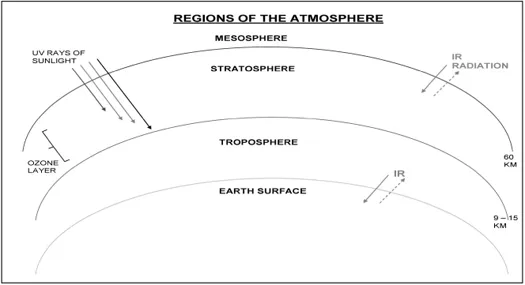
The ozone layer completely absorbs the lower wavelengths of the UV rays, namely UV-C and transmits only a fraction of the middle wavelength—UV-B. Almost all of the higher wavelengths (UV-A) are transmitted to the earth, where they cause skin ageing and degradation of other synthetic polymers. Human manufactured chemicals transported by the wind to the stratosphere are broken down by UV-B radiations, releasing halogen atoms like chlorine or bromine that catalyse destruction of ozone. As ozone is depleted, the increased transmission of UV-B radiations would endanger human health and the environment.1
The main source of these halogen atoms in the stratosphere is photo disassociation of chlorofluorocarbon (CFC) compounds, commonly called freons, and of bromochlorofluorocarbon compounds known as halons. These chemicals which destroy the ozone layer are termed as Ozone Depleting Substances (ODS). The chemical shorthand for these gas-phase reactions in the upper stratosphere is:
Cl + O3 → ClO + O2
ClO + O3 → Cl + 2 O2
ClO + O3 → Cl + 2 O2
A single chlorine atom is able to react with 100,000 ozone molecules. This fact, plus the amount of chlorine released into the atmosphere by chlorofluorocarbons (CFCs) every year, shows how dangerous CFCs are to the environment. Two chemists, Noble Laureates Mario J. Molina and F. Sherwood Rowland, were the first to discover the link between CFCs and ozone depletion in the 1970s.
Ozone depletion consists of two distinct, but related events: a slow, steady decline of about 4 percent per decade in the total volume of ozone in the ozone layer since the late 1970s, and a much larger, but seasonal, decrease in stratospheric ozone over the earth’s polar regions (Antarctica) during the same period. The latter phenomenon is commonly referred to as the ozone hole. The ozone hole area is defined as the size of the region with total ozone below 220 Dobson units (DU).2 The ozone hole occurs during the Antarctic spring, from September to early December, as strong westerly winds start to circulate around the continent and create an atmospheric container. This is known as the polar vortex and within this polar vortex most of the lower stratospheric ozone is destroyed during the Antarctic spring due to the presence of halogen containing source gases.
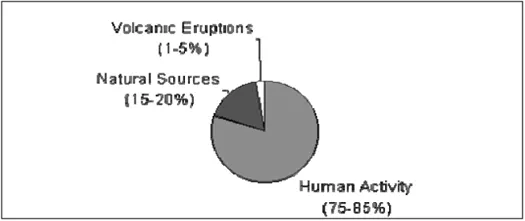
It is important to recognise the sources of ozone depletion before one can fully understand the problem. There are three main contributors to the ozone problem: human activity, natural sources, and volcanic eruptions and as Fig 1.2 below indicates, humans cause more damage to the ozone layer than any other source.
Fig 1.2: Percentages of Responsibilities for Ozone Damage Each Year
Source: www.Geocities.com, 1998
Humans have produced CFCs and halons for various applications in fire-fighting, foam-making, and refrigeration, etc. These chemicals have pillaged the ozone layer. From 1971 to 1985, scientists had carried out many observations, using different techniques, which pointed towards depletion of the ozone layer due to the presence of CFCs and halons. In 1982, the ozone measuring unit aboard the Nimbus 7 satellite registered such low levels of ozone that the computers ignored it. In 1984, the Japanese Meteorological Research Institute reported that the ozone level over Antarctica in September–October 1982, was the lowest since 1966 and was recorded to be under 250 Dobson units. The ozone hole in the Antarctic spring of 2006 was among the largest recorded – almost 30 million sq km. This could be due to super cold temperature (which supports ozone breakdown) prevailing in the stratosphere then, which paradoxically could be due to global warming. This effect of global warming to deplete the ozone layer would be covered in a subsequent chapter. It has been argued by scientists and countries alike that human interaction poses less of a threat to our atmosphere than do the natural processes like volcano eruptions or naturally occurring halogen atoms. It is, therefore, imperative that we understand the effects of these natural processes also for the benefit of the ‘naysayer’. The Halide acid HCl (also known as the hydrochloric acid) has been found to be effective in destroying ozone. However, most volcanic HCl is confined to the troposphere (below the stratosphere), where it is washed out by rain. Thus, it never has the opportunity to react with stratospheric ozone. But satellite data does point to some depletion of ozone levels after the eruptions of Mt Pinatubo and Mt Hudson (1991). These have been explained due to the presence of eruption-generated particles or aerosols which provide a surface for chlorine and bromine bearing compounds to react with ozone. Thus, these volcanic aerosols prove a catalyst for ozone depletion indirectly. The direct cause remains the presence of CFCs due to anthropogenic causes.
Global Warming
The earth’s climate has remained relatively stable during the interglacial period of around 10,000 years, with mean temperature change (not increase but variation) not exceeding 1oC per century.3The earth’s...
Table of contents
- Cover
- Half-Title
- Information
- Title
- Copyright
- Contents
- Dedication
- Acknowledgements
- Introduction
- 1 The Environment Change Matrix
- 2 Challenges for the Indian Military: Managing Ozone Depleting Substances
- 3 Kyoto Protocol and the Toolkit of Good Practices for the Indian Defence Forces
- 4 Climate Change and National Security: Contrarian or Interrelated?
- 5 Climate Change: Challenges and Adaptation Strategies for the Military
- 6 The Cauldron of Contradictions: Copenhagen
- 7 Green Technology: The Dawn of a New Industry
- 8 Environmental Governance
Trusted by 375,005 students
Access to over 1.5 million titles for a fair monthly price.
Study more efficiently using our study tools.
Frequently asked questions
Yes, you can cancel anytime from the Subscription tab in your account settings on the Perlego website. Your subscription will stay active until the end of your current billing period. Learn how to cancel your subscription
No, books cannot be downloaded as external files, such as PDFs, for use outside of Perlego. However, you can download books within the Perlego app for offline reading on mobile or tablet. Learn how to download books offline
Perlego offers two plans: Essential and Complete
- Essential is ideal for learners and professionals who enjoy exploring a wide range of subjects. Access the Essential Library with 800,000+ trusted titles and best-sellers across business, personal growth, and the humanities. Includes unlimited reading time and Standard Read Aloud voice.
- Complete: Perfect for advanced learners and researchers needing full, unrestricted access. Unlock 1.5M+ books across hundreds of subjects, including academic and specialized titles. The Complete Plan also includes advanced features like Premium Read Aloud and Research Assistant.
We are an online textbook subscription service, where you can get access to an entire online library for less than the price of a single book per month. With over 1.5 million books across 990+ topics, we’ve got you covered! Learn about our mission
Look out for the read-aloud symbol on your next book to see if you can listen to it. The read-aloud tool reads text aloud for you, highlighting the text as it is being read. You can pause it, speed it up and slow it down. Learn more about Read Aloud
Yes! You can use the Perlego app on both iOS and Android devices to read anytime, anywhere — even offline. Perfect for commutes or when you’re on the go.
Please note we cannot support devices running on iOS 13 and Android 7 or earlier. Learn more about using the app
Please note we cannot support devices running on iOS 13 and Android 7 or earlier. Learn more about using the app
Yes, you can access Environment Change and National Security by Manoj Kumar in PDF and/or ePUB format, as well as other popular books in Politics & International Relations & National Security. We have over 1.5 million books available in our catalogue for you to explore.