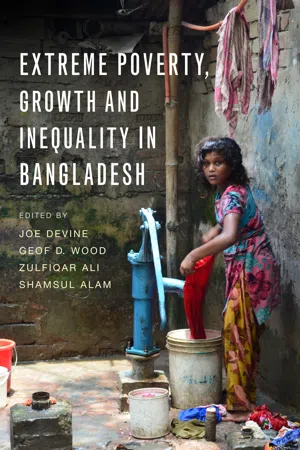
Over the past two decades, Bangladesh has enjoyed impressive economic growth rates and is now poised to become an upper Middle Income Country. Over the same period, the country has made considerable progress in reducing official poverty levels and in meeting its MDG targets. Despite this success, Bangladesh still has a sizeable proportion of its population living in poverty or extreme poverty; and it continues to see levels of inequality steadily rising. Furthermore Bangladesh remains one of the most climate-vulnerable countries in the world, with millions living in low-lying areas at risk from catastrophic flooding. This book is unique in that it focuses on extreme poverty. It brings together contributions from both academics and policy makers to address fundamental questions such as what difference does it make if we talk of extreme poverty as opposed to other more moderate forms of poverty? Should we define and characterize extreme poverty in terms of per capita income, social exclusion, welfare entitlements, intergenerational transfers, employment opportunities, gender and within household dynamics, spatial variations and mobility? How does a focus on extreme poverty challenge policy making and decisions? Bangladesh is on the brink of making real and sustainable in-roads on extreme poverty. To achieve this, it will need a new growth path that is more inclusive and redistributive, and will have to introduce innovative policies that are nuanced, blended and sustained. The book draws on empirical data and evidence to identify key priorities that can inform policy able to engage with extreme poverty. This book is essential reading for policy makers, civil society and donor staff, researchers and students from Bangladesh and beyond who are interested in understanding extreme poverty and how it can be eliminated.
- English
- ePUB (mobile friendly)
- Available on iOS & Android
eBook - ePub
Extreme Poverty, Growth and Inequality in Bangladesh
About this book
Information
CHAPTER 1
Sharing the well: towards sustained eradication of extreme poverty in Bangladesh
This chapter uses two metaphors to explore the moral and practical dimensions of extreme poverty eradication. The first metaphor, ‘leaving no one behind’, currently dominates policy discussions and broadly sees the eradication of extreme poverty as the consequence of economic growth and prosperity. In contrast, the chapter outlines an alternative approach, captured in the ‘sharing the well’ metaphor, which focuses much more on redistribution and rights. The chapter argues that, although both approaches are laudable, their differences are important. Crucially, the ‘sharing the well’ approach, although politically challenging, has roots in values shared by the people of Bangladesh. This argument helps contextualize the different chapters of the book.
Keywords: extreme poverty, redistribution, political settlement, sharing the well, leaving no one behind
Introduction
This volume examines evidence of the links between extreme poverty, growth, and inequality in contemporary Bangladesh. It brings together contributions from academics, practitioners, and policy leaders who, over the course of the past two to three years, have been working closely to inform policy debates in Bangladesh about extreme poverty. One of the highlights of this collaboration was a conference held in April 2015 and organized under the auspices of the General Economic Division (GED) of the Planning Commission of Bangladesh, the Bangladesh Bank, and the Bangladesh Institute of Development Studies (BIDS).1 One of the aims of the conference was to explore the policy challenges of eradicating extreme poverty in Bangladesh in the context of the government deciding on the strategic priorities for its seventh Five Year Plan. The original concept note for the conference promoted the metaphor of ‘sharing the well’, while other voices were keen to connect to the global language of ‘leaving no one behind’. While both terms are appropriate, they hide subtle differences of meaning about settlements and processes, and crucially about core values in a society. This contestation of language is the starting point of our initial reflections on the relationship between extreme poverty, growth, and inequality.
While the focus of this volume is one country, Bangladesh, the issues posed by this contestation apply more globally to many countries faced with large-scale poverty, including extreme poverty. Indeed, we might well argue that they apply with equal force to poverty eradication in rich countries such as the UK, which retain significant levels of poverty that have particular implications for the life chances of their child populations. So, although Bangladesh represents a case of recent transition from a low-technology, agrarian-based society to a differentiated and increasingly urban-oriented one, the core issues raised by the contestation of language are more generalized. To put the point bluntly, does poverty eradication require a rights-based, value commitment to the sharing of existing levels of wealth plus whatever is accumulated in the future? Or will it happen in the future only as a function of trickle-down inclusion from economic growth? ‘Leaving no one behind’ reflects the logic of the latter question, and refers to a society where most people will move forward and there is some need to purposefully include those who may be struggling. For neoliberals, this is best achieved by growth and the expansion of employment – any kind of employment. However, extreme poverty poses a particular challenge to that formula when the assumption of a capacity to work (to sustain individual or family livelihoods) cannot be applied due to old age; morbidity; mental health; disabilities; effects of chronic malnutrition, often arising from early stunting; gender discrimination; ethnic minority exclusion, and so forth. Societies faced with any aspects of this challenge (i.e. all societies) then have to think about trying to pass the more challenging test of sharing present resources more inclusively, thus addressing core issues of morality, fairness, and inequality. Evidence of increased inequalities within rich societies suggests that they are not so good at passing this test. What hope, then, for a society such as Bangladesh which faces large-scale moderate poverty alongside significant absolute numbers in extreme poverty? This volume, in effect, examines Bangladesh as a tough test case where, despite all kinds of political instabilities and profound contestation (Devine et al., 2017), there have been remarkable successes in poverty and extreme poverty reduction over the last three decades, and especially over the last 15 years. Moreover, the country now has a very explicit public discourse about the removal of extreme poverty by 2021, with the Government of Bangladesh's Planning Commission taking the lead. So, there is not just NGO and civil society pressure. And not just donor pressure. Thus the contributors to this volume invite the reader to witness and reflect on an explicit wrestling with moral, strategic, and pragmatic dimensions of extreme poverty eradication in a society more superficially noted for its poverty, violence, and floods.
Although the volume has an explicit focus on the challenges of extreme poverty eradication, its spotlight falls not just upon the fortunes of the extreme poor, but upon society as a whole, specifically its core morality. This is what lies at the heart of the ‘sharing the well’ metaphor. Today, Bangladesh retains large-scale poverty challenges alongside its many positive development achievements and signs of progress. But it is also a country that, since its inception four decades ago, has faced significant problems of identity and cohesion – challenges that have been sadly exposed by recent high-profile campaigns of targeted killings allegedly credited to Al-Qaeda and the Islamic State of Iraq and Greater Syria (ISIS).2 There is an ongoing contestation for the soul of Bangladesh and what it means to be Bengali in a country that combines strong traditions of folk cultures and Islamic beliefs with significant minorities of Hindu and Adivasi populations. This is the context within which the society searches for a settlement or an agreed position on the distribution of life chances and well-being among its people.
The subtle differences between the ‘leaving no one behind’ and ‘sharing the well’ metaphors highlight the significance of inequality, rights, and community or ummah. ‘Leaving no one behind’ is clearly laudable, but it implies an acceptance of inequality, a policy agreement on absolute rather than relative poverty, and an acknowledgement that there will always be ‘stragglers’. Such a notion is akin to the adage that ‘the poor will always be with us’, inviting at best the idea of policy as charity: welfare for (deserving) victims rather than the removal of victimhood – that is, the condition of being a victim. Unfortunately this is a widespread understanding of social policy, combined with a powerholder's instinct for narrowing the criteria of entitlement to reduce the redistributive burden upon the more self-sufficient, ‘hardworking’ others. There is much labelling at work in such an approach (Wood, 2007). It is also a reflection of the limited-access state (North et al., 2009).
‘Leaving no one behind’ implies a growing economy, one moving forward, in which some people could get left behind unless they are held in by Pareto-optimizing assumptions. This frames the analysis in terms of the ‘poverty elasticity response’ to economic growth. ‘Sharing the well’, instead, allows for the possibility that growth is not inevitable, and questions assumptions made about adequate trickle-down. It thus asks the harder political economy question of redistribution and sharing under conditions of inequality reproduced by elite powerholders. In the context of a fragile political economy, potentially made worse by climate change, are the social and cultural forces in Bangladesh able to compensate by acting out the values of solidarity and gendered fairness? Can the well – and the well-being that goes with it – be shared? Or at least shared to the extent that no one is left behind?
Part of the understanding of this question lies in the fact that Bangladesh is changing in its structure and values. While there has never been a golden age when the ‘well’ was ‘well shared’, Bangladesh's pre-capitalist, agrarian quasi-feudal society did contain some safety nets at the local level across the zamindari estates. If labour is the relatively scarce factor of production under low technological conditions, then those classes that need agricultural labour have to ensure the basic terms of its reproduction. So, alongside exploitation, there has to be a sufficient condition of multi-period redistribution to cope with both perennial seasonal fluctuations in food availability and the years between droughts and floods. This was therefore not a golden age, but there was some social and cultural capacity within an unequal political economy to share, even if unevenly and only under extreme conditions. The Mughal and colonial states added some elements of state-led relief to this welfare mix through public works, while continuing to preside over pre-capitalist arrangements. Perhaps the early signs of change occurred through the partial monetization of the rural economy through the use of jute as a cash crop for peasant production (there had previously been plantation-led indigo production), adding little security to livelihoods while partially exposing those livelihoods to the volatility of commodity markets and monopoly farm gate pricing. Indeed, East Pakistan, and East Bengal before it, provided this commodity at the expense of its own food security, classically under-developing as a result.
The liberation struggle also intensified a sense of unity among Bengalis against a common enemy – an enemy that was increasingly perceived as responsible for the immanent nation's underdevelopment. Despite ideological efforts to the contrary, that spirit eroded in the years after liberation. The removal of the external threat, at great cost to public infrastructure and public goods, led to an internal scramble for rents under conditions of post-liberation scarcity, posing a serious socio-cultural threat to a collective sharing of the well. The inheritance of widespread poverty morphed into a problematic for the internal political economy; close to 90 per cent of the population at liberation was rural, and approximately 50 per cent of them were effectively landless and reliant upon an uncertain monsoon rice crop. The nation was significantly dependent on food imports, with only jute to pay for them. If the cake was fixed in size, then survival became an internal zero-sum game, comprising a powerful threat to any concept of Bengali solidarity as the basis for sharing.
Change has certainly occurred since those early, post-liberation days. But the story is complex and mixed. The major contribution to food security has been the widespread introduction of the Green Revolution IRRI-boro rice crop in the dry season – supported, ironically, by irrigation from both surface and groundwater sources. Jute, a declining international commodity, has largely given way to this innovation. The overall decline in poverty in the country can be attributed partly to a rise in real agricultural wages, while the differentiated story is also a function of a more idiosyncratic and cyclical divergence of dependency ratios. Wage rates are rising, and in some areas, in some seasons, labour can now even be scarce. This shift is partly a function of greater diversification in the economy, which has accompanied the rise of urbanization, the commercialization of agriculture as a result, and an increase in internal trade, facilitated by enhanced road networks.
Agriculture, now less cereally homogeneous, has therefore shifted as a socio-economic phenomenon towards a greater emphasis on contract farming and absentee landowners, entailing more rurbanization as well as the growth of large urban centres, not just confined to Dhaka. The structure of employment and thus the labour force has changed, and, as a result, so have the explanations of persistent, extreme poverty. Many credit–labour exchanges have given way to cash wages and cash-fixed rents that are market sensitive rather than a function of social reproduction imperatives. Security may have been achieved in a Faustian pact, but at least it was more predictable and morally instanced, a function of intimate asymmetric transactions between people and families who were not, nevertheless, strangers. Those in the West, witnessing the rise of zero-hour contracts, will acutely recognize this point. Relying for sustained poverty reduction on rising real wages without any safety nets replaces socially sanctioned forms of insurance with nothing.
While there are many ways to characterize change in the country, in the context of a discussion about sharing the well, the key point to emphasize is that society has become more differentiated due to the diversification of the economy. The solidaristic liberation idea of Bangladesh comprising a homogeneous society of small, subsistence peasants (never strictly true; see Wood, 1981) has to give way to much greater complexity as the society interacts with globalization, pulling livelihood options apart and segmenting life chances. Both economic and social transactions become more contractual and instrumental, and risk becoming devoid of any moral dimension.
In 2021, Bangladesh will have been liberated for 50 years. It will probably then be classified as a middle-income country. Although there have been many transformations since 1971 and although the country has in many ways been a beacon of development success, there is still significant extreme poverty, much of it chronic. Approximately 17.6 per cent or 25 million are extreme poor according to the lower poverty threshold (BBS, 2011), and a large number of the population is moderately poor by the upper poverty threshold. On top of this, we already know that there is a churning of fortunes between extreme and moderate poverty, and that the thresholds themselves do not fully capture the real number of people living in poverty or vulnerability. Despite very realistic ambitions to be a middle-income country, therefore, Bangladesh still faces core problems of poverty in a context of climate vulnerability, inequality, and regional disparities.
Bangladesh has entered a further plan period with the launch of its seventh Five Year Plan, which lists the eradication of extreme poverty much more explicitly among its priorities. There have been a number of important government-supported initiatives that, accumulatively, offer optimism in relation to this priority. These include: significant success in addressing the challenges of eradicating extreme and moderate poverty; commitment to reforming its social protection policies; investment via infrastructure in labour mobility and market expansion, especially in the agricultural sector, which results in increases in agricultural wage rates; an improved environment for foreign direct investment and local collaboration, especially in the garments sector; an increase in budgetary commitments to the education and health sectors; and collaborative arrangements with donors and NGOs to extend targeted asset transfer programmes beyond its own direct interventions. For good reasons, therefore, the commitment to ‘leave no one behind’ has been ratcheted up by both political and policy leaders in Bangladesh. But will this vision require a fairer sharing of the well – that is, of present and predicted wealth? And how might that revised settlement in the political economy come about? And how might it be monitored and maintained?
In effect, this volume convenes a dialogue between applied academics contributing research analysis and policy leaders providing technical and political insights to influence the formation and formulation of that settlement. The driving focus of the dialogue takes the form of a core question: as Bangladesh moves towards middle-income status, implying stronger domestic revenues, how should its social policy evolve to eradicate extreme poverty? This implies a paradigm shift away from a reliance on mostly donor-supported, discrete development projects towards more domestically supported, mainstreamed policy across a range of sectors. Such a paradigm shift requires serious thought about the institutional challenges of leading, coordinating, and monitoring progress towards the eradication of extreme poverty when duty-bearers are spread across so many government and non-government organizations, as well as other parts of civil society and donors.
Volume contributions
Turning to the volume itself, our first empirical chapter is written by Binayek Sen and Zulfiqar Ali and builds on a background paper on extreme poverty commissioned by the Planning Commission as part of its preparatory work for the seventh Five Year Plan. The chapter offers a comprehensive overview of poverty reduction trends in Bangladesh, as well as an analysis of extreme poverty characteristics and dynamics. It then addresses the twin themes of responsiveness to growth and enduring inequality. In so doing, the authors embrace respectively the two perspectives of ‘leaving no one behind’ and ‘sharing the well’. In relation to growth, they develop an analysis of poverty elasticity, and offer statistically informed projections of responses to different growth scenarios. This allows them to calculate the projected costs of eradicating extreme poverty in the future. In terms of inequality as an enduring cause of extreme poverty, they note that Bangladesh, like other countries in South Asia and indeed globally, remains a deeply differentiated society in terms of class relations and other stratification indicators. Although the population is mainly ethnically homogeneous, there are significant ethnic and religious minorities who experience deep discrimination. Inequalities also manifest themselves spatially, in urban and rural locations but also in significant regional variations. The significance of these inequalities is that they frame opportunities and capabilities and contribute to the sustained reproduction of poverty.
In arguing for a new political settlement more aligned to ‘sharing the well’, Devine and Wood's chapter points out that extreme poverty can be both socially and economically contrasted with moderate poverty in terms of marginalization, social isolation, and intensity, as well as the prevalence of ethnic minorities, feminization, the elderly and the disabled. The poverty of the extreme poor is more idiosyncratic than the systemic poverty of the moderate poor. Thus, the political economy analysis of extreme poverty needs to be modified and more onus placed on duty-bearers, because the extreme poor have less of a voice and have less capacity for counterpart social action. This modification requires a deliberate dialogue with the middle classes to re-set the de facto welfare regime of the country. The chapter uses a well-being regime model to illustrate the challenge of agency between the poor themselves and other duty-bearers in society, and to indicate the structural limitations of agency and well-being outcomes for the majority of the population as offered by an institutional landscape, comprising the four domains of state, market, community, and household. The chapter concludes by reflecting on drivers and key dimensions of a future political resettlement.
It is abundantly clear across all the data arising from poverty research and programme interventions that poverty is significantly feminized. This is all the more evident in cases of extreme poverty. Drawing upon that research plus life history narratives generated through the EEP/Shiree programme, Maîtrot discusses the significance of female-headed and female-managed households within the extreme poverty category. Focusing on the significance of marriage for both a woman's well-being and household security and stability, Maîtrot asks the direct question of what happens when ‘male guardianship’ is removed, forcibly or otherwise, from a household, and how women, left with responsibility for those households, cope and survive. The chapter highlights the plurality of women's experiences at different life stages, influenced by, inter alia, class, marital status, and social marginalization. However, what remains common is the existence and influence of gendered inequalities. The chapter offers insights into different coping strategies and also highlights attempts by female-headed or female-managed households to try to rebuild forms of male guardianship through family or co...
Table of contents
- Cover Page
- Title Page
- Copyright Page
- Contents
- List of Figures and Tables
- Acronyms
- Bengali Terms
- Acknowledgements
- 1. Sharing the Well: Towards Sustained Eradication of Extreme Poverty in Bangladesh
- 2. Ending Extreme Poverty in Bangladesh: Trends, Drivers, and Policies
- 3. Leaving no One Behind in Bangladesh: The Case for a New Political Settlement
- 4. Guardianship and Processes of Change: The Feminization of Extreme Poverty in Bangladesh
- 5. Financial Exclusion and Extreme Poverty in Bangladesh
- 6. Dynamics of Regional Poverty and Real Wages: Policy Implications for Development Interventions
- 7. Agricultural Commercialization and Employment Generation: Implications for the Extreme Poor
- 8. Urbanization and Extreme Poverty
- 9. Reforming the Social Security System for Poverty Reduction
- 10. Conclusion: Sharing the Well
- Index
- Back Cover
Trusted by 375,005 students
Access to over 1.5 million titles for a fair monthly price.
Study more efficiently using our study tools.
Frequently asked questions
Yes, you can cancel anytime from the Subscription tab in your account settings on the Perlego website. Your subscription will stay active until the end of your current billing period. Learn how to cancel your subscription
No, books cannot be downloaded as external files, such as PDFs, for use outside of Perlego. However, you can download books within the Perlego app for offline reading on mobile or tablet. Learn how to download books offline
Perlego offers two plans: Essential and Complete
- Essential is ideal for learners and professionals who enjoy exploring a wide range of subjects. Access the Essential Library with 800,000+ trusted titles and best-sellers across business, personal growth, and the humanities. Includes unlimited reading time and Standard Read Aloud voice.
- Complete: Perfect for advanced learners and researchers needing full, unrestricted access. Unlock 1.5M+ books across hundreds of subjects, including academic and specialized titles. The Complete Plan also includes advanced features like Premium Read Aloud and Research Assistant.
We are an online textbook subscription service, where you can get access to an entire online library for less than the price of a single book per month. With over 1.5 million books across 990+ topics, we’ve got you covered! Learn about our mission
Look out for the read-aloud symbol on your next book to see if you can listen to it. The read-aloud tool reads text aloud for you, highlighting the text as it is being read. You can pause it, speed it up and slow it down. Learn more about Read Aloud
Yes! You can use the Perlego app on both iOS and Android devices to read anytime, anywhere — even offline. Perfect for commutes or when you’re on the go.
Please note we cannot support devices running on iOS 13 and Android 7 or earlier. Learn more about using the app
Please note we cannot support devices running on iOS 13 and Android 7 or earlier. Learn more about using the app
Yes, you can access Extreme Poverty, Growth and Inequality in Bangladesh by Joe Devine in PDF and/or ePUB format, as well as other popular books in Social Sciences & Global Development Studies. We have over 1.5 million books available in our catalogue for you to explore.