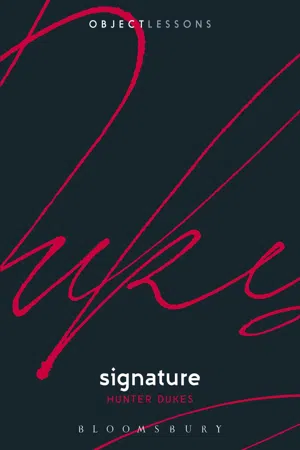
Object Lessons is a series of short, beautifully designed books about the hidden lives of ordinary things.
Why do we sign our names? How can a squiggle both enslave and liberate? Signatures often require a witness-as if the scrawl itself is not enough. What other kinds of beliefs and longings justify our signing practices?
Signature addresses these questions as it roams from a roundtable on the Greek island of Syros, to a scene of handwriting analysis conducted in an English pub, from a wedding in Moscow, where guests sign the bride's body, to a San Franciscan tattoo parlor interested in arcane forms.
The signature's history encompasses ancient handprints on cave walls, autograph hunters, the branding of slaves, metaphysical poetry, medical malpractice, hip-hop lyrics, legal challenges to electronic signatures, ice cores harvested from Greenland, and tales of forgery and autopens.
Part cultural chronicle, part travelogue, Signature pursues the identifying marks made by people, animals, and planetary forces, revealing the stories and fantasies hidden in their signatures.
Object Lessons is published in partnership with an essay series in The Atlantic.
eBook - ePub
Signature
About this book
Information
1 The Dotted Line
We rarely perceive our own signatures. When did you last study yours? They are supposed to be habitual, automatic—lines that disappear into the background of life. But if we injure our writing hand, or sign with an unruly instrument, the autograph may leap back into presence, become strange once again. Something like this happened to me years ago, in an unlikely place: not at the UK university where I had enrolled for graduate school, but in my local pub.
Paying with an American credit card can be a puzzling ritual when abroad. While our Visas and Mastercards are now equipped with microchips, they often lack the PIN (Personal Identification Number) codes that govern European commerce; instead, a signature is required. It has been an empty formality in the United States for some time: a dash under a waiter’s blind eyes. Credit card companies finally recognized this in 2018, allowing merchants to go “signature free” for most transactions. But several financial services continue to require signatures for payments over a certain threshold.1
British publicans have been known to respect the signature. The card reader’s demanding chirp, its prompt for an autograph, occasionally triggers a decorous procedure, both charming and mad: handwriting analysis between packets of crisps. It was my first year in England. I spoke the language and I didn’t. Keen, pitch, sarnie, toff, twee, bap, batty, bop, what? Trying to make these funny words my own, I adopted a woeful mid-Atlantic accent—think less FDR, more Bermuda Triangle—and laid it on thicker than treacle. In retrospect, I sounded like the lock-jawed lovechild of William F. Buckley and Lauren Bacall, with a kazoo for a larynx, whose husky pronunciation of “whine” and “wheel” positively whistled. I am still embarrassed by the brio (and of the frequency with which I used words like brio), by the indulgences of language, the affected signature of my adolescent self.
We were in a gallant tavern. Equal parts town and gown, it lacked only a carpet stained with ambiguous fluids (the signature fug of a good boozer, or so someone said). Autumn’s seasonal depression had begun to swamp the country: a bland and general sogginess, like the pub’s battered cod. Colleagues explained that my round had come. I elbowed toward the barman, bald with spectacles, his fingers thicker than the brushed steel jigger they held. All right? he asked. Yeah, I’m doing pretty well, thanks, and how are you? He blinked. (If you don’t know: the proper response to all right? is to ask it right back—the “I’m rubber, you’re glue” mode of hailing.) My order proceeded anyway, to something called real ale. I was in England, Albion, Blighty, baby. Authenticity or bust.
The barman grabbed a pendant light, swung it over the signed receipt. Then he asked to see my card.
“Sorry, isn’t you.”
“Sorry?”
“Isn’t your signature, that.”
“Whose is it?”
“Looks like another gent’s.”
“Another gent’s?”
[blink]
“You mean, like, someone you know?”
“You know what?”
“What?”
“Right.”
Exhibit one: a shaky scrawl, still wet around its edges. Exhibit two: my credit card’s looping signature, confidently inscribed several years earlier, now rubbed out. I wanted to say bollocks to his assessment or practice some regional, East Anglian insults, recently acquired. But the pint-puller was right. These signatures shared little resemblance, except for a name, scarcely discernible in each.
And why should they have? If an autograph is the legal shorthand of an individual’s agency and consent, the stamp of his presence at a specific time and place, would it not be a dynamic thing? I had changed in the intervening years; my signature had changed too, it seemed. Standing at that sticky counter I was thrown into a momentary crisis, the acute experience of derealization.
“Put a man on the moon,” growled the beast of bitter, “think they could figure out chip and PIN!” Fair shout. Unpersuaded by a California driver’s license, he reversed the card charges; we settled up with cash. The pints were mine, but the thought that I could be dispossessed of my signature, suddenly, by a stranger, left me shaken, stirred. Even my autograph knew I was faking it.
* * *
What are signatures? They are seismographs of personality. A mountainous horizon drawn by Etch A Sketch, with rolling peaks and troughs. Or, if slant and dense, the synthesizer’s sawtooth wave, each letter breaking into the next. When scribbled in haste on a tablet’s screen, names seem closer to cardiograms than autographs: the trace of a rhythmic life. Signatures are transient, too—the ink fades while you look away, like contrails dissolving into blue.
We grant them more authority than other forms of writing. The name gains fortitude from the shape of its letters, their unique, graphological profile. Your autograph is a paradox: both a failed improvisation and an unfaithful copy. Discussing the contradiction of signatures, Mario Carpo distinguishes between sameness and similarity.2 Every signature is a repetition, but with difference; Sonja Neef calls this property iterable uniqueness.3 The exact same signature, signed twice, would be a forgery. While any shape signed by your hand should be, de facto, a working signature, authentication relies upon another party: a person, institution, or object that co nfirms its past iterations.
Think about chicken scratch, the power it commands! A signed confession binds you to a crime and its requisite punishment; if a petition receives enough signatures, it can change the course of history; with a good forgery, a thief comes one step closer to stealing an identity, becoming you before the law. “Great is the hand that holds dominion over / Man by a scribbled name,” wrote Dylan Thomas.4 Are you surprised, then, that making a deal with the devil revolves around an autograph? Faust signed his agreement with Mephistopheles in blood.
Why are signatures vulnerable to interference? Because at the moment of creation they take on a life of their own. When someone signs their name, argues David Wills pace Jacques Derrida, they have potentially created “something that will function beyond the term of one’s mortal existence.”5 Or, to quote Josh Lauer: “every signature is a memorial.”6 They are effective techniques for leaving a trace on the planet. We do not bring them with us when we go. Signatures stay on as relics, staving off oblivion, fossilized versions of our former selves.
But even our own signatures can turn against us, in pubs and elsewhere. Charles Lamb recounts an unnerving scene during his 1823 essay, “Oxford in the Vacation,” when discussing George Dyer, the most absent of men. Dyer drops in on a friend and finding them away, signs the guestbook kept for missed encounters. Hours later, he returns; again he enquires; and again he asks to leave his name: “the book is brought, and in the line just above that in which he is about to print his second name (his re-script)—his first name (scarce dry) looks out upon him like another Sosia, or as if a man should suddenly encounter his own duplicate!”7 The reference is to Plautus’s Amphitryon in which the god Mercury disguises himself as Sosia, the slave of a Theban general, and proceeds to attack his likeness. Our signatures create replica selves, which are startling to confront. If they differ, we are disowned; when they cohere, we can feel usurped. In the play, Sosia is terrified. Wouldn’t you be?
Signatures teach us a lesson about classification. They are mercurial constellations, lines drawn between the stars of an overcast sky. A name is not necessarily a signature; a signature does not need to be a name. Signatures are made through addition or subtraction, impasto and incision. Some are carved or chiseled, achieving depth, while others glide from fountain pens across a surface. (Vilém Flusser calls the former inschrift, the latter aufschrift: inscription vs. onscription.)8 Signatures can be like birthmarks, without an alphabet, bound to the body. I am more interested in the marks birthed by a body as it moves through the world: prints, tracks, writing.
While autograph indicates something alphabetic, I define signature broadly in this book as any material trace that leads back to a body, specific or abstract, human, geologic, animal, digital, genomic, or atmospheric, in the case of climate signatures. For a signature to be recognized as such requires a successful instance of communication. A “unique mark” only exists within a collective understanding and regulation of those terms. Seals, autographs, and sweat patterns—secreted and impressed by the whorls on a person’s fingertips—are sites of consensus: they delimit the signifying element, an iterative form.
To perceive a signature involves the capacity for recognition, something determined by the sensorium itself, its physiological and cultural limitations. Dogs can discern their own scent, but not their reflection in a mirror; fire hydrants are laden with olfactory marks that, for most of us, signify nothing. Faces are unique and recognizable because humans see them in a certain way. They would be meaningless craters of flesh should prosopagnosia (“face blindness”) become a widespread condition. (Media scholars like Anna Munster would add that faciality is itself a “frozen” signatory structure, which solidified at a certain point in history.)9
Where the senses fail and the body fails to impress, others forms of signature are supplemented by technologies of preservation. Our faces do not naturally leave marks in the world (when they do, it is a miracle, like the Veil of Veronica or the Shroud of Turin). But death masks detach a facial signature from its body; photographs too. We are surprisingly good at extrapolating age, sex, mood, and other characteristics from vocal cues, but could not imprint our voices in the world until the invention of phonography.
Before “signature” signaled a squiggle, it captured a sense of impression. As late as the third century, Roman cursive was “too undeveloped for signatures written in it to be recognized.”10 The etymology of signature remembers an earlier technology: signums created by the authoritative impressions of a seal’s matrix. In antiquity, signets featured personal silhouettes, animals, or alphabetic letters. To further personalize the waxen seal, some documents were then inscribed by a handwritten signature: “a way of putting yourself in or on a document that grew naturally out of the practice of sealing itself.”11
Elizabeth Meyer’s idea of putting yourself into a signature points toward the strange sense of presence facilitated by autographs. In the Roman Empire, they were not always names, but could be formed from entire, identifying sentences known as subscriptio. After the fall of Rome, Merovingian kings and noblemen used elaborate monograms to sign charters, while certain byzantine signatures, christograms and cruciforms, spliced an individual’s initials into a Christian invocation. During seances in the nineteenth century, mediums confirmed the authenticity of spirits through automatic writing. Often the content of these messages carried less personal character than the spir...
Table of contents
- Cover
- Series
- Dedication
- Title
- Epigraph
- Contents
- 1 The Dotted Line
- 2 S for Signature
- 3 Autograph Collecting
- 4 The Origins of Signature
- 5 Signing the Body
- 6 Signaling Digits, Digital Signatures
- 7 Paw Prints & Ice Cores
- Epilogue
- Acknowledgments
- Notes
- List of Figures
- Index
- Copyright
Trusted by 375,005 students
Access to over 1.5 million titles for a fair monthly price.
Study more efficiently using our study tools.
Frequently asked questions
Yes, you can cancel anytime from the Subscription tab in your account settings on the Perlego website. Your subscription will stay active until the end of your current billing period. Learn how to cancel your subscription
No, books cannot be downloaded as external files, such as PDFs, for use outside of Perlego. However, you can download books within the Perlego app for offline reading on mobile or tablet. Learn how to download books offline
Perlego offers two plans: Essential and Complete
- Essential is ideal for learners and professionals who enjoy exploring a wide range of subjects. Access the Essential Library with 800,000+ trusted titles and best-sellers across business, personal growth, and the humanities. Includes unlimited reading time and Standard Read Aloud voice.
- Complete: Perfect for advanced learners and researchers needing full, unrestricted access. Unlock 1.5M+ books across hundreds of subjects, including academic and specialized titles. The Complete Plan also includes advanced features like Premium Read Aloud and Research Assistant.
We are an online textbook subscription service, where you can get access to an entire online library for less than the price of a single book per month. With over 1.5 million books across 990+ topics, we’ve got you covered! Learn about our mission
Look out for the read-aloud symbol on your next book to see if you can listen to it. The read-aloud tool reads text aloud for you, highlighting the text as it is being read. You can pause it, speed it up and slow it down. Learn more about Read Aloud
Yes! You can use the Perlego app on both iOS and Android devices to read anytime, anywhere — even offline. Perfect for commutes or when you’re on the go.
Please note we cannot support devices running on iOS 13 and Android 7 or earlier. Learn more about using the app
Please note we cannot support devices running on iOS 13 and Android 7 or earlier. Learn more about using the app
Yes, you can access Signature by Hunter Dukes in PDF and/or ePUB format, as well as other popular books in Literature & Literary Criticism Theory. We have over 1.5 million books available in our catalogue for you to explore.