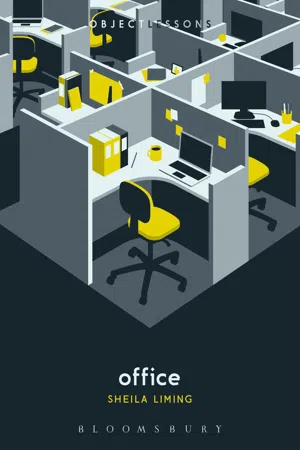
Object Lessons is a series of short, beautifully designed books about the hidden lives of ordinary things.
From its origins in the late 19th century to its decline in the 21st, Sheila Liming's Office narrates a cultural history of a place that has arguably been the primary site of labor in the postmodern economy.
During the post-war decades of the 20th century, the office rose to prominence in culture, achieving an iconic status that is reflected in television, film, literature, and throughout the history of advertising. Most people are well versed in the clichés of office culture, despite evidence that an increasing number of us no longer work in offices.
With the development of computing technology in the 1980s and 90s, the office underwent many changes. Microsoft debuted its suite of multitasking applications known as Microsoft Office in 1989, firing the first shot in the war for the office's survival. This book therefore poses the question: how did culture become organized around the idea of the office, and how will it change if the office become extinct?
Object Lessons is published in partnership with an essay series in The Atlantic.
eBook - ePub
Office
About this book
Information
1 The Office as Space
Offices of Antiquity
We know them when we see them. A spirit of similitude and blandness tends to preside over each, whether we’re talking about a maze of cubicles or an executive’s suite with mahogany paneling and a view of the city skyline. We know what is supposed to happen in these spaces, too: work. Often, it’s a type of work that could be performed almost anywhere else, except that custom has decreed that it take place here, within the physical confines of what is known as an office.
Above all else, an office means a space. This, at least, is the prevailing contemporary definition of the term. It’s one that was hundreds of years in the making, though. The word office, which descends from the Latin oficium, originally referred to a position or post that came with certain responsibilities (as in the phrase “to hold public office”). It was these metaphorical spaces, or else the people who occupied them, that formed the beginnings of the word. Over the centuries, though, a kind of transubstantiation occurred, and an office became first and foremost a thing, a space that could be physically experienced and also inhabited. What has remained consistent throughout its etymological history, though, is the way the word office has been used to call attention to conditions of separation. In being elected to a public office, a person becomes separated and distinguished from the masses, who are his constituents. In a similar way, the space of the office, regardless of its physical particularities, tends to denote something that has been set aside, a space apart. But apart from what exactly?
The origins of the idea begin simply enough, with the word office designating a space for work that existed indoors and, thus, stood apart from the kinds of work taking place outside. Nikil Saval points to the middle of the nineteenth century, explaining that offices developed during that era in order to accommodate new types of work. Because of its newness, that work was initially deemed “unnatural”1 and characterized by its distance from nature. But, as a space, the office has a long history that stretches all the way back to the days of religious enclaves, with medieval scribes arguably serving as some of the first office workers. For example, Herman of Tournai was a twelfth-century abbot who famously chronicled life at his medieval Flemish monastery, describing scenes that would be at home in any modern-day office. Among them is his account of “the cloister,” where one might see “more than twelve young monks sitting in chairs in front of small tables and silently writing careful and skillful compositions.”2 Here, Herman is talking about cloister carrels, individual desks that were designed to accommodate the scribes’ work and which would have been arranged within a larger setting known as a scriptorium, or writing house. Medieval scribes toiled away inside these early, office-like spaces, producing handwritten copies of sacred manuscripts.
Scriptoria and chapter houses emerged so that resources—including shelter, heat, and materials like vellum and ink—might be jointly shared among laborers, which included monks but also, sometimes, professional scribes. For this reason, scriptoria became a common feature of cenobitic monasteries, which placed an emphasis on community life as opposed to eremitic (or “hermit”) traditions. Meanwhile, other religious orders throughout the medieval world maintained that individual cells were best for study and clerical work. Famous examples of monastic cells include Skellig Michael, a Gaelic Christian monastery that was founded between the sixth and eighth centuries on an austere island located off the coast of Ireland (and seen recently in the newest spate of Star Wars films). Monks at Skellig Michael lived inside of beehive-shaped huts known as clocháns, which provided only meager protection from the punishing weather. These types of cells emblematized the medieval cleric’s lifestyle, which was supposed to have been stripped of luxuries and instead organized around work and study. And because clerk, the word used to describe most office workers starting in the nineteenth century, is etymologically fused with the word cleric, monks have earned a reputation as the founders—or patron saints, if you will—of the modern-day office.
In 1975, for instance, Xerox launched a popular advertising campaign that featured a lovable, office-dwelling figure known as “Brother Dominic.” In the commercial that debuted in July of that same year, an appropriately tonsured Brother Dominic appears slaving away inside his medieval scriptorium. He is seated at his cloister carrel and preparing his copies by candlelight. Gregorian-style chanting forms the soundtrack to his labor, which he eventually presents to his abbot, only to be told that he must produce “500 more sets.” Fortunately for Brother Dominic, a hole in the space-time continuum grants him admission to the twentieth century; he is transported to a brightly lit, modern office where a new copying device known as the Xerox 9200 Duplicating System promptly produces the required sets for him. Brother Dominic then returns to his medieval enclave and delivers the sets to his delighted abbot-boss, who issues the campaign’s catchphrase: “It’s a miracle!”3
In the commercial, Brother Dominic acts as a kind of conduit between the clerics of medieval Europe and the clerks of today. The work that he does inside the scriptorium enables his seamless entrance into the space of the twentieth-century office. Candlelight in the first gets swapped for overhead neon in the second, but these spaces appear nonetheless related to each other. Both, for example, appear defined by a similar set of conditions and restraints, including the employee-supervisor relationship and the occurrenc e of highly repetitive, tedious labor. Brother Dominic’s discovery of a time-saving shortcut for his work maps the sort of anxieties that haunt the modern-day office—namely, the concern for efficiency and speed—onto a historically analogous workspace. As a result, in the Xerox commercial, contemporary bureaucrats and office workers are encouraged to see themselves and their own office spaces as not just historically relevant but as mythic, even. Never mind the fact that illiteracy was the norm throughout medieval Europe, or that monks actually formed part a privileged minority. The Xerox commercial’s message is one of camaraderie: all of us modern office workers are the living descendants of Brother Dominic.
The Nineteenth-Century Occupation of the Office
Though it had existed in some form for centuries, the office rose to prominence as a space during the nineteenth century. At least, this is what nineteenth-century literature—brimming with offices and office-dwelling characters—would have you believe. Herman Melville is responsible for crafting one of the more famous exemplars of this tradition in the form of Bartleby the Scrivener, an irritable office worker who stars in the 1853 short story of the same name. Offices and office workers were not the most popular literary subjects when Melville’s story was first published,4 but they were both ascendant species that would, in time, come to define much of the dominant culture.
Previously, in 1841, for instance, the poet and essayist Ralph Waldo Emerson had observed that one’s “installment” within an office located in an urban setting was already being viewed as the new standard for both work and success in America. What bothered Emerson was the way offices appeared tied to visions of lifelong career stability. American men were being judged by their abilities to acquire a place in an office and to achieve that level of stability, which Emerson saw as having a ruinous effect on the national psyche. “If the finest genius studies at one of our colleges and is not installed in an office within one year afterwards in the cities or suburbs of Boston or New York, it seems . . . that he is right in being disheartened and in complaining the rest of his life,” Emerson explains in his famous essay “Self-Reliance.” Yet Emerson argues that the enterprising young man who succeeds in rebounding from failure and in trying his hand at a variety of careers “is worth a hundred of these city dolls.”5 The suggestion is that office workers are more or less all the same, and that a nation comprised of clerks therefore cannot help but become a nation of followers.
One of the most famous and best-selling works of nineteenth-century American literature, for instance, actually begins in an office. Few readers of Nathaniel Hawthorne’s The Scarlet Letter (1850), though, have probably noticed this fact. Hawthorne opens his historical novel, the bulk of which is set in the Massachusetts Bay Colony of the 1600s, with reflections upon the years that he spent working as a customs agent in Salem, Massachusetts. And here, just as in Herman of Tournai’s accounts of life within his medieval abbey, are familiar descriptions of office space and office work.
[O]n ascending the steps, you would discern—in the entry, if it were summer time, or in their appropriate rooms, if wintry or inclement weather—a row of venerable figures, sitting in old-fashioned chairs, which were tipped on their hind legs back against the wall. Oftentimes they were asleep, but occasionally might be heard talking together . . . with that lack of energy that distinguishes . . . all other human beings who depend for subsistence . . . on monopolized labor, on anything but their own independent exertions.6
Office work during the nineteenth century had yet to be revolutionized by the Taylorist insistence on efficiency and speed (that would come later, in the twentieth century). That is why, instead of haste, we get lassitude in Hawthorne’s descriptions of the office environment, a situation that fueled Emerson’s worries about the future of the American psyche.
The space of the office, as both Emerson and Hawthorne present it in their writings from this era, inspired not productive or creative labor but, rather, lethargy. It was a space populated by the somnambulant and the idle, where nothing ever got invented or created or done but, merely, half-heartedly managed or arranged or overseen. This idea appears to have been well established by the midpoint of the nineteenth century, making Melville’s story “Bartleby, the Scrivener” look more like a famous reiteration than a point of origin. Melville’s story takes place in an office, but that office proves to be more than just a setting: it is a physical reflection of its occupants’ aspirations and mentalities. It lacks, for instance, for a view. “Owing to the great height of the surrounding buildings” of New York City’s Wall Street, and given its position on the second floor, the windows in Melville’s narrator’s office look out upon an industrial air shaft at one end and upon a neighboring building’s brick façade at the other.7 These physical details conspire to create an atmosphere of claustrophobia and futility. Melville’s characters, meanwhile, enact those feelings and display an increasing reluctance to do their work, which involves the copying of legal documents and so is essentially nonproductive. Two of the office’s employees turn varyingly to drink, “their fits relieving each other like guards,” while Bartleby himself starves and wastes away after repeatedly declaring that he would “prefer not to” do his work.8
Bartleby’s inertia in this story is as symbolic as it is symptomatic, though. The nineteenth-century rise of the office corresponded, perplexingly enough, with another trend: the decline in the number of hours actually spent working. This is according to the labor historian Benjamin Kline Hunnicutt, who explains that, from the beginnings of the nineteenth century, and lasting up until the start of the twentieth, “working hours in America were gradually reduced . . . and this is true for most modern industrial nations.”9 That the idea of the office was ascendant even as work itself appeared descendant might seem like paradox but, in fact, the first is a direct expression of the second. Offices looked like spaces of idleness, not work, for the very reason that most work was still taking place elsewhere, either out of doors or else in factories and manufacturing centers.
So great was the need to see the office as a space unto itself and thus apart, that nineteenth-century factories, when they included offices for the housing of bosses or superiors, went to great lengths to separate them both physically and architecturally from those larger working arenas. We see this kind of separation, for instance, in the English novelist Elizabeth Gaskell’s North and South (1855), which dramatically captures the encroachment of industrialization on life in mid-nineteenth-century England. Gaskell’s protagonist, Margaret Hale, upon her first visit to the sprawling Malborough Mills, observes
a great oblong yard, on one side of which were offices for the transaction of business; on the opposite, an immense many-windowed mill, whence proceeded the continual clank of machinery and the long groaning roar of the steam-engine, enough to deafen those who lived within the enclosure.10
Margaret notes how the boss’ offices at Marlborough Mills are positioned at a safe distance away from the actual work of manufacturing. That distance, in Gaskell’s novel, proves to be at once symbolic and practical; Bessy Higgins, a millworker whom Margaret later befriends, ends up dying of byssinosis, which results from the inhaling of dust from cotton weaving.
In order to be recognized as work, then, clerical labor during the nineteenth century had to be contextualized and sanctioned with the help of dedicated physical space. And because it housed a more desirable kind of middle-class labor, it also needed to be protected.
The Modern, Organized Office
The idea of office work gradually took hold and became a more acceptable and likely expression of human labor during the nineteenth century. As it did, the office underwent a transformation, shifting away from its identity as a space of lethargy and waste and toward its twentieth-century incarnation as a space of efficiency and production. One symptom of this transformation was that the office became more recognizable as a space; it began to develop a set of hallmarks and characteristics that would, decades later, ripen into full-blown clichés (think water-cooler talk and office pranks).
At the heart of the modern office space, though, was an insistence upon organization. Offices became showrooms and testing grounds for new technologies that promised to revolutionize modern living by making information and resources more accessible. For instance, the National Fire Insurance Company, in a corporate history that it published in 1897, describes its newly built headquarters in Hartford, Connecticut, in lavish, uncompromising detail. In particular, it mentions how the newly occupied offices included “steel cases with rolling shuttered fronts” that “are so accessible and conveniently arranged that any paper desired can be produced at a moment’s notice”—and because this is a fire insurance company we’re talking about, the cases were also guaranteed to be “fireproof.”11
A photographic plate accompanying these descriptions shows what the company’s new Hartford offices looked like when they were built in 1893. Like many others at the time, they featured an open floor plan composed of individual wooden desks, n...
Table of contents
- Cover
- Series
- Title
- Contents
- List of Figures
- Introduction
- 1 The Office as Space
- 2 The Office as Stockpile
- 3 The Office as Hierarchy
- 4 The End of the Office
- Acknowledgements
- Notes
- Index
- Copyright
Trusted by 375,005 students
Access to over 1.5 million titles for a fair monthly price.
Study more efficiently using our study tools.
Frequently asked questions
Yes, you can cancel anytime from the Subscription tab in your account settings on the Perlego website. Your subscription will stay active until the end of your current billing period. Learn how to cancel your subscription
No, books cannot be downloaded as external files, such as PDFs, for use outside of Perlego. However, you can download books within the Perlego app for offline reading on mobile or tablet. Learn how to download books offline
Perlego offers two plans: Essential and Complete
- Essential is ideal for learners and professionals who enjoy exploring a wide range of subjects. Access the Essential Library with 800,000+ trusted titles and best-sellers across business, personal growth, and the humanities. Includes unlimited reading time and Standard Read Aloud voice.
- Complete: Perfect for advanced learners and researchers needing full, unrestricted access. Unlock 1.5M+ books across hundreds of subjects, including academic and specialized titles. The Complete Plan also includes advanced features like Premium Read Aloud and Research Assistant.
We are an online textbook subscription service, where you can get access to an entire online library for less than the price of a single book per month. With over 1.5 million books across 990+ topics, we’ve got you covered! Learn about our mission
Look out for the read-aloud symbol on your next book to see if you can listen to it. The read-aloud tool reads text aloud for you, highlighting the text as it is being read. You can pause it, speed it up and slow it down. Learn more about Read Aloud
Yes! You can use the Perlego app on both iOS and Android devices to read anytime, anywhere — even offline. Perfect for commutes or when you’re on the go.
Please note we cannot support devices running on iOS 13 and Android 7 or earlier. Learn more about using the app
Please note we cannot support devices running on iOS 13 and Android 7 or earlier. Learn more about using the app
Yes, you can access Office by Sheila Liming in PDF and/or ePUB format, as well as other popular books in Literature & Literary Criticism Theory. We have over 1.5 million books available in our catalogue for you to explore.