Winner of the Heldt Prize for Best Book in Slavic, East European, and Eurasian Women's and Gender Studies 2021
There was a discontent among Russian men in the nineteenth century that sometimes did not stem from poverty, loss, or the threat of war, but instead arose from trying to negotiate the paradoxical prescriptions for masculinity which characterized the era. Picturing Russia's Men takes a vital new approach to this topic within masculinity and art historical studies by investigating the dissatisfaction that developed from the breakdown in prevailing conceptions of manhood outside of the usual Western European and American contexts. By exploring how Russian painters depicted gender norms as they were evolving over the course of the century, each chapter shows how artworks provide unique insight into not only those qualities that were supposed to predominate, but actually did in lived practice.
Drawing on a wide variety of source material, including previously untranslated letters, journals, and contemporary criticism, the book explores the deep structures of masculinity to reveal the conflicting desires and aspirations of men in the period. In so doing, readers are introduced to Russian artists such as Karl Briullov, Pavel Fedotov, Alexander Ivanov, Ivan Kramskoi, and Ilia Repin, all of whom produced masterpieces of realist art in dialogue with paintings made in Western European artistic centers. The result is a more culturally discursive account of art-making in the nineteenth century, one that challenges some of the enduring myths of masculinity and provides a fresh interpretive history of what constitutes modernism in the history of art.
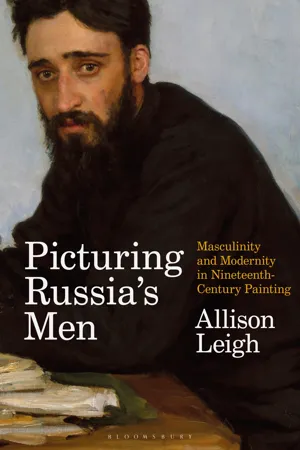
eBook - ePub
Picturing Russia’s Men
Masculinity and Modernity in Nineteenth-Century Painting
- 288 pages
- English
- ePUB (mobile friendly)
- Available on iOS & Android
eBook - ePub
About this book
Information
Part One
Autocratic Masculinity
1
Karl Briullov:Fathers, Brothers, Husbands, and Sons
You are our everything: as a Russian, as a nursling, as an artist, as an articulation, as a comrade. We welcome you with open arms.
Speech given in honor of Karl Briullov, delivered June 11, 18361
Sometime between 1813 and 1816, in the years immediately following the defeat of Napoleon, a boy named Karl Briullov made his first self-portrait [Figure 1.1]. In it, he looks intensely at something over his left shoulder; his eyes are wide and bright at the sight of it. His jacket is buttoned up and the cravat underneath it is carefully wound, the dark fabric neatly tucked beneath the rigid collar. His shoulders are slightly hunched, and the faintest outline of a hand appears tucked inside his jacket. Above all this, the artist carefully delineated his own facial features with light pencil strokes. He lit his own visage brightly, almost artificially, with only the faintest of shadows cast under the right eye and the bottom lip. The focus is clearly on the face, and despite the sharp three-quarter profile, the far eye is not lost, nor is it shadowed. Instead his averted gaze reads as purposeful and brightly confident. The firmness of the jaw, the aquiline tip of the nose, the sweep of the hair—all hint at the budding personality of a young man already wielding considerable artistic talent.
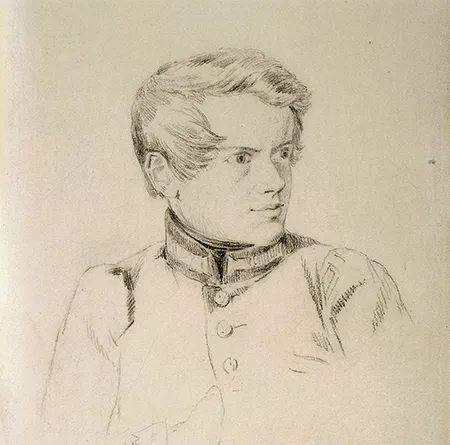
Figure 1.1 Karl Briullov, Self-Portrait, 1813–16; pencil on paper, 21.8 × 16.9 cm., The State Tretiakov Gallery, Moscow.
Briullov was between fourteen and seventeen years old when he made this small self-portrait and he came from a long line of artists. His great-grandfather Georges had been a modeler in the Imperial Porcelain Factory in St. Petersburg, his grandfather Ivan had worked as a sculptor, and his own father, Pavel, was an engraver and woodcarver who had served for a time as a professor at the Imperial Academy of Arts.2 Briullov was expected to continue in these men’s footsteps and by the age of ten, he had already begun studying at the preparatory school of the Academy in St. Petersburg.3 His older brothers Fëdor and Alexander had also begun studying there a few years before. After six years in this school, all three were admitted into the Academy proper, where a further six years of intense work awaited them.4 Students attending the institution in these same years attested to the brothers’ attachment to one another; they also described Karl as exceptionally talented.5 He used the drawing skills imparted to him by his father, which exceeded those in his age group, to help his fellow students with their sketch assignments—if they could pay the price of “rolls and other foods” which he required.6
The Academy of Arts had opened in St. Petersburg in 1758 and by the beginning of the nineteenth century had become the preeminent training ground and arbiter of artistic taste in Russia. In the time of Catherine the Great, the institution became the only art academy in Europe to have its own boarding school. The hope was that young men brought up in isolation from their potentially ignorant families would become ideal citizens as a result of the enlightened education they received in the seclusion of the Academy’s walls. Most boys originally entered the school at the age of five or six, where they remained for nine years before being admitted to the Academy proper for another six years. From 1802, the age of entrance was changed such that students were admitted at the age of eight or nine. Thus, young men in the nineteenth century would ultimately study, as Briullov and his brothers did, for a total of twelve years.
Throughout this era, the desire to transform boys into ideal citizens via an education in art remained one of the core values of the institution.7 While attending the school, boys wore a series of specific uniforms which designated where they were in their training and Briullov wears one of these uniforms in his self-portrait. The required garb included everything from shoes to undergarments and one was expected to maintain all these items with absolute precision. Rosalind Blakesley describes the rigor of life for students in the early days of the Academy in stark detail:
Each boy was expected to devote himself to his moral and artistic education … Discipline was harsh, corporal punishment rife and … the student dropout rate was high—above fifty per cent in one period of twenty-seven years. From 1774 to 1783, seventy-three of the 380 students in the boarding school even died, possibly as a result of the alarming notion circulating in an Academy of Sciences publication that children from the age of six or seven should not be warmly dressed, “for in this way little by little from earliest years they learn to bear extreme cold.” … From 1788, when the Academy’s new building opened on the Neva embankment, students would sleep cheek by jowl in spartan dormitories on the top floor. Shivering in the winter or sweltering in the summer heat, they would rise at five o’clock in the morning, don the uniform appropriate to their stage of education and gather for prayer half an hour later.8
All this provides insight into how the institution sought to instill a moral education in the young men it housed under its roof, one that went hand in hand with a rigorous artistic training. Schools like this in the first half of the century were concerned above all with the dissemination of social duty and they provided strict models for the behavior of boys in their care. The pattern was set by treatises like The Honorable Mirror of Youth, the first part of which was aimed at young men. Instructions included practical prescriptions—one should stand up straight, not interrupt, be respectful toward one’s parents.9 Behavior manuals focused on male youths were also particularly preoccupied with giving instructions on how to act when mingling with those further up the social scale. The emphasis was continually on obedience and respect, as well as on the utter regulation of one’s emotions. Men were to demonstrate external self-control at all times, and yet also be brave and assertive when necessary. This led to something of a contradiction: “On the one hand, the ideal young man was self-restrained, modest, and malleable; on the other hand, he was eloquent, assertive through manipulation … and not unduly modest.”10 Such incongruous prescriptions for masculine behavior resulted in tension for young men like Briullov. When was it proper to be firm-willed and when should a man be obsequious?
These dueling attributes seem to subtly clash in the self-portrait the artist made while still a student at the Academy. He is both assertive and modest in the drawing; his gaze is a sign of nascent confidence and control, but the averted eyes demonstrate restraint and obedience. This chapter will utilize the self-portraits Briullov made over his lifetime, as well as his letters and the reminiscences of his contemporaries, to explore the competing ideals for masculinity which rose to the fore in the period. Patriarchal male roles were key to the constitution of manhood in this moment and Briullov provides a fascinating case for investigating the evolving positions men occupied over the course of their lives as sons, brothers, husbands, and fathers. Masculinity was to a large degree constituted through such close familial relationships with other men throughout one’s life, but the expectations these bonds entailed would come to clash as Briullov sought a place for himself as a man and as an artist in the world.
In the end, the teenage boy in the little self-portrait would go on to achieve more professional success than any other artist in his generation. Lauded in both Russia and abroad, he became known as the “great Karl” for a singular masterpiece he completed between 1830 and 1833.11 Yet the magnitude of Briullov’s reputation has to a large extent blinded scholars to certain peculiar aspects of his masculine identity. For all his professional attainment, Briullov was in several ways a failure as a man according to the strictures of the time. He ultimately did not follow the traditional life pattern common for men in that he never fathered children of his own, but his artistic abilities allowed him to evade such expectations by adopting the paternal role of mentor to a bevy of students. Throughout his life, he continued to draw and paint himself, as well as many of those men closest to him—including some of the most notable playboys, princes, and artistic figures of his generation—all of which allow us to assess new aspects of masculinity as they rose to the fore during Tsar Nicholas I’s reign.
Fathers
The rigorous education Briullov received at the Academy of Arts was not the only influence on the man he would eventually become. By all accounts, his father was also a domineering presence throughout his childhood. Alexandre Benois tells us: “Without taking pity on the boy, he forced little Karl to an unremitting study of nature, and punished him severely for laziness or blunders.”12 Other sources tell us that as a child Briullov was not allowed breakfast until he had completed a copy of a designated engraving or a certain number of figures or animal studies.13 His father was once so displeased by a copy of a Velazquez that he made the boy repeat the drawing twelve times before he was satisfied.14 Little affection was shown to young Karl, he said many years later that his father “in all his life kissed me just once, when I boarded the stagecoach to go abroad.”15 Several sources also report a slap Karl once received from his father that he found hard to forget; the blow left him partially deaf in his left ear for the rest of his life.16
Such severe discipline on the part of fathers was not unusual at the time and was supported by various institutions in Russia—from the patriarchal values of the Orthodox Church and the government itself, to behavior manuals and domestic handbooks. The late eighteenth and first half of the nineteenth century saw a surge in treatises on conduct, which according to Catriona Kelly were “instrumental in shaping the ‘conscious’ assimilation of behavior patterns in Russia.”17 Surviving copies of manuals like Friendly Advice to a Young Man Beginning to Live in the World (1765), On the Duties of Man and Citizen (1783), and Pavel Voloshinov’s A Father’s Letters to His Son upon the Nature of a Life Distinguished by Virtue and Free of Mischief (1810) show heavy underlining and marginal notes, indicating that they were not only read, but annotated such that their prescriptions might be followe...
Table of contents
- Cover
- Halftitle Page
- Title Page
- Dedication
- Contents
- List of Illustrations
- List of Plates
- Acknowledgments
- Note on Translations
- Introduction
- Part 1 Autocratic Masculinity
- Part 2 Homosociality and Homoeroticism
- Part 3 Modern Women and Their Wounded Men
- Conclusion
- Selected Bibliography
- Index
- Imprint
Trusted by 375,005 students
Access to over 1.5 million titles for a fair monthly price.
Study more efficiently using our study tools.
Frequently asked questions
Yes, you can cancel anytime from the Subscription tab in your account settings on the Perlego website. Your subscription will stay active until the end of your current billing period. Learn how to cancel your subscription
No, books cannot be downloaded as external files, such as PDFs, for use outside of Perlego. However, you can download books within the Perlego app for offline reading on mobile or tablet. Learn how to download books offline
Perlego offers two plans: Essential and Complete
- Essential is ideal for learners and professionals who enjoy exploring a wide range of subjects. Access the Essential Library with 800,000+ trusted titles and best-sellers across business, personal growth, and the humanities. Includes unlimited reading time and Standard Read Aloud voice.
- Complete: Perfect for advanced learners and researchers needing full, unrestricted access. Unlock 1.5M+ books across hundreds of subjects, including academic and specialized titles. The Complete Plan also includes advanced features like Premium Read Aloud and Research Assistant.
We are an online textbook subscription service, where you can get access to an entire online library for less than the price of a single book per month. With over 1.5 million books across 990+ topics, we’ve got you covered! Learn about our mission
Look out for the read-aloud symbol on your next book to see if you can listen to it. The read-aloud tool reads text aloud for you, highlighting the text as it is being read. You can pause it, speed it up and slow it down. Learn more about Read Aloud
Yes! You can use the Perlego app on both iOS and Android devices to read anytime, anywhere — even offline. Perfect for commutes or when you’re on the go.
Please note we cannot support devices running on iOS 13 and Android 7 or earlier. Learn more about using the app
Please note we cannot support devices running on iOS 13 and Android 7 or earlier. Learn more about using the app
Yes, you can access Picturing Russia’s Men by Allison Leigh in PDF and/or ePUB format, as well as other popular books in Art & Art General. We have over 1.5 million books available in our catalogue for you to explore.