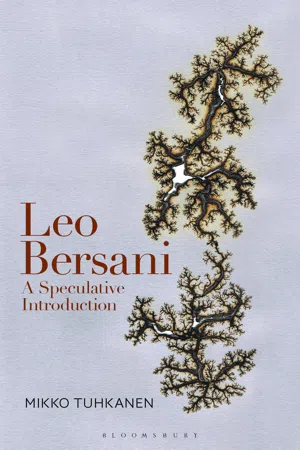
For the past 60 years, Leo Bersani has inspired, resisted, guided, and challenged scholarly work in the fields of literary criticism, queer theory, cultural studies, psychoanalytic theory, and film and visual studies. Moving across an impressive range of sources, Mikko Tuhkanen seeks out the "fundamental notes"-the questions that we find and refind-in Bersani's extensive oeuvre across the decades.
The chapters explore Bersani's engagement with psychoanalytic theory (Freud, Laplanche, Klein, Lacan), French and American modernist fiction (Proust, Baudelaire, Mallarmé, James, Beckett), poststructuralist theory (Derrida, Foucault, Deleuze, Guattari, Blanchot), queer theory (Butler, Edelman), and the visual arts (Caravaggio, Almodóvar, Pasolini, Malick, Dumont). This first introduction to Bersani's work provides a chronological overview of his thought and details his contributions to literary studies and critical theory.
- 344 pages
- English
- ePUB (mobile friendly)
- Available on iOS & Android
eBook - ePub
About this book
Information
Part One
Wanting Being
In Western culture, sex is taken all too seriously.
Gayle Rubin, “Thinking Sex: Notes for
a Radical Theory of the Politics of Sexuality”
a Radical Theory of the Politics of Sexuality”
We have to de-Proustify ourselves.
Leo Bersani, “Rigorously Speculating”
1
The Psychoanalytic Subject
Freud is not the only psychoanalyst to have been fascinated by murder mysteries. He was an avid consumer of detective stories such as Arthur Conan Doyle’s;1 according to some reports, he also planned, at the end of his life, to write a “historical novel” revealing the hidden truth behind Moses’s death (which would turn out to be a murder, and subsequent cover-up, at the hands of the Jews) (see Badcock). His followers have often not only expressed their appreciation for but also tried their hand at writing detective fiction. In addition to her influential theoretical texts, Julia Kristeva, for example, has published such “fictions of detection” as The Old Man and The Wolves (1991), Possessions (1996), and Murder in Byzantium (2004) (see C. Davis; Trigo). The British analyst Frank Tallis is the author of a series of detective stories set in fin-de-siècle Vienna and featuring a protagonist who is also a disciple of Freud’s. And Bruce Fink, Jacques Lacan’s most recent translator and a Lacanian analyst, has written a trilogy of detective novellas, The Psychoanalytic Adventures of Inspector Canal (2010).
Like the sleuth, the analyst, in his classic incarnation, is an expert reader: he reveals mysteries by interpreting the cryptic traces left behind by hidden processes, whether those of the unconscious or the criminal mind. As Tallis notes, the connection “was not lost on Freud” (467): both the detective and the analyst are after what Freud in the Introductory Lectures (1916–17) calls the “slight and obscure traces” found on the scene (52). They organize seemingly random and disconnected pieces of evidence into a legible narrative, interpreting, as Lacan writes, “the various clues, as the English say, the traces, the marks left on the trail” (Seminar XI 256); they seek the solution, Lösung, to the problems—the crime or the symptom—that ail the analysand or the community. “There was,” writes the psychoanalyst Christopher Bollas, “a kind of sleuth-like sensibility about Freud” (Shadow 68); in developing what he hoped would be a new anthropological science, he conceptualized the psychoanalyst “as a detective sifting through the clues that lie on the surface” (Bollas, Cracking 105).
Leo Bersani would add Marcel Proust’s work to psychoanalysis and detective stories as exemplary products of turn-of-the-century European zeitgeist.2 As he frequently notes, Proust’s masterwork should be read as the literary counterpart, the novelistic reimagining, of the Freudian text. As much as the traditionally conceptualized psychoanalyst tackles the mysteries that the analysand has hidden from himself and others, Proust’s narrator regards the people around him as riddles to be solved. “Proust … has given us the most complete representation of what we might call the psychoanalytic subject” (TT 4)3 because of the way in which the Freudian and Proustian texts have conceptualized their protagonists’—the analyst’s/analysand’s or Marcel’s—desire to know, to reveal the truth about, the object of their attentions. Already in 1970, Bersani notices “Marcel’s detective-like investigations into Albertine’s activities” (BB 215); in 1981, he notes that “the linear structure of A la recherche du temps perdu is that of an epistemological detective story” (DSM 41). Repeating the assignation of the novel as “an epistemological detective story,” he continues in The Culture of Redemption (1990) that the Proustian text “ha[s] little patience for structurally unassimilated material or false starts” (CR 114, 113). Proust repeats the tight, economical structure of detective stories, where even the misleading clues are finally integrated into the solution as the necessary red herrings.
In this chapter, I outline Bersani’s encounter with two oeuvres that are never to relinquish their grip on him: Proust’s and Freud’s. From the very beginning of his engagement with these, Bersani discerns in Proust and Freud—the two are nearly interchangeable for him—authoritative and prescriptive accounts of how we move in the world and relate to otherness: their manifest text lays out, and participates in, the training we in Western modernity have had in desiring. What Bersani calls “the psychoanalytic subject” is the subject of modernity, whose beginning he, in his latest work, traces, first, to Cartesian philosophy and, second, to Cartesianism’s rearticulation in late-nineteenth-century sexological discourses, most prominently psychoanalysis.
But Bersani also observes from the very beginning that, even if these texts, and particularly psychoanalysis, want to pass as universalizeable accounts of desire’s ontology, there may be other ways in which we can become in our encounters with the world. One way to describe his oeuvre is to suggest that, with theoretical and aesthetic texts, he experiments with potential ways in which the self can variously come into being in its encounter with otherness. His is an onto-ethical project, one that, moreover, thinks such becoming in terms of an aesthetic.
In what follows, I move from a brief outline of some salient aspects in Proust’s narrative to a discussion of Jean Laplanche’s reading of Freud, which becomes important for Bersani’s understanding of psychoanalysis. The third and final section synthesizes the discussion of Proust and Laplanche and points to the directions that remain, according to Bersani, not articulable in Proustian-Freudian/Laplanchean language. Even if, from the very beginning, Bersani is skeptical about the modes of being he sees illustrated in these oeuvres, he (and, consequently, we) will return to both as his own work (and this introduction) unfolds. Neither Proust nor psychoanalysis ever lets go; both compel repetitive returns to the scene of the crime.
Devouring Attention: The Proustian Subject
As Bersani observes in his first book, Marcel Proust: The Fictions of Life and of Art (1965), Proust’s narrative unfolds as a series of investigations into the lives of the people—mostly, the women—his narrator meets. The narrator’s objects of interest have one thing in common: “Their life seems full of secrets to Marcel, essentially erotic secrets” (MP 58). Marcel’s project is to unravel the mysteries that he suspects the women keep from him—mysteries that constitute “that unknown life which permeates [them] and which we aspire to possess with [them]” (Proust, Remembrance 2.587). His is, as Bersani writes, “an essentially investigating attitude,” of “knowing and therefore possessing the other person” (MP 87, 45). His persistence in tracking down the women’s secret lives makes him a sleuth; as Walter Benjamin, too, writes, “There [is] something of the detective in Proust’s curiosity” (“On the Image” 243).
It is not only in other humans but also in the inanimate world that Marcel detects a persistent sense of mystery. When he looks at the twin spires of Combray, he suspects that “something lay hidden beneath that nobility, that luminosity, something which they seemed at once to contain and to conceal” (Remembrance 1.183). But while Marcel “obsessi[vely]” (1.185) seeks to penetrate such mysteries, the narrative also constitutes “an extraordinarily dense exercise in introspection” (MP 4), something that we say, of course, of analysis too. Like traditional analysis, the Proustian method of detection aims at increased self-knowledge; Marcel is after others’ secrets in order to get to know himself. The narrator, as Bersani writes, “desire[s] to possess what is different from the self” (MP 92), but only because such difference promises to fill in the void of the unknown that inheres in himself. The puzzle that Marcel wants to complete is, ultimately, that of his own being. The other, then, is in the end secondary to the subject’s investigative efforts: he or she—or it—is only there as an enigma to be cracked and subsequently discarded. We find, in other words, “the loved one’s irrelevance to the lover’s feelings” (MP 101).
As in detective novels, the investigative subject is faced with riddles. “Marcel often sees other people,” Bersani writes, “as puzzles to be solved” (MP 60). The term solving here suggests not only the sleuth’s discernment but also the kind of undoing that takes place in digestion—(dis)solving. Proust often speaks of the narrator’s objects in terms of their appetitiveness; Marcel’s is a “fantasy of knowing by eating” (MP 37). His devouring desire is violent in its ambition to undo its objects by assimilation. But nothing will ultimately satiate the hunger of the subject, who must turn to the next appetitive object, persisting in his “uninhibited appetitive attack on the world” (BB 219). The various women in Marcel’s life “seem to contain the keys to enigmas of nature, art, and history” (MP 14), but, as Marcel discovers, such keys do not quite fit being’s lock.
To discuss Proustian appetition, Bersani turns—and returns—to a famous scene in À la recherche du temps perdu where Marcel’s gaze is arrested by a field of buttercups by the side of the road:
the buttercups grew past numbering on this spot which they had chosen for their games among the grass, standing singly, in couples, in whole companies, yellow as the yolk of eggs, and glowing with an added lustre, I felt, because, being powerless to consummate with my palate the pleasure which the sight of them never failed to give me, I would let it accumulate as my eyes ranged over their gilded expanse, until it had acquired the strength to create in my mind a fresh example of absolute, unproductive beauty.
(Remembrance 1.172)4
The visual pleasure of the flowers immediately evokes consumable matter, egg yolks, which stimulates the narrator’s appetite. As Bersani notes in 1965, Marcel seeks in this tableau “the satisfaction, on a non-physical level, of a desire to assimilate” (MP 36). The voracious gaze with which he contemplates the flowers is typical of his approach to other objects, too. Artworks constitute another example:
Marcel’s compulsive need to possess something different from himself makes him consider the work of art almost as something to devour; when he has fully digested the truth it contains, the pleasure of assimilation and with it his esthetic pleasure disappear.
(MP 203)
Bersani continues in 1976, again evoking the buttercup scene: “Marcel is tempted to see things and people as puzzles to be solved. He stares at flowers in order to force them to reveal a truth they seem to be both proposing and concealing” (FA 87, emphases added). The twofold gesture of “proposing and concealing,” of offering and withdrawing, solicits the desire of the Proustian subject. Marcel’s attention is captured by a series of enigmas that objects seem at once “to contain and to conceal” (Proust, Remembrance 1.183). Suggesting a secret, and then refusing access to the enigma, the object captures the subject, who now assumes that what is being withheld from him is nothing less than the truth about his being. Bersani describes this dynamic elsewhere as follows:
In Proust, it is precisely at the moment when the loved one turns away from her lover—becomes most mysterious, most inaccessible—that she (or he) is rediscovered within the lover—as if that essential secret being pursued by the lover were the lover’s own secret, his own otherness.
(“Death” 864)
Later, he and Ulysse Dutoit identify this production of enigmatic otherness with the experience of the “erotic.” In their study of Caravaggio’s art, they indicate that the twofold address we observe in Proust—“proposing and concealing,” “containing and concealing”—is also evident in the mode in which Caravaggio renders his models’ seductiveness: “the soliciting move toward the viewer, and the self-concealing move away from the viewer” constitute “a double movement” that should be “qualif[ied] as erotic … It is … the movement away that fascinates, indeed that eroticizes the body’s apparent (and deceptive) availability” (CS 3). Captured by the objects’ “fascination,” the subject/viewer wants to solve—or digest, (dis)solve—the other that embodies the enigma. Like Caravaggio’s models, the buttercups solicit—but, importantly, block—Marcel’s “most characteristic relation to the external world, which is a devouring one; his metaphors generally function as sublimated incorporations. They ‘solve’ the mystery of otherness by digesting it” (CS 68). The quotation marks around the verb “to solve” suggest that Bersani and Dutoit are citing Bersani’s own earlier discussion of the scene in Marcel Proust and A Future for Astyanax. It also indicates, as in the earlier books, the incorporation of objects by digestive dissolution, by (dis)solving.5
If Marcel observes the flowers with an appetitive desire, in his subsequent encounters with women we again witness “his devouring attention” (MP 78). He is, as Germaine Brée writes, “a fascinated spectator of life” (149). But who is being eaten? Bersani writes that the difference embodied in the women, the difference that Marcel seeks as the missing piece of his own puzzle, makes the world “dangerous and fascinating” for Marcel (MP 46). The other fascinates. We should consider this word closely, for it contains the paradox of Proustian (and, concomitantly, psychoanalytic) desire.6 As if under a spell, Marcel is drawn to the women whose mysteries compel him. The objects of our desire, as Bersani writes later, “fascinate our eyes … mak[ing] it impossible for us to turn our glutted vision away from the hypnotic scene” (FA 257). With his appetitive desire, Marcel seeks to undo, to (dis)solve, the objects of his fascination. Yet if he wants to assimilate the enthralling object, the evil magic under whose spell he has fallen—the witchcraft denoted by the Latin fascināre7—signals the threat of this process to his own integrity. The fascinated subject, after all, is a being captured by the devouring intentions of a malevolent other, like Mowgli, in Rudyard Kipling’s The Jungle Books (1894), who has to negotiate “the python’s powers of fascination” (77). Fascination, as Proust writes in “Contre Sainte-Beuve,” leaves one “fe[eling] transfixed, as a small bird might do on catching a sight of a snake” (56); it immobilizes one with “the strange and unexpected forms of an approaching death” (Remembrance 2.87). What gets devoured and (dis)solved in fascination is not only the fascinating object but also, and perhaps primarily, the fascinated subject. If Marcel is moved by an “extraordinary appetite” (MP 16), his hunger is ultimately matched by the world’s voraciousness.
If fascination’s dynamics suggests that the being to be undone along desire’s trajectory is not primarily Marcel’s various objects but the desiring self, in psychoanalytic terms “fascination” suggests the dangerous slippage between desire and the drive. For Lacan, the drive names a force that comes into being at the emergence—a mythical moment—of the symbolic order. The drive is that which aims at the unnamable underside of the symbolic: the real, the in...
Table of contents
- Cover
- Halftitle Page
- Title Page
- Dedication Page
- Contents
- Acknowledgments
- List of Abbreviations
- Introduction
- Part One: Wanting Being
- Part Two: The Correspondence Thesis
- Part Three: … But Is It Art?
- Works Cited
- Index
- Imprint
Trusted by 375,005 students
Access to over 1.5 million titles for a fair monthly price.
Study more efficiently using our study tools.
Frequently asked questions
Yes, you can cancel anytime from the Subscription tab in your account settings on the Perlego website. Your subscription will stay active until the end of your current billing period. Learn how to cancel your subscription
No, books cannot be downloaded as external files, such as PDFs, for use outside of Perlego. However, you can download books within the Perlego app for offline reading on mobile or tablet. Learn how to download books offline
Perlego offers two plans: Essential and Complete
- Essential is ideal for learners and professionals who enjoy exploring a wide range of subjects. Access the Essential Library with 800,000+ trusted titles and best-sellers across business, personal growth, and the humanities. Includes unlimited reading time and Standard Read Aloud voice.
- Complete: Perfect for advanced learners and researchers needing full, unrestricted access. Unlock 1.5M+ books across hundreds of subjects, including academic and specialized titles. The Complete Plan also includes advanced features like Premium Read Aloud and Research Assistant.
We are an online textbook subscription service, where you can get access to an entire online library for less than the price of a single book per month. With over 1.5 million books across 990+ topics, we’ve got you covered! Learn about our mission
Look out for the read-aloud symbol on your next book to see if you can listen to it. The read-aloud tool reads text aloud for you, highlighting the text as it is being read. You can pause it, speed it up and slow it down. Learn more about Read Aloud
Yes! You can use the Perlego app on both iOS and Android devices to read anytime, anywhere — even offline. Perfect for commutes or when you’re on the go.
Please note we cannot support devices running on iOS 13 and Android 7 or earlier. Learn more about using the app
Please note we cannot support devices running on iOS 13 and Android 7 or earlier. Learn more about using the app
Yes, you can access Leo Bersani by Mikko Tuhkanen in PDF and/or ePUB format, as well as other popular books in Letteratura & Teoria della critica letteraria. We have over 1.5 million books available in our catalogue for you to explore.