- 216 pages
- English
- ePUB (mobile friendly)
- Available on iOS & Android
eBook - ePub
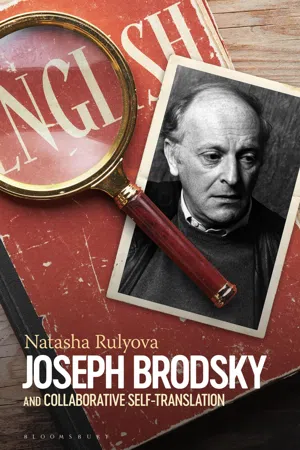
Joseph Brodsky and Collaborative Self-Translation
About this book
Joseph Brodsky and Collaborative Self-Translation is the first in-depth archival study to scrutinize the Russian-American poet Joseph Brodsky's self-translation practices during the period of his exile to the USA in 1972-1996. The book draws on a large amount of previously unpublished archival material, including the poet's manuscripts in Russian and English, draft translations, notes, comments in the margins and correspondence with his translators, editors and friends. Rulyova's approach to the study of self-translation is informed by 'social turn' in translation studies. She focuses on the process of text production, the agents and institutions involved, translation practices and the role played by translators and publishers in the production of the text.
Information
Chapter 1
Joseph Brodsky
Exile and the great English language
A writer’s biography is in his twists of language. (Brodsky 1986: 3)
Brodsky in Russia: ‘Walking out’
Joseph Brodsky, the Nobel Prize winner for literature in 1987, is one of the most revered Russian poets of the twentieth century. He is also the first Russian poet who has mastered the English language to be appointed the fifth Poet Laureate of the United States in May 1991. This book is an inquiry into his extraordinary linguistic journey and the first attempt to understand how he became a bilingual writer.
Joseph Brodsky was born into a Jewish family in St Petersburg in 1940. His father Alexander was a newspaper photographer (Brodsky 1986: 461). He was assigned to the navy and went through the Second World War. In 1950, his ‘father was demobilized in accordance with some Politburo ruling that people of Jewish origin should not hold high military rank’, as Brodsky recalls in an autobiographical essay (Brodsky 1986: 469). Under Stalin’s rule, anti-Semitic persecution turned into a government policy. At the age of seven, Joseph himself experienced the consequences of anti-Semitic Soviet laws when he and his schoolmates had to fill in school library membership application forms, which contained a question about ethnicity (Brodsky 1986: 7). Joseph refused to fill in the form on the grounds that he did not know his ‘nationality’1 and walked out. He concealed the truth to avoid the consequences of his being Jewish that automatically inscribed him into the category of ‘outcasts’. Many years later Brodsky justifies his act by saying that he was ‘ashamed of the word “Jew” itself – in Russian, “yevrei” – regardless of its connotations’ (Brodsky 1986: 8). Svetlana Boym observes the two consequences of this ‘walk out’: artistic, which led to ‘the art of estrangement’, and ‘political’, which was manifested in ‘the embarrassment of national identity’ (Boym 1998: 259). His first ‘free act’, a silent rebellion, was prompted by being Jewish in Soviet Russia. By distancing himself from ostracism of Soviet anti-Semitism, Brodsky felt further estrangement, and his first ‘walk out’ became symptomatic of his life story: ‘I’ve been walking out ever since, with increasing frequency’ (Brodsky 1986: 13). Brodsky’s act of self-identification through a ‘walk out’ echoes Ernst Van Alphen’s remark on Maurice Blanchot: ‘the Jew is someone who relates to the origin, not by dwelling, but by distancing himself from it. Separation and uprooting are the acts in which the truth of origin can be found’ (Alphen 1998: 230).
David Bethea makes a parallel between the Polish-Lithuanian origin of Czeslaw Milosz and Brodsky’s Jewish Russian roots. He suggests that it is not their ethnicity but the duality of their origin which is the source of their personal alienation. Bethea finds that the two poets have in common their ‘metaphysical’ passion for ideas, the ‘gnomic representation of them’, their ‘stoic’ world view and their repulsion in the face of the ‘martyrial-messianic reflex’ of their respective cultures as a consequence of their origin (Bethea 1994: 14). Milosz himself points to the ‘advantages’ of his duality in terms of its power that allows one to estrange oneself from ‘the present moment’.
Brodsky grew up in Leningrad (St Petersburg) where his family lived in a ‘room and a half’ in a communal apartment in Liteinyi street, as described by Brodsky himself (Brodsky 1986: 447–500). He was an autodidact, having left school at the age of fifteen. In 1956, he went to work as milling-machine operator, moving to a job in a morgue and then joining geological expeditions. Between 1956 and 1962 he changed thirteen jobs. In Brodsky’s biography, the poet’s friend and professor of Russian literature at Dartmouth College Lev Loseff lists thirty jobs that Brodsky held at different times. But he was truly committed only to poetry. He soon became part of the unofficial Leningrad literary scene, being recognized for his exceptional talent by Anna Akhmatova, one of the greatest Russian poets of the twentieth century, and Nadezhda Mandelshtam (1999; 2001) who is known for her powerful memoirs, providing a fearless critique of Stalinist repressions, which led to the death of her husband, the poet Osip Mandelshtam. When Brodsky read his elegy to John Donne to Akhmatova she famously exclaimed, ‘You have no idea what you’ve written!’ (Losev 2006). She was so impressed with Brodsky’s verse.2
However, Soviet authorities did not consider ‘writing poetry’ as a job for someone who neither graduated with an appropriate degree from a university, nor was a member of the Writers’ Union. In Brodsky’s own words, in the Soviet society a person had to choose between the two roles only: either to be ‘a slave with enthusiasm’ or ‘an enemy’ (Polukhina 2000: 295). Brodsky’s free views, idiosyncratic behaviour, the refusal to submit to the social norm were intolerable to Soviet bureaucrats and turned him into an ‘enemy’. As Brodsky’s friend Yakov Gordin recalls, the ‘irreconcilability of Leningrad authorities’ towards Brodsky was caused not only by his poems which seemed ‘difficult to understand’ (‘maloponiatnye’) and did not have any ‘political declarations’ but by the style of his social behaviour because ‘he lived like a free person’ (Gordin 2000: 130–1). His freedom was in conflict with the requirements of Soviet society for the poet and citizen, according to which talent was seen as a ‘social/public phenomenon’, and the goals of poetry were not to please a few but to ‘serve millions and to encourage the shaping of a new communist person’. Gordin cites this from the article ‘What Is a Real Poet?’, which appeared in Smena on 23 March 1963 (Golubenskii 1963), and was directed against another freethinking young Leningrad poet and Brodsky’s friend, Aleksandr Kushner (Gordin 2000). In the same year, the newspaper The Evening Leningrad (Vechernii Leningrad) published a feuilleton A Semi-Literary Drone exposing Brodsky’s ‘parasitic’ lifestyle (Ionin et al. 1963). The accusation was based on the Soviet government decree on people who led a ‘parasitic lifestyle’; that is, they did not hold a job (Iakimchuk 1990: 4). The law was ‘On strengthening the fight against individuals who avoid socially useful work and lead anti-social, parasitic lifestyle’, which was adopted by the Supreme Soviet of the RSFSR on 4 May 1961 (Article 273).
In 1964, Brodsky was tried for ‘social parasitism’ and convicted to five years of hard labour in Norenskaia in the Arkhangelsk region. The records of his infamous trial have been preserved and published thanks to the journalist Frida Vigdorova, who took notes of the process. They reproduce the trial in detail. Nadezhda Mandelshtam recalls that those notes mark a new historical threshold because Frida was the first to record a Soviet trial. The judge who allowed Frida to take notes could not imagine that a Soviet journalist would dare to publish the notes of the trial without due censorship or self-censorship and even leak it to be published abroad (Mandel’shtam 2001: 256–7). Efim Etkind adduces ten ‘accusations’ which the Soviet authorities could have laid against Joseph Brodsky, among them ‘selfishness’ and ‘egotism’, ‘thinking about death’, ‘pessimism’, ‘decadence’ and ‘modernism’, the fact that Brodsky did not complete secondary school and remained ‘undereducated’ (‘nedouchka’), that he did not want to join societies and stayed astray. He was accused of ‘Jewish nazism’ and castigated for saying that ‘reality made him lie’ (Etkind 1988: 24–8). The allegations were thus mainly aesthetic and social.
Brodsky’s worst memories, nevertheless, were evoked not by his banishment to Norenskaia but by his treatment in the mental hospital where he was incarcerated twice. The two years of his banishment, on the other hand, he described as the best times of his life. It needs pointing out that although he later claimed to have enjoyed physical work, it was damaging for his health. In May 1964, two months into his banishment, he was taken to hospital. Upon his return he was given less hard physical work to do, such as shepherding cows. He spent his free time reading and writing. By the poet’s request, his friend Gordin posted him an anthology of contemporary English poetry subtitled From Browning to Our Days (Brodsky 1986: 359–60). It was in that book that Brodsky discovered Auden’s poem ‘In Memory of W. B. Yeats’. Later Brodsky admitted that the lines ‘time . . . worships language’ had had an extraordinary effect on him and shaped his own relationship with language. Brodsky writes that this poem confirmed his own understanding of language as ‘greater, or older, than time, which is in its turn, older and greater than space’ (Polukhina 1989: 86) (further discussion of Auden’s influence on Brodsky is in a section of this Introduction).
In 1965 Brodsky’s prison term was shortened; and he was freed after a campaign by Soviet and foreign writers including Akhmatova, Samuil Marshak, Korneyĭ Chukovskii and Jean Paul Sartre. He returned to his hometown Leningrad and tried to settle back into his life. According to Ellendea Proffer Teasley and Carl Proffer, who met the poet on several occasions in the late 1960s and the early 1970s, Brodsky looked for opportunities to leave the former USSR but none of them came to fruition (Teasley 2017). However, the offer to emigrate to Israel, which he received by telephone from the authorities, took him by surprise. He agreed without yet realizing that this was the beginning of his new life in a new ‘re-incarnation’, as he refers to it in the documentary film Joseph Brodsky: A Maddening Space (Pitkethly 1999). Brodsky never returned to Russia, even after Gorbachev’s perestroika and the collapse of the USSR in 1991.
Brodsky in the west
In June 1972, Brodsky arrived in Vienna, Austria, his first destination in Europe. At the airport, he was met by Carl Proffer, George L. Kline and some other Slavists and émigrés who learnt about Brodsky’s arrival (Teasley 2017). Carl Proffer took him to the hotel, in which Proffer had booked a room to share with the poet. According to Teasley, Proffer looked after Brodsky during the first several weeks abroad. He helped him with accommodation, general advice, paperwork, tickets and the bureaucracy needed to be dealt with in order for Brodsky to move to the United States instead of emigrating to Israel. Proffer also managed to find a teaching position for Brodsky at the University of Michigan where Carl Proffer held the post of the Professor in Russian. His wife and a Slavist herself Ellendea Proffer Teasley describes how confusing and alien Western life appeared to Brodsky upon his arrival, for example, his first encounter with a toaster, a device, which did not exist in Soviet Russia, or opening a bank account (Teasley 2017).
While still in Vienna, Brodsky met his beloved Auden. Teasley recalls that Proffer and Brodsky visited Auden in his residence in Austria. Despite the first lukewarm meeting (according to Teasley), Auden warmed to Brodsky and later in the same year travelled with him to England. Brodsky’s recollection of this first meeting with Auden reflects the humility that Brodsky felt at the time, commenting with self-deprecation that his English was weak and he was sure not to make a mistake only in one question: ‘Mr. Auden, what do you think about . . .’ (Brodsky 1986: 376). Brodsky kept repeating the same question but adding different names of contemporary poets and ‘grilled him [Auden] quite extensively on the subject of poetry’ (Brodsky 1986: 376). In B rodsky’s interpretation of events during those first weeks after banishment, Auden looked after his ‘affairs with the diligence of a good mother hen’. Correspondence for Brodsky was sent ‘c/o W. H. Auden’. Auden solicited the first financial support of $1,000 from the Academy of American Poets for Brodsky (Brodsky 1986: 377). This money covered Brodsky’s expenses until he was paid his first salary at the University of Michigan.
Both poets read each other’s poems in translation. In 1973, Auden admits that he ‘can do little more tha...
Table of contents
- Cover
- Half-Title
- Dedication
- Title
- Contents
- List of illustrations
- List of abbreviations
- Note on the text
- Acknowledgements
- Introduction
- Chapter 1 Joseph Brodsky: Exile and the great English language
- Chapter 2 From solo writer in Russian to collaborative self-translator in English: Theoretical framework and insights into the practice of self-translation
- Chapter 3 What are Joseph Brodsky’s collaborative self-translations made of?
- Chapter 4 ‘Microhistories’ of Joseph Brodsky’s translators
- Conclusion
- Bibliography
- Index
- Copyright
Trusted by 375,005 students
Access to over 1.5 million titles for a fair monthly price.
Study more efficiently using our study tools.
Frequently asked questions
Yes, you can cancel anytime from the Subscription tab in your account settings on the Perlego website. Your subscription will stay active until the end of your current billing period. Learn how to cancel your subscription
No, books cannot be downloaded as external files, such as PDFs, for use outside of Perlego. However, you can download books within the Perlego app for offline reading on mobile or tablet. Learn how to download books offline
Perlego offers two plans: Essential and Complete
- Essential is ideal for learners and professionals who enjoy exploring a wide range of subjects. Access the Essential Library with 800,000+ trusted titles and best-sellers across business, personal growth, and the humanities. Includes unlimited reading time and Standard Read Aloud voice.
- Complete: Perfect for advanced learners and researchers needing full, unrestricted access. Unlock 1.5M+ books across hundreds of subjects, including academic and specialized titles. The Complete Plan also includes advanced features like Premium Read Aloud and Research Assistant.
We are an online textbook subscription service, where you can get access to an entire online library for less than the price of a single book per month. With over 1.5 million books across 990+ topics, we’ve got you covered! Learn about our mission
Look out for the read-aloud symbol on your next book to see if you can listen to it. The read-aloud tool reads text aloud for you, highlighting the text as it is being read. You can pause it, speed it up and slow it down. Learn more about Read Aloud
Yes! You can use the Perlego app on both iOS and Android devices to read anytime, anywhere — even offline. Perfect for commutes or when you’re on the go.
Please note we cannot support devices running on iOS 13 and Android 7 or earlier. Learn more about using the app
Please note we cannot support devices running on iOS 13 and Android 7 or earlier. Learn more about using the app
Yes, you can access Joseph Brodsky and Collaborative Self-Translation by Natasha Rulyova in PDF and/or ePUB format, as well as other popular books in Literature & Literary Criticism in Poetry. We have over 1.5 million books available in our catalogue for you to explore.