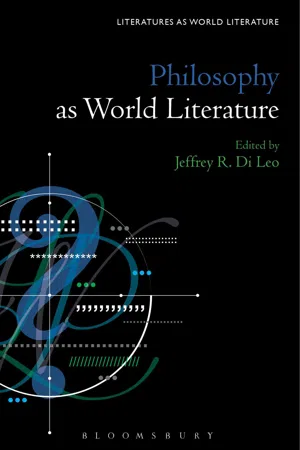
What does it mean to consider philosophy as a species of not just literature but world literature? The authors in this collection explore philosophy through the lens of the "worlding" of literature--that is, how philosophy is connected and reconnected through global literary networks that cross borders, mix stories, and speak in translation and dialect.
Historically, much of the world's most influential philosophy, from Plato's dialogues and Augustine's confessions to Nietzsche's aphorisms and Sartre's plays, was a form of literature--as well as, by extension, a form of world literature. Philosophy as World Literature offers a variety of accounts of how the worlding of literature problematizes the national categorizing of philosophy and brings new meanings and challenges to the discussion of intersections between philosophy and literature.
- 304 pages
- English
- ePUB (mobile friendly)
- Available on iOS & Android
eBook - ePub
Philosophy as World Literature
About this book
Information
Part I
World, Worlding, Worldliness
1
The World, the Text, and Philosophy: Reflections on Translation
Brian O’Keeffe
My topic is philosophy’s “world”—the concept philosophy makes of it and how philosophy encounters it in a real sense. But the world is a big place, so I begin on a smaller scale, with two small islands. Consider, first, Thomas More’s Utopia: insularity protects utopia’s borders from less-than-ideal encroachments—this society flourishes in secure isolation. Utopian language flourishes here too, and we may read a little example (in English translation): “The commander Utopus made me into an island out of a non-island / I alone of all nations, without philosophy / have portrayed for mortals the philosophical city.”1 How to make an island out of a non-island? Imagine digging a deep ditch, contoured to the island’s profile, or making a moat out of the sea itself. Perhaps the easier way to insularize an island, however, is to erect a linguistic border: surely the hardest border is constituted by an invented language. Yet inasmuch as we have a translation, hasn’t the deconstruction of this border already begun? As a thought experiment in imagining the ideal nation, in any case, it may well require an island to serve as the space wherein such experiments can occur: the ideal nation as an island where geographical, national, and linguistic borders map onto each other, presuppose each other. Plato take heed: “I alone … have portrayed for mortals the philosophical city.” If so, experiments in construing the philosophical Republic require what Marc Shell calls an “islandology”: the best way to idealize a nation, or a republic, is to maroon philosophical and political thought on an island of the mind—a circumscribed, eutopian place, immune from encroachment, bridgeless and without pier or jetty, alone and isolate.
My second island is Robinson Crusoe’s. Robinson doesn’t invent a new language, of course—the lingo of his scepter’d isle is English. But it took a Frenchman’s flair to insert this English literary text into a sustained discussion of philosophical sovereignty. I refer, of course, to Jacques Derrida’s The Beast and the Sovereign. Insularity is requisite to the discussion because Daniel Defoe’s text, among other things, is an attempt to proffer a truly national literary work—no wonder an island serves this agenda, since its borders are geographically distinct, as distinct as one might hope a national literary work might be as well. Derrida cites James Joyce: “[Defoe was] the first English author to write without imitating or adapting foreign works.”2
Islandology describes spaces immune from foreignness that serve the heuristic need for a tabula rasa where, in literature and in philosophy, ideal nationalisms, absolute sovereignties, and utopian communities can be imagined. We are far from the “world,” therefore, or from the “non-island”: connected landmasses or adjoined continents linked by internal borders (hard or soft) or by bridges and tunnels. So be it, if we wish to imagine the aboriginal, the indigenous, and a political philosophy of splendid isolation. Alas, moreover, “island” describes our own isolation as well—aren’t we all Crusoes, marooned on separate islands because we are all different from one another? My world is not your world, my being in time and space is not your being in time and space:
Between my world and any other world there is first the space and the time of an infinite difference, an interruption that is incommensurable with all attempts to make a passage, a bridge, an isthmus, all attempts at communication, translation, trope, and transfer that the desire for a world … will try to pose, impose, propose, stabilize.3
Every man is an island, then, islanded by a singularity that forbids transference, transposition, or translation, since no man can turn or trope himself into someone else. The isolate, desolate conclusion, pace John Donne’s “no man is an island,” is that “there is no world, there are only islands.”4
Not that the word “island” is immune from translation. When Derrida asks “qu’est-ce qu’une île?” (what is an island?), and “qu’est une ‘île’?” (what is an island?), he lets French speakers hear a different question, namely, “qu’est-ce qu’une ‘il’?” (what is a he?), where the feminine article “une” introduces the masculine “il.” None of this is really translatable into English, but Anglophone readers of Derrida ought not to miss the point. Every man is an island; no man is an island. Perhaps we ought to question the philosophical and literary sovereignty awarded to the masculine.
These two instances of islandology (three, if you add Joyce—a specialist of Irelandology, I think) give us a sense of the figurative and conceptual geographies to consider when philosophy’s relation to the world is at issue. Perhaps philosophy would prefer to circumscribe its intellectual dominion thanks to an island, rather than emplace itself in the world. For on an island, philosophy’s logos spreads unimpeded, transparently intelligible to all. Philosophical utopia wards off barbarians, translators, and inopportune writers, like Homer, writing in that foreign genre called “literature” (foreign to philosophy at any rate), knocking at the gates, seeking admission to philosophy’s safe space.
World Philosophy
If philosophy is to leave its islands and encounter the world, we must imagine a voyage or at least consider the modes of circulation whereby philosophy travels worldwide. If “translation” describes one such mode, we might accordingly activate the maritime metaphor resident in translatio and contemplate journeying from a home shore to a foreign shore—envisage embarkation, the crossing, and disembarkation at that farther shore. But philosophy will eventually ask us to relinquish metaphors, cease referring to literary texts, and abandon these whimsical itineraries of translation in order to get serious: the philosophical treatment of the world, and indeed the “world analytic” philosophy offers, requires rigorous engagement with the concept of world. At issue, moreover, is the purchase philosophy gains on what it means to inhabit the world, to make or form “world,” and besides, to survey the world from the position of philosophical universality. Then there’s the matter of what philosophy conveys to the world: concepts, principles, hypotheses and theses, and, above all, Truths. If a truth is subject to the vicissitudes of a worldwide journey, it presumably wishes to arrive intact as the same truth it was when it departed. If translation is one of the journeys to be envisaged, nothing of a truth as such should be lost in translation. Thus, philosophy must idealize a model of perfect translation: as Derrida puts it in The Ear of the Other, “the origin of philosophy is translation or the thesis of translatability.”5
I’ll have more to say later concerning this provocative determination of philosophy’s origin and its related thesis of translatability. I allude to it here in order to make the point that, if philosophy relies on a certain model of translation, it does so the better to secure for philosophy a distinction it doesn’t apparently share with anything else, namely, the prerogative to establish, verify, and circulate truths. I insist on this. For it clarifies what philosophy’s attitude might be to the proposal that philosophy be regarded as world literature. That is: if philosophy is to encounter a wider world, it might have to convey itself to that world as literature. If, on the contrary, philosophy has its own modes of circulation—one of which is afforded by a translation model that broadcasts philosophical truths without loss—then philosophy has no need of other conveyances and would therefore decline the invitation to transpose (or translate) itself into literature.
Nonetheless, in order to examine how the notion of “world literature” can serve as a touchstone for construing a corresponding (or opposing) notion of “world philosophy,” it may be instructive to briefly describe how scholarship has treated the question of literature’s worldliness, the dynamics of its “worlding,” and its modes of worldwide circulation. For Edward Said, writing in The World, the Text, and the Critic, texts have a circumstantial reality, a “worldliness.”6 Once the horizons of such worldliness are discerned by the critic, texts become mobile—the world isn’t static, so texts cannot be static either. In “Traveling Theory,” moreover, Said calls for a study of the circulation not just of texts, but also of ideas, and indeed literary or philosophical theories. The starting point is an acknowledgement that “like people and schools of criticism, ideas and theories travel—from person to person, from situation to situation, from one period to another.”7 Said describes the four stages of the journey: there’s a point of origin, this being a matter of the initial circumstances enabling an idea’s birth. Then there’s a “distance traversed, a passage through the pressure of various contexts as the idea moves from an earlier point to another time and place.”8 Then, at the other time and place, there’s acceptance and resistance to that transplanted idea. Finally, once the accommodations have been made, the idea is transformed by the new uses being made of it.
David Damrosch shares Said’s emphasis on a text’s worldliness, and the motif of travel is also active in his What Is World Literature? But the specific context for Damrosch’s account is Goethe’s call for the advent of the age of world literature. If one wished to hasten world literature’s advent, wouldn’t that mean reading all literature and mastering all the languages of literature? For Damrosch, however, “world literature is not an infinite, ungraspable canon of works but rather a mode of circulation and of reading.”9 Moreover, “I take world literature to encompass all literary works that circulate beyond their culture of origin, either in translation or in their origi...
Table of contents
- Cover
- Half-title Page
- Series Page
- Title Page
- Contents
- Epigraph
- Acknowledgments
- Philosophy as World Literature: An Introduction
- Part I World, Worlding, Worldliness
- Part II Migration and Difference
- Part III Philosophy, Religion, and the East
- Part IV Philosophy versus World Literature
- Contributors
- Index
- Copyright Page
Trusted by 375,005 students
Access to over 1.5 million titles for a fair monthly price.
Study more efficiently using our study tools.
Frequently asked questions
Yes, you can cancel anytime from the Subscription tab in your account settings on the Perlego website. Your subscription will stay active until the end of your current billing period. Learn how to cancel your subscription
No, books cannot be downloaded as external files, such as PDFs, for use outside of Perlego. However, you can download books within the Perlego app for offline reading on mobile or tablet. Learn how to download books offline
Perlego offers two plans: Essential and Complete
- Essential is ideal for learners and professionals who enjoy exploring a wide range of subjects. Access the Essential Library with 800,000+ trusted titles and best-sellers across business, personal growth, and the humanities. Includes unlimited reading time and Standard Read Aloud voice.
- Complete: Perfect for advanced learners and researchers needing full, unrestricted access. Unlock 1.5M+ books across hundreds of subjects, including academic and specialized titles. The Complete Plan also includes advanced features like Premium Read Aloud and Research Assistant.
We are an online textbook subscription service, where you can get access to an entire online library for less than the price of a single book per month. With over 1.5 million books across 990+ topics, we’ve got you covered! Learn about our mission
Look out for the read-aloud symbol on your next book to see if you can listen to it. The read-aloud tool reads text aloud for you, highlighting the text as it is being read. You can pause it, speed it up and slow it down. Learn more about Read Aloud
Yes! You can use the Perlego app on both iOS and Android devices to read anytime, anywhere — even offline. Perfect for commutes or when you’re on the go.
Please note we cannot support devices running on iOS 13 and Android 7 or earlier. Learn more about using the app
Please note we cannot support devices running on iOS 13 and Android 7 or earlier. Learn more about using the app
Yes, you can access Philosophy as World Literature by Jeffrey R. Di Leo in PDF and/or ePUB format, as well as other popular books in Literature & Literary Criticism for Comparative Literature. We have over 1.5 million books available in our catalogue for you to explore.