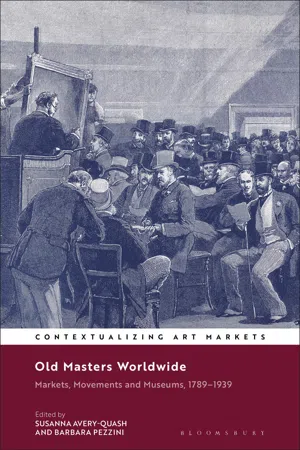
As a result of the Napoleonic wars, vast numbers of Old Master paintings were released on to the market from public and private collections across continental Europe. The knock-on effect was the growth of the market for Old Masters from the 1790s up to the early 1930s, when the Great Depression put an end to its expansion.
This book explores the global movement of Old Master paintings and investigates some of the changes in the art market that took place as a result of this new interest. Arguably, the most important phenomenon was the diminishing of the traditional figure of the art agent and the rise of more visible, increasingly professional, dealerships; firms such as Colnaghi and Agnew's in Britain, Goupil in France and Knoedler in the USA, came into existence. Old Masters Worldwide explores the ways in which the pioneering practices of such businesses contributed to shape a changing market.
eBook - ePub
Old Masters Worldwide
Markets, Movements and Museums, 1789–1939
- 320 pages
- English
- ePUB (mobile friendly)
- Available on iOS & Android
eBook - ePub
Old Masters Worldwide
Markets, Movements and Museums, 1789–1939
About this book
Information
Part One
Developing European Networks, 1780–1894
1
The European Market for Italian Old Masters after Napoleon
Robert Skwirblies
The period between the end of the Napoleonic Wars and the beginning of the series of new revolutions (1815–30) was to define the market for Old Master paintings for the entire nineteenth century.1 Although brief, these fifteen years were crucial for three main reasons: above all, a large quantity of works of art circulated throughout Europe, including a vast amount of objects previously smuggled or traded during the post-revolutionary years. Second, an increasing number of effective collaborations were established between state officials, collectors and dealers. Sometimes one person fulfilled all three roles, but, generally speaking, the dealer became a noticeably more independent agent during the period under review. Finally, increasing knowledge about and demand for old paintings was intertwined with the rise of public museums with active acquisition policies.
This chapter will focus on the turning point for the development of the market for Italian Old Masters, with a brief investigation of those protagonists and collections that represent key moments in that story. The methodological approach has been to draw general conclusions from analysing and comparing specific case studies, an approach best suited to the limited availability of empirical evidence.2 Indeed, the main difficulty for the historian is the lack of primary source material in this area: much of the trade was not documented, which is not surprising given that a large part of it was conducted in violation of export restrictions or simply to avoid paying taxes.3 An exception is the cache of family letters of Vincenzo and Pietro Camuccini dating to the Napoleonic era, which gives an idea of these dealers’ clandestine methods of bringing Old Master paintings of the highest quality from Rome to England for sale.4 They can be studied alongside the letters of two British art dealers, William Buchanan and John Smith, an exercise which sheds useful light on the contemporaneous British context.5 In most cases, though, hints and claims about smuggled works of art and dubious sales are often all that is left, which has led to speculation about the sums of money involved in various transactions.6 Further difficulties for historians arise in relation to attribution and identifying the works of art mentioned in primary documentation: official documents such as licenses, inventories and sale catalogues provide only an asserted authenticity so that, in most cases, it cannot be proved whether an offered or examined picture was an original, a copy, a forgery or a painting by another hand.7 What can be said, even from analysing only the preserved export licenses usually issued by professors and functionaries of the Florentine and Milanese art academies or the papal court (and appointed for that purpose), is that there was a noticeable increase in export activity during the period, even while there were increasingly public debates about the value of works of art as national or cultural treasures that should be protected.8
Conditions for a Thriving Art Market
During the first fifteen years of the nineteenth century, the documented number of Italian paintings brought to auction according to the data in the Getty Provenance databases was over 32,000, a third higher than in the previous twenty years, and forming an exceptional peak.9 However, in the following years between 1815 and 1830, there were still another 27,000 lots of Italian paintings listed in sale catalogues.10 This generic observation concurs with the high number of – mostly undocumented – mass auctions and sales in Italy during and after the late Napoleonic period (Fig. 1.1).11 Hundreds, and sometimes thousands, of paintings might be sold during one auction; the pictures sold were mostly not by famous top-end masters with equivalent high prices, but were anonymous or minor works.12 Such objects very often found their way into sales abroad given that the lower their estimated value was, the lower the associated fees and taxes were.13 Indeed, the export restrictions that were reinforced by law in Tuscany in 1817 and also two years later in northern Italy14 were concentrated on objects considered precious and significant for the country’s identity.15 In a similar vein, the Pacca Edict of 1820 strengthened the export controls in the Roman Papal State, and again only really affected the most esteemed, and hence most expensive, paintings.16 These measures to enforce control led to an increasing number of fine art objects being officially presented, and then marked and sealed for exportation in the following years, which had the knock-on effect that, in 1823, the Florentine Academy introduced printed forms for the purpose.17 This increase in paperwork had its own problems because individual states in the Italian Peninsula lacked sufficient resources to deal with the sheer number of requests. Consequently, to speed things up and to facilitate trade in the art market, in 1830, the Brera Academy in Milan, responsible for the examination and authorization of paintings that were to leave the state, supported a dealer’s request to shorten the bureaucratic procedures.18 Similar tendencies can be identified in Bologna, where already in the early 1820s the Academy was greatly in favour of allowing paintings...
Table of contents
- Cover
- Half-Title Page
- Series Page
- Title Page
- Contents
- List of Illustrations
- List of Abbreviations
- Series Editor’s Introduction
- Foreword by
- Acknowledgements
- Introduction
- Part One Developing European Networks, 1780–1894
- 1 The European Market for Italian Old Masters after Napoleon
- 2 Old Masters from Rome to London: Alexander Day and Pietro Camuccini
- 3 Selling Old Masters in Britain, France and the Netherlands: The Networking Strategies of John Smith
- 4 A Network of Agents: Buying Old Masters for the National Gallery, London
- Part Two Gaining International Visibility and Expertise, 1850–1909
- 5 Old Masters versus Modern Art in Parisian Auctions
- 6 Agnew’s: From Modern Art to Old Masters
- 7 Taste or Opportunity? Durand-Ruel and Spanish Old Masters
- 8 Authority and Expertise in the Old Master Market: Bode and Duveen
- 9 Scholar, Dealer and Museum Man: Robert Langton Douglas in the International Old Master Market
- Part Three Casting a Wider Net, 1900–1939
- 10 A Missed Opportunity? Goupil and the Old Masters
- 11 Knoedler and Old Masters in America
- 12 Trust, Friendship and Politics in the Old Master Market: Duveen and the State Art Collection of the Kingdom of Yugoslavia
- 13 Negotiating Old Masters for the Melbourne National Gallery
- 14 The Distant Old Masters of South Africa
- Contributors
- Select Bibliography
- Index
- Copyright
Trusted by 375,005 students
Access to over 1.5 million titles for a fair monthly price.
Study more efficiently using our study tools.
Frequently asked questions
Yes, you can cancel anytime from the Subscription tab in your account settings on the Perlego website. Your subscription will stay active until the end of your current billing period. Learn how to cancel your subscription
No, books cannot be downloaded as external files, such as PDFs, for use outside of Perlego. However, you can download books within the Perlego app for offline reading on mobile or tablet. Learn how to download books offline
We are an online textbook subscription service, where you can get access to an entire online library for less than the price of a single book per month. With over 1.5 million books across 990+ topics, we’ve got you covered! Learn about our mission
Look out for the read-aloud symbol on your next book to see if you can listen to it. The read-aloud tool reads text aloud for you, highlighting the text as it is being read. You can pause it, speed it up and slow it down. Learn more about Read Aloud
Yes! You can use the Perlego app on both iOS and Android devices to read anytime, anywhere — even offline. Perfect for commutes or when you’re on the go.
Please note we cannot support devices running on iOS 13 and Android 7 or earlier. Learn more about using the app
Please note we cannot support devices running on iOS 13 and Android 7 or earlier. Learn more about using the app
Yes, you can access Old Masters Worldwide by Susanna Avery-Quash, Barbara Pezzini, Susanna Avery-Quash,Barbara Pezzini in PDF and/or ePUB format, as well as other popular books in Art & Art General. We have over 1.5 million books available in our catalogue for you to explore.