In a bar called The Bucket of Blood, a man shoots the bartender four times in the head. In the small town of Millhaven, a teenage girl secretly and gleefully murders her neighbors. A serial killer travels from home to home, quoting John Milton in his victims' blood.
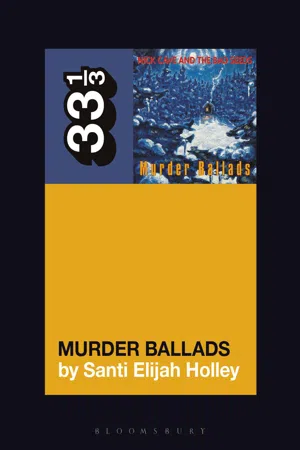
Murder Ballads, the ninth studio album from Nick Cave and the Bad Seeds, is a gruesome, blood-splattered reimagining of English ballads, American folk and blues music, and classic literature. Most of the stories told on Murder Ballads have been interpreted many times, but never before had they been so graphic or profane. Though earning the band their first Parental Advisory warning label, Murder Ballads, released in 1996, brought Nick Cave and the Bad Seeds their biggest critical and commercial success, thanks in part to the award-winning single, "Where the Wild Roses Grow," an unlikely duet with Australian pop singer, Kylie Minogue.
Closely examining each of the ten songs on the album, Santi Elijah Holley investigates the stories behind the songs, and the numerous ways these ballads have been interpreted through the years. Murder Ballads is a tour through the evolution of folk music, and a journey into the dark secrets of American history.
- 152 pages
- English
- ePUB (mobile friendly)
- Available on iOS & Android
eBook - ePub
Nick Cave and the Bad Seeds' Murder Ballads
About this book
Information
1
Song of Joy
It begins with an invocation, an appeal to the listener, a petition for a sympathetic ear. It is a supplication, a prayer for compassion. It is the sound of a man with nothing left but his suffering and nothing to offer but his story.
But to whom is this appeal addressed? Who is the listener on the receiving end of this petition? Is it some ordinary husband and father, standing in the doorway of his home, momentarily detained by this surprise visitor? The narrator has traveled a great distance to arrive here, and he has no time to waste with formalities or unnecessary preamble. Like Samuel Taylor Coleridge’s anonymous bard of “The Rime of the Ancient Mariner,” the unnamed narrator of “Song of Joy” does not wait for an invitation from the listener whose door he has darkened, because he is not asking permission. He is demanding attention.
With its dirge-like drums, its ghostly organ, its mysterious single-note tone, pulsing like a heart monitor, and Nick Cave’s low and resonant vocals, “Song of Joy,” belying its title, is a bleak and desolate story. Cave’s voice reaches the lowest depths, rattling the silverware, settling deep within your bones. He is not so much singing as intoning the words.
The opening verse uses the “come all ye” formula of popular seventeenth- and eighteenth-century English and Scottish folk ballads, as compiled and published by folklorist Francis James Child, particularly the seventeenth-century English ballad, “Robin Hood and the Beggar”:
Come light and listen, you gentlemen all
Hey down, down, and a down
That mirth do love for to hear
And a story true I’le tell unto you
If that you will but draw near.
As the album opener, “Song of Joy” sets the stage for all the mirth and madness to follow. The unnamed narrator invites you, the listener, into his world, while also asking if you would beckon him into yours. But while “Song of Joy” serves as an overture or prelude to Murder Ballads, it was recorded before there was any consideration of dedicating an entire album to songs about murder.
After wrapping basic recording sessions in London at the close of 1993, for what would be the Bad Seeds’ eighth studio album, Let Love In, members of the band returned to Melbourne, Australia, for overdubs and mixing. On December 14, at the Metropolis Audio recording studio, Cave and longtime collaborator and multi-instrumentalist Mick Harvey began to improvise a new song.
“I was playing drums and Nick was playing the piano, and we just recorded the basic track,” Harvey says. “I think he felt immediately that that didn’t belong on Let Love In. It inhabited its own space, its own kind of world.”
This new song was too dark, too macabre, even by Bad Seeds standards. It was, Harvey admits, “a pretty spooky song.” It did, however, share similarities with another song the band had recorded months earlier, around the time of the Let Love In sessions. “O’Malley’s Bar” (which we will return to later) was told from the point of view of another unreliable narrator, who also happens to be a sociopathic killer on a murderous rampage. With these two new compositions, the band found itself with two thematically similar songs, neither of which had a home. That’s when the new project began to come into shape.
“Really what we did was to make a record on which these two songs would sit comfortably,” Cave said. “So we made it around the rather spurious subject of murder.”1
Though an album of murder-themed songs seemed at the time like an obvious choice for the Bad Seeds—who, since forming in 1983, had customarily fit at least a couple of murder songs on each of their eight previous albums—an entire record solely dedicated to the subject hadn’t occurred to the band until that moment. There would be none of Cave’s personal or confessional songs. The record would inhabit its own domain, not so much signaling a new direction for the band, but serving instead as an interlude and, above all, a catharsis.
“This was a multifunctional record, in that it was necessary for a lot of reasons,” Cave said. “We wanted to make a record that was literally impossible to tour with, no matter what.”2
The band’s aversion to touring owed in large part to an unpleasant experience. Immediately after a two-month tour of Europe, the Bad Seeds had flown to the US to join the two-and-a-half-month-long 1994 Lollapalooza tour, which was then an annual, traveling festival of mostly American alternative rock and grunge acts. Nick Cave and the Bad Seeds weren’t yet a big name in America, and they soon found themselves overworked and largely misunderstood by festival goers.
“First of all, there was fatigue and exhaustion,” Bad Seeds percussionist Jim Sclavunos says. “Second, there was a certain level of exasperation. We had just come from a headlining tour of Europe, but with the Lollapalooza tour we were on at something like two o’clock in the afternoon, wedged between, I think, L7 and the Breeders. Playing in the afternoon, fully decked out in our suits. Blazing hot sun, already a bit burned out from the previous tour.”
An American-born multi-instrumentalist and former drummer for seminal 1970s no-wave bands Teenage Jesus and the Jerks and 8 Eyed Spy, Sclavunos was invited by Cave to contribute percussion and organ on Let Love In. He then joined the band for the Let Love In tour and the following Lollapalooza tour, and he has been a member of the Bad Seeds ever since. But his first experience as a touring member of the band wasn’t a particularly auspicious one.
“Our profile in the States at that point was pretty low,” Sclavunos says. “We weren’t MTV darlings and we definitely weren’t considered a major attraction of the Lollapalooza tour. . . . I think everybody in the band had pretty much lost the plot by the end of the tour and were fed up with the tour itself, with the relentless grind of it and the lackluster response we were getting.”
An example of this frustration can be seen in a video clip from that tour, in which Billy Corgan of the Smashing Pumpkins attempts to interview a visibly exasperated (and likely hungover) Cave for MTV’s “120 Minutes” program. As Corgan stumbles his way through pre-prepared interview questions, Cave grows increasingly exasperated, at one point having to remind Corgan that the Bad Seeds weren’t “English.” It gets worse from there, with Cave conceding that 27-year-old Corgan has “the mentality of a teenager,” until the video stops and cuts to live footage.
Sclavunos believes this tour may have had an influence on the band’s next album. Recording a record where everyone is murdered in myriad, violent ways seemed like a perfectly reasonable catharsis after Lollapalooza.
“I think it was a little bit of a reaction to the American tour,” Sclavunos says. “And being so deeply embedded in America during Lollapalooza, and the fallout from that and the impressions of that. Before I joined the band, they had done tours of America, but never quite so long and never quite on that scale. . . . I think that fed into Murder Ballads a little bit.”
Though “Song of Joy” was recorded during the Let Love In sessions, before the theme of the next record had yet been conceived, its placement at the start of Murder Ballads serves not only as a prologue to the album, but also as a bridge between the two records. As Ian Johnston writes in his 1995 biography of Nick Cave, Bad Seed, “Song of Joy” was originally titled “Red Right Hand II,” and was to be a sort of follow-up to “Red Right Hand,” from Let Love In. But aside from those three words, the two songs share few similarities. “Red Right Hand” is a sort of noir-blues, narrated in the third person about a mysterious, Faustian figure. It’s catchy. You can snap your fingers and sing along to it.
“Song of Joy,” on the other hand, includes no choruses, refrains, or hooks. Narrated in the first person, by an anonymous speaker to an unnamed listener, it is claustrophobic and discomfiting. It is a private song. It is meant to be listened to alone, at night, with the lights off and a bitter wind rattling the windows. As Cave explained, his motivation for “Song of Joy” had been “to write a throughout evil song.”3
“Song of Joy” tells the story of a nameless drifter who has landed at a stranger’s door one night. After asking forgiveness for his imposition, the narrator goes on to relate the story of how he came to this misfortune. He’d fallen in love ten years ago with a young woman named Joy, “a sweet and happy thing,” with eyes like “bright blue jewels.” They’d married and enjoyed peace and happiness early on. But Joy is soon stricken with a severe melancholy which never leaves her. We aren’t told the cause of Joy’s sorrow, but the narrator suggests she may have had some intuition or foreboding sense of her ultimate fate, which she’d carried like a curse with her the rest of her days.
The couple give birth to three children: Hilda, Hattie, and Holly. But rather than providing a salve to the unhappy couple, the three daughters inherit not only their mother’s bright, blue eyes but also her deep and unwavering melancholy, which causes even the neighbors to comment and gossip.
By this point in his story, the narrator has already dropped the first clue as to his potential unreliability. While lamenting Joy’s descent into melancholy, he cries, “Farewell happy fields, where joy forever dwells, hail, horrors, hail!” Lifted from Book I of John Milton’s Paradise Lost, these are the words spoken by Satan following his expulsion from heaven and banishment to the underworld. Milton’s unbroken quote reads:
Farewell, happy fields
Where joy for ever dwells; hail, horrors, hail
Infernal world; and thou profoundest hell
Receive thy new possessor
By leaving this quote incomplete, the drifter draws attention to the alliterative parallel to his daughters’ names, which may or may not be coincidental. This reference to Milton, as we will soon see, is also no accident.
One night, the story continues, the narrator was away from home, attending to a sick friend, when somebody entered his home, bound his wife and daughters with electrical tape, stabbed them to death, and stuffed their bodies into sleeping bags. He returns home at midnight to find his family murdered. The police are unable to find a suspect, while the killer has meanwhile gone on to murder many more.
The killer uses his victims’ blood to quote lines from Milton’s poetry on the walls, while the narrator informs us that in his own home, inked with his family’s blood, the killer had written the words, “his red right hand,” a phrase from Paradise Lost.
The use of “calling cards” by serial killers is a familiar trope in film and fiction, as well as a few well-known historical cases, most famously the Zodiac Killer’s cryptograms, Richard “the Night Stalker” Ramirez’s pentagrams, and Keith Hunter Jesperson’s smiley faces. In fiction, particularly in crime stories, the use of calling cards is more ubiquitous, for example, Buffalo Bill’s Death’s-Head hawkmoth from The Silence of the Lambs, or in Peter Straub’s “Blue Rose” trilogy, where the killer (or killers) write “Blue Rose” on the wall near the victims’ bodies (we will return to Straub in a later chapter).
In Let Love In’s “Red Right Hand,” the mysterious protagonist is understood to possess a literal red-stained hand, with which he grants wishes for a terrible price. In “Song of Joy,” however, the red right ...
Table of contents
- Cover
- Series
- Title
- Contents
- Introduction
- 1 Song of Joy
- 2 Stagger Lee
- 3 Henry Lee
- 4 Lovely Creature
- 5 Where the Wild Roses Grow
- 6 The Curse of Millhaven
- 7 The Kindness of Strangers
- 8 Crow Jane
- 9 O’Malley’s Bar
- 10 Death Is Not the End
- Acknowledgments
- Notes
- Also Available in the Series
- Copyright
Trusted by 375,005 students
Access to over 1.5 million titles for a fair monthly price.
Study more efficiently using our study tools.
Frequently asked questions
Yes, you can cancel anytime from the Subscription tab in your account settings on the Perlego website. Your subscription will stay active until the end of your current billing period. Learn how to cancel your subscription
No, books cannot be downloaded as external files, such as PDFs, for use outside of Perlego. However, you can download books within the Perlego app for offline reading on mobile or tablet. Learn how to download books offline
Perlego offers two plans: Essential and Complete
- Essential is ideal for learners and professionals who enjoy exploring a wide range of subjects. Access the Essential Library with 800,000+ trusted titles and best-sellers across business, personal growth, and the humanities. Includes unlimited reading time and Standard Read Aloud voice.
- Complete: Perfect for advanced learners and researchers needing full, unrestricted access. Unlock 1.5M+ books across hundreds of subjects, including academic and specialized titles. The Complete Plan also includes advanced features like Premium Read Aloud and Research Assistant.
We are an online textbook subscription service, where you can get access to an entire online library for less than the price of a single book per month. With over 1.5 million books across 990+ topics, we’ve got you covered! Learn about our mission
Look out for the read-aloud symbol on your next book to see if you can listen to it. The read-aloud tool reads text aloud for you, highlighting the text as it is being read. You can pause it, speed it up and slow it down. Learn more about Read Aloud
Yes! You can use the Perlego app on both iOS and Android devices to read anytime, anywhere — even offline. Perfect for commutes or when you’re on the go.
Please note we cannot support devices running on iOS 13 and Android 7 or earlier. Learn more about using the app
Please note we cannot support devices running on iOS 13 and Android 7 or earlier. Learn more about using the app
Yes, you can access Nick Cave and the Bad Seeds' Murder Ballads by Santi Elijah Holley in PDF and/or ePUB format, as well as other popular books in Media & Performing Arts & Music. We have over 1.5 million books available in our catalogue for you to explore.