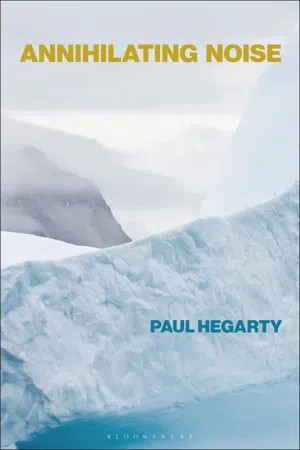
Noise has become a model of cultural and theoretical thinking over the last two decades. Following Hegarty's influential 2007 book, Noise/Music, Annihilating Noise discusses in sixteen essays how noise offers a way of thinking about critical resistance, disruptive creativity and a complex yet enticing way of understanding the unexpected, the dissonant, the unfamiliar.
It presents noise as a negativity with no fixed identity that can only be defined in connection and opposition to meaning and order. This book reaches beyond experimental music and considers noise as an idea and practice within a wide range of frameworks including social, ecological, and philosophical perspectives. It introduces the ways in which the disruptive implications of noise impact our ways of thinking, acting, and organizing in the world, and applies it to 21st-century concerns and today's technological ecology.
- 336 pages
- English
- ePUB (mobile friendly)
- Available on iOS & Android
eBook - ePub
Annihilating Noise
About this book
Information
Part One
Ungrounding
This section is about an expanded realm of noise. It is not uncommon to posit models for sound, music and noise that exceed direct human experience and presence, and this section works through some of those ideas to remind us of noise as disruption and also of human relation to it, in defining it. For all the attempts to leave the human behind in favour of objects, materiality and so on, there is a broad tendency in contemporary thought to reject deconstructive modes of thought in order to return to a positivistic way of seeing the universe, which means statements about things that exist autonomously, made anew into uncritical categories. In the four chapters that make up this part, I try to reintroduce a nihilistic and deep critical reading of noise that can nonetheless work on scales that are more-than-human, in order to illustrate the value of the less-than. This is the most ‘technically’ theoretical part of the book.
The first chapter addresses noise on an extravagant scale, a way of rethinking sound in nature as threat, as action, as effect; in short, it is an attempt to fashion a general ecology of a nature that does not exist for our listening pleasure. The second chapter in this part continues on the theme of sound ‘in the world’ to think about the question of ‘field’ in field recording. What is the natural world that is presumed in the process of field recording? Where Chapter 1 considers the idea of sound in nature, this looks at how we record it, process it and add to its claims of objective realness. Beyond the sounds to be found in the ‘field’, how do we hear the field itself? What do we presume when going ‘into’ the field? Closer inspection reveals that there is no field other than generated through the apparatus of recording. This is not about inadequacy, or dishonesty, but a deep failure connected to the dark ecology of sound that is beyond ‘us’. From there, the third chapter looks at noise and coding. Pioneers of information theory have much to tell us about noise, but readers and listeners need to have perspective: information theory is just one of many codings of noise, and it is in its failure to understand noise that it can be useful to compare with the much fuller theorizations available if we adopt a multiple, more open sense of what it means to encode or decode. The perverse uncertainty of Warren Weaver in his use of ‘etc.’ offers that theory a way back in, as part of a way to understand the recodings [sic] at play in the hearing of noise. Along the way, entropy within mid-twentieth-century telephonics is distinguished from the version developed by nineteenth-century physics. The fourth and closing part of this section is about temporalities and noise, via a heavily sound-based exhibition curated by Philippe Decrauzat and Mathieu Copeland that established a multilayered relation between film and music or sound, and a complex genealogical model of sound as open temporal device. Origins, proper placement of noise and relic-validating are all marshalled on the way to a declaration of the terranormativity of sound.
1
Earth Apathy: A General Ecology of Sound
‘Nothing is more foreign to our way of thinking than the earth in the middle of the silent universe and having neither the meaning that man gives things, nor the meaninglessness of things as soon as we try to imagine them without a consciousness that reflects them … But animal life, halfway distant from our consciousness, presents us with a more disconcerting enigma’ (Georges Bataille, Theory of Religion, 20–21).1 Such was Bataille’s sense of mirroring emptiness.
The isolation of presence in outer space is captured by `in space no-one can hear you scream’, the line that helped sell Ridley Scott’s 1979 film Alien and that centres on sound, on the sound of the human voice, of that voice in pain, that voice warning. The sound is isolated because it will not be heard – there is no one there to hear, there is no hearing, this not hearing is insurmountable. Just you, your scream, in space. As you scream, the futility of the sound informs, materializes the meaning of the sound even more than if it were heard. Of course, despite several centuries of assertions about the silence of space, it would seem that in fact sound can occur in space, with the potential question being about its reception, as opposed to its occurrence.2 The universe has its own perma-ambience in the form of the cosmic microwave background, the static that feeds all static, the formless that we hear as a trace of the creation of form from within which we hear. Planets make sounds, and in 2003 a black hole was discovered humming low and slow, oscillating once every 10 million years at a note fifty-seven octaves below human hearing. This is only the start of it, as, again, contrary to vacuum fans or phobics since Blaise Pascal, space is full of stuff, it is the scale of things that has confused humans into thinking it was empty. Sound at any frequency requires something to vibrate, and therefore the wavelength needs to be longer than the distance of molecules one from another. As this situation is not at all frequent, there is plenty of quiet, but also plenty of yet undiscovered sound (given the scale and statistical nature of the presence of the conditions for sound) and, more curiously, lots of local sound. Perhaps we can move from the supposedly silent scream into another kind of silence that emerges after considerations of the vexed place of nature, and of sound beyond the human, a silence of dread apathy.
When a human speaks, they are not only alive, they mark their existence through sound, and, argues Giorgio Agamben in Language and Death, the beginning of this human voice lies in animality. The origin of the voice is the scream emitted by the dying animal, as a moment of complete presence.3 This is there as potential in human existence, but it is suppressed, with language coming into existence as the trace, the supplement of the transitional vibration between human and animal, as seen from a human perspective, at least. When a human is alive, they are still full of cavities with gas and liquid which can vibrate. In space you will hear yourself scream, knowing that no one else can hear. You will increasingly hear sounds that are your body creating not just high fidelity but total fidelity, uninterrupted by anything else auditory, or any other receiver. Like an anechoic chamber designed to deaden sound, only a lot more instructive. But, even adrift in your spacesuit, other sounds can filter in, perhaps generated directly by the brain, in an uncanny analogue of digital sound-making. And the chance of switching off radio communications is probably slim. The warmth of others’ voices who can still hear your transmission may offer some comforting community but it is likely to be a community based on your death, a perfect expression of the general economy of sacrifice that, for Georges Bataille, grounds human existence, even when it is repressed, forbidden, elided, unheard, routinized into labour, measured activity, normative behaviours.
Radio was the first clue that space was not empty of sonic phenomena, the first aural glimpse into the prospect of sound worlds beyond our own limited apparatus for the sonic. Radio waves travel unhindered through vast distances, if the medium permits. Unlike light, radio is much less directional – the waves expand, spherically and imperfectly, whether initially broadly cast or not.4 But it is not unbounded, either – it can be blocked, or halted, as the medium runs out. So the screaming astronaut’s sound could vibrate outward indefinitely, but its short waveband will more likely result in a bubble of sound, a space in which it is unlikely there will be any one (else) to hear. But between the localized productions of sound and the potentially huge number of sounds unheard by humans or their prostheses, the main reason no one will hear you scream is that there is so much sound occurring in the universe … or so much soundlike stuff, and so many listeners, but so widely separated, that very little is heard, with sound an exemplary human experience of the limits of the human or even existence-centric being, in true Boltzmannian entropy. For physicist Ludwig Boltzmann, the fundamental state of the universe was to be empty. This led him to the idea of a statistical entropy which on the one (massive) hand gives us complete equilibrium and heat death, where ‘in the course of time the universe must tend to a state where the average vis viva of every atom is the same and all energy is dissipated’, whilst on the other (small) hand, local pockets of communication do occur.5 Listeners will likely be biologically and situationally limited in range of hearing, and will not perhaps be interested in some sonic phenomena, nor pay attention, or hear but not listen. No one will hear you, not because they are not there or your voice has no traction in vacuum, but because, just as if the universe were empty, no one cares to listen. Stephen Hawking regularly expressed his concern that humans are making so much noise and trying so hard to attract alien attention that we risk being contacted and destroyed, but what if ‘The Great Silence’ out there is not due to any of the many ingenious ways of explaining the Fermi paradox (the probability of intelligent life versus the absence of evidence) but due to a properly cosmic, quasi-sublime apathy?6
Those are all sounds ‘out there’, caught between multiplicity and being inactivated. Earth, though, is a sound-filled place. To us at least, as we (a very broad we, this time) have evolved to be able to process sound waves, our gills remoulded into tapping devices serving as the entry to a complex set of processes by which a brain hears sound. All this attention to sound may in itself be very local, a dying astronaut’s gasping as they float at massive speed. But, from within the locality of Earth, sound is not only important in proximity, but at all distances, as the primary use of sound seems to be to spatialize (within a loop where hearing identifies dimensions, and sound structures space and spaces, as suspected and mobilized by sound artist Alvin Lucier in his I Am Sitting in a Room from 1969, a work that will appear spectrally several times in this book). Sound is localization, as perceived by listeners, and leaving aside whether a tree falling makes a sound if no one is there to hear it, because obviously, it both makes and doesn’t make sound in this scaled-up quantum question. My point is that sound itself is contingent, dependent on capacity (if not necessarily actuality) of hearing and listening. So how should we treat sound as neither factual, ‘objective’ (it just is), nor as ‘subjective’ (needing to transmit through perception)? Perhaps we should think about the use of the word ‘sound’, and stop saying ‘sound does this or that’ or ‘we hear’, ‘hearing is always open’ or ‘sound cannot be controlled’. Instead of sound, sounds themselves, as caught within perceptual systems, are needed to do sound studies.7 Sociology does not talk about light when it thinks about TV or public rallies, nor does art history address visual culture through light. I am suggesting a hyperbolic recalibration, something extravagant and seemingly out of step with the machine pragmatics of technological change and the aesthetic or ethical modes of disruption that seek only to empty existing forms.
This is going to require the return of the ‘sublime’, and a rethinking of what ‘nature’ has come to mean in the thought of sound – because addressing nature in terms of its sounds is still new enough to not have developed satisfactory critical approaches, largely, I think, because it turns its back on the value of analytically deconstructive approaches in favour of metaphysical truth claims that are hedged in parts of theory that legitimate a return to unreflective and positivist assertions of what is seemingly ‘true’. Theory becomes a statement of ‘isness’ or ‘ipseity’ rather than a set of methods. Even Steve Goodman’s explosive Sonic Warfare rests on the claim of ‘an ontology of vibrational force’ (xvi), which may be processual, it may be complex and unhuman, but it’s still a metaphysical truth claim.8 That said, I’m going to make another claim, based on the groundless and violent recasting of the sublime by Georges Bataille, and this will be from a position of addressing specific materials, seeing how they work, and ultimately bringing us to the kind of sound that is largely marginalized in sound studies – the sounds of animal death, or more precisely, a sound that does not show the bringing or causing of the death but its very clear ‘presence’.
Sound studies looks at nature in a kind of sanitized David Attenborough mode, and this is not because it is ‘hindered or tainted by thinking about music’, as some writers believe to be a problem in thinking about audio phenomena,9 but because it tracks an inheritance from field recording, acoustic ecology and the politically managerialist notion that listening is morally good, and in fact IS a moral good in itself. There are attempts to play with ideas of nature, of merging what had been accepted as category borders, between humans, media, animals, deep space etc. Not least among these is Douglas Kahn’s Earth Sound Earth Signal, wherein Earth is recast as a kind of privileged routing station for cosmic sounds, where humans form part of a system with the planet they mostly (all but six currently) dwell on.10 Earth exists ‘in circuit’ (Earth Sound Earth Signal, 256–57), as revealed in the discoveries of elemental sound, often in the form of interference, that arose through the development of new media in the nineteenth century. For Kahn, it seems that nature becomes audible as supplement, due to the supplement of those new media – i.e. the original, ever-oscillating threads in nature are brought into being for us, and then located in atemporal pre-existence – what Heidegger or Derrida would refer to as ‘always already’. So when Kahn says that ‘nature was broadcasting globally before there was a globe’ (Earth Sound Earth Signal, 2), he is making a claim at several levels: nature does not need human media; humans discover and use natural waveforms, but do not definitively master them; lastly, nature is to be taken knowingly as a human construct. Kahn’s model suggests both an autonomous sonic universe and the limitation that humans can only know it through treating humanity itself as medium – he mostly does not directly claim that there is a nature that is ‘out there’, but he sometimes forgets and then goes on to deal with nature as something true, essential, objectively existing, producing masses of sound which cannot be known or controlled by humans.11 So what Kahn offers is a step into thinking sound and sonic media beyond the human, whilst illustrating the difficulty in philosophically maintaining that position.
Jacob Smith’s Eco-Sonic Media also attempts to place human sound production and reception into wider circuits, or more precisely, Latour-inspired networks, with various animal and vegetable actants, in ‘biological eco-systems and industrial infrastructures that enable sound reproduction [in order] to assess the eco-cosmopolitan potential of various modes of sound-media communication’ (Eco-Sonic Media, 3).12 More than looking at how media process natural phenomena, or how sound itself transmits information of any sort, he is interested in how eco-sonic media arise:
Sound media become eco-sonic media when they manifest a low-impact sustainable infrastructure; when they foster an appreciation of, or facilitate communication with, nonhuman nature; when they provide both a sense of place and a sense of planet; and when they represent environmental crisis.
(6)
For Smith, human and nature interact through media. Media becomes the interaction, the set of linking activities, as opposed to being simply an enabling tool. We should then build an ecologically friendly set of discourses and practices into our sonic interaction with the world. Eco-sonic media are ideologically consistent with one political position, one philosophical outlook – which is that of acknowledging humanity’s reckless waste of planetary resources, while trying to correct that through increasingly proper behaviour. Despite Smith’s gestures toward Timothy Morton’s ‘dark ecology’, Arne Naess’s massive initial step, in ‘deep ecology’, toward removing humans from the centre of ecological importance, is sidestepped.13 Not for the first or last time, humans using tools will know nature better, know nature well enough to save it, if only they care, if only they listen properly.
Such a listening underpins both ecologically aware sound writing and sound recording, and emanates from R. Murray Schafer’s concept of acoustic ecology, developed through a series of projects and books in the 1970s, wherein the world’s natural sonic balance is constantly under threat from human, industrial and machinic takeover. Sound is indeed a useful and under-used way of directly capturing ecological changes in specific environments. But what I’m interested in is how nature, as sound-producer, has slipped easily into being a new kind of resource, one that is being tapped in parallel to ecotourism and indeed tar sands and subpolar mineral searching. Maybe it’s sustainable, but it is increasingly the case that nature can be mined to help its own cause.
Eco-sonic media emphasize the creation of sound as species/material crossovers, and field recordings are part of that, very obviously making nature into a sound artefact, via the artefactuality of recording process, and, at its best, revealing this taut self-deconstruction at the, or as the, core of its activity. Jean-Yves Bosseur is the latest (in Musique et environnement) to catalogue the many ways composers, installation artists and architects with sonic interest have attempted to configure sound into an environment suffering from its loss of aural authenticity.14 At the core of Bosseur’s book is Schafer’s belief that urban, modern environments experience a lack, are low fidelity, due to the mass of uncontrollable and loud sounds, whereas nature and ‘traditional’ domains (as also valorized by Smith) offer high fidelity, and therefore a higher level of authentic dwelling with and in nature.15 For Bosseur, sound artists can have a massive influence on how we think about sound and also affect how such thinking feeds into wider ecological concerns. This rich panoply of species of creators in the soundscape-scape, each with their own niche, will actually improve us all, bringing a greater sense of harmony between nature and culture (Musique et environnement, 48).
There is little sense, among the newly global, universally consc...
Table of contents
- Cover
- Halftitle Page
- Title Page
- Dedication Page
- Contents
- Nothing Is Not the End
- Part One: Ungrounding
- Part Two: Unsettled
- Part Three: Unmoored
- Part Four: Undermined
- Notes
- Bibliography
- Index
- Imprint
Trusted by 375,005 students
Access to over 1.5 million titles for a fair monthly price.
Study more efficiently using our study tools.
Frequently asked questions
Yes, you can cancel anytime from the Subscription tab in your account settings on the Perlego website. Your subscription will stay active until the end of your current billing period. Learn how to cancel your subscription
No, books cannot be downloaded as external files, such as PDFs, for use outside of Perlego. However, you can download books within the Perlego app for offline reading on mobile or tablet. Learn how to download books offline
Perlego offers two plans: Essential and Complete
- Essential is ideal for learners and professionals who enjoy exploring a wide range of subjects. Access the Essential Library with 800,000+ trusted titles and best-sellers across business, personal growth, and the humanities. Includes unlimited reading time and Standard Read Aloud voice.
- Complete: Perfect for advanced learners and researchers needing full, unrestricted access. Unlock 1.5M+ books across hundreds of subjects, including academic and specialized titles. The Complete Plan also includes advanced features like Premium Read Aloud and Research Assistant.
We are an online textbook subscription service, where you can get access to an entire online library for less than the price of a single book per month. With over 1.5 million books across 990+ topics, we’ve got you covered! Learn about our mission
Look out for the read-aloud symbol on your next book to see if you can listen to it. The read-aloud tool reads text aloud for you, highlighting the text as it is being read. You can pause it, speed it up and slow it down. Learn more about Read Aloud
Yes! You can use the Perlego app on both iOS and Android devices to read anytime, anywhere — even offline. Perfect for commutes or when you’re on the go.
Please note we cannot support devices running on iOS 13 and Android 7 or earlier. Learn more about using the app
Please note we cannot support devices running on iOS 13 and Android 7 or earlier. Learn more about using the app
Yes, you can access Annihilating Noise by Paul Hegarty in PDF and/or ePUB format, as well as other popular books in Media & Performing Arts & Music. We have over 1.5 million books available in our catalogue for you to explore.