- 144 pages
- English
- ePUB (mobile friendly)
- Available on iOS & Android
eBook - ePub
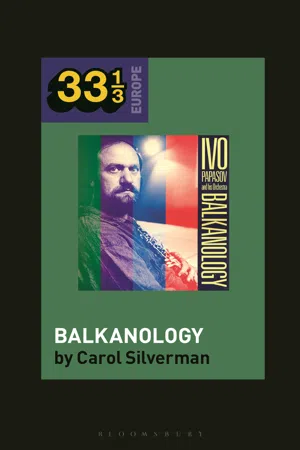
Ivo Papazov’s Balkanology
About this book
From countercultural resistance to world music craze, Balkan music captured the attention of global audiences. Balkanology, the 1991 quintessential album of Bulgarian music, highlights this moment of unbridled creativity. Seasoned musicians all over the world are still in awe of the technical abilities of the musicians in Ansambl Trakia-their complex additive rhythms, breakneck speeds, stunning improvisations, dense ornamentation, chromatic passages, and innovative modulations. Bridging folk, jazz, and rock sensibilities, Trakia's music has set the standard for Bulgarian music until today, and its members, especially Ivo Papazov, are revered stars at home and abroad. The album reveals how Romani (Gypsy) artists resisted the state's prohibition against Romani music and fashioned a genre that became a youth movement in Bulgaria, and then a world music phenomenon. Balkanology underscores the political, economic and social roles of music during socialism and postsocialism.
Information
1 Introduction
Why Balkanology?
From countercultural resistance to world music craze, Bulgarian “wedding music” burst through the iron curtain, invading BBC stages, jazz clubs, and world music festivals. This book is about how the 1991 album Balkanology captured the attention of global audiences precisely at the time when communism fell in Eastern Europe. The unquestioned guru of wedding music was Ivo Papazov1 (birth name Ibryam Hapazov), founder of Orkestŭr Trakiya (Orchestra from Thrace) (Figure 1). In the 1970s–1980s, Trakiya was the most famous band in the country, and patrons waited months and even years to engage them. Whenever Trakiya played, uninvited fans showed up from miles around to listen to and catch a glimpse of the stars.

Figure 1 Ork. Trakiya, 1990. Clockwise from top left: Yuri Yunakov, Ivo Papazov, Salif Ali, Radi Kazakov, Maria Karafezieva, and Neshko Neshev. Courtesy of Ivo Papazov.
Seasoned musicians all over the world are still in awe of the technical abilities of the musicians in Trakiya—their complex additive rhythms, breakneck speeds, stunning improvisations, dense ornamentation, chromatic passages, and innovative modulations. Bridging folk, jazz, and rock sensibilities, Trakiya’s music has set the standard for Bulgarian music until today, and its members are revered stars at home and abroad. Balkanology also has a significant political current related to the fact that all the instrumentalists in Trakiya are Turkish-speaking Muslim Roma2 who were prohibited from playing Romani music in the 1980s. These artists resisted the socialist state’s prohibitions (even serving jail time) and fashioned a genre that became a youth movement in Bulgaria, and then a world music phenomenon. Balkanology underscores the political, economic, and social roles of music during socialism and postsocialism.
This book begins in Bulgaria (see Map 1), exploring the emergence of “wedding music” despite communist restrictions, and expands into wider frames. I chronicle wedding music from its inception in the 1970s, through the fall of communism, to the present, interpreting its varying musicological, political, economic, and artistic contexts and meanings. Wedding music provides a window into the changing roles of the state and the market and the economic challenges of professional musicians during socialism and postsocialism. It also raises questions such as what is folk music? What is authenticity? And what is Romani music? I place these issues in the context of changing markets and media outlets, both Eastern and Western. Wedding music thus illuminates questions of nationalism and Balkan identity through dynamic political periods.

Map 1 Map of Bulgaria. Credit: https://www.cia.gov/library/publications/the-world-factbook/attachments/maps/BU-map.gif.
The book’s core is the album itself—how it was conceived, produced, and consumed, and how it is remembered and revered today. I trace the pivotal role of the album’s British producer, Joe Boyd, who took a risk on his Bulgarian hunch and shepherded Trakiya to Western audiences. I explore Balkanology’s repertoire and genres, noting what was omitted as well as what was recorded, in addition to how it was conceived. I provide a listening guide to the album, including a deep dive into modes and modulations. In addition, I delve into the artists’ life stories and professional training—how they learned to play and how they created a new type of music combining elements of folk music, jazz, and rock on a solid Bulgarian base. I then follow the music through the current postsocialist period, chronicling momentous economic, political, social, and artistic changes via the lives of the musicians.
Genesis of the Book
These pages also chronicle my forty-year relationship with wedding music and the artists who performed it. When I visited Bulgaria multiple times during the 1970s I was planning to do research on village vocal traditions, but wedding music drew me in. I did not pick this topic in advance; it simply demanded my attention because it was the most popular and controversial music of that era.
Let’s turn the clock back to 1979–1980, when my husband, ethnomusicologist Mark Levy, and I were studying music at the Folk Music High School in Shiroka Luka in the Rodop Mountains. I befriended Sonya, who was the sole Romani student in the entire school. Notice the irony of the situation that there were dozens of talented Romani children in the country, but only one was admitted to the best music school; this points to overt structural discrimination. Sonya hid the fact that she was Romani and tried to pass as ethnic Bulgarian because of the historic prejudice that Roma confronted. But she rarely succeeded. Sonya and I started to gravitate toward each other because of our interest in Romani music. I shared tapes of old Balkan Romani music with her, and eventually she opened up to me, and invited us to her cousin’s wedding during spring break in her hometown of Septemvri.
When we arrived in Septemvri we were immediately immersed in the domestic and ritual life of the sprawling poor Romani neighborhood. I documented the first of dozens of Romani weddings I have since attended. I met many musicians who were all performing the newly emerging wedding music genre. They spoke about Ibryam Hapazov and Ork. Trakiya in reverential terms, just like the music students at the high school, and they constantly listened to bootleg cassettes of the star performers. Sonya’s brother was hoping to hire Ork. Trakiya for his upcoming wedding, and they eventually engaged him through Yashko Argirov, a famous clarinet player from Brestovitsa, near Plovdiv.
In May 1980, Mark and I moved to Kotel in North Bulgaria to attend the other noted Folk Music High School. The frenzy over wedding music was tangible there as well, and the students followed the new tunes and arrangements, even though playing and even listening to wedding music was forbidden (I discuss this policy in more detail in Chapter 2). Students played the prohibited music in secret, and plotted how to hear the best players live, which often meant sneaking out of school and crashing a wedding. To thwart these adventurous plans, school administrators deliberately confiscated students’ civilian clothing and only let them have uniforms in their dormitory rooms. However, some students cleverly hid their civilian clothing so they could escape. The teachers were often covertly supportive of their students’ pursuit of wedding music because they, too, were ardent secret fans.
From the students, Mark and I heard about a wedding in the village of Iskra, near Haskovo, that was not to be missed. In those days, the rumor of a wedding with Ork. Trakiya would spread like wildfire via word of mouth; fans would then plot how and when to get there to secure a view of the stars. This June wedding was doubly promising because two bands would be performing, Trakiya, led by Hapazov, and Konushenska Grupa, led by legendary Bulgarian clarinetist Nikola Iliev. We later understood that two Bulgarian families in Iskra were having weddings on the same day.
Mark and I drove several hours to Iskra, along with hundreds of other fans, and asked villagers where the wedding with Ibryam Hapazov was. Asking local people where a wedding will be held is exactly what musicians do, too; numerical addresses and street names in villages are still rarely used. Because we were Americans who spoke the language, the sponsoring family invited us inside the courtyard. Bulgarians of all ethnicities were extremely generous and welcomed us to their family celebrations. In Iskra, we had a great view of the ceremony of the groom’s relatives coming to “get the bride” and veiling her; all these rituals were accompanied by Ork. Trakiya’s slow melodies (bavni melodii) performed acoustically. Then we processed on foot with the musicians (see Figure 2) to the village restaurant where the band set up its sound system; drinking, eating, and daruvane (reciprocal gift giving) began.

Figure 2 Wedding procession led by Ivo Papazov, clarinet, and Ali Gardzhev, accordion, in Iskra, Haskovo region, 1980. Courtesy of Ivo Papazov.
After several hours of feasting, the guests again switched venues—this time we walked or drove to the village square (ploshtad), the central, open gathering place. The wedding couple went into the chitalishte (literally reading room, but more generally meaning the public administration building), where they signed official documents marrying them. They came out amidst a barrage of candy, popcorn, rice, and coins, all to ensure their prosperity and fertility. In the meantime, Ork. Trakiya had set up a huge sound system on the steps of the building, and began to play. The bride led the first horo (line dance) and then every family member, in order of age and respect, was given the privilege of leading the dance line.
Meanwhile, on the other side of the square, Konushenska Grupa had set up their huge sound system, and they too began to play. They had been hired by another Bulgarian family that had also gone through all the wedding rituals I described above. Because playing in the village square on Sunday afternoon was a required part of every wedding, the two bands played simultaneously, and cranked up their sound to try to drown out their rivals. People viewed the event as a contest between Hapazov and Iliev in terms of stamina, technique, and number of fans. Yet it was a friendly competition, and all the musicians respected each other. The two dance lines stayed on their respective sides, but it was pure cacophony in the middle! When it began to rain, bystanders grabbed umbrellas, but the dancers were undeterred, and they got soaked. After several hours, the band and the guests moved indoors to a large school and the festivities continued until the next morning. Some dances went on for over an hour without a break. In total, the musicians played for over fifteen hours! Years later, when I showed the grainy videotapes of this wedding to Ibryam and other Trakiya members, they fondly remembered the rainstorm and the competition with Konushenska Grupa. As for long hours of playing, that was the regular routine for every celebration in the early 1980s.
I recount this long vignette to illustrate the passion for wedding music during socialism, especially among the youth. People travelled hundreds of miles to crash weddings to listen to live performances of the stars; and their bootleg recordings cost a month’s salary. I, too, became a fan, followed Trakiya, charted the repertoire, met the artists and their families, and documented dozens of weddings. All of this research was unofficial because wedding music was prohibited by the state for being impure, kitsch, and containing “foreign” elements. But the reaction on the ground was the opposite: the musicians who were harassed became countercultural heroes. Thus, I studied resistance to the state in artistic and economic terms.
I continued to follow the fate of these musicians during the fall of socialism and the subsequent explosion of Balkan music on world music stages. I met Joe Boyd when he toured the United States in 1988 with Balkana, a Bulgarian folk music group he was promoting before Ork. Trakiya. Boyd and I were riding in a taxi together on the way to the Balkana sound check when he brought up with me his plan to produce Balkanology. I said I was thrilled, and then he asked me to write the liner notes! I gladly agreed, and we stayed in touch. I met the members of the band again in 1991 when Trakiya did a concert in Portland, Oregon. My husband Mark and I brought gifts and Balkan food to their motel rooms, and we took them shopping and relaxed together. I remember vividly that Ibryam wanted to visit a gun store because in Bulgaria it was illegal for civilians to own guns, and he was curious about the rules in America.
Later during the tour, Yuri Yunakov, Trakiya’s saxophone player, made contact with several North Macedonian Roma in the Bronx, New York, whom I knew well. Since 1988 I had been working transnationally with Roma, both in North Macedonia and in New York. These Bronx Roma invited Yunakov to come back to America to play at a private party, and they subsequently sent him plane tickets. After Yunakov arrived in NY, he decided to stay and try to emigrate, and his wife soon followed him. Suddenly, my two separate worlds of North Macedonian Roma and Bulgarian Roma had merged in the Bronx. I helped Yunakov obtain a work permit, and in 1994 recommended him to teach at the Balkan Music and Dance Workshop, sponsored by the East European Folklife Center, where he was introduced to American audiences. In 1995, I assisted him in successfully applying for asylum and served as his translator at his hearing. He then formed the Yuri Yunakov Ensemble and asked me to join as a vocalist (I have been performing and teaching Balkan music since the early 1970s). I performed and recorded several albums with the ensemble. I also toured with the ensemble for over ten years, often serving as its booker/agent/manager, and arranged a reunion tour in the US with members of Trakiya in 2003 (see Silverman 2000; 2009; 2019; 2020) (Figure 3).

Figure 3 From left to right: Yuri Yunakov, Mark Levy, Ivo Papazov, Carol Silverman, Salif Ali, and Neshko Neshev, Eugene, OR, 2003. Courtesy of Carol Silverman.
In 2005, I worked with Harold Hagopian, the director of the Traditional Crossroads label, to produce the second national reunion tour and the album Together Again: Legends of Bulgarian Wedding Music, with Yunakov, Papazov, Ali, and Neshev plus Kalin Kirilov (my former student in Folklore at the University of Oregon; currently Professor of Music at Towson University). I also sang several songs on the album. Travelling with musicians for many weeks provided me valuable insights into the performance process, including how arrangements and improvisations happen. One thing I noticed was that the musicians never really rehearsed! For sure, Yunakov needed to learn some new repertoire because he had left the band in 1994, but otherwise they knew their arrangements so well that “rehearsing” them was not necessary. Due to this, their performances always had a fresh energy, not to mention that much of the music was improvised.
Ork. Trakiya musicians were hosted by my mother in the Bronx, by me in my home in Oregon, and by many other American friends. These intimate gatherings cemented our relationship. I continue to undertake research in Bulgaria, and have stayed in contact with Trakiya artists as well as many other wedding musicians. During September 2018, I interviewed nine musici...
Table of contents
- Cover
- Halftitle Page
- Title Page
- Contents
- List of Figures
- Acknowledgments
- 1 Introduction
- 2 Prelude and Golden Age: The Paradoxes of Wedding Music during Socialism
- 3 Balkanology: The Album
- 4 Music and Mafias: 1990s Postsocialism
- 5 Global Balkanology
- Notes
- References
- Discography
- Index
- Imprint
Trusted by 375,005 students
Access to over 1.5 million titles for a fair monthly price.
Study more efficiently using our study tools.
Frequently asked questions
Yes, you can cancel anytime from the Subscription tab in your account settings on the Perlego website. Your subscription will stay active until the end of your current billing period. Learn how to cancel your subscription
No, books cannot be downloaded as external files, such as PDFs, for use outside of Perlego. However, you can download books within the Perlego app for offline reading on mobile or tablet. Learn how to download books offline
Perlego offers two plans: Essential and Complete
- Essential is ideal for learners and professionals who enjoy exploring a wide range of subjects. Access the Essential Library with 800,000+ trusted titles and best-sellers across business, personal growth, and the humanities. Includes unlimited reading time and Standard Read Aloud voice.
- Complete: Perfect for advanced learners and researchers needing full, unrestricted access. Unlock 1.5M+ books across hundreds of subjects, including academic and specialized titles. The Complete Plan also includes advanced features like Premium Read Aloud and Research Assistant.
We are an online textbook subscription service, where you can get access to an entire online library for less than the price of a single book per month. With over 1.5 million books across 990+ topics, we’ve got you covered! Learn about our mission
Look out for the read-aloud symbol on your next book to see if you can listen to it. The read-aloud tool reads text aloud for you, highlighting the text as it is being read. You can pause it, speed it up and slow it down. Learn more about Read Aloud
Yes! You can use the Perlego app on both iOS and Android devices to read anytime, anywhere — even offline. Perfect for commutes or when you’re on the go.
Please note we cannot support devices running on iOS 13 and Android 7 or earlier. Learn more about using the app
Please note we cannot support devices running on iOS 13 and Android 7 or earlier. Learn more about using the app
Yes, you can access Ivo Papazov’s Balkanology by Carol Silverman in PDF and/or ePUB format, as well as other popular books in Media & Performing Arts & Music. We have over 1.5 million books available in our catalogue for you to explore.