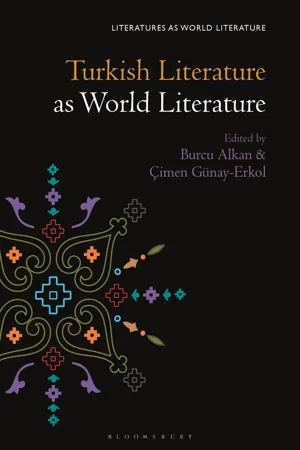
Essays covering a broad range of genres and ranging from the late Ottoman era to contemporary literature open the debate on the place of Turkish literature in the globalized literary world. Explorations of the multilingual cosmopolitanism of the Ottoman literary scene are complemented by examples of cross-generational intertextual encounters. The renowned poet Nâzim Hikmet is studied from a variety of angles, while contemporary and popular writers such as Orhan Pamuk and Elif Safak are contextualized.
Turkish Literature as World Literature not only fills a significant lacuna in world literary studies but also draws a composite historical, political, and cultural portrait of Turkey in its relations with the broader world.
- 264 pages
- English
- ePUB (mobile friendly)
- Available on iOS & Android
eBook - ePub
Turkish Literature as World Literature
About this book
Information
PART I
Breathing Turkish in the World Stage
1
The Entangled History of Cosmopolitanism and Nationalism in Modern Turkish Literature
Fatih Altuğ
The dominant vein in literary historiography in Turkey dates the beginning of modern Turkish literature to the 1860s. The first examples of modern poetry, drama, and criticism emerged in those years, and the genres of the novel and drama became central in the literary field shortly thereafter, in the 1870s. At the same time, traditional genres weakened, and after the 1870s the novel became the dominant genre in the different literatures of the Ottoman people (Ayaydın-Cebe 2009: 321; Charrière 2016: 40). The first novels of Turkish literature were published in Istanbul using Armenian, Greek, and Arabic scripts, and the first Armenian and Bulgarian novels were published there as well. Citizens of Istanbul created literary texts in Turkish, Greek, Armenian, Bulgarian, French, and Ladino. These modern literatures, which developed simultaneously and used different languages and scripts, made Istanbul an exceptional city for world literature. Peoples who had been living in the same city for centuries constructed a new literature in their own languages during these years.
In this milieu, Turkish was the main language of three distinct literatures, each of which used a different script and none of which interacted much with the others. Of these three literatures, the first novel written in Turkish using the Arabic script was Taaşşuk-ı Talât u Fıtnat (The Romance of Talât and Fitnat) (1872), written by Şemsettin Sami [Fraşeri] (Sâmi Frashëri), a lexicographer and prominent scholar of literature whose native language was Albanian. His publisher was Faris Shidyaq, who was also the author of the first Arabic novel, which had been published in Paris in 1855 (Strauss 2003: 56). The first novel written in Turkish using the Armenian script was Akabi Hikayesi (Akabi’s Story) by Hovsep Vartanian, published in 1851, several years before Şemsettin Sami’s novel. A third body of literature was written in Turkish using the Greek script, as epitomized by Evangelinos Misailidis’s 1871 novel Temaşa-i Dünya (Theatrum Mundi).
Modern literary practices emerged simultaneously among different groups of Ottoman subjects. Literary translations between these languages were few, and each language formed its modern literature through translations from French. The paucity of interaction between the different literatures of the city meant that the plural literary field of nineteenth-century Istanbul failed to form a multilayered network of literature. That said, modern Ottoman literatures in different languages and scripts often had connections with one another through French literature, which served as a kind of mediator. This means that any effort to interpret the similarities and parallels between these literatures must also take French literature into account (Strauss 2003: 51). Etienne Charrière states that 95 percent of translated novels published in Istanbul were originally written in French: “In fact, in late-nineteenth-century Constantinople, translating a foreign literary work almost always meant translating a novel, and translating a novel almost always meant translating a French novel” (Charrière 2016: 40).
Istanbul was the locus of negotiation between French literature and Turkish, Armenian, Greek, and Bulgarian literatures. David Damrosch’s elliptical model (2003: 283) can be useful in order to understand the literary dynamics of this period. We can think of each Istanbulite literature and French literature as two foci that generate an elliptical space, with nineteenth-century Istanbul becoming the intersection point of these literary ellipses. Speaking of this intersection, Namık Kemal, who is regarded as the “founding father” of modern Turkish literature, attributed the need for a new literature to the encounter between Ottoman literature (his writings rarely mention other literatures in the empire) and Western literature. This encounter weakened classical Ottoman literature, and the traditional genres of the ghazal, mathnawi, and qasida experienced rapid declines (Ayaydın Cebe 2009: 327). Namık Kemal called this incapacitating encounter a “shock” (sadme), and he looked to the basic dynamics of classical Ottoman and Western literatures to design a new literature.
In 1866, Namık Kemal penned a manifesto containing the basic principles of modern Turkish literature: “Lisan-ı Osmaninin Edebiyatı Hakkında Bazı Mülahazatı Şamildir” (Some Considerations about the Literature of the Ottoman Language). In this article, he lays out the basic principles of modern Turkish literature and discusses the encounter with Western literature, the deficiencies of classical Ottoman literature compared to ideal literature, and the things to be done to form a new literature (Namık Kemal 1866). Through the intense globalization of Western literature, Namık Kemal and his generation became aware of the weaknesses of their own literature. When they looked at classical literature from this new perspective, old school texts appeared unrealistic, anti-representational, and bombastic. Namık Kemal described classical literature as a dead carcass, a corpse. The enervating experience of the literary encounter with the West weakened the old literature, but it also empowered the agents of the new. They sought to jettison the old literature from the body of the nation and thus imagined the literary field as an empty space without any value. The emergence of a new literature required a fundamental rupture with, and an absolute devaluation of, the past.
Although they trivialized the classical literature, Namık Kemal and his generation were also forced to grapple with the problems inherent in using a foreign model to construct a new literature. In doing so, Namık Kemal used various universalization and localization tactics. According to Namık Kemal, literature was universal, and its basic principles were not bound by historical and geographical conditions. He believed that this universal literature was formed at a certain place in every age: first India, then ancient Greece, then the Abbasid Caliphate. In each, universal literature had flowered. Over time, however, Muslims abandoned the principles of verisimilitude and transparency which had given rise to this literature, and t hese were taken up by the West, which became the new locus of universal literature. This entangled logic of universalization and localization allowed Namık Kemal to efface the foreignness of Western literature (Altuğ 2007: 87–132).
The consistency of this model, in which both classical Arab and modern Western literature were representatives of a broader universal literature, involved a devaluation of classical Persian literature. Arabs, in Namık Kemal’s theory, were estranged from their own literature over time, which had been rational and realistic, and the Ottomans were later influenced instead by Persian literature, which was corrupt, bombastic, unrealistic, and abject. The goal, as he presented it, was thus to eliminate the Persian influence and to construct a modern literature subject to the universal model represented by both classical Arabic and modern Western literature.
In Namık Kemal’s view, modern Ottoman literature was not based on an absolute idea of Turkishness and a homogeneous center, but was a combination of classical Arabic literature, modern French literature, and Turkish. In the “garden” of Ottoman literature, the positive aspects of Eastern and Western literatures could come together; however, there was no place for other Ottoman literatures—including those with a non-Arabic script—in that garden. His model, while constructing a modern Turkish literature, also obliterated the literary space for other languages and alphabets, as well as the marks of classical Ottoman literature. Greek and Arabic literatures were precious only for their classical examples; the contemporary Greek and Arab peoples were followers of a corrupt literature far behind that of their forebears.
Namık Kemal conceived of legitimate literary relations as occurring only between the dominant languages, and this was connected to his notion of national sovereignty. Though a host of languages were used in Ottoman lands, Namık Kemal ignored virtually everything other than Turkish. He did not say even a single word about Armenian, Bulgarian, French, and Ladino literatures, though examples of them abounded in the very city around him. When he did mention other literatures, he did so in a derogatory way, as in the case of modern Greek and Arabic literature, which for him were characterized by backwardness. This derogatory tone was even more evident when it came to the Albanians and the Laz: he believed Turkish was so weak that it could not make even these peoples, who lacked so much as their own alphabets, forget their respective languages. From this example, one sees how closely the construction of a new literature was, for Namık Kemal, related to the domination of the other peoples in the empire. This is an important point where Namık Kemal’s ideas of literary and political sovereignty intertwined.
Naoki Sakai’s concept of “the schema of cofiguration” helps shed some light on the politics of inclusion and exclusion in these closely connected spheres of sovereignty:
[T]he schema of cofiguration is a means by which a national community represents itself to itself, thereby constituting itself as a subject. But this auto-constitution of the national subject would not proceed unitarily, on the contrary, it would constitute itself only by making visible the figure of another with which it engages in a translational relationship. (1997: 15)
In this light, modern Turkish literature was constructed through a relational assemblage of modern French literature and classical Arab literature, but also through the exclusion of literatures of others under Ottoman rule, who were made invisible and thereby devalued.
Until recently, Turkish literary historiography has stuck to the principles and discourse of Namık Kemal. However, his was not the only model. Another was offered by his contemporary Ahmet Mithat, who was one of the most productive and influential writers of his time, with around two hundred works to his name. His novels often bear traces of the multicultural and cosmopolitan lives of the empire, especially in Istanbul. In his 1891 Müşahedat (The Observations), one of the most important literary experiments of the century, he classified the Turkish novel into two types: the national (milli) and the local (yerli) (Ahmet Mithat 1891). While the national novel speaks only of Muslims, the local novel involves people from different religions, ethnicities, and languages. Müşahedat was a local novel, and in it, Armenians, Arabs, Turks, and Catholics often interact with one another. The author himself is a character in the novel, and the processes of writing and reading the novel are included in its plot. Through this metafiction, we follow the plurality of the city and the layering of the novel; but at the end of the novel, all the protagonists unite under Islam, and the religious difference between them is eliminated.
Ahmet Mithat was not just a prolific author, but also one whose novels were widely transliterated and published in the Armenian and Greek scripts. Müşahedat testifies to this through one of its main characters, an Armenian woman named Siranush, who has read Ahmet Mithat’s Felatun Bey ile Rakım Efendi (Felatun Bey and Rakım Efendi) in the Armeno-Turkish script. His works were also translated into other languages, includ...
Table of contents
- Cover
- Half-Title
- Series
- Dedication
- Title
- Contents
- List of Figures
- Acknowledgments
- A Note on the Text
- Introduction: “Turkish Literature as World Literature”? What Is in a Preposition?
- PART I Breathing Turkish in the World Stage
- PART II Turkish Literature in Transnational Waters
- PART III Contemporary Forms and Cosmopolitanism
- Notes on Contributors
- Index
- Copyright
Trusted by 375,005 students
Access to over 1.5 million titles for a fair monthly price.
Study more efficiently using our study tools.
Frequently asked questions
Yes, you can cancel anytime from the Subscription tab in your account settings on the Perlego website. Your subscription will stay active until the end of your current billing period. Learn how to cancel your subscription
No, books cannot be downloaded as external files, such as PDFs, for use outside of Perlego. However, you can download books within the Perlego app for offline reading on mobile or tablet. Learn how to download books offline
Perlego offers two plans: Essential and Complete
- Essential is ideal for learners and professionals who enjoy exploring a wide range of subjects. Access the Essential Library with 800,000+ trusted titles and best-sellers across business, personal growth, and the humanities. Includes unlimited reading time and Standard Read Aloud voice.
- Complete: Perfect for advanced learners and researchers needing full, unrestricted access. Unlock 1.5M+ books across hundreds of subjects, including academic and specialized titles. The Complete Plan also includes advanced features like Premium Read Aloud and Research Assistant.
We are an online textbook subscription service, where you can get access to an entire online library for less than the price of a single book per month. With over 1.5 million books across 990+ topics, we’ve got you covered! Learn about our mission
Look out for the read-aloud symbol on your next book to see if you can listen to it. The read-aloud tool reads text aloud for you, highlighting the text as it is being read. You can pause it, speed it up and slow it down. Learn more about Read Aloud
Yes! You can use the Perlego app on both iOS and Android devices to read anytime, anywhere — even offline. Perfect for commutes or when you’re on the go.
Please note we cannot support devices running on iOS 13 and Android 7 or earlier. Learn more about using the app
Please note we cannot support devices running on iOS 13 and Android 7 or earlier. Learn more about using the app
Yes, you can access Turkish Literature as World Literature by Burcu Alkan,Çimen Günay-Erkol in PDF and/or ePUB format, as well as other popular books in Literature & European Literary Criticism. We have over 1.5 million books available in our catalogue for you to explore.