We know a lot about the directors and stars of Italian cinema's heyday, from Roberto Rossellini to Sophia Loren. But what do we know about the Italian audiences that went to see their films?
Based on the AHRC-funded project 'Italian Cinema Audiences 1945-60', Italian Cinema Audiences: Histories and Memories of Cinema-going in Post-war Italy draws upon the rich data collected by the project team (160 video interviews and 1000+ written questionnaires gathered from Italians aged 65 and over; archival material related to cinema distribution, exhibition and programming, box-office figures, and critical discussions of cinema from film journals and popular magazines of the period). For the first time, cinema's role in everyday Italian life, and its affective meaning when remembered by older people, are enriched with industrial analyses of the booming Italian film sector of the period, as well as contextual data from popular and specialized magazines.
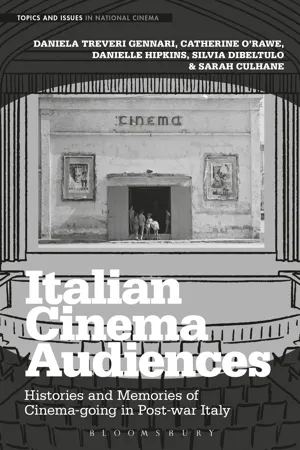
eBook - ePub
Italian Cinema Audiences
Histories and Memories of Cinema-going in Post-war Italy
- 240 pages
- English
- ePUB (mobile friendly)
- Available on iOS & Android
eBook - ePub
Italian Cinema Audiences
Histories and Memories of Cinema-going in Post-war Italy
About this book
Information
1
Introduction
In 1988 Giuseppe Tornatore’s film Nuovo Cinema Paradiso (Cinema Paradiso, Italy) achieved global success with a story that placed Italian cinema audiences at the centre of its narrative. In it, spectators are portrayed attending cinemas, bonding with the stories they saw on the screen and interacting loudly with films such as Visconti’s neorealist classic La terra trema (The Earth Trembles, Italy, 1948), Raffaello Matarazzo’s enormously popular melodrama Catene (Chains, Italy, 1949) and Mario Mattoli’s comedy I pompieri di Viggiù (The Firemen of Viggiù, Italy, 1949). This representation of post-war film culture demonstrates vividly both the affective charge of Italian cinema, at its peak of popularity, and its role in the social fabric of daily life.
Nuovo Cinema Paradiso shows the space of the cinema as both a refuge from poverty and the hardship of life, as well as a space of interaction, sociality and romance. Its nostalgic appeal to a time before television, when cinemagoing was Italians’ most popular leisure activity, resonates strongly with our research project, ‘Italian Cinema Audiences’.1 Our intention was to excavate and recover memories of cinemagoing in the 1950s, by interviewing and surveying people who lived through that period. Although Italians were among the most assiduous cinemagoers in Europe (Gyory and Glas 1992), we were struck by the fact that the spectators themselves, their tastes and preferences and their emotional investment in the medium are often missing from scholarly literature.
This monograph is the final output of the ICA project, funded by the UK Arts and Humanities Research Council (2013–16). ICA expanded on the findings of two pilot projects, one undertaken in 2007 which tested our methodology (Treveri Gennari et al. 2011) and one in 2009 on cinemagoing culture in Rome (see Treveri Gennari 2015). The project focused particularly on the importance of cinema in everyday life by interviewing audience members, analysing their responses using qualitative data analysis software and contextualizing these responses through further archival research. With this project, oral and written accounts of film-going during this period were augmented by press reception, box-office figures and film industry data in order to uncover the hidden side of Italian film history: its audiences. Our research was guided by a series of questions: How did cinemagoing figure in the daily lives of people throughout Italy at that time? What was the relationship between audiences and film genres and stars, and how did this vary according to gender and location? How did Italian cinemagoers select and watch films? How did cinemagoing preferences relate to wider social trends and changes in Italy in the 1950s? And finally, how might our project help us to better understand the nature of memory work?
In 1997, the esteemed Italian film historian Gian Piero Brunetta asked,
Why is the experience of the historian and the critic so rarely congruent with that of the audience? Why has nobody ever wanted to study in all its specificity the lived experience of the audience, the emotional fluctuations and the changes to social patterns that are produced by the ritual of film-viewing? … How can systematic research be organized ‘from the point of view of the spectator’? (1997: xx)2
Throughout the project, and the writing of this book, we have sought to address the cinemagoing experience of Italians in the post-war period, paying close attention to the lived experiences of audience members, as recounted to us. We have tried to capture, via the thoughts and words of Italians who grew up in that era, the films that had meaning for spectators, and also, as Roland Barthes (1986: 349) puts it, ‘the texture of the sound, the hall, the darkness, the obscure mass of other bodies, the rays of light, entering the theater, leaving the hall’.
The Italian audience: Myths and realities
The growth in the Italian cinema audience in the 1950s was striking: in 1955, based on SIAE – Società Italiana degli Autori e degli Editori (Italian Society of Authors and Publishers) – data, there was one cinema seat per nine Italians, as compared to one per sixteen in France and the United States, and one per twelve in the UK (see Mosconi 1995: 332; Villa 2002: 191). By 1959, there were 10,503 commercial cinemas operating in Italy, as well as over 5,000 parish cinemas (Villa 2002: 191). Commercial cinemas were divided into different runs, according to their distribution function. First-run cinemas screened newly released films, which would then move to second- and third-run venues, with a lower admission price and a less luxurious setting.
Ticket sales peaked in Italy in 1955, with over 819 million tickets sold (Gremigni 2009: 24), before beginning to decline in the late 1950s, partly due to the arrival of television; in some cinemas, in order to avert the damage of television to ticket sales, the hugely popular game show Lascia o raddoppia? (Double or Quits?) (...
Table of contents
- Cover
- Half-title Page
- Dedication Page
- Series Page
- Title Page
- Contents
- Figures
- Tables
- Authors
- Foreword
- Acknowledgements
- 1 Introduction
- Part One The activity of cinemagoing
- Part Two Films: Genre, taste and popular memory
- Part Three Gender and cinemagoing
- Conclusions
- Appendix 1 Questionnaire
- Appendix 2 Video interview questions
- Appendix 3 List of thematic areas
- Bibliography
- Index
- Copyright Page
Trusted by 375,005 students
Access to over 1.5 million titles for a fair monthly price.
Study more efficiently using our study tools.
Frequently asked questions
Yes, you can cancel anytime from the Subscription tab in your account settings on the Perlego website. Your subscription will stay active until the end of your current billing period. Learn how to cancel your subscription
No, books cannot be downloaded as external files, such as PDFs, for use outside of Perlego. However, you can download books within the Perlego app for offline reading on mobile or tablet. Learn how to download books offline
Perlego offers two plans: Essential and Complete
- Essential is ideal for learners and professionals who enjoy exploring a wide range of subjects. Access the Essential Library with 800,000+ trusted titles and best-sellers across business, personal growth, and the humanities. Includes unlimited reading time and Standard Read Aloud voice.
- Complete: Perfect for advanced learners and researchers needing full, unrestricted access. Unlock 1.5M+ books across hundreds of subjects, including academic and specialized titles. The Complete Plan also includes advanced features like Premium Read Aloud and Research Assistant.
We are an online textbook subscription service, where you can get access to an entire online library for less than the price of a single book per month. With over 1.5 million books across 990+ topics, we’ve got you covered! Learn about our mission
Look out for the read-aloud symbol on your next book to see if you can listen to it. The read-aloud tool reads text aloud for you, highlighting the text as it is being read. You can pause it, speed it up and slow it down. Learn more about Read Aloud
Yes! You can use the Perlego app on both iOS and Android devices to read anytime, anywhere — even offline. Perfect for commutes or when you’re on the go.
Please note we cannot support devices running on iOS 13 and Android 7 or earlier. Learn more about using the app
Please note we cannot support devices running on iOS 13 and Android 7 or earlier. Learn more about using the app
Yes, you can access Italian Cinema Audiences by Daniela Treveri Gennari,Catherine O'Rawe,Danielle Hipkins,Silvia Dibeltulo,Sarah Culhane in PDF and/or ePUB format, as well as other popular books in Media & Performing Arts & Film & Video. We have over 1.5 million books available in our catalogue for you to explore.