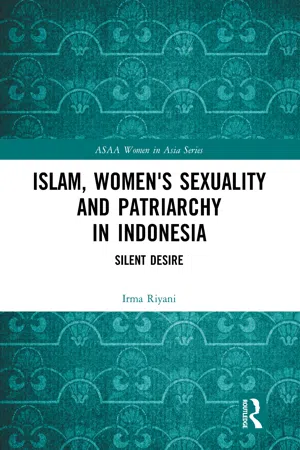
This book explores the intimate marital relationships of Indonesian Muslim married women. As well as describing and analysing their sexual relationships, the book also investigates how Islam influences discourses of sexuality in Indonesia, and in particular how Islamic teachings affect Muslim married women's perceptions and behaviour in their sexual relationships with their husbands. Based on extensive original research, the book reveals that Muslim women perceive marriage as a social, cultural, and religious obligation that they need to fulfil; that they realise that finding an ideal marriage partner is complicated, with some having the opportunity for a long courtship and others barely knowing their partner prior to marriage; and that there is a strong tendency, with some exceptions, for women to consider a sexual relationship in marriage as their duty and their husband's right. Religious and cultural discourses justify and support this view and consider refusal a sin (dosa) or taboo (pamali). Both discourses emphasise obedience towards husbands in marriage.
- 240 pages
- English
- ePUB (mobile friendly)
- Available on iOS & Android
eBook - ePub
About this book
Information
1 Marriage and sexuality
The Indonesian context and Islamic perspectives
Research on gender issues in contemporary Indonesia has increased significantly in recent years. A large and growing body of literature has emerged addressing gender relations in Indonesia (Ford and Parker 2008b; Robinson 2001). The Reform era—since 1998—has offered good opportunities for various discussions in Indonesia that include gender equality. Nevertheless, other challenges have also emerged related to fundamentalist movements opposing gender equality. Gender relations are an important element in the study of women in Indonesian society, and they play a key role in marriage and sexuality where responsibilities are divided according to gender roles. Sexuality is a site from which women are mainly excluded. Women's sexuality (in or outside of marriage) is highly controlled by men, society, and the state (Berninghausen and Kerstan 1992; Mather 1985; Wolf 1992).
In this chapter, I review the existing literature addressing marriage and sexuality in the Indonesian context and from Islamic perspectives. The discussion is divided into two sections. The first section explores ethnographic research on marriage and sexuality in the Indonesian context, and the second the academic literature on marriage and sexuality in Islam. These reviews are important because they show how gender plays a significant role in marriage and sexuality in Indonesia, as well as in Islam. I aim to clearly map the research already conducted by other scholars related to marriage and sexuality, to position my own research within it and to identify how my research contributes to existing knowledge. This book addresses gender relations in marriage with specific attention to married women's experiences of their sexual relations, particularly in West Java, which is comparatively neglected in the literature.
The Indonesian context
Ethnographic research on marriage: gender contested
Much of the ethnographic research related to marriage has been concentrated in Java (Berninghausen and Kerstan 1992; Brenner 1998; Geertz 1961; Jay 1969; Koentjaraningrat 1985; Sullivan 1994; Wolf 1992). While other research has been done in Sulawesi (Blackburn 2001; Idrus 2003) and Lombok (Bennett, Andajani-Sutjahjo, and Idrus 2011; Platt 2017), very little has been conducted in West Java. Some of these authors have supported the notion that women have high status and authority in the family (e.g. Blackwood 1995b; Geertz 1961; Hull 1982; Jay 1969). Others challenge this idea by asserting that women still experience subordination in every aspect of their lives, especially within family life (Brenner 1998; Sullivan 1994; Wolf 1992).
Marriage in Indonesia is almost universal and represents an important phase of life. Marriage establishes a new household and marks the achievement of adult economic and social status. It is the only institution where a man and a woman can legally engage in sexual relations. The expectation of marriage is even greater for women than for men. This is because women are expected to guard their sexual purity and sanctity before being married, with virginity considered important for women but not men.
Marriage also signifies the recognition of gendered roles for women in society and in the nation. In Indonesia, the gender roles attached to women, as promoted by the state during the New Order regime, were that women's responsibility was to stay at home and be good wives and mothers, manage the household, and take care of the children. Men's duty was in the public sphere as provider and protector of the family (Blackwood 1995b; Robinson 2009; Suryakusuma 1996). Although the regime has long ended, its gender ideology remains intact. The state gender ideology influences the gender relations of everyday life and has become a stereotype that governs the allocation of roles between males and females in Indonesian society. Kathryn Robinson (2009) argues that this state gender ideology has failed to consider diverse gender practices throughout Indonesia. The government has reduced the roles of men and women to the public and private spheres, respectively.
Hilda Geertz's work (1961) shows that women in Javanese society have a relatively strong position. Javanese women are employed in various occupations in and around the community. Women also control the household economy and make major decisions for the family concerning household expenses, children, and family rituals (Koentjaraningrat 1985). By contrast, Norma Sullivan (1994) argues that women in Indonesia still experience subordination in the family. She compared the relationship between wife and husband to that of manager and master. The wife (manager) will spend all household expenses in accordance with the husband's (master's) will and instructions. Similarly, Suzanne Brenner (1998) stated that even though women have authority over the household economy, because they are the ones who perform the business, this does not directly gain them high status. In Solo, the site where Brenner did her research, dealing with money is associated with low status. High status, which can only be claimed by men, is acknowledged through self-control and spiritual potency (Brenner 1998; on men's self-control see Adamson 2007).
Furthermore, married women are assessed for their ability to satisfy their husbands' sexual needs and for their own reproductive capacity. Marriage in Indonesia focuses on reproduction. The success of marriage is measured by the presence of children. Lyn Parker (2008, 23) showed that there is a close connection between marriage, sexuality, and procreation as ‘the ideal and the norm’ in Indonesia. Therefore, a childless marriage is viewed as pitiful. It is assumed to be the woman's fault and may become an excuse for her husband to either divorce her or engage in polygynous marriage (Koentjaraningrat 1985).1 Blaming the woman for an infertile marriage is a common phenomenon in Indonesia.
Previous and recent studies have reported that in Java, the rate of polygynous marriage is low (Geertz 1961; Koentjaraningrat 1985; Nurmila 2009; Wichelen 2009). However, it is not uncommon for men to practise polygyny through nikah siri (secret marriage), in order to keep their reputation as respectable men, especially if they have not obtained their first wife's permission. Thus, their polygynous marriage remains unknown. Having an affair (selingkuh, nyeleweng) is also a common phenomenon in Indonesia. However, these phenomena do not weaken the expectation to marry. In many cases, couples who engage in selingkuh take the further step of either engaging in polygynous marriage (for the man) or terminating the former marriage and entering into a new married life.
Bilateral kinship is the most common kinship system in Indonesia. Bilateral kinship considers that the family lines of both husband and wife are important and have equal status. In a patrilineal system, the family lines are based on the male line, while in matrilineal societies, such as the Minangkabau, family lines are based on the female line.
Ethnographic research on marriage in different regions shows a strong connection between Islam and adat (custom) (Blackwood 1995b; Idrus 2003; Platt 2017; Robinson 2001). However, the extent to which Islam has adapted to local custom and vice versa differs significantly across these regions. Maria Platt's (2017) research on marriage among the Sasak people in Lombok showed that Sasak Islam is unique and differs from the mainstream Islamic belief of other places in Indonesia. For example, in performing prayers (shalat), Sasak Muslims pray Wetu Telu (three times) while in other parts of Indonesia the conventional prayer regime of five times a day is the norm. Platt reports that many marriages are organised in accordance with adat and Islam instead of state regulations. Consequently, many marriages are not registered (Platt 2017). In these cases, Islam is continuously misused to justify men's conduct, especially in issues such as polygyny and divorce. Similarly, Nurul Idrus (2003) found that Islam has influenced adat in marriage patterns among the Bugis, but unlike in Sasak areas, Bugis marriages are regulated by the state.
The contribution of Islam to the understanding and regulation of marriage should be considered. In Indonesia, Islam's close engagement with social practices and the government, and now politics, has given it significant influence in policies and regulations. For example, the Indonesian Marriage Law of 1974 was influenced by Islamic texts in regard to man's authority in the household and permission to practise polygyny. Chapter VI, Article 31(3) of the Indonesian Marriage Law states that ‘The husband is the head of the family, the wife is the mother of the family’ and this point was influenced by the Qur'anic verse which states that ‘Men are the protectors and maintainers of women’ (4: 34).
As we enter the third decade of the twentieth century, as a result of improved education, opportunities for women in the workforce have improved, with women working not only as labourers but also as professionals (Ford and Parker 2008a; Sen 1998). Research by Krishna Sen (1998) advises that both class and gender need to be considered in examining women's participation in the workforce. Women's participation in paid work has contributed to family incomes, as claimed by Jutta Berninghausen and Birgit Kerstan (1992), Diane Wolf (1992), and Brenner (1998). Wolf's study (1992) revealed that daughters, although not contributing significantly to family finances, could pay their own expenses, thus lessening the burden of on her parent/s. Brenner (1998) provided another example of women's engagement in the market and in business which gives them economic strength and autonomy. However, as she further noted, this financial strength and autonomy does not, at the same time, give women high status.
Women's participation in the workplace enables them to contribute to household income; however, it does not mean they are excused from housework and child rearing or that men participate in housework duties. Women's domestic work is considered ‘dirty’ (Munir 2002, 196) and insignificant; this work is marginalised and undervalued (Ford and Parker 2008a). New Order gender ideology gives priority to the husband's primary roles as provider and head of the family, and therefore the housewife's role is considered to be subordinate.
West Java
There are a few studies that focus on gender relations in West Javanese society. There are even fewer addressing women, marriage, and sexuality. Several studies have been published that are concerned with—women as industrial and non-industrial workers (Grijns 1987; Grijns et al. 1994; Hancock 2001; Mather 1985; Silvey 2004; Warouw 2004); women's health issues (Iskandar et al. 1996; Shefner-Rogers 2004; Utomo 1996); the im...
Table of contents
- Cover
- Half Title
- Series Page
- Title Page
- Copyright Page
- Dedication
- Contents
- List of illustrations
- Acknowledgements
- Series Editor's Foreword
- Introduction
- 1 Marriage and sexuality: the Indonesian context and Islamic perspectives
- 2 Situating sexuality in fieldwork
- 3 Women’s perceptions and expectations of marriage and sexual relations
- 4 Prelude to marriage: finding the right Jodoh (soul mate) for life
- 5 Marital adjustment and household management
- 6 Women’s experiences of marital sexual relationships: sex as a duty
- 7 Women’s experiences of marital sexual relationships: sex as a right
- 8 Women, Islamic texts, and knowledge construction
- Conclusion
- Glossary
- Abbreviations and Acronyms
- Index
Trusted by 375,005 students
Access to over 1.5 million titles for a fair monthly price.
Study more efficiently using our study tools.
Frequently asked questions
Yes, you can cancel anytime from the Subscription tab in your account settings on the Perlego website. Your subscription will stay active until the end of your current billing period. Learn how to cancel your subscription
No, books cannot be downloaded as external files, such as PDFs, for use outside of Perlego. However, you can download books within the Perlego app for offline reading on mobile or tablet. Learn how to download books offline
Perlego offers two plans: Essential and Complete
- Essential is ideal for learners and professionals who enjoy exploring a wide range of subjects. Access the Essential Library with 800,000+ trusted titles and best-sellers across business, personal growth, and the humanities. Includes unlimited reading time and Standard Read Aloud voice.
- Complete: Perfect for advanced learners and researchers needing full, unrestricted access. Unlock 1.5M+ books across hundreds of subjects, including academic and specialized titles. The Complete Plan also includes advanced features like Premium Read Aloud and Research Assistant.
We are an online textbook subscription service, where you can get access to an entire online library for less than the price of a single book per month. With over 1.5 million books across 990+ topics, we’ve got you covered! Learn about our mission
Look out for the read-aloud symbol on your next book to see if you can listen to it. The read-aloud tool reads text aloud for you, highlighting the text as it is being read. You can pause it, speed it up and slow it down. Learn more about Read Aloud
Yes! You can use the Perlego app on both iOS and Android devices to read anytime, anywhere — even offline. Perfect for commutes or when you’re on the go.
Please note we cannot support devices running on iOS 13 and Android 7 or earlier. Learn more about using the app
Please note we cannot support devices running on iOS 13 and Android 7 or earlier. Learn more about using the app
Yes, you can access Islam, Women's Sexuality and Patriarchy in Indonesia by Irma Riyani in PDF and/or ePUB format, as well as other popular books in Social Sciences & Ethnic Studies. We have over 1.5 million books available in our catalogue for you to explore.